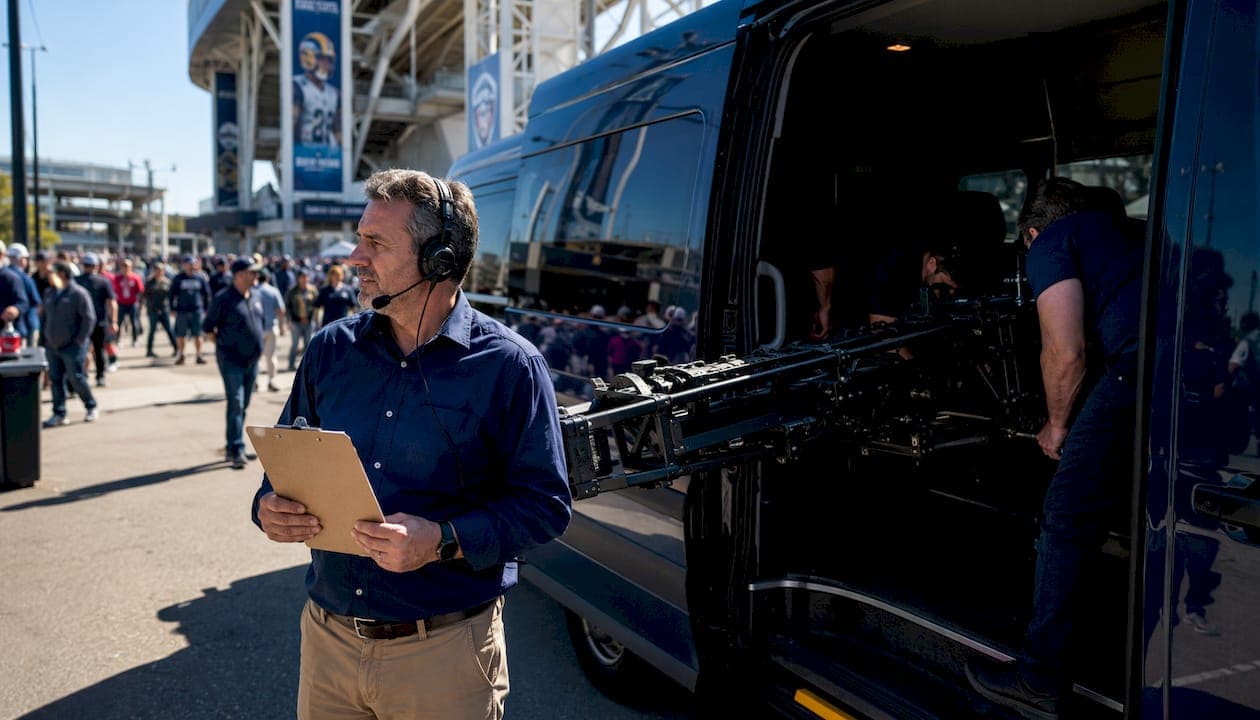
Broadcast sports ground transportation is the managed network of credentialed chauffeurs, crew shuttles, equipment vans, and staging support that moves talent, production executives, on-air crews, and broadcast gear between airports, hotels, and sports venues during a live event. For production buyers, the single most important action is to engage a managed transport provider early, well before venue credentialing windows open, and to spec the full vehicle mix in your initial RFP rather than piecing it together show by show.
- Talent and executives: luxury sedans or SUVs, white-glove chauffeur service
- On-air crews and producers: passenger vans or Sprinter minibuses
- Large technical crews: passenger coaches
- Equipment and OB gear: cargo vans and equipment trucks sized to your specific load
Pro Tip: Request that your transport provider submit credentialed driver lists to venue security at least 72 hours before build day. Last-minute credential submissions are the single most common cause of access delays at the loading bay.
"Large broadcast operations use credentialed drivers and managed driver networks rather than handing keys to rental cars — this preserves security and schedule control across hundreds of daily movements." — FOX Sports World Cup logistics
Table of Contents
- What services does broadcast sports ground transportation include?
- Why do productions prefer managed networks over rental cars or ride-hail?
- When should you start planning broadcast transport procurement?
- How do you spec and tender a broadcast transport provider?
- What do venue operational requirements look like in practice?
- What pricing models and contract terms should buyers expect?
- How do you build operational contingencies that keep broadcasts on air?
- How Rigaglobaltravel approaches broadcast sports ground transportation
- Key Takeaways
- The part of broadcast transport most productions get wrong
- Rigaglobaltravel handles production transport so your crew stays focused on air
- Useful sources and further reading
What services does broadcast sports ground transportation include?
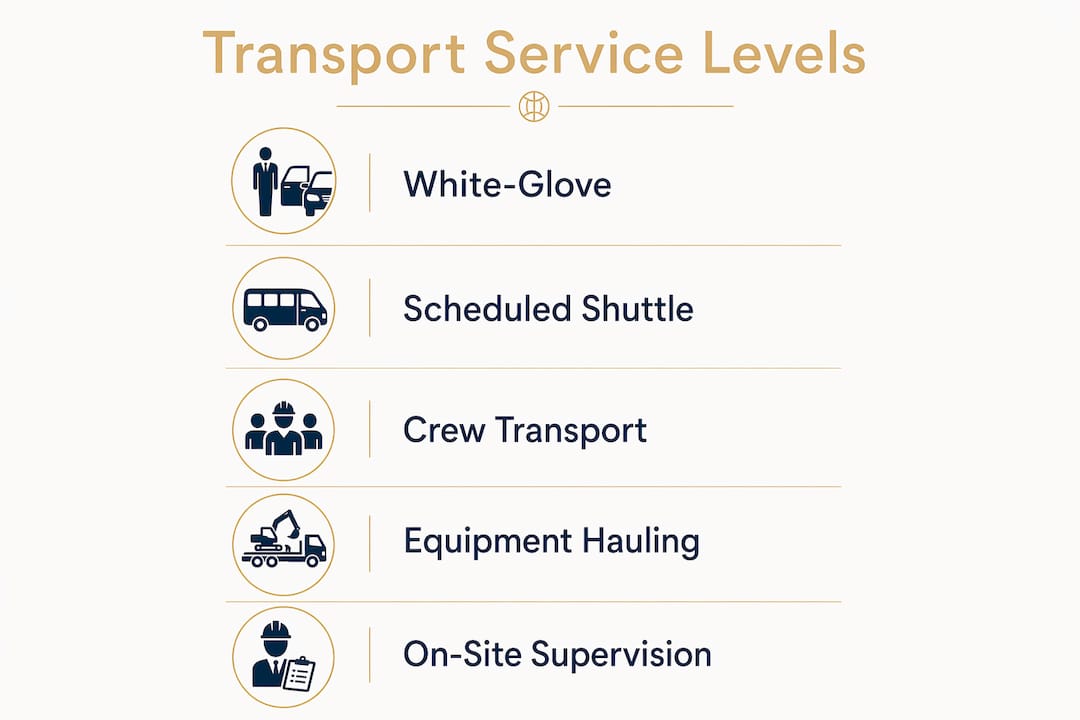
The service catalog breaks into three layers: vehicles, operational roles, and service levels. Getting all three right is what separates a smooth broadcast week from a chaotic one.
Vehicles and their roles
- Luxury sedans and SUVs for talent, on-air anchors, and network executives requiring white-glove chauffeur service
- passenger vans for on-air production crews moving between hotel, venue, and studio positions
- Sprinter minibuses for smaller technical teams or secondary broadcast units
- passenger coaches for large crews, especially during multi-day tournament assignments
- Cargo vans and equipment trucks for OB units, camera packages, cabling, and broadcast infrastructure
Operational roles
Broadcast event logistics requires more than drivers. You need on-site supervisors who know the venue compound, dispatchers monitoring live call sheets, load-in drivers familiar with equipment handling, and freight coordinators who can manage crew travel and load-in timing alongside production ops.
Service levels
White-glove chauffeur for talent is a different product from a scheduled crew shuttle, which is itself different from a dedicated equipment-movement run. A well-structured RFP separates these tiers so you can price and staff each one correctly.
Why do productions prefer managed networks over rental cars or ride-hail?
The short answer: control. Rental cars and ride-hail apps hand the scheduling problem back to your crew. A managed network takes it off your plate entirely.
Managed driver networks provide live dispatch, real-time tracking, and consistent driver assignments — advantages that matter enormously when you are moving the same talent through three venues over five days. Drivers who know the route, know the credential process, and know your production coordinator by name are not a luxury; they are an operational asset.
- Security and compliance: Vetted, credentialed drivers integrate with production security teams. A ride-hail driver cannot be pre-cleared for the broadcast compound.
- Punctuality: Managed networks run against your call sheet, not surge pricing. Private chauffeurs for sportscasters operate on production time, not passenger demand.
- Adaptability: When a live show runs long or a press conference moves, a dispatcher can reroute the entire fleet in minutes. A rental car cannot be redirected.
When should you start planning broadcast transport procurement?
Planning typically begins several weeks before international sporting events, but for multi-venue tournaments or events with complex credentialing, months is more realistic. The table below maps the key milestones.
| Milestone | Lead Time Before Event | Owner |
|---|---|---|
| Venue survey (loading bays, clearance, power) | several weeks to months | Transport manager + venue ops |
| Driver/vendor tender and RFP | 8–10 weeks | Production logistics lead |
| Credentialing window submission | 4–6 weeks | Transport provider + production security |
| Route approvals and staging plan | 3–4 weeks | Transport ops + venue traffic management |
| Test/load-in day rehearsal | 1–2 weeks | On-site supervisor |
| Final call sheet integration | 48–72 hours | Dispatcher + production coordinator |
Single-match broadcasts can compress this timeline, but the sequence stays the same. Skipping the venue survey is the most common mistake; failing to confirm OB-van dimensions and loading routes in advance can add hours to build day or prevent vehicles from reaching operating positions entirely.
How do you spec and tender a broadcast transport provider?
Your RFP needs to cover more than vehicle counts. Here is what to include:
RFP checklist
- Vehicle specifications by role (passenger capacity, cargo dimensions, accessibility)
- Driver vetting process: background check standard, credential submission history
- Insurance minimums: commercial auto liability, cargo coverage, umbrella limits
- SLA terms: on-time performance target, replacement-driver response window
- Dispatch technology: live tracking capability, integration with production call sheets
- Stadium and venue credentialing experience: named prior events
- Multi-venue and multi-week assignment capability
- On-site supervisor availability and communication protocol
Sample questions to ask providers
- What is your on-time performance rate for broadcast and live-event clients?
- How do you handle a last-minute driver substitution, and what is your replacement window?
- Can your dispatch system receive and act on production call sheet updates in real time?
- Have your drivers been credentialed at NFL, NBA, or major international tournament venues?
- How do you manage driver continuity across a multi-week assignment?
- What is your escalation path if a vehicle is blocked from a loading bay on build day?
For game day transportation at major venues, also ask whether the provider has coordinated with venue traffic management on perimeter drop-off staging — this is a detail that separates experienced operators from generalists.
What do venue operational requirements look like in practice?
Production logistics guides emphasize naming owners for every dependency between production and venue operations. For transport, that means collecting specific data points before build day.
Venue checklist
- Loading bay ID, dimensions, and clearance height for each access point
- Vehicle staging lot location, capacity, and timed entry windows
- Credential holder names, titles, and submission deadlines for each access tier
- Venue security contact and radio channel for day-of coordination
- Power and electrical access windows for OB vehicles requiring shore power
- Floor weight limits for equipment-laden trucks in the broadcast compound
Pro Tip: Confirm OB-van dimensions against the loading bay clearance height during the venue survey, not on build day. A two-inch discrepancy discovered at 5 AM costs you hours and potentially your broadcast position.
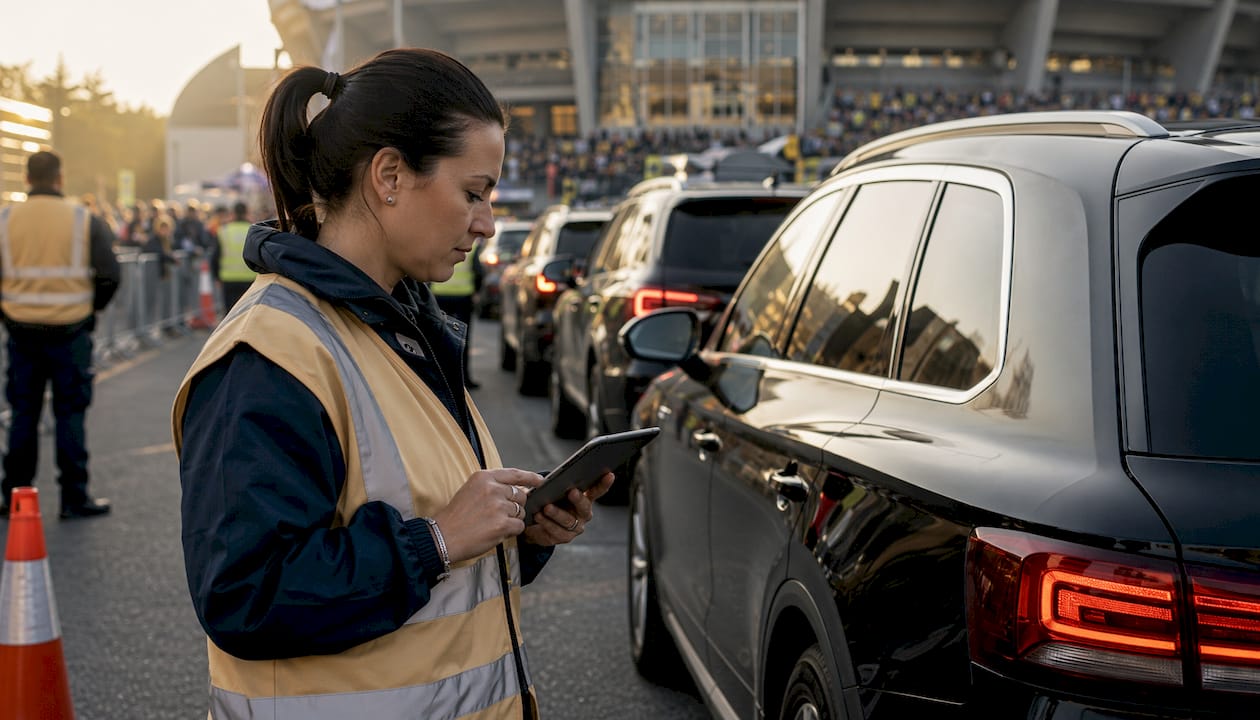
Stadium events require coordinating with venue traffic management to stage drop-offs near perimeter points, using on-site coordinators and consistent vehicle assignments for multi-match packages. Get those contact names in writing before the first vehicle rolls.
What pricing models and contract terms should buyers expect?
Broadcast transport contracts typically combine a base rate structure with event-specific add-ons.
| Vehicle Type | Common Pricing Model | Typical Contract Element |
|---|---|---|
| Luxury sedan / SUV | Hourly or day rate | Driver continuity clause, overtime rate |
| Passenger vans | Day rate or block-hour package | Cancellation window, standby fee |
| Passenger coaches | Day rate or per-trip | Deposit, multi-week retainer option |
| Equipment / cargo van | Per-trip or day rate | Cargo liability coverage, load-in fee |
Key contract clauses to negotiate:
- Cancellation terms: What is the notice window before you owe a kill fee?
- Overtime rules: How is time calculated after the contracted window closes?
- Driver continuity: Can you lock in the same drivers for the full assignment?
- Invoicing cadence: Weekly invoicing with net-30 terms is standard for corporate accounts; confirm whether the provider supports direct billing to a production company account.
For multi-modal productions where talent arrives by private aviation, coordinate ground transport contracts to align with flight manifests — baggage and equipment movement must be priced separately from passenger transfers.
How do you build operational contingencies that keep broadcasts on air?
Transportation and production logistics function as a single discipline. A credential problem at the loading bay is a broadcast problem.
Contingency protocol: step by step
- Identify two alternate routes to every venue access point before build day.
- Assign a spare vehicle and standby driver for each critical talent or equipment run.
- Establish a three-way communication channel: producer, transport ops, venue security.
- Define a rapid credential resolution contact at venue security with a direct radio or phone line.
- Integrate the transport dispatch system with the production rundown so schedule changes propagate automatically.
- Conduct a test run on load-in day to validate routes, timing, and staging positions.
Live tracking and dispatch integration
- Dispatch should receive call sheet updates in real time, not via email chains.
- Crew shuttle service planning works best when shuttle departure times are tied directly to production call times, not fixed clock intervals.
- On-site supervisors should carry radios on the venue security channel, not just cell phones.
How Rigaglobaltravel approaches broadcast sports ground transportation
Rigaglobaltravel provides chauffeured cars, crew shuttles, equipment-capable vehicles, and credential support for production companies, television networks, and talent agencies across major U.S. broadcast markets. The operational model is built around driver continuity, on-site coordination, and direct integration with production schedules.
Rigaglobaltravel's match-day and multi-week checklist
- Dedicated credentialed chauffeurs assigned to named talent for the full production run
- On-site transport coordinator stationed at the venue compound during build, broadcast, and strike
- Staging liaison who confirms loading bay access windows with venue ops 48 hours in advance
- Dispatch system updated from production call sheets, not standalone schedules
- Spare vehicle and standby driver pre-positioned for every critical movement
- Corporate account billing with weekly invoicing for production company accounts
For airport transfers for sports correspondents and multi-city assignments, Rigaglobaltravel coordinates equipment and baggage handling alongside passenger transfers so nothing arrives at the venue separately from the crew that needs it.
Key Takeaways
Broadcast sports ground transportation requires early procurement, a managed driver network, and venue-specific operational planning to protect the broadcast signal from ground-level logistics failures.
| Point | Details |
|---|---|
| Start procurement early | Begin the vendor tender 8–10 weeks out; credentialing submissions require 4–6 weeks minimum. |
| Spec all vehicle types upfront | Match sedans, vans, coaches, and cargo vehicles to specific broadcast roles in the RFP. |
| Require SLA terms in writing | On-time performance targets, replacement-driver windows, and escalation paths must be contractual. |
| Conduct a venue survey first | Confirm loading bay clearance, staging lots, and power access before build day, not on it. |
| Rigaglobaltravel | Offers credentialed chauffeurs, on-site coordinators, and corporate account billing for production teams. |
The part of broadcast transport most productions get wrong
Productions that treat ground transportation as a commodity purchase almost always regret it by day two of a multi-week assignment. The driver who knows your talent's preferences, knows the loading dock supervisor by name, and knows which gate opens at 4 AM is not interchangeable with whoever shows up from a rental counter.
The real operational risk is not a vehicle breaking down. It is a credential gap, a route assumption that turns out to be wrong, or a dispatcher who is not watching the same rundown your producer is. Those are process failures, and they are entirely preventable with the right provider structure. Productions that invest in a managed network with a dedicated on-site coordinator consistently run cleaner logistics than those that spend twice as much patching ad-hoc solutions together under pressure.
Rigaglobaltravel handles production transport so your crew stays focused on air
When a broadcast production needs credentialed chauffeurs for talent, crew shuttles for technical teams, and equipment-capable vehicles for OB gear, Rigaglobaltravel delivers all three under a single corporate account. No juggling three vendors, no invoice reconciliation across separate providers, and no dispatcher who has never heard of a production call sheet.
Rigaglobaltravel serves productions across New York, Los Angeles, Miami, and Connecticut, with corporate account billing that supports direct invoicing to production companies. Whether you need a luxury chauffeur in New York for a network anchor or a full crew shuttle package for a stadium broadcast week, the team can build a production transport proposal matched to your specific venue, schedule, and credentialing requirements. Contact Rigaglobaltravel to request a production transport proposal or schedule a venue survey.
Useful sources and further reading
- FOX Sports World Cup Transport Logistics — Sports Video Group: Production-side account of how a major broadcaster manages credentialed driver networks and daily transport logistics at scale.
- Sports Broadcast Management Guide — Video Team Hungary: Planning timelines, vendor tender processes, and venue-access protocols for international sports broadcasts.
- Production Logistics for International Sports Broadcast — Video Team Hungary: Venue survey requirements, OB-van staging, loading routes, and the importance of named dependency owners.
- Live Event Production Management Services — Broadcast Management Group: Core deliverables list for broadcast transport providers, including freight movement and load-in/load-out timing.
- Riga Global Travel: Sports Network Ground Transport Examples: Operational examples and vehicle-role matching for sports broadcast productions.
- How to Plan Shuttle Service for Broadcast Stadium Crews — Rigaglobaltravel: Step-by-step stadium shuttle planning and procurement checklists.