
A sports venue transfer service is a dedicated transportation solution that moves fans, athletes, and staff between pickup locations and sports venues on event days. Unlike standard rideshares or public transit, these services are booked in advance, coordinated with venue logistics, and sized to match the group. The industry term for this category is "event ground transportation," and understanding how it works gives you a real advantage when planning your next game day trip. Rigaglobaltravel provides exactly this type of service, specializing in chauffeured transport for the entertainment and sports world across New York, Los Angeles, and beyond.
What is a sports venue transfer service, exactly?
A sports venue transfer service covers the full door-to-door movement of passengers to and from a sports event. The service handles scheduling, routing, and coordination with venue access rules so you do not have to figure it out on the day. Sports venue transfer services can include group shuttles, VIP luxury vehicles, team transport, and airport-to-venue transfers, each matched to a different type of attendee or group size.
The core benefit is reliability. A private charter or pre-booked shuttle removes the uncertainty of finding parking, hailing a cab in a crowd of 70,000 people, or waiting for a delayed train. The service provider takes responsibility for timing, routing, and driver coordination, so you arrive relaxed rather than frazzled.

Three parties make this work: the transportation provider, the event organizer or venue management, and the attendee. When all three communicate clearly, the experience is smooth. When they do not, you end up dropped off a half-mile from the gate in the rain.
What types of sports venue transfer services are available?
The right vehicle depends on your group size, budget, and how you want to arrive. The main categories are:
- Executive sedans and luxury cars. Best for individuals or pairs who want a private, comfortable ride. Common for VIP guests, media, and athletes traveling without a full team.
- SUVs and minivans. Ideal for small groups of 4–7 people. Offer more luggage space and flexibility for families or small corporate groups.
- Minibuses (14–24 passengers). A practical choice for medium-sized groups like corporate suites, fan clubs, or team staff.
- Full-size coaches (40–55 passengers). Used for large fan groups, team travel, and stadium staff shuttles. Cost per person drops significantly at this scale.
- Public event shuttles. Some stadiums operate pre-booked fan shuttles that require advance registration and ticket presentation before boarding. Access is restricted to event ticket holders to manage crowd flow and security.
Private charters give you control over timing and routing. Public shuttles cost less but run on fixed schedules. VIP transfers, like those offered through game day VIP transport providers, add amenities such as meet-and-greet service, chilled beverages, and direct drop-off at restricted venue access points.
The choice between these options comes down to one question: do you want to control the schedule, or are you comfortable fitting into someone else's?
How do sports venue transfer services handle scheduling and logistics?
Scheduling is where most event transport plans succeed or fail. Effective venue transport planning accounts for boarding time, traffic patterns, buffer time for delays, and venue unloading. Actual driving time is only one part of the equation. A 20-minute drive to a stadium can easily become a 50-minute ordeal when 40,000 cars are converging on the same exit.
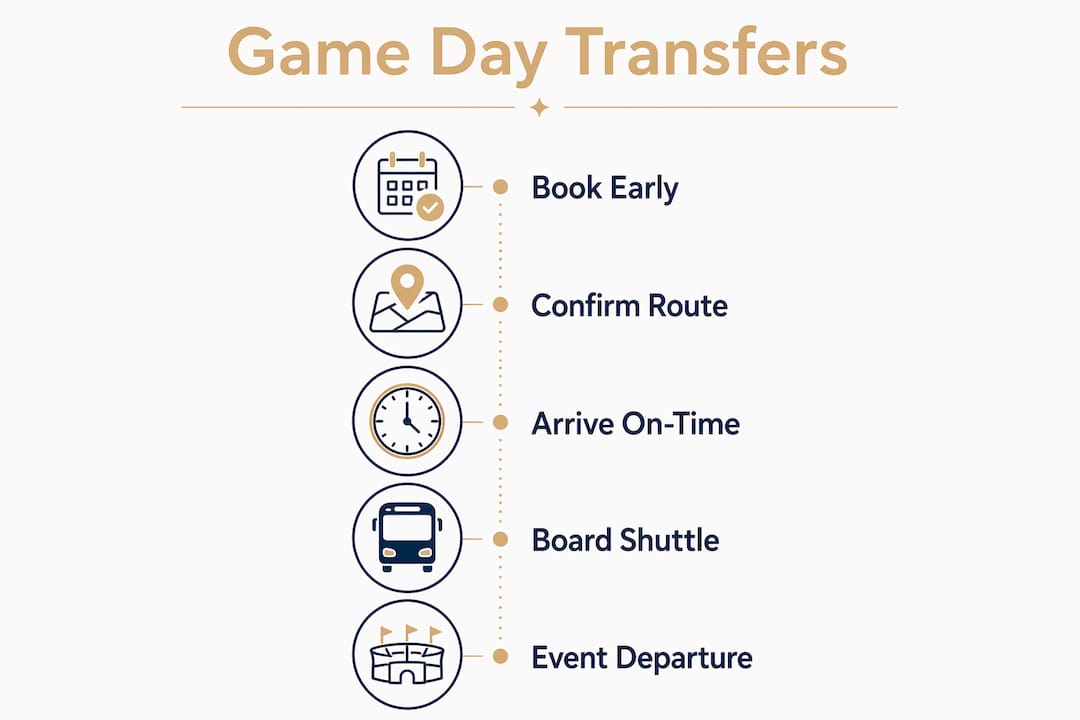
Professional providers build in time buffers at every stage. They calculate when the vehicle needs to leave, not just when you need to arrive. They also map pickup and drop-off points in advance, accounting for venue-specific restrictions on where vehicles can stop.
Real-time communication between drivers, event coordinators, and passengers is standard practice among quality providers. Sharing driver contact numbers and using messaging apps to send live updates reduces stress on event days. You should know your driver's name and number before the day begins.
Pro Tip: Ask your provider to send a route confirmation and driver contact at least 24 hours before the event. If they cannot do this, treat it as a red flag.
Coordinating drop-off points matters more than most attendees realize. Venues often designate specific zones for charter vehicles, separate from public drop-off areas. Your provider needs to know these zones in advance, or you risk being redirected at the gate.
What are the key considerations when booking a sports venue transfer service?
Booking a transfer service for a sports event requires more detail than booking a standard car service. Get these factors right before you confirm:
- Licensing and insurance. Unlicensed operators frequently carry inadequate insurance and skip proper driver vetting. Verify credentials through official databases like TLC.nyc.gov for New York providers. Do not rely on a company's own marketing claims.
- Vehicle capacity and amenities. Confirm the exact number of passengers and whether the vehicle fits your luggage. A minibus rated for 16 passengers does not always have room for 16 sets of stadium bags.
- Cost structure. Many providers require minimum hire periods of 4–8 hours, even if your actual transit time is 45 minutes. This is standard for larger coaches and should be factored into your budget from the start.
- Deposits and cancellation policies. Deposits typically range from 20–50% of the total cost. Contracts should spell out the itinerary and cancellation terms clearly. Never book without a written agreement.
- Exact pickup and drop-off addresses. Being specific about locations and total luggage counts from the start prevents logistical failures on the event day. "Near the stadium" is not an address.
- Accessibility needs. If anyone in your group uses a wheelchair or has mobility requirements, confirm vehicle specifications before booking, not after.
Pro Tip: When comparing quotes, ask each provider whether the quoted price includes gratuity, tolls, and parking fees. These additions can increase your total by 20–30% if not disclosed upfront.
Understanding the cost structure also helps you compare providers fairly. Hourly pricing suits smaller vehicles and shorter trips. Flat-rate contracts with minimum hours apply to larger coaches and are common for airport transfers for sports events where timing is fixed.
How do sports venue transfer services adapt to venue access restrictions and traffic?
Venue access restrictions are the biggest logistical challenge in sports event transportation. Most major stadiums enforce strict rules on event days that directly affect where your vehicle can go.
Here is how restrictions typically play out at large venues:
- Private vehicle bans near the stadium. Venue management often enforces road closures and bans private vehicle access during major events. Your driver needs pre-approved access or must use a designated drop-off zone.
- Off-site drop-off points. Drop-off points may be located a 10-minute walk from stadium entrances on event days. Your provider should communicate this to you before the day, not when you are already in the vehicle.
- Shuttle-only access zones. Some venues funnel all non-pedestrian traffic through official shuttle corridors. Your charter vehicle may need to join this system or park off-site.
- Game day road closures. For major events like the FIFA World Cup 2026, shuttle stops are located 0.3 to 0.5 miles from stadium entrances on game days. That distance matters when you are traveling with elderly guests or young children.
Traffic compounds every one of these restrictions. A provider who has worked the venue before knows which roads close first, which alternate routes hold up under pressure, and where the vehicle can legally wait during the event. That local knowledge is worth paying for.
The practical impact on cost is real. Longer routes and extended wait times push hourly-rate services higher. Fixed-rate contracts protect you from this, which is one reason flat-rate pricing is often the smarter choice for high-traffic event days.
Key Takeaways
A sports venue transfer service removes the guesswork from game day travel by combining pre-booked vehicles, precise scheduling, and knowledge of venue access rules into one coordinated solution.
| Point | Details |
|---|---|
| Verify licensing before booking | Check provider credentials through official databases like TLC.nyc.gov, not marketing materials. |
| Budget for minimum hire periods | Many providers require 4–8 hours minimum, regardless of actual transit time. |
| Confirm drop-off zones in advance | Venue restrictions often place drop-off points 0.3–0.5 miles from stadium entrances. |
| Build in time buffers | Effective scheduling accounts for boarding, traffic, and venue unloading, not just drive time. |
| Get everything in writing | Deposits of 20–50% and cancellation terms should appear in a signed contract before you pay. |
Why the details matter more than the vehicle
I have coordinated event transportation for enough high-profile sports occasions to know where things go wrong. It is almost never the vehicle. It is the details that get skipped in the booking conversation.
The most common mistake I see is attendees focusing on price per hour and ignoring the minimum hire clause. You book a coach for what you think is a two-hour job, and you owe eight hours. That is not a hidden fee. It is in the contract. The problem is that most people do not read the contract carefully enough.
The second mistake is underestimating venue-specific knowledge. A driver who has never worked a stadium event before will not know that the east gate closes to vehicles 90 minutes before kickoff, or that the preferred drop-off zone requires a venue-issued pass. That gap in knowledge costs you time and patience on the day you can least afford it.
Fixed pricing is almost always the better choice for sports events. Hourly rates create anxiety when traffic backs up. A flat rate lets you focus on the game, not the meter. I have seen groups pay significantly less with a flat-rate contract than they would have on hourly billing for the same trip, simply because the event ran long.
The providers worth hiring are the ones who ask you detailed questions before they quote. If a company sends you a price without asking about your drop-off zone, luggage count, or venue access requirements, they are not ready for event-day logistics.
— Sammy
Rigaglobaltravel for your next sports event
Rigaglobaltravel provides professional chauffeured transportation built for the demands of sports and entertainment events. Whether you need a luxury sedan for a VIP arrival or a coordinated group transfer for a full suite of guests, the team handles licensing, routing, and venue coordination so you do not have to.

For events in New York, Rigaglobaltravel's New York chauffeur service covers stadium transfers, airport pickups, and everything in between. Los Angeles attendees can book through the Los Angeles limousine service for game day transport to SoFi Stadium, Crypto.com Arena, and other major venues. Every booking includes a licensed, insured driver and a confirmed itinerary before your event day begins.
FAQ
What is a sports venue transfer service?
A sports venue transfer service is a pre-booked transportation solution that moves fans, athletes, or staff between a pickup location and a sports venue. It differs from standard rideshares by offering advance scheduling, group capacity, and coordination with venue access rules.
How far in advance should I book a venue transfer?
Book at least two to four weeks before a major event. High-demand game days fill vehicle availability quickly, and last-minute bookings often carry premium pricing or limited vehicle options.
Are sports event shuttle services free?
Some stadiums operate free pre-booked shuttles for ticket holders, but these require advance registration and ticket presentation. Private charter and VIP transfer services carry a fee based on vehicle type and hire duration.
What happens if the event runs late?
With hourly-rate contracts, extended event time adds to your bill. Fixed-rate contracts typically include a grace period. Confirm the overtime policy with your provider before signing any agreement.
How do I verify a transport provider is licensed?
Check the provider's operating license through an official government database. In New York, the Taxi and Limousine Commission database at TLC.nyc.gov lists all licensed operators. Always verify directly rather than accepting a company's self-reported credentials.