Sports network ground transport is the specialized movement of broadcast crews, talent, equipment, and officials using coordinated vehicle fleets during major sporting events. The best operations combine centralized dispatch platforms, multifunctional vehicles, and dedicated event-only transit networks to keep broadcasts on schedule. At the 2026 Milan Cortina Winter Olympics, NBC moved 1,500 staff with just 20 vehicles, a ratio that shows how tightly engineered sports network ground transport examples must be. This guide breaks down the real-world cases, vehicle strategies, and coordination models that event coordinators need to run ground transport at scale.
1. Sports network ground transport examples: multifunctional motorcoaches
The single most underused tool in sports logistics is the multifunctional vehicle. Most coordinators default to booking separate vehicles for talent, crew, and equipment, which multiplies fleet size and venue congestion.

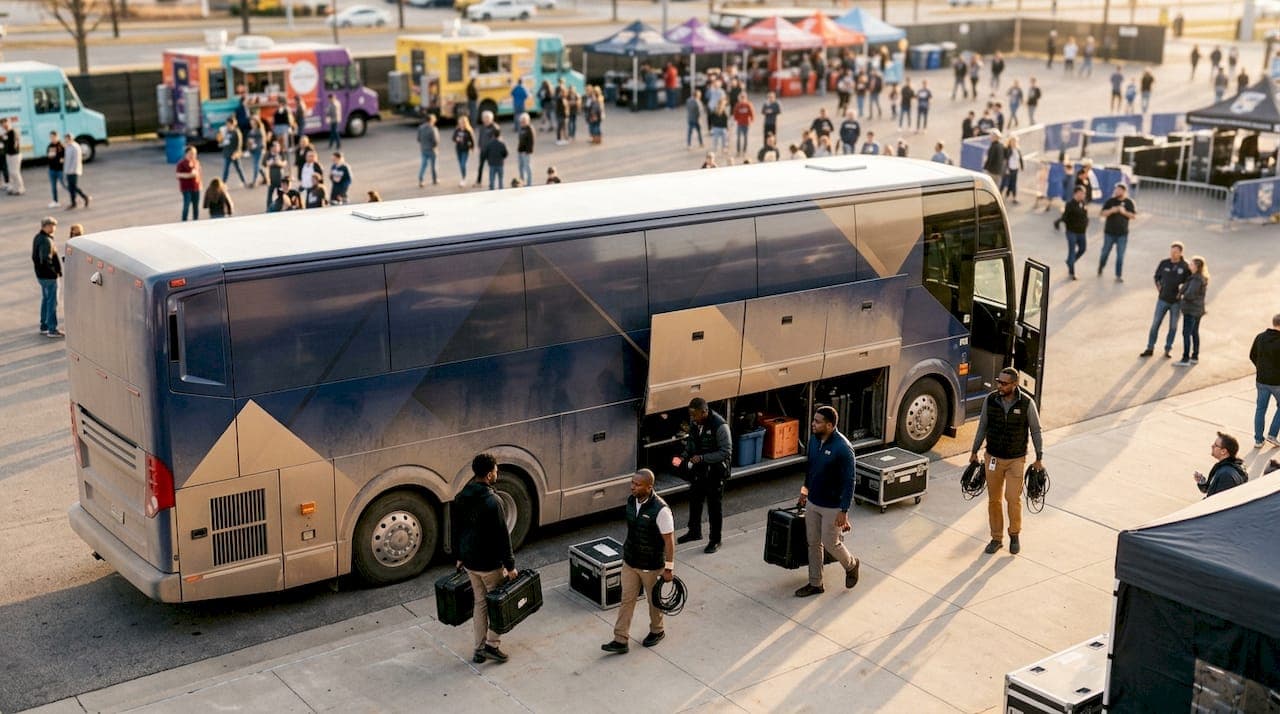
ESPN's broadcast tour used a 45-foot luxury motorcoach that served simultaneously as a mobile production studio, talent lounge, and hospitality suite across 36+ markets in a single season. That one vehicle replaced what would otherwise require three or four separate units. The operational savings in parking, fuel, and driver hours are significant.
Key functions built into a broadcast motorcoach:
- Live content transmission equipment and satellite uplinks
- Talent green room and makeup area
- Production workstations for editors and directors
- Secure equipment storage with climate control
- Hospitality area for sponsors and network executives
Pro Tip: Require your vehicle vendor to provide a full onboard systems checklist before the first market. Discovering a missing uplink capability on event day costs far more than a pre-trip audit.
The tradeoff is real. Multifunctional vehicles cost more upfront and require drivers with specialized training to handle both the road and the onboard systems. For multi-market tours covering 30+ stops, the math favors consolidation. For a single-venue event, a standard executive van fleet may be more practical.
2. Centralized coordination: the backbone of sports event transit
Decentralized dispatch is the most common failure point in sports event ground transport. When individual departments book their own vehicles, you get duplicate routes, missed pickups, and zero visibility into the full fleet.
Centralized booking and dispatch platforms allow transport managers to see every vehicle, every route, and every schedule change in real time. ATPI, which manages travel for professional sports leagues, identifies centralized coordination as the defining factor between operations that hold up under pressure and those that collapse when a game goes to overtime.
"Centralizing transport management allows instant adaptation to last-minute schedule changes, maintaining production continuity during dynamic sporting event conditions. Decentralized dispatch is a major pitfall that costs networks broadcast windows they cannot recover." — ATPI Sports Travel Management
Practical coordination steps that work at scale:
- Assign one transport operations manager with authority over all vehicle allocation
- Use a single dispatch platform that integrates with the event's master schedule
- Build 20-minute buffer windows into every crew transfer between venues
- Establish a dedicated radio or app channel for driver-to-coordinator communication
- Pre-position vehicles at secondary locations to handle schedule overruns
The real-time routing capability of centralized platforms matters most when events run long or venues change. A network that loses its anchor desk talent because a driver was waiting at the wrong gate has a coordination problem, not a vehicle problem.
3. Dedicated temporary transit networks at major events
Public transit systems are not built for mega-events. A city's normal bus and rail capacity assumes a spread of destinations across the day. A World Cup match sends 80,000 people to one location within a two-hour window.
Kansas City addressed this directly for the 2026 FIFA World Cup by building Connect KC 26, a tournament-only transit system running 247 buses on exclusive routes. The system replaced the loss of roughly 20,000 public parking spots at Arrowhead Stadium, which were converted to event operations zones.
The Connect KC 26 network operated across three service tiers:
- Airport direct lines connecting KCI Airport to the stadium and fan zones without intermediate stops
- Stadium express routes running from designated park-and-ride lots every 8–10 minutes on match days
- Regional connector lines linking downtown hotels, the convention center, and broadcast compounds
| Service Tier | Primary Users | Frequency |
|---|---|---|
| Airport direct | Media, officials, VIP guests | On-demand scheduling |
| Stadium express | Fans, accredited staff | Every 8–10 minutes |
| Regional connectors | Broadcast crews, team personnel | Every 15–20 minutes |
Pro Tip: Map your broadcast compound's location against all three service tiers before the event. Crews staying in downtown hotels often assume stadium express routes serve them directly. They usually don't.
Dedicated event transit networks also give event coordinators something public transit cannot: guaranteed arrival windows. When a bus runs on an exclusive route with no civilian traffic, you can build a production schedule around it. That reliability is the core reason networks request accredited transport access rather than relying on city infrastructure.
4. Airport transfers as a critical first link
The ground transport chain for any sports network starts at the airport. A crew that misses its connection from the terminal to the broadcast compound loses hours that cannot be recovered before air time.
Specialized airport transfer services for sports correspondents differ from standard car services in three ways. First, drivers monitor flight arrivals in real time and adjust pickup times automatically. Second, vehicles are sized to carry both passengers and production equipment without requiring a separate cargo van. Third, the service operates on the event's accreditation schedule, not standard commercial hours.
For NBC's Milan Cortina operation, driver professionalism and punctuality were identified as non-negotiable standards. English-speaking drivers who understand broadcast schedules and credentialing requirements are not a luxury at international events. They are an operational requirement.
5. Talent and on-air personality transport
On-air talent has different transport needs than production crews. A correspondent traveling between a press conference and a live shot has a hard deadline measured in minutes, not hours.
Private chauffeur services for sportscasters address this by providing dedicated vehicles that stay with the talent throughout the broadcast day. The vehicle does not return to a pool between assignments. It waits, repositions on instruction, and moves the moment the talent is ready.
This model costs more per vehicle than a shared shuttle. The tradeoff is zero dependency on shuttle schedules during live programming windows. For a network anchor doing three live hits from three locations in one afternoon, a dedicated vehicle is the only workable option.
6. Equipment transport as a separate logistics category
Broadcast equipment is not cargo. A camera package, satellite uplink case, or audio rack requires climate-controlled transport, secure loading protocols, and drivers who understand that the equipment cannot be stacked or left in a hot vehicle.
The standard approach at major events is to separate equipment transport from personnel transport entirely. Equipment moves in dedicated cargo vans or sprinters with padded interiors and tie-down systems. Personnel move in executive SUVs or sedans. The two fleets operate on different schedules and report to different coordinators.
This separation prevents the most common equipment damage scenario: a driver who loads crew bags on top of camera cases because the vehicle is running late. Keeping the fleets separate removes the temptation entirely.
7. Key elements of successful sports network ground transport
The operational standards that separate reliable sports transport from unreliable transport are consistent across events of every scale.
Core requirements for any sports network ground transport program:
- English-speaking drivers with event-specific briefings on venue layouts and credentialing checkpoints
- Vehicle quality matched to the event tier, with executive SUVs for talent and sprinters for crew
- Real-time communication between drivers, dispatch, and the network's transport coordinator
- Flexibility protocols that allow vehicle reallocation within 15 minutes of a schedule change
- Multi-site coverage with pre-positioned vehicles at broadcast compounds, hotels, and stadiums
Operational discipline from drivers is the factor most often underestimated in pre-event planning. A driver who cannot navigate a credentialing checkpoint or communicate a delay to dispatch creates a cascade of problems that a centralized platform cannot fix. Hiring standards matter as much as technology.
Shuttle planning for broadcast stadium crews requires a separate operational layer from talent transport. Crew shuttles run on fixed loops. Talent vehicles run on demand. Mixing the two models into a single fleet creates scheduling conflicts that compound throughout the broadcast day.
Key Takeaways
The most effective sports network ground transport programs combine centralized dispatch, multifunctional vehicles, and dedicated event transit networks to maintain broadcast continuity under pressure.
| Point | Details |
|---|---|
| Multifunctional vehicles reduce fleet size | One broadcast motorcoach can replace three or four single-purpose vehicles across multi-market tours. |
| Centralized dispatch prevents failures | A single platform managing all vehicles and routes eliminates duplicate bookings and missed pickups. |
| Dedicated transit networks replace public infrastructure | Event-only bus systems like Connect KC 26 guarantee arrival windows that city transit cannot provide. |
| Talent and crew transport must stay separate | On-demand vehicles for talent and fixed-loop shuttles for crew cannot share the same fleet model. |
| Driver professionalism is non-negotiable | English-speaking drivers with event briefings are an operational requirement, not a preference. |
What I've learned running transport for broadcast events
The part of sports network ground transport that rarely gets discussed is how quickly a well-planned operation unravels when one assumption turns out to be wrong. I've seen networks build detailed transport plans around hotel locations that turned out to be 40 minutes from the broadcast compound in event-day traffic. The plan looked perfect on paper.
The fix is always the same: centralized tech platforms that let you reroute in real time, and drivers who are briefed well enough to make judgment calls without calling dispatch for every decision. Those two things together absorb the surprises that no pre-event plan survives.
Multifunctional vehicles are genuinely undervalued. Coordinators resist them because the upfront cost is visible and the savings from fleet reduction are harder to quantify. But when you're managing 36 markets in a season, the math is not close. One vehicle that does three jobs is cheaper and simpler than three vehicles that each do one.
The public transit assumption is the one I warn every new coordinator about. Host cities always say their transit system can handle event loads. It almost never can at the scale of a World Cup or Olympics. Build your own network or contract into an accredited one. Do not leave your broadcast schedule dependent on a city bus that is also carrying 10,000 fans to the same stadium.
— Sammy
Rigaglobaltravel: professional transport for sports networks
Sports broadcast operations demand vehicles and drivers that perform without fail during the hours that matter most. Rigaglobaltravel provides professional chauffeur and fleet services built for entertainment and broadcast industry clients across major US markets.
For event coordinators managing talent, crew, and equipment across Los Angeles, New York, or Miami, Rigaglobaltravel offers limousine service in Los Angeles and luxury car service in New York with experienced drivers who understand broadcast schedules, credentialing requirements, and the pace of live event production. Every vehicle is available for dedicated assignment, not shared pools. Contact Rigaglobaltravel directly to build a transport program around your next event.
FAQ
What is sports network ground transport?
Sports network ground transport is the coordinated movement of broadcast crews, talent, and equipment using dedicated vehicle fleets during sporting events. It differs from standard car service in its real-time dispatch integration, event-specific driver briefings, and multi-site routing requirements.
How many vehicles does a major sports broadcast operation need?
The number depends on event scale and vehicle type. NBC moved 1,500 staff with 20 vehicles at the 2026 Milan Cortina Winter Olympics by using large-capacity transport. Multifunctional motorcoaches reduce total vehicle count by combining crew, talent, and production functions into one unit.
Why can't sports networks rely on public transit at major events?
Public infrastructure cannot absorb the concentrated demand of mega-events. Kansas City deployed 247 dedicated buses for the 2026 FIFA World Cup after the stadium lost roughly 20,000 public parking spots, because city transit had no capacity to fill that gap on match days.
What makes a ground transport provider suitable for sports broadcasts?
The key markers are English-speaking drivers with event-specific briefings, vehicles sized for both passengers and equipment, real-time dispatch integration, and the ability to reallocate vehicles within minutes of a schedule change.
How does centralized dispatch improve sports event transport?
Centralized platforms give one coordinator visibility over every vehicle, route, and schedule in real time. This allows instant rerouting when games run long or venues change, preventing the missed pickups and duplicate bookings that decentralized booking creates.