
Broadcast crew shuttle service is a dedicated, credentialed transport system built around production schedules, not fan egress timelines. When you plan shuttle service for broadcast stadium crews, you are coordinating heavy equipment, security access, and shift timing that standard rideshare apps cannot handle. Dedicated transport with credentialed drivers is the only reliable option for production teams working inside secured stadium zones. The difference between a crew that arrives on time and one that misses a live window often comes down to how early and how specifically the transport plan was built.
What vehicles and resources does a broadcast crew shuttle service require?
The right vehicle is not a preference. It is a production requirement. Standard rideshare and public transit are routinely blocked by security perimeters at major stadium events, making dedicated large SUVs and Sprinter vans the baseline for broadcast crew logistics. Sprinter vans carry camera rigs, cable drums, and audio equipment without forcing crews to split gear across multiple vehicles. Large SUVs serve smaller units, field producers, and on-air talent who need faster, more discreet access to media zones.
Vehicle capacity must match both crew size and gear volume, not just headcount. A six-person camera crew traveling with two flight cases and a tripod system needs a Sprinter, not a seven-passenger SUV. Getting this wrong creates delays at loading zones and forces last-minute vehicle swaps that ripple through the entire production schedule.
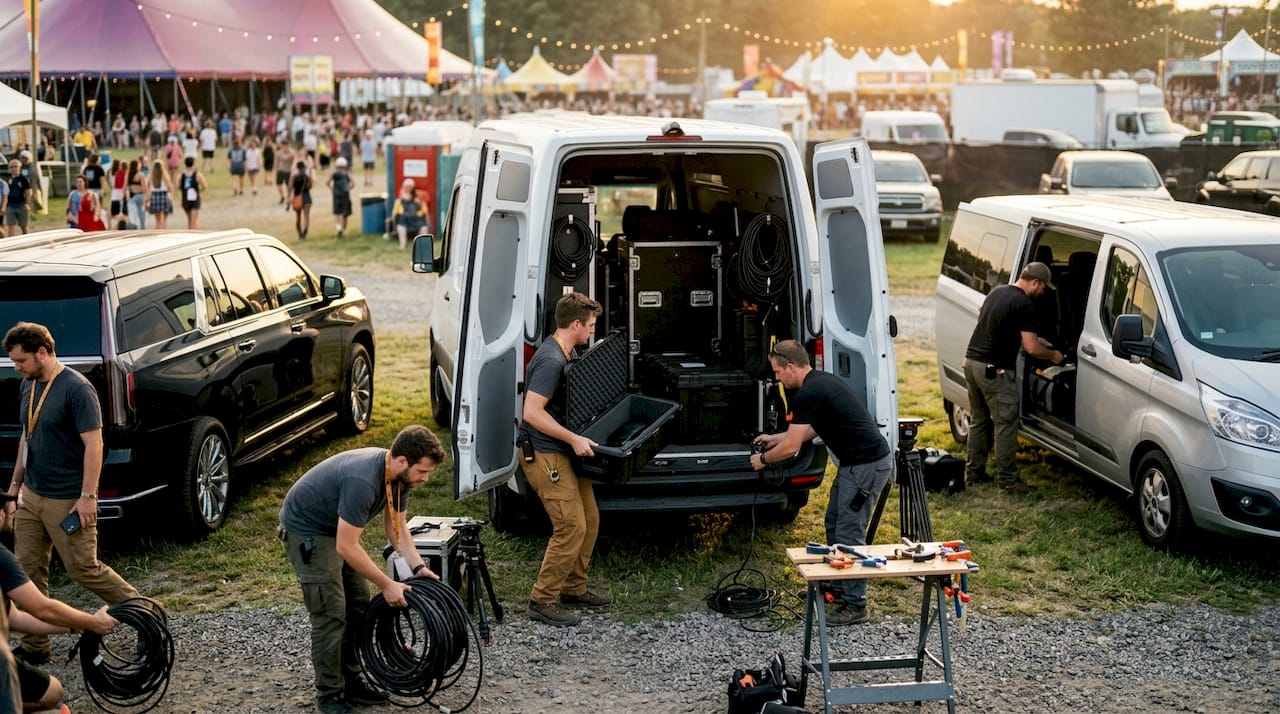
Credentialing directly controls which vehicles can enter which zones. A vehicle without the correct credential cannot access the broadcast compound, regardless of who is inside it. This means transport coordinators must register vehicle plates and driver credentials with venue security before the first shuttle run, often weeks in advance for major events.
Vehicle types by crew size and equipment load
| Vehicle type | Crew size | Equipment capacity | Best use case |
|---|---|---|---|
| Large SUV (Suburban, Yukon XL) | 2–5 personnel | Carry-on gear only | Field producers, on-air talent, small units |
| Sprinter van (12–15 passenger) | 6–12 personnel | Full equipment load | Camera crews, audio teams, technical staff |
| Executive minivan | 4–7 personnel | Moderate gear | Segment producers, directors, logistics staff |
| Coach or mini-bus | 13+ personnel | Luggage bays only | Large crew transfers between hotels and compounds |
Pro Tip: Assign the same driver to the same vehicle and crew group for every day of a multi-day event. Consistent driver-vehicle pairings build crew trust, reduce boarding time, and give drivers working knowledge of security checkpoints and road closures that no GPS app can replicate.
How do you schedule shuttle routes and timings for broadcast crews?
Scheduling broadcast crew transport from the wrong anchor point is the single most common planning failure. Effective shuttle scheduling builds timelines backward from the crew technical breakdown, not from fan exit times. At a stadium like Allegiant Stadium, the last shuttle for staff is timed to the breakdown sign-off, which can fall at 2:00 a.m. or later. Planners who use fan egress as their scheduling anchor leave crews stranded in parking lots after midnight.
Broadcast schedules change constantly. A match that runs to extra time, a technical delay in the production truck, or a post-game press conference that extends by 45 minutes all shift the transport window. Advanced transport platforms update routes dynamically when sessions run overtime, notifying drivers within 20 minutes of a schedule change. Without that capability, drivers sit idle or leave early, and crews are left without a ride.
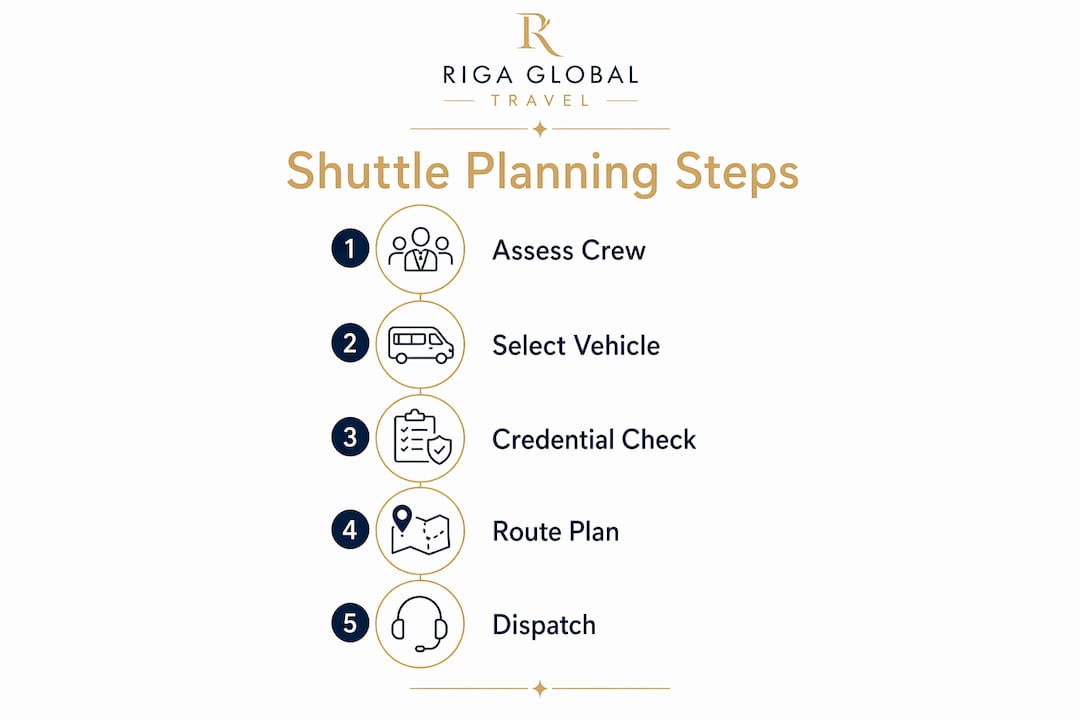
The scheduling framework for broadcast crew transport should follow these steps:
- Anchor to technical breakdown. Set the last shuttle departure at the estimated end of technical breakdown, not fan exit. For live broadcasts, this is typically 90–120 minutes after the final whistle.
- Build in early morning runs. Pre-production crews often arrive at 5:00 a.m. or earlier. Schedule the first shuttle to match the earliest call time on the production schedule, not the general event start.
- Create separate timing tracks. Camera crews, technical directors, and on-air talent all have different call times. Each group needs its own shuttle window, not a shared departure that forces the earliest crew to wait for the latest.
- Plan for overtime buffers. Add a minimum 60-minute buffer to every scheduled departure. Live events almost never end exactly on time.
- Communicate changes in real time. Use a centralized dispatch system that pushes schedule updates directly to drivers and crew contacts simultaneously.
Pro Tip: Never rely on the public event schedule as your transport timeline. Production-specific schedules from the broadcast director are the only accurate source for crew call times and wrap times.
What are the credential and security requirements for broadcast crew shuttles?
Credential-based routing is not optional at major stadium events. Mixing transport streams for athletes, officials, and media crews causes security conflicts that delay everyone and create access violations. Broadcast crews must travel in separate shuttle streams with vehicles that carry the correct credential tier for the zones they need to reach.
At events like the 2026 FIFA World Cup, dedicated shuttle corridors are reserved up to 6 hours before kickoff, and general fan parking is eliminated entirely. This means broadcast crew vehicles must be pre-registered in the venue's transport manifest or they will not clear the outer security perimeter.
The credential and security planning process should follow this sequence:
- Obtain broadcast zone access credentials. Work with the rights-holding broadcaster and venue security to get vehicle and driver credentials for the broadcast compound and media zones.
- Submit vehicle manifests early. Provide plate numbers, driver names, and credential tiers to venue security at least two weeks before the event. Last-minute additions are rarely approved.
- Separate transport streams by credential tier. Broadcast crews, on-air talent, and production executives each carry different credential levels. Route each group through the correct security checkpoint.
- Coordinate with municipal authorities. Road closures and dedicated shuttle corridors are managed by local traffic authorities, not just venue security. Confirm lane access with the relevant municipal agency.
- Budget for security coordination costs. Dedicated lane access and credentialed vehicle registration carry fees at major events. Include these in the transport contract, not as an afterthought.
- Prepare for perimeter changes. Security perimeters expand and shift in the days before a major event. Build a communication protocol with venue security so drivers receive updated access maps 24 hours before each event day.
The separation of transport streams also protects the broadcast crew from delays caused by talent or official vehicle convoys. A Sprinter van carrying camera equipment does not belong in the same lane as a black car service moving a head of state. Keeping streams separate keeps everyone moving.
How do you troubleshoot common shuttle challenges for broadcast crews?
Late transport arrivals are the most damaging problem in broadcast crew logistics. A camera operator who misses the pre-show setup window because a shuttle was 30 minutes late creates a cascade of production problems that no amount of overtime can fully fix. Centralized transport dashboards with real-time vehicle tracking give transport directors the visibility to intervene before a late vehicle becomes a missed call time.
The most common challenges and their fixes:
- Late arrivals. Assign a dedicated transport coordinator who monitors the dashboard continuously during event days. Do not rely on drivers to self-report delays.
- Last-minute schedule changes. Build a direct communication line between the production office and the transport coordinator. Any change to the production schedule must reach the transport team within five minutes.
- Multi-venue routing. When a broadcast operation spans a stadium and an off-site production facility, assign dedicated vehicles to each route. Never share vehicles between venue and off-site runs during active production hours.
- Crew fatigue. Consistent transport and trusted drivers reduce the mental load on crews working 16-hour days. Unpredictable transport adds stress that compounds over a multi-week event.
- Nighttime safety. Broadcast crews wrapping at 2:00 a.m. or later face real safety risks in large, poorly lit parking lots. Shuttle pickup points for late-night runs must be inside the secured perimeter, not in general parking areas.
"The difference between a production that runs smoothly and one that falls apart at the edges is almost always communication. When the transport team knows what the production team knows, in real time, the whole operation holds together."
Pro Tip: When security perimeters shift on event day, drivers need updated maps immediately. Broadcast crew logistics at major events require a dedicated driver briefing at least two hours before the first shuttle run, covering all perimeter changes confirmed that morning.
Key takeaways
Successful broadcast crew shuttle planning requires credentialed vehicles, backward scheduling from technical breakdown, and real-time communication between the production office and transport team.
| Point | Details |
|---|---|
| Start with the right vehicle | Match vehicle type to crew size and gear volume; Sprinter vans are the baseline for equipment-heavy teams. |
| Schedule backward from breakdown | Set the last shuttle departure at technical breakdown sign-off, not fan exit time. |
| Separate transport streams | Route broadcast crews, talent, and officials through different credential-verified shuttle lanes. |
| Use real-time dispatch | A centralized dashboard prevents late arrivals from becoming missed production windows. |
| Register credentials early | Submit vehicle manifests and driver credentials to venue security at least two weeks before the event. |
What I've learned from watching broadcast transport go wrong
I've watched production managers build detailed run-of-show documents that account for every camera angle and zero of the transport logistics. The assumption is always the same: someone else will handle the vehicles. That assumption is where events fall apart.
The credential piece catches people off guard every time. You can have the right vehicle, the right driver, and the right departure time, and still have a Sprinter full of camera operators sitting at a security checkpoint for 45 minutes because the plate was never submitted to the venue manifest. That is not a security failure. That is a planning failure.
What I've seen work consistently is treating transport as a production department, not a vendor service. The transport coordinator should be in the production meeting, not receiving a PDF of the schedule two days before the event. When transport is in the room, changes get communicated in real time and drivers are briefed before problems happen, not after.
The fatigue factor is also underestimated. A crew that gets reliable, on-time transport every day of a two-week tournament performs differently than one that spends mental energy worrying about whether the shuttle will show up. Consistency in drivers and vehicles is not a luxury. It is a performance variable.
— Sammy
Rigaglobaltravel's approach to credentialed broadcast crew transport
Production managers coordinating stadium events need a transport partner who understands credentialing, equipment, and production schedules, not just point-to-point driving. Rigaglobaltravel specializes in entertainment industry ground transport, with a fleet that includes Sprinter vans and large SUVs suited for broadcast crews and their gear.

Rigaglobaltravel operates across key production markets including New York, Los Angeles, Miami, and Connecticut, with drivers experienced in credentialed venue access and production-schedule timing. The team works directly with production coordinators to build transport plans that align with call sheets, not general event timelines. For event organizers who need corporate-grade crew transport built around broadcast logistics, Rigaglobaltravel provides the planning support and vehicle resources to keep crews moving.
FAQ
How far in advance should I plan broadcast crew shuttle service?
Production managers at events with 100 or more personnel should begin shuttle planning several months before the event to meet credential registration deadlines and secure equipment-capable vehicles.
What vehicles work best for broadcast crew transport at stadiums?
Sprinter vans are the standard for camera and audio crews with heavy equipment. Large SUVs serve smaller units and on-air talent who need faster access to media zones.
How do I handle schedule changes during a live broadcast event?
Use a centralized dispatch system that pushes updates to drivers within minutes of any production schedule change. Dynamic route recalculation prevents late arrivals when sessions run overtime.
Can broadcast crew vehicles use the same routes as fan shuttles?
No. Credential-verified, separate shuttle routing for broadcast crews is required at major events. Mixing transport streams with fan or official vehicles creates security conflicts and access delays.
When should the last broadcast crew shuttle depart?
The last shuttle should depart at the end of technical breakdown, often between 2:00 a.m. and 3:00 a.m. for live events. Scheduling the last run at fan egress time leaves crews stranded after wrap.