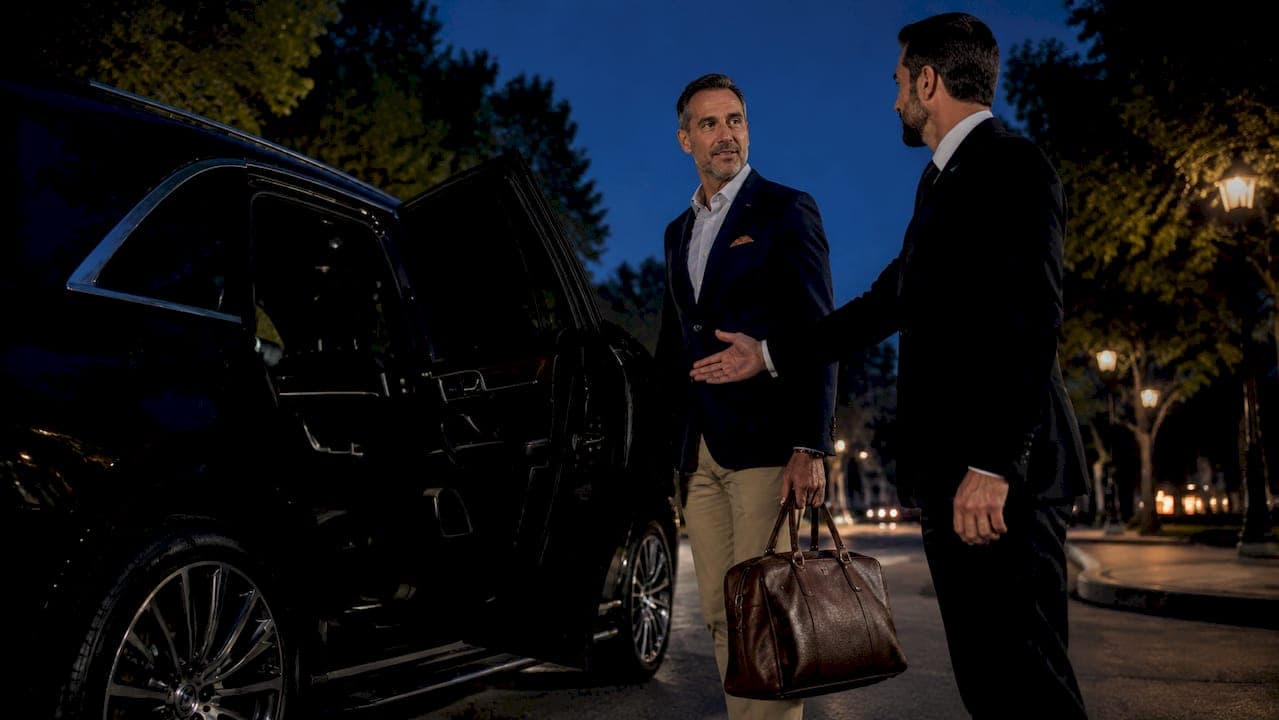
Private chauffeurs are defined as professional, credentialed drivers who provide exclusive, on-demand ground transportation tailored to high-profile clients. Sportscasters use private chauffeurs because live sports broadcasting demands punctuality, security, and discretion that rideshare apps and public transit simply cannot deliver. Networks like NBC and ESPN operate across multiple venues and time zones, and their on-air talent cannot afford a missed pickup or a surge-priced ride. Understanding why sports commentators need private transport means understanding the full weight of what goes wrong when that transport fails.
Why sportscasters use private chauffeurs at live events
The operational case for private chauffeurs starts with one fact: sports broadcasting runs on a schedule that does not bend. A pre-game segment, a halftime interview, and a post-game wrap can happen across three different locations in under four hours. A driver who does not know the venue perimeter, the credentialed access gates, or the real-time road closures around a stadium is a liability, not an asset.
Here is what private chauffeurs do that rideshare drivers cannot:
- Manage multi-stop turnarounds. A sportscaster covering the FIFA 2026 World Cup may need to move from a broadcast center to a press conference to a studio in a single afternoon. A dedicated driver tracks that entire sequence in advance.
- Avoid surge pricing. Rideshare surge pricing can spike up to 500% of the normal rate during peak demand, such as FIFA semi-finals. That unpredictability is unacceptable for a network managing a production budget.
- Access secured broadcast zones. Credentialed drivers receive real-time security alerts on perimeter shifts that rideshare apps miss entirely. A driver without the right credentials gets turned away at the gate.
- Navigate local logistics. Local drivers know the shortcuts, the timing of road closures, and the alternative routes that GPS apps flag too late. During the College Football Playoff or the World Cup, that knowledge is the difference between on-time and off-air.
Pro Tip: If you are coordinating transport for a broadcast crew at a major event, request a driver who has been pre-cleared for the specific venue's credentialing system at least 48 hours before game day. Last-minute clearance requests are routinely denied.
The broadcast crew shuttle service model has evolved to address exactly these pressures, with dedicated dispatch teams managing real-time route adjustments as event logistics shift.

Private chauffeurs vs. rideshare vs. personal drivers: which wins?
The comparison is not close. Private chauffeurs operate in a professional category that rideshare platforms and informal personal drivers do not reach. The table below breaks down the key differences for sports broadcasting contexts.
| Category | Private Chauffeur | Rideshare (Uber/Lyft) | Personal Driver |
|---|---|---|---|
| Pricing | Fixed, transparent rates | Variable, surge-prone | Negotiated, inconsistent |
| Venue Access | Credentialed, pre-cleared | No access privileges | Rarely credentialed |
| Vehicle Options | Sedans, SUVs, vans for gear | Standard passenger cars | Depends on individual |
| Discretion | Trained for high-profile clients | No confidentiality standard | Varies widely |
| Availability | 24/7 dispatch support | App-dependent | Limited by individual schedule |
| Broadcast Gear | Equipped to handle bulky equipment | Not designed for cargo | Rarely equipped |
Professional chauffeur services offer luxury, privacy, and door-to-door personalized service that conventional drivers do not provide. That distinction matters when the person in the back seat is preparing live commentary for a national audience. A rideshare driver may be perfectly competent for a casual trip. For a sportscaster who needs to review notes, take calls, and arrive composed, the environment inside the vehicle is part of the job.
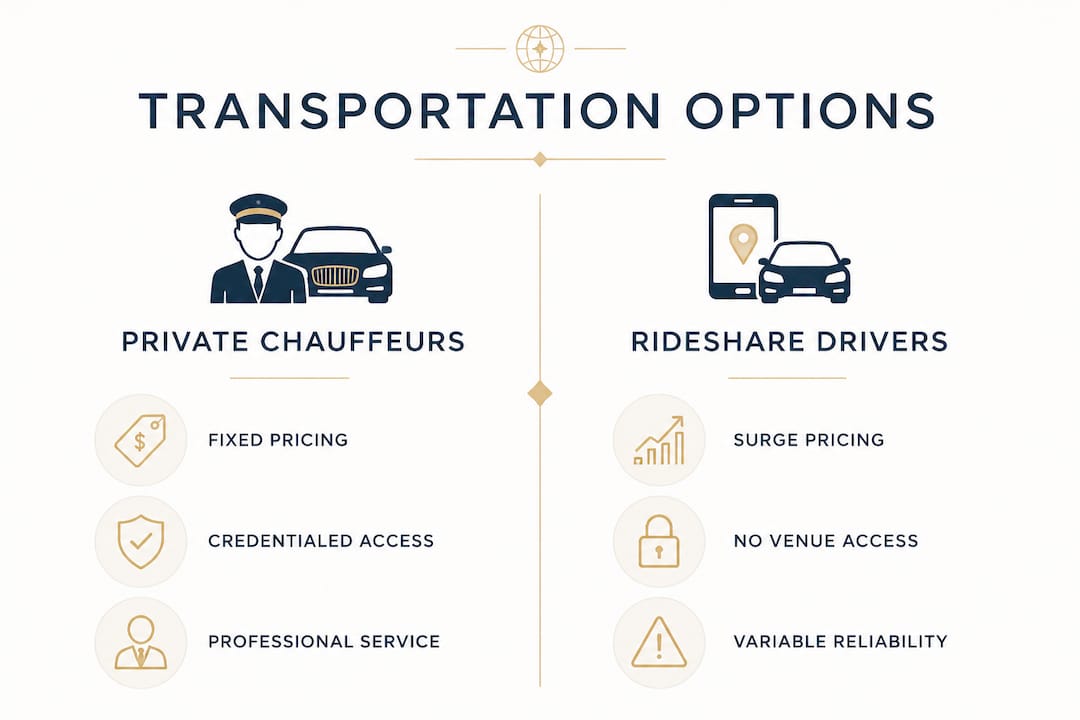
Fixed pricing from private services creates predictable travel budgets. Network production managers can plan transportation costs weeks in advance without worrying about a surge event wiping out the budget on a single ride.
For a deeper look at how these roles differ in practice, the breakdown of personal driver vs. chauffeur distinctions is worth reviewing before you book for a major event.
How private chauffeurs protect sportscaster safety and privacy
Safety for a sportscaster is not just about physical protection. It includes protecting their focus, their schedule, and their public image. A chauffeur service addresses all three.
The most visible benefit is shielding talent from chaotic public environments. After a high-profile game, a sportscaster exiting through a public rideshare pickup zone faces crowds, cameras, and unpredictable delays. A private driver meets them at a pre-arranged, secured exit point.
- Paparazzi management. Credentialed chauffeurs know which exits are monitored and which routes avoid media staging areas. That knowledge protects both the broadcaster's privacy and their network's brand.
- Confidential route handling. Experienced drivers working with high-profile clients treat route information as confidential. They do not share pickup locations, destinations, or schedules with third parties.
- Stress reduction. Broadcaster Kevin Harlan has stated that travel-related exhaustion impacts on-air performance as much as the broadcast pressure itself. Reliable transport is not a luxury. It is a performance tool.
- Consistent environment. A familiar driver, a clean vehicle, and a confirmed pickup time remove three variables from an already demanding day.
Pro Tip: Ask your chauffeur service to provide the same driver for multi-day events when possible. Familiarity with your preferences, your gear, and your schedule cuts preparation time and reduces friction on high-pressure broadcast days.
The safety and privacy case for private chauffeurs applies equally to celebrities and sports media professionals. The threat environment is similar, and the solution is the same.
Real-world logistics: how broadcasters handle demanding travel schedules
The most compelling evidence for why sports broadcasters require discreet drivers comes from actual broadcast schedules. Consider what NBC's talent faced during the 2026 sports calendar.
An NBC sportscaster traveled 6,000 miles in 10 hours via private aviation to cover both the Super Bowl and the Winter Olympics within a single broadcast window. That flight time is only half the story. The ground transportation on both ends of that flight determines whether the broadcaster arrives at the venue on time and ready to perform.
The table below illustrates how a typical multi-event broadcast week breaks down logistically.
| Day | Event | Transport Mode | Key Requirement |
|---|---|---|---|
| Monday | Pre-game press conference | Private chauffeur | Credentialed venue access |
| Tuesday | Cross-city studio appearance | Chauffeur plus SUV for gear | Cargo capacity, fixed timing |
| Wednesday | Travel day (multi-city) | Private aviation plus ground chauffeur | Seamless airport-to-venue transfer |
| Thursday | Live broadcast, two locations | Dedicated driver on standby | Real-time route adjustment |
| Friday | Post-event wrap and departure | Chauffeur to airport | Punctual, no surge risk |
Private aviation combined with chauffeur ground transport is the standard logistics model for top-tier sports broadcasters managing multi-venue coverage. The air travel gets the talent across the country. The chauffeur gets them through the last mile, which is often the most complicated part of the journey.
Public transport and rideshare platforms fail in this context for a specific reason: they are designed for individual, point-to-point trips. Sports broadcasting logistics require a system that thinks in sequences, not single rides. Professional fleets with 24/7 dispatch, ranging from black cars to vans, handle talent and bulky production gear as a single coordinated operation. That is a fundamentally different service model.
Key takeaways
Private chauffeurs are the standard transportation solution for sportscasters because they combine credentialed access, fixed pricing, and professional discretion in a single service that rideshare platforms cannot replicate.
| Point | Details |
|---|---|
| Surge pricing is a real budget risk | Rideshare costs can spike 500% during major events like FIFA semi-finals. |
| Credentialed access is non-negotiable | Only pre-cleared drivers can enter secured broadcast zones at major venues. |
| Fixed pricing enables budget planning | Transparent chauffeur rates remove financial unpredictability from production logistics. |
| Stress reduction improves performance | Reliable transport directly supports broadcaster focus and on-air quality. |
| Multi-modal logistics require coordination | Private aviation paired with ground chauffeurs is the standard for multi-event coverage. |
What i've learned watching sports media transport up close
The conversation around sportscasters travel arrangements almost always focuses on the glamour of the job. The private jets, the courtside seats, the post-game access. What rarely gets discussed is how fragile that entire operation is when ground transportation fails.
I have seen broadcast teams scramble because a rideshare driver could not get past a venue checkpoint. I have watched a network's pre-game segment nearly collapse because surge pricing made the production manager hesitate on booking a ride, and that hesitation cost 20 minutes. These are not edge cases. They happen regularly at major events.
The shift I expect to see accelerate through 2026 and beyond is the full integration of chauffeur dispatch systems with broadcast production software. Networks will stop treating ground transport as a separate logistics problem and start building it into the production schedule the same way they schedule satellite uplinks. The broadcasters who thrive in this environment will be the ones whose teams treat transport as a production asset, not an afterthought.
Kevin Harlan's point about travel exhaustion affecting performance is the most underrated insight in sports media right now. Physical and mental recovery between events is only possible when the travel itself is not a source of stress. A chauffeur service does not just move you from point A to point B. It gives you back the 30 minutes you would have spent watching a surge price tick upward on your phone.
My advice to any sportscaster or production coordinator reading this: stop treating private chauffeur services as a perk. They are infrastructure.
— Sammy
Rigaglobaltravel: built for sports media professionals
Sports broadcasting does not wait, and neither should your transportation. Rigaglobaltravel provides celebrity and talent transportation designed specifically for the demands of media professionals working under broadcast deadlines. The fleet includes black cars, SUVs, and vans capable of handling both talent and production equipment in a single run.
Every driver is vetted, credentialed, and trained on the discretion standards that high-profile clients require. Pricing is fixed and transparent, so your production budget stays predictable regardless of what is happening on the field. Dispatch runs 24/7, covering markets including New York, Los Angeles, Miami, and Connecticut. If your broadcast schedule demands reliable ground transport, Rigaglobaltravel is the service built to deliver it.
FAQ
Why do sportscasters prefer chauffeurs over rideshare apps?
Private chauffeurs offer credentialed venue access, fixed pricing, and professional discretion that rideshare platforms cannot provide. During major events, rideshare surge pricing can reach 500% of normal rates, making chauffeurs the more reliable and cost-predictable option.
How do chauffeurs access secured broadcast venues?
Credentialed chauffeurs receive pre-clearance and real-time security updates for broadcast hubs and event perimeters. Standard rideshare drivers and rental cars are denied access to these restricted zones.
What vehicle types do chauffeur services use for sports broadcasts?
Professional chauffeur fleets include sedans, SUVs, and cargo vans designed to transport both talent and bulky production equipment. This versatility makes them the practical choice for full broadcast crew logistics.
Does private transport actually affect a sportscaster's performance?
Broadcaster Kevin Harlan has directly linked travel exhaustion to on-air performance, stating that reliable transport is a core part of managing the physical demands of the job. Stress-free ground transport gives broadcasters recovery time between segments.
How do sportscasters manage transport across multiple events in one week?
The standard model combines private aviation for long-distance travel with dedicated chauffeur ground transport for venue-to-venue movement. This integrated approach, used by NBC talent during events like the Super Bowl and Winter Olympics, keeps broadcasters on schedule across multiple cities.