
Multi-city production tour transport is the coordinated movement of equipment, vehicles, and personnel across multiple venues using customized freight fleets, regulated driver schedules, and staged logistics systems. The industry term for this discipline is production logistics, and it covers everything from trailer specifications to load-in sequencing. The best multi-city production tour transport examples share three traits: a defined vehicle fleet, strict compliance with federal driver regulations, and a repeatable staging rhythm. Freight forwarders require a 3 to 6 month lead time to organize these logistics. That window covers site inspections, routing, and load timing before the first truck rolls.
1. Multi-city production tour transport examples by scale
Scale is the clearest way to understand how production transport works in practice. A small regional tour might run 4–8 trucks, a crew of 20–30, and a single equipment set. A mid-size arena tour typically runs 15–30 trucks with 60–90 crew members handling lighting, audio, video, and staging.
Stadium-level productions operate at a different order of magnitude. Major stadium tours use 80–120 trucks and 120–150 personnel, with load-ins taking up to 48 hours. That scale means a single show requires the equivalent of a small freight operation running around the clock.
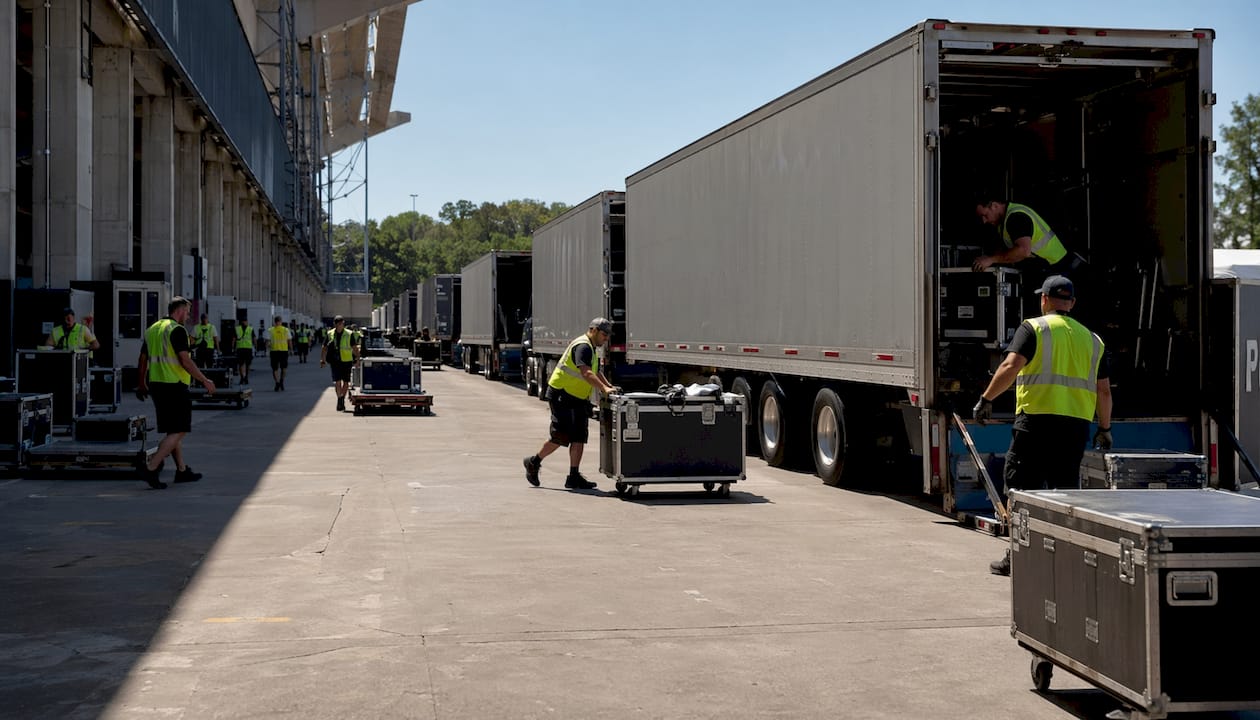
The difference between these tiers is not just truck count. It is the number of departments running parallel logistics, the complexity of customs and permitting on international legs, and the number of contingency plans required when one truck runs late.
2. Vehicle types used in production tour transport
The core freight vehicle for most tours is the dry van trailer, a standard 53-foot enclosed unit that carries cases, risers, and general production gear. Dry vans are reliable and widely available, which matters when you need replacement vehicles on short notice in a city you have never worked in before.
Specialized equipment demands specialized vehicles. Key vehicle types include:
- Hydraulic drop deck trailers: These lower to ground level, allowing forklifts to roll cargo on and off without ramps. They reduce manual labor and speed load-in for heavy staging equipment.
- Climate-controlled trailers: Used for temperature-sensitive instruments, electronics, and pyrotechnic materials.
- Cargo vans and box trucks: Standard for advance teams, wardrobe, and smaller production departments that move independently of the main convoy.
- Sleeper cab trucks: Allow drivers to rest on-site or at nearby lots, keeping the vehicle available for early morning load-out.
Pro Tip: Wrap your trucks in tour branding. Every mile the convoy travels is a moving billboard. Production managers who coordinate with marketing teams on custom wraps get promotional value out of freight costs they are already paying.
3. How driver Hours of Service rules shape tour scheduling
US federal Hours of Service rules are a hard constraint on every convoy schedule. Drivers are limited to 11 hours of driving after 10 consecutive off-duty hours, all within a 14-hour on-duty window. These rules apply to property-carrying commercial drivers and carry significant fines for violations.
For production tours, this creates a scheduling puzzle. If a show ends at midnight and load-out takes four hours, trucks cannot legally depart until drivers have rested. That pushes arrival at the next city into the following afternoon, compressing load-in time.
Production managers solve this with several tactics:
- Multi-driver convoys: Two drivers per truck allow one to rest while the other drives, keeping the vehicle moving legally.
- Overnight runs: Scheduling drives during off-peak hours reduces traffic delays and makes better use of the legal driving window.
- Split load-out: Sending advance trucks with rigging and lighting gear first, while audio and video load out later, staggers departure times and keeps drivers compliant.
- Buffer days: Building one travel day between shows in cities more than 400 miles apart prevents Hours of Service violations from becoming show-day emergencies.
4. Operational strategies that keep multi-city tours moving
The leapfrog model is the single most effective strategy for tight multi-city scheduling. Two or three equipment sets rotate between cities: one in use at the current show, one in transit to the next city, and one prepping at a future venue. This approach lets a tour play cities just days apart despite setup times that would otherwise make the schedule impossible.
The standard on-site load-in sequence follows this order:
- Rigging crew: Establishes overhead points and motor systems before anything else enters the room.
- Lighting department: Hangs fixtures and runs cable while the floor remains clear.
- Stage and set construction: Builds the physical stage structure once overhead work is complete.
- Video department: Installs LED walls, screens, and camera systems.
- Audio department: Flies speaker arrays and runs front-of-house and monitor systems last, since cable runs require a clear floor.
Pro Tip: Score each city on your route by loading dock access, proximity to freight hubs, and local rental availability. Cities with poor infrastructure scores get larger contingency buffers. Cities with strong scores can run tighter schedules.
Strategic contingency storage in select cities reduces downtime when a truck runs late or equipment is damaged. Placing backup stock near key hubs means a show can open even when one freight unit does not arrive on time.
Successful tours also follow a "ship identity, rent utility" approach. You never ship every item. Brand-specific and fragile gear travels with the convoy. Generic utility items like cable, stands, and basic lighting fixtures get rented locally. This cuts freight volume and cost without compromising the show's visual identity.
5. Technology and communication tools for production logistics
Centralized documentation is the operational backbone of any multi-city tour. Live itineraries and shared updates replace email chains and keep every department, from production to finance, working from the same information. When a truck is delayed, every department head knows within minutes rather than hours.
Routing and shipment tracking platforms give production managers real-time visibility into convoy positions. That visibility lets you make decisions before problems become crises. If a truck is running two hours behind, you can call the venue and adjust load-in sequencing before the crew is standing around waiting.
Communication on the road and on-site relies on layered systems. Radio comms handle intra-department coordination during load-in and load-out, where speed matters and phones are impractical. Messaging apps handle inter-department updates between cities, where documentation and searchability matter more than speed.
Relying solely on venue calendars misses local rental and freight challenges. A complete logistics plan incorporates local resource availability and infrastructure risk scores for every city on the route. That data lives in the centralized system, accessible to every department head on any device.
For production teams coordinating ground transportation in New York and other major markets, having a single point of contact for executive and talent transport removes one more variable from an already complex operation.
6. Equipment packaging and road case standards
Road cases are not all equal, and the difference matters when you are moving fragile instruments and electronics across 30 cities. Cases come in three tiers: Category I for 100 or more round trips, Category II for 10 or more trips, and Category III for single use. Choosing the wrong tier means either overspending on packaging or losing equipment to damage mid-tour.
Category I cases use aluminum extrusions, heavy-duty latches, and high-density foam interiors. They are built for the punishment of daily loading and unloading across a full tour cycle. Category III cases are essentially heavy-duty cardboard with foam, appropriate for one-way shipments of items that will not return.
Modified trailers improve crew safety and speed the movement of heavy cases. Maximizing trailer internal height lowers the bed height, which creates safer ramp angles and reduces the physical strain on loaders. That modification pays for itself in reduced injury risk and faster load times across a full tour.
For celebrity and talent transport running parallel to the freight operation, the same attention to detail applies. Talent vehicles need to arrive on schedule regardless of what is happening with the freight convoy.
Key takeaways
Effective production tour logistics require a coordinated system of the right vehicles, compliant driver scheduling, and a repeatable staging rhythm that scales with the show.
| Point | Details |
|---|---|
| Scale determines fleet size | Stadium tours require 80–120 trucks and 120–150 crew; regional tours run 4–8 trucks. |
| Hours of Service rules are non-negotiable | Plan driver shifts around the 11-hour driving limit to avoid fines and show-day delays. |
| Leapfrog equipment sets enable tight schedules | Rotating two or three equipment sets lets you play cities days apart without setup conflicts. |
| Ship identity, rent utility | Freight brand-specific gear and rent generic items locally to cut volume and cost. |
| Centralized documentation prevents breakdowns | Live shared itineraries keep every department aligned when conditions change on the road. |
What I've learned about tour transport after years in production
The biggest mistake I see production managers make is treating transport as a logistics afterthought. They nail the creative vision, lock the routing, and then hand the freight problem to a broker two months before the first show. That gap is where tours fall apart.
The tours that run well share one trait: the transport plan is built at the same time as the show design. When the scenic designer knows the truck count before they finalize the set, the set fits the trucks. When the lighting director knows the trailer height before they spec the rig, the rig loads faster. That coordination saves real money and real time.
I am also a firm believer in the hybrid shipping model. Renting utility gear locally is not a compromise. It is a decision that frees up truck space for the gear that actually defines the show. Every cubic foot you reclaim from cable and stands is a cubic foot you can use for something irreplaceable.
Contingency planning gets lip service in most production meetings. What actually works is assigning a risk score to every city before the route is locked. Cities with limited dock access, no nearby rental houses, and poor freight hub proximity need buffer days built into the schedule. Cities with strong infrastructure can run tight. That scoring process takes a few hours and saves days of scrambling on the road.
— Sammy
Rigaglobaltravel: ground transport built for production teams
Production tours move fast, and talent transport cannot be the weak link. Rigaglobaltravel provides professional chauffeured vehicles and concierge ground transport for entertainment industry clients across major markets.
Whether your production is running through New York, Los Angeles, Miami, or Connecticut, Rigaglobaltravel coordinates executive and talent transport to match your show schedule. Every vehicle is tracked, every driver is vetted, and every pickup runs on production time, not standard car service time. For teams managing limousine service in New York or limousine service in Los Angeles, Rigaglobaltravel delivers the reliability that production schedules demand.
FAQ
What is a typical truck count for a mid-size arena tour?
A mid-size arena tour typically runs 15–30 trucks carrying staging, lighting, audio, and video equipment. Crew size for these productions generally falls between 60 and 90 people.
How do Hours of Service rules affect show-day scheduling?
Federal rules limit drivers to 11 hours of driving within a 14-hour window after 10 off-duty hours. Production managers build buffer days and use multi-driver trucks to stay compliant without compressing load-in time.
What is the leapfrog strategy in production transport?
The leapfrog model uses two or three identical equipment sets rotating between cities: one performing, one in transit, and one prepping at the next venue. This approach allows shows in cities just days apart despite long setup times.
How far in advance should production transport be planned?
Freight forwarders require a 3 to 6 month lead time to organize concert tour logistics. That window covers routing, site inspections, customs paperwork, and load timing coordination.
What road case category should touring productions use?
Category I cases, built for 100 or more round trips, are the standard for touring productions. Category III single-use cases are appropriate only for one-way shipments of non-returning equipment.