
A broadcast crew shuttle service is defined as a specialized, pre-cleared transportation system that moves media personnel, production staff, and technical equipment between hotels, media compounds, and event venues on a fixed, coordinated schedule. Without it, a live broadcast does not happen on time. The role of broadcast crew shuttle service has grown from a logistical convenience into a mission-critical function, particularly as productions like the FIFA World Cup 2026 and the Super Bowl operate inside layered security perimeters that standard rideshare apps cannot penetrate. Rigaglobaltravel works directly in this space, providing vetted drivers, fleet versatility, and 24/7 dispatch coordination for entertainment and broadcast clients who cannot afford a single missed call time.
What operational challenges do broadcast crews face that shuttle services solve?
Broadcast crew transportation operates in an environment that most corporate travel managers never encounter. Security perimeters at major venues divide public, credentialed, and restricted zones, and only pre-cleared vehicles with approved drivers can cross each boundary. A rideshare driver who has not passed an event-specific background check will be turned away at the first checkpoint, leaving your camera operator stranded 400 meters from the media compound.
The specific challenges that dedicated shuttle services address include:
- Security perimeter access. Dedicated shuttle loops are required over rideshares at events like FIFA World Cup 2026 because security restrictions block uncleared vehicles from reaching broadcast centers. A pre-approved shuttle bypasses that friction entirely.
- Credentialed drivers. Many secure venues require chauffeurs to pass background checks and event permits before they can enter restricted media zones. Standard rideshare platforms do not carry this clearance.
- Equipment handling. A camera package, tripod case, and audio rack do not fit in a sedan. Shuttle fleets sized for broadcast work include Sprinter vans and cargo SUVs that accommodate gear without improvisation.
- Group coordination. A crew of twelve cannot split across four rideshare pickups and arrive simultaneously. A single shuttle solves the coordination problem before it starts.
- Traffic and schedule volatility. Urban traffic around major event venues is unpredictable. Shuttle providers with local driver expertise and GPS monitoring reroute in real time, while a rideshare driver unfamiliar with the area may default to a blocked route.
Pro Tip: Confirm with your venue's security office at least six weeks before the event which vehicle classes and driver credential types are required for media zone access. This single step prevents the most common day-of transport failure.
How do broadcast crew shuttles differ from corporate or airline crew shuttles?
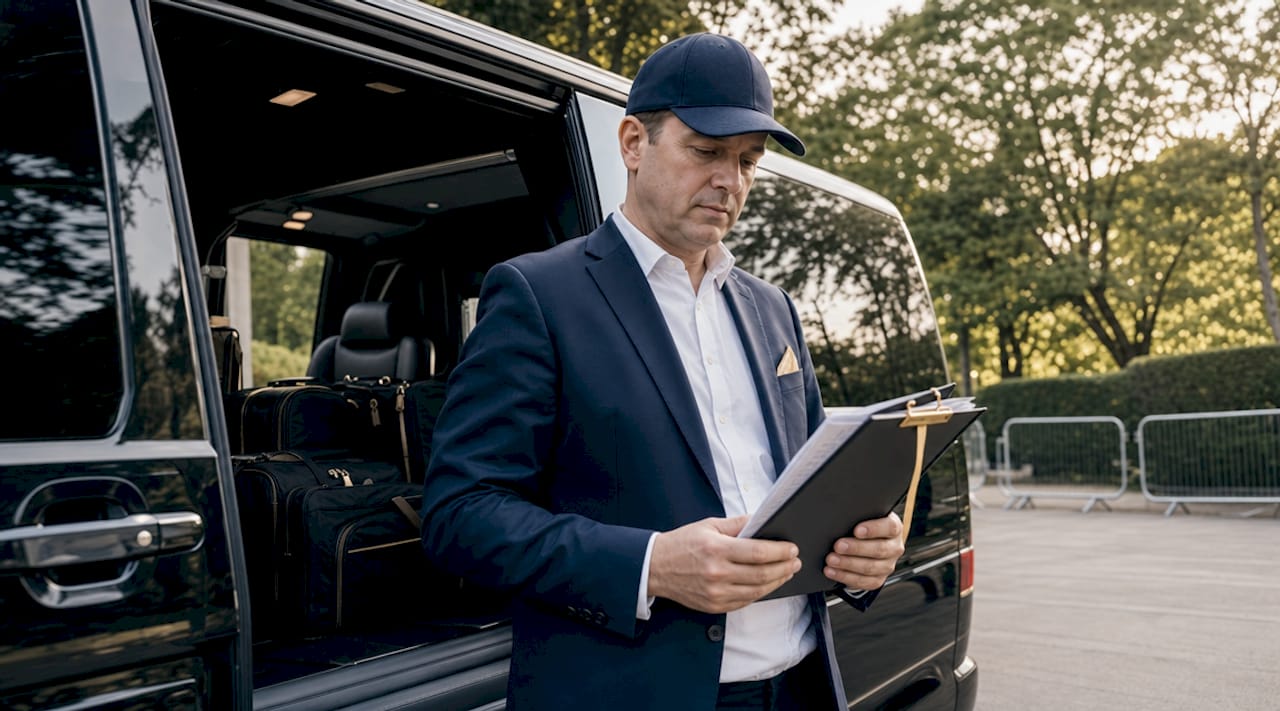
The term "crew shuttle" covers a wide range of services, and conflating them creates planning errors. Broadcast crew transportation is a distinct category with requirements that align with dynamic production timelines rather than the fixed schedules that define airline or corporate commuter shuttles.
| Feature | Broadcast crew shuttle | Airline crew shuttle | Corporate commuter shuttle |
|---|---|---|---|
| Routing | Media zones, restricted compounds, multi-venue loops | Airport to hotel, fixed route | Office campus, fixed stops |
| Driver vetting | Event-specific background checks, security clearances | Standard commercial license | Standard commercial license |
| Schedule basis | Production call sheets, dynamic timelines | Fixed flight schedules | Fixed business hours |
| Vehicle types | Sprinter vans, SUVs, cargo vehicles, executive cars | Standard passenger vans | Standard passenger buses |
| Equipment capacity | High, designed for production gear | Low | Low |
| Coordination partner | Operations manager, technical manager | Airline crew scheduler | HR or facilities team |
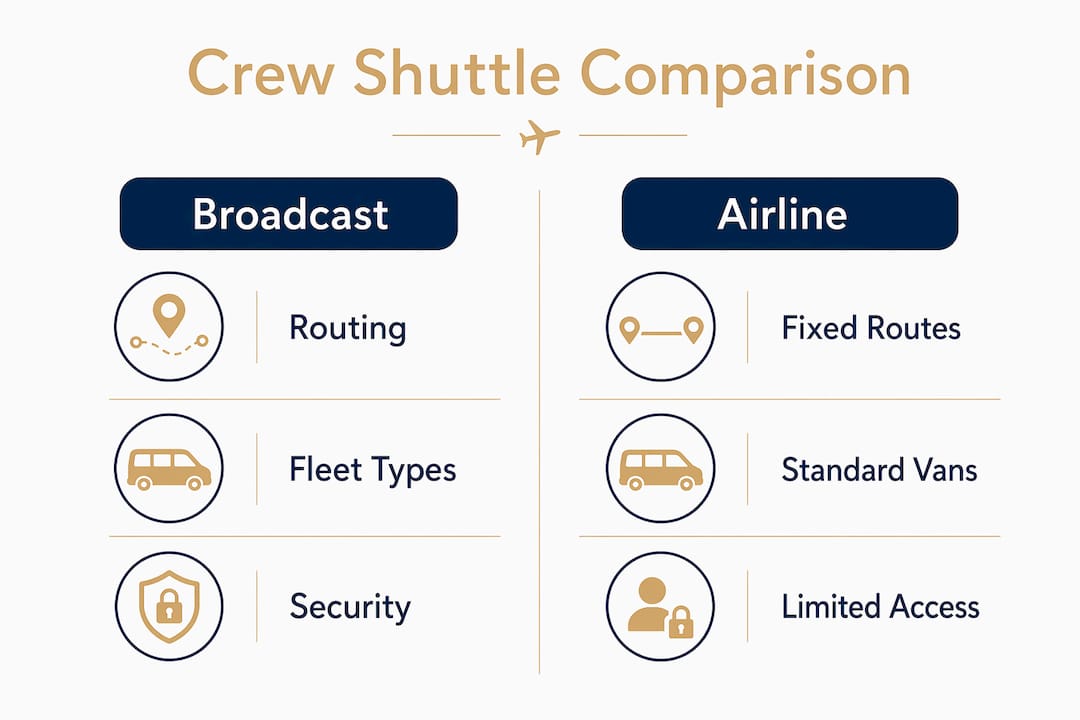
The practical implication of this table is significant. When a production coordinator books a generic shuttle vendor without specifying broadcast requirements, they typically receive an airline-style service: fixed pickup times, standard passenger vans, and drivers with no awareness of media compound access protocols. The result is a fleet that cannot get your crew to the right place at the right time.
Fleet options for dedicated broadcast work range from cargo vans to luxury black cars, covering every transport demand from equipment runs to executive talent movement. That versatility is not a feature of standard shuttle categories.
What best practices ensure effective broadcast crew shuttle operations?
Planning for major events requires synchronized effort across operations and technical management teams to meet the strict daily schedules that broadcast productions demand. Transport is not a detail you finalize two weeks before the event. It is a planning pillar you establish at the same time you book your venue and technical infrastructure.
Follow this sequence to build a shuttle operation that holds under pressure:
- Engage your shuttle provider during pre-production. CBS Sports senior director Jenna McKeon has noted that shuttle services must be involved early to avoid logistical roadblocks. Bring your transport partner into planning calls before call sheets are finalized, not after.
- Align transport schedules with production call sheets. Your operations manager and technical manager should share daily schedules with the shuttle coordinator so vehicle assignments match crew movements, not generic departure windows.
- Build deliberate time buffers. Scheduling buffer times is standard in broadcast transportation planning to accommodate VIP path changes, threat-level adjustments, and traffic volatility. A 15-minute buffer on every shuttle leg is not waste. It is insurance.
- Use GPS monitoring and real-time communication. Drivers with local expertise and live route data can adapt when a road closes or a security sweep delays a checkpoint. Static schedules without communication tools fail under exactly those conditions.
- Match vehicle selection to crew size and cargo. A five-person crew with a full camera package needs a Sprinter van, not a sedan. Confirm vehicle specifications against your crew manifest and equipment list before the contract is signed.
- Verify credential and clearance requirements for every driver. Vetting drivers for broadcast site access means confirming background checks, security clearances, and event-specific permits are in place before operations begin. This is not optional at major productions.
Pro Tip: Request a written confirmation from your shuttle provider listing each driver's credential status and the specific access zones they are cleared for. Keep that document with your production credentials package.
How are shuttle services executed at events like the FIFA World Cup or Super Bowl?
Large-scale productions expose every weakness in a transport plan. At FIFA World Cup 2026, the broadcast center transport model relies on dedicated shuttle loops that run continuous circuits between credentialed hotels, the International Broadcast Center, and individual stadium media compounds. Public parking is restricted near most venues, which means the shuttle is not a convenience. It is the only legal and practical way to move crew.
The operational structure at this scale looks like this:
| Transport element | Description | Purpose |
|---|---|---|
| Shuttle loops | Fixed circuits between IBC, hotels, and stadiums | Continuous crew movement without individual vehicle coordination |
| Credential checkpoints | Driver and vehicle pre-clearance at each zone boundary | Prevents unauthorized access, eliminates checkpoint delays |
| Drop-off zones | Designated media-only vehicle areas at each venue | Keeps crew separate from public and VIP traffic flows |
| Last-mile transport | Short-range vehicles for compound-to-field movement | Covers distances too short for full shuttle loops |
| Communication systems | GPS dispatch, radio, and mobile coordination | Real-time rerouting and crew status updates |
NBC Sports demonstrated this complexity during Super Bowl production, implementing layered communication systems and specialized vehicle deployment to move talent and equipment across multiple locations simultaneously. The transport operation was not a background function. It was integrated directly into the technical execution plan.
The lesson from both productions is that shuttle services for media crews at this scale function as a logistics layer equal in importance to your technical infrastructure. A camera that cannot reach the venue on time is as damaging as a camera that fails on air. Understanding private shuttle advantages for broadcast and sports events helps planners build that layer correctly from the start.
Key takeaways
Broadcast crew shuttle services are mission-critical transport systems that require vetted drivers, specialized vehicles, and production-aligned scheduling to prevent delays that directly disrupt live broadcasts.
| Point | Details |
|---|---|
| Security access is non-negotiable | Only pre-cleared vehicles and credentialed drivers can enter restricted media zones at major events. |
| Broadcast shuttles are a distinct category | They differ from airline and corporate shuttles in routing, vetting, vehicle type, and scheduling logic. |
| Early engagement prevents failures | Involving your shuttle provider during pre-production, not post-planning, eliminates the most common transport breakdowns. |
| Buffer time is standard practice | Building schedule cushions into every shuttle leg protects against VIP movements, security sweeps, and traffic volatility. |
| Scale demands integration | At FIFA 2026 and Super Bowl level, shuttle operations are embedded in the technical execution plan, not treated as a separate vendor function. |
Why transport is the production element most teams underestimate
I have watched productions spend six figures on technical infrastructure and then assign shuttle coordination to the most junior person on the operations team. That decision costs more than it saves. Transport is not a commodity function at a live broadcast. It is the first link in a chain that ends with your signal going out on time.
The misconception I see most often is treating shuttle providers as vendors you call the week before. Constant collaboration between shuttle providers and broadcast operations managers is what actually lowers the risk of delays and technical disruptions. The providers who know your call sheet, your credential requirements, and your venue access protocols are the ones who solve problems before you know they exist.
There is also a morale dimension that rarely appears in logistics planning documents. A crew that arrives late, stressed, and disorganized because their transport failed does not perform at the same level as a crew that arrived on time in a vehicle that fit their gear. Transport affects the human side of production, and that affects the work. I have seen it directly. The productions that treat their on-site transport as a strategic function consistently run tighter schedules and report fewer day-of disruptions than those that treat it as an afterthought.
— Sammy
How Rigaglobaltravel supports broadcast crew transport
Rigaglobaltravel specializes in crew and executive transportation for the entertainment industry, with a fleet that covers every broadcast transport demand from Sprinter vans for equipment-heavy crews to executive black cars for talent and network leadership.
Every driver in the Rigaglobaltravel network is vetted for event-specific access requirements, including background checks and security clearance protocols that major productions demand. Dispatch operates 24/7 with real-time GPS coordination, so your shuttle schedule adapts when production timelines shift. If you are planning crew transport for a live event, a remote production, or a multi-venue broadcast, contact Rigaglobaltravel to build a transport plan that holds under the pressure of a live show.
FAQ
What is a broadcast crew shuttle service?
A broadcast crew shuttle service is a pre-cleared, scheduled transportation system that moves media personnel and production equipment between hotels, media compounds, and event venues. It differs from standard shuttles by requiring credentialed drivers, specialized vehicles, and scheduling aligned to production call sheets.
Why can't broadcast crews use rideshare apps at major events?
Rideshare drivers lack the event-specific background checks and vehicle pre-clearance required to enter restricted media zones at productions like FIFA World Cup 2026 or the Super Bowl. Security perimeter restrictions block uncleared vehicles from reaching broadcast centers entirely.
How far in advance should you book shuttle services for a broadcast production?
Engage your shuttle provider during pre-production planning, at the same stage you finalize venue access and technical infrastructure. CBS Sports operations leadership identifies early shuttle involvement as the single most effective way to prevent logistical roadblocks on production day.
What vehicle types are used for broadcast crew transportation?
Broadcast shuttle fleets include Sprinter vans, cargo SUVs, and executive black cars, selected based on crew size, equipment volume, and the access requirements of each venue zone.
How do shuttle services handle last-minute schedule changes during a live event?
Experienced broadcast shuttle providers use GPS dispatch and real-time communication systems to reroute vehicles when security sweeps, VIP movements, or traffic shifts occur. Buffer times built into every shuttle leg give operations teams the flexibility to absorb those changes without missing crew call times.