
VIP sports guest transport is a logistics-driven, concierge transport ecosystem that coordinates every movement of high-profile guests around a sporting event, from tarmac to greenroom, so production teams protect their schedule, their principals' privacy, and the event's public image. It is not vehicle hire. It is orchestrated movement management, and the difference matters the moment your talent's flight lands 40 minutes late during a Super Bowl broadcast window.
Rigaglobaltravel, which specializes in chauffeured and concierge transport for the entertainment industry, handles exactly this kind of engagement, from Formula 1 media summits to multi-day network sports productions across major U.S. markets. When logistics teams define VIP transport at major events, the vehicles are tools. The team is the service.
Table of Contents
- What does VIP sports guest transport actually cover?
- Who owns what: roles and responsibilities on event day
- How does the operational workflow run from planning to post-event?
- What SLAs and performance metrics should you require?
- How are VIP sports transport services priced?
- How do you vet and select a VIP sports transport provider?
- A real-world example: how VIP sports transport works end-to-end
- Key Takeaways
- The part most production teams get wrong
- Useful resources for further reading
- Rigaglobaltravel handles the logistics so your production doesn't have to
What does VIP sports guest transport actually cover?
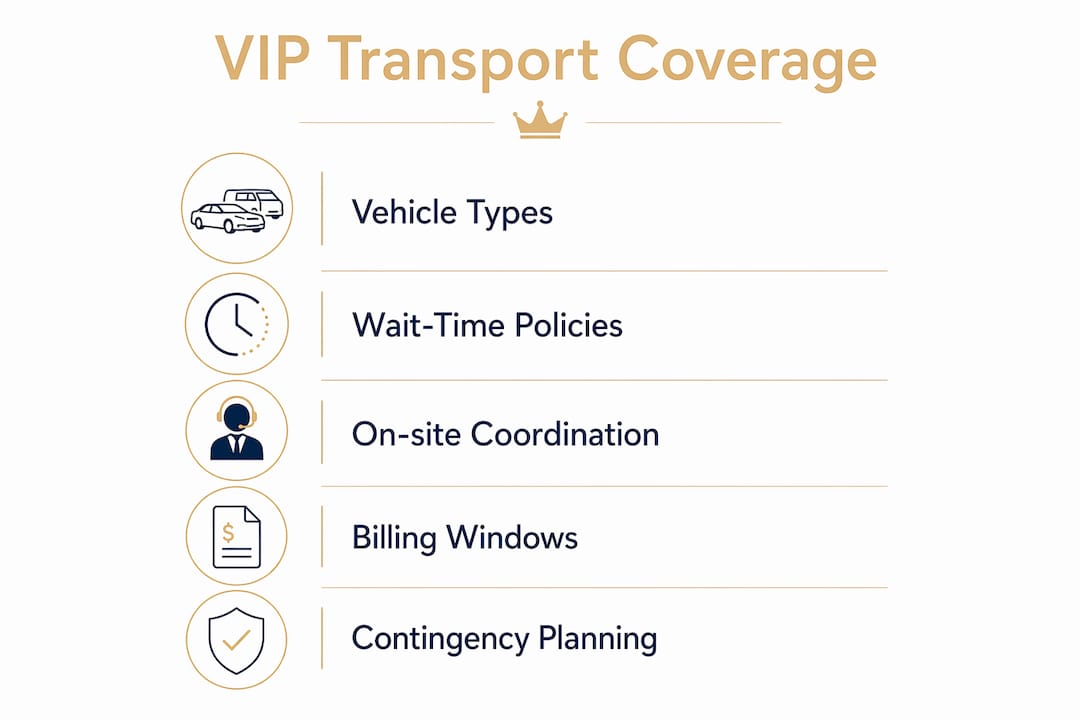
The scope is broader than most production teams budget for on their first engagement. Core deliverables typically include:
- Airport meet and greet: credentialed staff meeting principals at the gate or FBO, handling customs liaison, and escorting through private terminals
- Secure transfers: point-to-point routing with vetted, background-checked chauffeurs and pre-approved vehicle staging
- Hotel-to-venue routing: timed departures aligned with call sheets, accounting for traffic and venue access windows
- Dedicated chauffeurs: assigned per principal, not pooled, so the same driver knows the guest's preferences across the full engagement
- On-site shuttles and vehicle staging: coordinated movement between backstage, media zones, and hospitality areas
- Accreditation handling: coordinating credentials and access passes so vehicles clear perimeter checkpoints without delay
- Luggage and equipment handling: including specialty sports equipment transport and production gear
- Concierge add-ons: dining reservations, last-mile logistics, and hotel coordination
Optional add-ons that production teams often treat as standard (and then get surprised when they are billed separately) include standby vehicles, after-hours driver availability, and security escort coordination.
Pro Tip: The three scope gaps that cause the most day-of friction are wait-time billing windows (when does the clock start?), perimeter access versus public drop-off zones, and backup vehicle staging. Get all three in writing before the contract is signed.
The game-day VIP transport guide from Rigaglobaltravel breaks down vehicle options and operational considerations in more detail for teams planning multi-principal rotations.
Who owns what: roles and responsibilities on event day
Clear role mapping prevents the handoff failures that turn a minor delay into a headline. Here is how responsibilities typically divide:
| Role | Core Responsibilities |
|---|---|
| Production lead | Approves run-of-show, owns final schedule, escalation authority |
| Transport manager | Manages manifests, driver briefings, real-time routing decisions |
| Operations coordinator | Tracks arrivals/departures, updates schedule, flags conflicts |
| On-site captain | Manages vehicle staging, driver check-ins, perimeter access |
| Chauffeur | Executes assigned transfers, reports delays in real time |
| Security liaison | Coordinates with venue security, approves vehicle access routes |
| Venue liaison | Manages accreditation, parking permits, and backstage access |
| Airport/airline handler | Coordinates FBO or gate meet-and-greet, customs, and luggage |
| Client concierge | Handles VIP preferences, dietary needs, last-minute requests |
A few responsibilities that production teams sometimes leave ambiguous:
- Permits and accreditation typically remain the production or venue's responsibility. A transport provider can coordinate, but the credentials must originate from the rights holder.
- Run-of-show ownership should sit with the transport manager, not the chauffeur pool. Drivers execute; coordinators decide.
- Rigaglobaltravel typically assumes responsibility for driver briefings, vehicle readiness, real-time routing, and contingency execution. The production team retains control of the master schedule and venue access approvals.
For a deeper look at on-site coordination and venue liaison, the operational guidance covers how those handoffs work in practice.
How does the operational workflow run from planning to post-event?
A well-run VIP sports transport engagement moves through five phases: planning, coordination, staging, execution, and post-event reconciliation. Here is a sample timeline production ops can adapt:
- T-minus 30 days: Confirm scope, vehicle classes, and staffing levels. Establish the transport manager and primary communication lead. Begin permit and accreditation applications.
- T-minus 7 days: Distribute draft manifests to all stakeholders. Confirm airport handlers, hotel contacts, and venue liaisons. Conduct route reconnaissance for primary and backup routes.
- T-minus 48 hours: Finalize run-of-show with confirmed arrival/departure windows. Brief all drivers. Stage backup vehicles and confirm their readiness.
- T-minus 24 hours: Distribute final manifests. Confirm accreditation status for all vehicles. Run a communications check across all coordinators.
- Day of: Execute against the manifest. Transport manager holds a single source-of-truth schedule. All real-time changes route through one communication lead to prevent conflicting instructions reaching drivers.
- Post-event: Reconcile billing against the manifest (wait times, overtime, additional transfers). Document incidents and near-misses for the next engagement.
Pro Tip: GPS feeds and digital schedule tools improve visibility, but they only work when a human coordinator is interpreting the data and making calls. Assign one person as the real-time decision authority on the day. Two people with equal authority create hesitation at exactly the wrong moment.
A shared manifest that every driver and coordinator references eliminates the double-bookings and routing errors that cluster during high-density arrival windows.

What SLAs and performance metrics should you require?
Minimum SLA language worth including in any contract typically includes high on-time pickup rates for scheduled transfers, quick response times to schedule changes, backup vehicle availability during peak windows, and confidentiality adherence with signed NDAs for all drivers and coordinators before credentialing.
| KPI | Minimum Threshold | Escalation Trigger |
|---|---|---|
| On-time pickup rate | 95% | Performance below 95% triggers executive review |
| Schedule change response | 10-minute acknowledgment | Delays trigger incident logs |
| Vehicle readiness check | Full pre-shift check | Any unresolved defect grounds the vehicle |
| Incident resolution time | Timely resolution | Extended delays escalate to production lead |
Required documents to request during vetting: certificate of insurance (commercial auto and general liability), commercial vehicle licensing, driver background check summaries, vehicle maintenance logs, and a sample run-of-show manifest from a comparable prior event. VIP athlete transport engagements add equipment handling protocols and training-schedule alignment to this list.
How are VIP sports transport services priced?
Pricing blends several models, and the final number rarely matches the opening quote once the real scope is mapped.
- Per-transfer flat fees: standard for single airport pickups or point-to-point hotel transfers; predictable but does not cover wait time
- Hourly or day rates: common for dedicated chauffeurs and on-site vehicles; the right model for multi-stop, variable-schedule days
- Corporate account or retainer billing: invoiced monthly; suits production companies running recurring engagements across a season
- Bundled concierge packages: combine transport, hotel, dining, and ticketing into a single line item; useful for talent management but harder to audit
Main cost drivers: vehicle class (sedan vs. Sprinter vs. coach), wait-time policy (when billing starts after scheduled pickup), airport and FBO fees, off-site staging and parking, driver overtime beyond agreed hours, equipment handling, and last-minute routing changes.
Simple scenarios to illustrate how drivers compound: a single VIP airport transfer in a luxury sedan runs at a flat rate. Add a flight delay, a second vehicle on standby, and a route change through a secured venue perimeter, and the same transfer can cost multiple times the base rate. A multi-VIP game-day rotation with six principals, two backup vehicles, and a four-hour staging window is a day-rate engagement, not a per-transfer one.
Pro Tip: Build a contingency line into the transport budget for any multi-day production. Define wait-time billing windows and overtime triggers in the contract before the event, not after the invoice arrives.
Understanding executive fleet types helps budget owners match vehicle class to actual need rather than defaulting to the most expensive option across the board.
How do you vet and select a VIP sports transport provider?
Vendor vetting checklist:
- Documented experience at comparable major sporting or entertainment events
- Credentialed, background-checked drivers with event-specific briefing protocols
- Scalable fleet covering sedans, SUVs, Sprinters, and coaches
- Current certificate of insurance and commercial vehicle licensing
- Technology for real-time GPS tracking and schedule updates
- Verifiable client references from productions of similar scale
Contract clauses to require:
- SLA penalties tied to the KPI thresholds above
- Manifest ownership and update protocols (who controls the master document)
- Data-sharing and communications protocols for real-time ops
- Confidentiality and NDA terms covering all staff
- Cancellation terms and wait-time billing definitions
- Backup vehicle commitment with response time guarantee
Red flags that should disqualify a bidder:
- Cannot produce a sample run-of-show or manifest from a prior event
- Vague or absent backup vehicle plan
- No driver background check process
- Insurance certificates that exclude commercial event use
- Single point of contact with no ops team behind them
Questions to ask during RFP review: How do you handle a principal's flight arriving 90 minutes late during peak venue access? Who is the on-site decision authority? Can you show us a manifest from a comparable event? What is your escalation path if a vehicle is grounded day-of?
For last-minute VIP ground transport scenarios specifically, contingency planning depth separates capable providers from ones who will leave you managing the problem yourself.
A real-world example: how VIP sports transport works end-to-end
A national sports network production staging a two-day broadcast event needed transport for 14 principals, including on-air talent, league executives, and sponsor VIPs, across three venues in one metropolitan market. The primary constraint was a compressed arrival window: 11 principals were scheduled to land within a 90-minute period at two different airports.
The transport team pre-staged vehicles at both airports 45 minutes before the first arrival, assigned a dedicated coordinator to each terminal, and held two standby vehicles at a central staging point between the airports. When two flights were delayed simultaneously, the on-site captain redistributed the standby vehicles without waiting for a production call, because the decision authority and the contingency plan were already agreed in the manifest.
The single operational decision that prevented a cascade failure was pre-staging backup vehicles at a midpoint rather than at the venues. When delays hit both airports at once, the team had assets in position to respond quickly. Without that staging call, the first venue arrival would have been significantly delayed, pulling the entire broadcast schedule.
Measurable outcomes: nearly all principals arrived on schedule with minimal delay; no schedule incidents required production escalation.
This case is drawn from the operational experience of Sammy at Rigaglobaltravel. For sports network ground transport examples and further case studies, see the Rigaglobaltravel blog.
Key Takeaways
VIP sports guest transport is a logistics ecosystem, not a vehicle booking, and production teams that treat it as the latter consistently face avoidable day-of failures.
| Point | Details |
|---|---|
| It is a logistics ecosystem | VIP transport covers planning, coordination, contingencies, and concierge, not just vehicle hire. |
| Scope gaps cost money | Define wait-time billing, perimeter access, and backup staging in the contract before the event. |
| SLAs need numbers | Require a 95% on-time pickup rate, 10-minute change response, and backup vehicle commitments in writing. |
| Budget for contingency | Add 15–20% contingency to the transport budget and define overtime triggers before signing. |
| Rigaglobaltravel | Rigaglobaltravel provides chauffeured and concierge transport for entertainment and sports productions across major U.S. markets. |
Next steps for production teams:
- Copy the scope checklist from Section 2 into your RFP or SOW template.
- Request insurance certificates, commercial licensing, driver background check summaries, and a sample manifest from every bidder.
- Schedule a run-of-show walkthrough with your shortlisted provider at least 7 days before the event.
- Confirm backup vehicle staging locations and decision authority in writing before the contract is signed.
- Build a 15–20% contingency line into the transport budget line item.
The part most production teams get wrong
The conventional wisdom treats VIP transport as a procurement checkbox: find a licensed provider, confirm the vehicles, move on. That framing is where most day-of problems originate.
The real value of a specialist provider is not the fleet. It is the continuous control function: a team that is reading live traffic data, monitoring flight boards, tracking venue access queues, and making proactive decisions before the production team even knows there is a problem. Most clients do not see that work because, when it is done well, nothing goes wrong. They only notice it when it is absent.
The single biggest mistake production teams make is treating the transport manager as an order-taker rather than an operational partner. The teams that get the best outcomes brief their transport manager the same way they brief their technical director: full access to the run-of-show, a seat at the pre-event production meeting, and the authority to flag conflicts before they become incidents.
Rigaglobaltravel's approach to celebrity and talent transportation is built around exactly that model: the transport team is embedded in the production workflow, not bolted on after the schedule is locked.
Useful resources for further reading
Rigaglobaltravel resources:
- VIP hospitality transport at sports venues — operational coordination and venue liaison guide
- Luxury transport's role in sports media — case studies on transport's impact on media and PR outcomes
- Sports venue transfer services guide — practical timeline and SLA examples for game-day operations
- VIP production crew transport options — crew transport integration with VIP movement planning
External partner resources:
- What is a VIP airport transfer? — primer on airport meet-and-greet and service expectations
- Airport executive fleet types — vehicle class inventory and operational tradeoffs for budget planning
Templates available on request from Rigaglobaltravel: vendor vetting checklist, run-of-show manifest template, vehicle staging and backup plan template.
Rigaglobaltravel handles the logistics so your production doesn't have to
Production teams running major sports events in New York, Los Angeles, Miami, or Connecticut need a transport partner who is already inside the run-of-show before the first vehicle moves. Rigaglobaltravel provides chauffeured limousine, executive car, and shuttle transport for entertainment industry productions, with full concierge coverage including airport transfers, hotel-to-venue routing, talent logistics, and on-site coordination.
The difference from a standard car service: Rigaglobaltravel's team operates as an embedded logistics function, not a dispatch queue. Your transport manager is briefed on the full production schedule, holds a seat at pre-event planning calls, and has backup vehicles staged before the first principal lands.
For productions in the New York market, the New York limousine and chauffeur service covers the full range of entertainment and sports engagements. For talent and celebrity logistics specifically, the celebrity transport service page outlines how Rigaglobaltravel manages high-profile principals from arrival to wrap.
Contact Rigaglobaltravel to request a scope consultation and sample manifest for your next production.