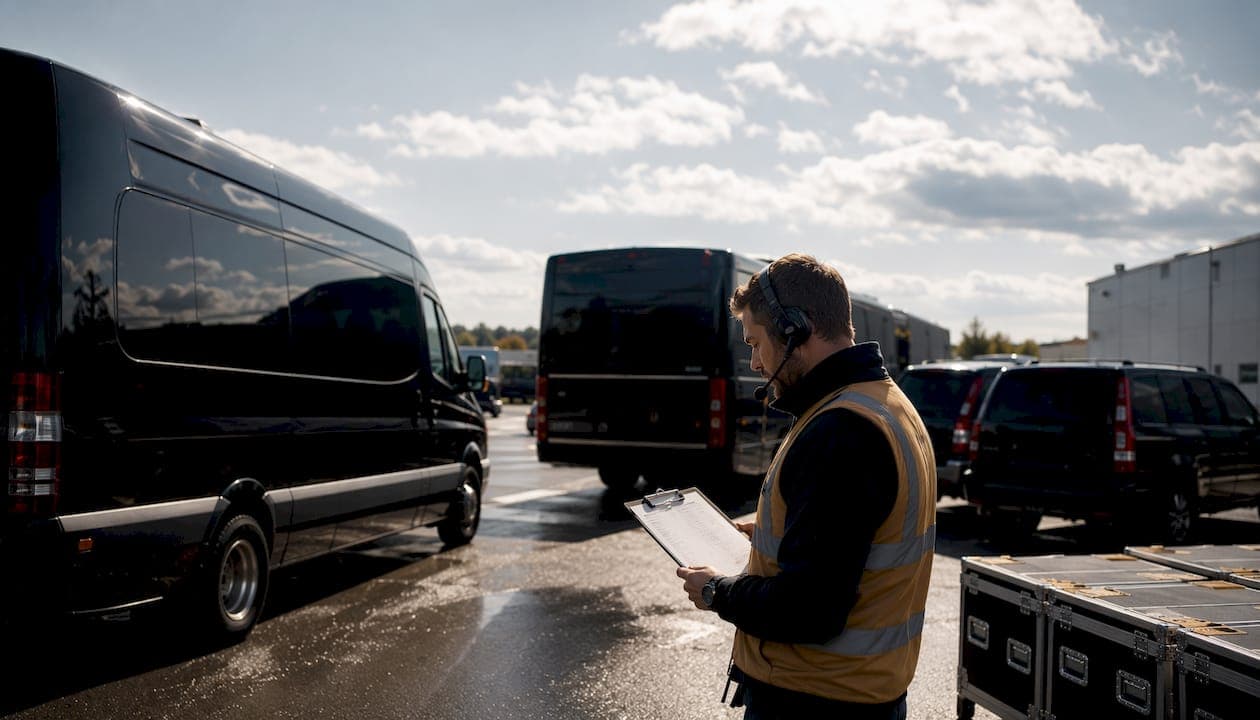
VIP production crew transport options are specialized vehicles and services designed to balance comfort, efficiency, and security for high-profile film and event productions. Production managers and logistics coordinators face a distinct challenge: moving talent, directors, and key crew members on time, in comfort, and without incident. The industry standard for this category is called production ground transportation, and it covers everything from chauffeured SUVs to executive crew buses with onboard sleeping quarters. Getting it right protects your schedule, your talent, and your production's reputation.
1. What are the top VIP production crew transport options?
The best vehicle for any production depends on crew size, schedule intensity, and the level of privacy required. Four primary categories cover most production scenarios.
Luxury Sprinter vans are the most versatile option for small VIP crews of four to eight people. Luxury vehicles now function as mobile offices, with Starlink Wi-Fi, 4K displays, and dedicated workspace areas built into the cabin. That means your director or showrunner can review dailies and take calls between locations without losing a minute of productive time.
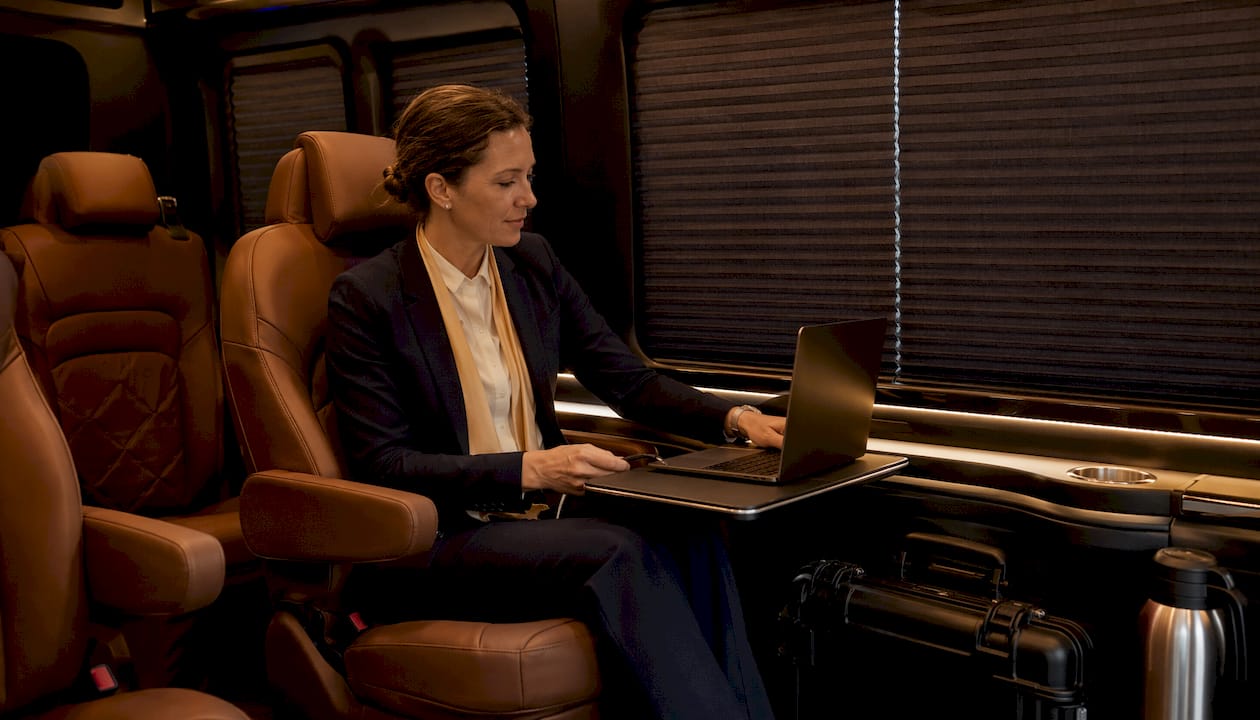
Executive crew buses handle larger groups and longer hauls. Crew buses include sleeping bunks, kitchenettes, lounge space, and Wi-Fi to support overnight drives between multi-location shoots. CDL-certified drivers on these vehicles understand production timelines, which reduces the friction that comes from working with general charter operators.
Chauffeured limousines and SUVs remain the standard for principal talent and A-list crew. These vehicles offer the highest level of privacy, and their drivers are typically trained in defensive driving and discretion protocols. For red carpet arrivals and studio lot access, a chauffeured SUV is the default choice.
White-glove specialty transport applies when the asset being moved is itself high-value, such as a custom prop vehicle or a production-owned supercar. Specialized white-glove delivery can cut transit time from four to eight weeks by sea to under 48 hours by air for vehicles valued between €1M and €5M. That speed matters when a shoot is on a fixed calendar.
| Vehicle Type | Capacity | Key Amenities | Best For |
|---|---|---|---|
| Luxury Sprinter van | 4–8 passengers | Starlink Wi-Fi, 4K display, workspace | Small VIP crews, multi-stop days |
| Executive crew bus | 12–40 passengers | Bunks, kitchenette, lounge, Wi-Fi | Overnight drives, large crews |
| Chauffeured SUV/limo | 1–6 passengers | Privacy partition, premium audio | Principal talent, studio access |
| White-glove specialty | Asset-specific | Climate control, air freight capable | High-value prop or production vehicles |
Pro Tip: Book your Sprinter van with a driver who has at least two prior production credits. General chauffeurs unfamiliar with call sheets and base camp logistics add friction that compounds across a long shoot.
2. How VIP transport services enhance airport and on-set logistics
Airport coordination is where production ground transportation either earns its cost or creates a crisis. The difference between a smooth talent arrival and a security incident often comes down to one decision: public terminal meet-and-greet versus private VVIP terminal access.
Public terminal meet-and-greet places a greeter inside the arrivals hall, while private VVIP terminal access bypasses public terminals entirely through tarmac transfers. Choosing the wrong tier for high-profile talent exposes them to crowds, cameras, and potential security gaps. For any principal cast member or executive producer, private terminal access is the correct default.
Precise vehicle staging is the operational backbone of airport transfers. Tracking aircraft tail numbers allows your transport provider to stage vehicles engine-running as passengers deplane, eliminating wait time on the tarmac. That level of coordination requires a provider with direct access to private aviation terminal data, not just a commercial flight tracker.
Precise vehicle staging synced with aircraft tail number tracking dramatically reduces wait times and crew downtime at airports. A vehicle that arrives two minutes after the talent is a failure, regardless of how luxurious it is.
Porter and luggage handling are part of the same service tier. Production crews traveling between cities often carry equipment cases, wardrobe, and personal luggage simultaneously. A transport provider that handles only the passenger and leaves the crew to manage their own bags is not operating at the VIP level.
Pro Tip: Book private terminal transfers at least 72 hours in advance. Staffing and security screening for tarmac access require that lead time, and same-day requests are routinely declined.
3. Features production managers should prioritize when booking luxury crew transport
The amenities inside the vehicle matter as much as the vehicle itself. Luxury interiors now mirror private aviation, with Starlink Wi-Fi, 4K displays, and workspace areas that let crew members stay productive during transit. For a production manager coordinating a 14-hour shoot day, a vehicle that doubles as a mobile office is not a luxury. It is a productivity tool.
Privacy features separate production-grade transport from standard luxury car service. Electronic partitions, tinted glass, and private restrooms give talent the ability to decompress, change, or take confidential calls between locations. The Imperial by Lexani Motorcars includes heated and ventilated VIP captain chairs, a private restroom, and advanced entertainment technology for six passengers. That specification represents the current benchmark for bespoke Sprinter builds.
Driver qualifications deserve more scrutiny than most production managers give them. A driver who has worked production logistics understands call sheet timing, base camp geography, and the reality that schedules shift without warning. Experienced drivers with production familiarity handle unpredictable schedule changes proactively, rather than waiting for instruction. That difference shows up most clearly during night shoots and multi-location days.
Vehicle maintenance and safety checks are non-negotiable for any provider working at this level. Ask for documented pre-trip inspection records and confirm that backup vehicles are available for critical talent runs. A single mechanical failure during a principal pickup can cost a production far more than the price difference between a vetted provider and a cheaper alternative.
Pro Tip: Request a luxury van overview from your transport provider before booking. A reputable company will share vehicle specs, driver credentials, and maintenance records without hesitation.
4. How to choose the right transport based on crew size, budget, and production needs
Matching the vehicle to the situation is the core skill in production ground transportation. The wrong vehicle wastes money. The right one protects your schedule and your talent.
Small VIP crews (1–6 people) are best served by chauffeured SUVs or a high-spec Sprinter van. SUVs work well for urban productions where parking and maneuverability matter. Sprinter vans make more sense for productions with multiple stops across a region, where the crew needs to work in transit.
Large production teams (12–40 people) require executive crew buses. The cost per seat drops significantly compared to running multiple SUVs, and the crew arrives together, which simplifies on-set logistics. For overnight drives between locations, a bus with sleeping bunks eliminates the need for hotel rooms, which can offset the higher vehicle cost.
Urban versus multi-set productions have different priorities. Urban shoots in cities like New York or Los Angeles benefit from chauffeured SUVs and celebrity transport services that know the city's traffic patterns and studio lot protocols. Multi-set productions spread across regions need crew buses and a transport coordinator who can manage a rolling schedule across multiple vehicles.
Cost-saving strategies exist without dropping service quality. Consolidating crew into fewer, larger vehicles reduces per-trip costs. Booking a dedicated transport account with a single provider, rather than using multiple vendors, gives you negotiating leverage and consistent service standards. Flexible billing arrangements, where charges are tied to actual usage rather than flat daily rates, also reduce waste on shorter shoot days.
| Scenario | Recommended Vehicle | Key Consideration |
|---|---|---|
| Principal talent, urban shoot | Chauffeured SUV or limo | Privacy, city maneuverability |
| Small VIP crew, multi-stop day | Luxury Sprinter van | Mobile office capability |
| Large crew, overnight drive | Executive crew bus | Bunks, CDL-certified driver |
| High-value asset transport | White-glove specialty service | Air freight, climate control |
Pro Tip: For productions running more than three weeks, negotiate a dedicated fleet arrangement with your transport provider. You get priority vehicle availability, consistent drivers who learn your schedule, and a single point of contact for all logistics.
Key takeaways
The most effective VIP production crew transport strategy matches vehicle type, service tier, and driver expertise to the specific demands of each production phase.
| Point | Details |
|---|---|
| Match vehicle to crew size | SUVs suit small VIP groups; executive buses handle large crews more efficiently. |
| Prioritize private terminal access | VVIP tarmac transfers prevent security and privacy failures for principal talent. |
| Demand production-experienced drivers | Drivers familiar with call sheets handle schedule changes without disrupting the shoot. |
| Book airport transfers 72 hours out | Private terminal staffing and screening require advance notice to guarantee service. |
| Use mobile office specs as a baseline | Starlink Wi-Fi and 4K displays keep crew productive between locations. |
What I've learned about production transport that most articles won't tell you
The conversation about VIP production crew transport almost always focuses on the vehicle. The seats, the Wi-Fi, the partition. Those things matter, but they are not where productions actually lose time or money.
The real failure point is coordination. I have watched productions book a genuinely excellent vehicle and then pair it with a driver who has never worked a film set. That driver does not know what a base camp is. He does not understand why the call sheet time is not the same as the pickup time. He shows up at the wrong gate at LAX because no one told him the production uses a private terminal. The vehicle was perfect. The service was a disaster.
The second thing most articles skip is booking lead time. The 72-hour rule for private terminal access is real, and it applies to the best vehicles too. High-spec Sprinter builds and executive crew buses are not sitting idle waiting for last-minute bookings. Productions that treat ground transportation as a day-of decision consistently pay more and get less.
Tech upgrades in luxury transport are genuinely changing what is possible. Starlink connectivity in a Sprinter van means your director can do a live edit review while driving between locations. That is not a gimmick. It is a real workflow change that reduces the number of hours the crew needs to be on set. The productions that figure this out first will have a real scheduling advantage.
My honest advice: treat your transport provider the same way you treat your key department heads. Brief them on the production, share the schedule, and build the relationship before day one. The providers who work well in this industry are not order-takers. They are logistics partners, and they perform better when they understand what you are actually trying to accomplish.
— Sammy
Rigaglobaltravel's approach to production crew transport
Production managers who need white-glove studio transport without the coordination headache have a direct option with Rigaglobaltravel. The company specializes in limousine and concierge services for the entertainment industry, with a fleet built for production-level demands.
Rigaglobaltravel provides real-time flight tracking, private terminal access coordination, and dedicated account managers who understand production schedules. Whether your shoot is based in New York, Los Angeles, Miami, or Connecticut, the company offers luxury chauffeur services and production-specific transport in Los Angeles with flexible billing tied to your actual usage. Contact Rigaglobaltravel for a customized quote before your next production begins.
FAQ
What vehicles are standard for VIP production crew transport?
Chauffeured SUVs, luxury Sprinter vans, and executive crew buses are the three standard vehicle categories for production ground transportation. The right choice depends on crew size, schedule length, and privacy requirements.
How far in advance should I book private terminal airport transfers?
Private terminal transfers require at least 72 hours advance notice for staffing and security screening. Same-day requests are typically not accommodated at VVIP terminal level.
What is the difference between a public meet-and-greet and VVIP terminal access?
A public meet-and-greet places a greeter inside the arrivals hall, while VVIP terminal access routes talent through a private terminal via tarmac transfer, bypassing public areas entirely. The latter is the correct choice for principal cast and high-profile crew.
Why does driver experience with production logistics matter?
Production-experienced drivers understand call sheet timing, base camp locations, and how to respond when schedules shift without notice. A driver unfamiliar with film sets adds delays that compound across a long shoot day.
Can luxury Sprinter vans function as mobile offices during production?
Yes. Current high-spec builds include Starlink Wi-Fi and 4K displays that allow crew members to review footage, take calls, and work between locations. This capability is now a standard feature in production-grade Sprinter configurations.