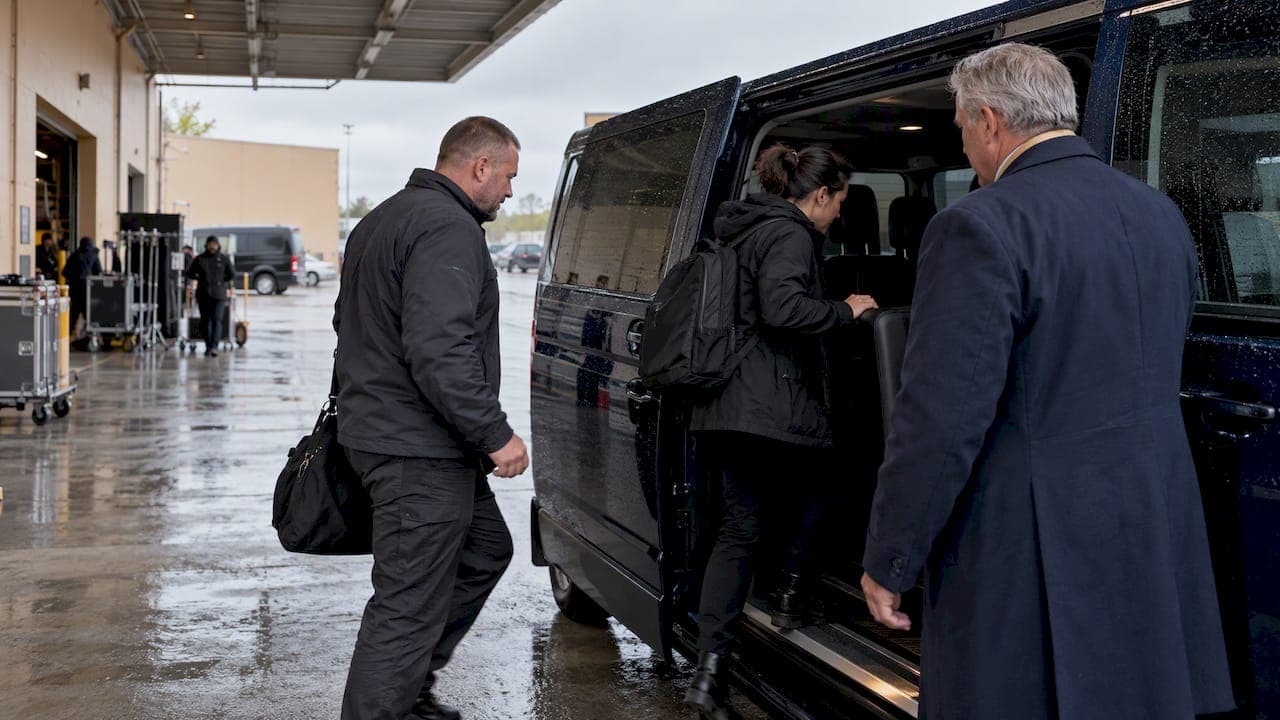
When weather threatens a shoot day or executive move, assign a weather monitor immediately, activate the production's action plan, and route people to pre-staged vehicles and shelters while running a manifest check-in. Safety Bulletin #38 calls for exactly this kind of designated response, and production-focused operators like Riga Global Travel build their chauffeured and shuttle services around it.
TL;DR:
- Assign a weather monitor, transport lead, location manager, and safety officer before call time; post the lightning trigger and decision authority on the call sheet.
- Stop outdoor work when lightning reaches the set trigger, commonly 6 to 10 miles, and wait 30 minutes after the last strike before resuming.
- Book vehicle holds, inland hotel blocks, and driver briefings days ahead; include a wrap buffer of 90 minutes and document overtime, cancellation, and hold terms.
- Assign each passenger to a vehicle, name a contact to verify headcounts, print manifests, plan backup routes, and halt travel when conditions make movement unsafe.
- Call wrap early if forecasts threaten safe departure, then stagger vehicle arrivals at assigned pickup points to prevent congestion during evacuation.
Table of Contents
- Building a prioritized action plan for weather escalation
- Pre-booking vehicles, hotel blocks, and drivers before weather hits
- Running safety meetings and staging on the day of the event
- Coordinating a mass evacuation for cast and crew
- Closing out operations after a weather event
- What productions get wrong about weather contingency planning
- How Riga Global Travel supports weather contingency transportation
- FAQ
- Sources
Building a prioritized action plan for weather escalation
A production's action plan only works if everyone knows the order of operations before the sky turns. Safety Bulletin #38 requires a designated person to track conditions, defined evacuation routes, meeting areas, a headcount method, and clear transportation protocols for moving cast and crew to shelter.
Escalation has thresholds, not guesswork. A watch means conditions are possible; a warning means they are happening or imminent, and that distinction should trigger different transport responses. For lightning, the 30-30 rule applies: once lightning is within the production's trigger distance, commonly 6 to 10 miles, outdoor work stops and people move to vehicles or shelter, with a 30-minute wait after the last strike before resuming.
When the forecast threatens to push wrap past the window, call wrap early rather than risk a late, weather-compromised departure.
Pro Tip: Post the trigger distance and the names of the weather monitor and transport lead on the call sheet so no one has to ask who decides.
Priority order during escalation:
- Secure equipment and gear likely to fly or short out.
- Activate vehicle holds and move essential personnel toward staged vehicles.
- Run manifest verification and roll call at each pickup point.
- Confirm comms channels and point-of-contact assignments per vehicle.
Roles to assign before the day starts:
- Weather monitor: tracks conditions and calls the trigger.
- Transport lead: manages vehicle holds, staging, and driver communication.
- Location manager and 1st AD: coordinate movement with the schedule.
- Safety officer: confirms shelter readiness and signs off on evacuation.
Pre-booking vehicles, hotel blocks, and drivers before weather hits
Last-minute scrambling for vehicles during a weather event is expensive and slow, so the real work happens days before the forecast turns. Structure vehicle holds by type: buses and shuttles for mass moves, sedans and SUVs for talent and executives, each with a defined hold window rather than an open-ended "on call" arrangement. Build a 90-minute wrap-time buffer into every ground booking so a late wrap does not trigger a surcharge or leave a vehicle unassigned.
- Hold buses and shuttles separately from sedans so capacity for a mass evacuation does not compete with executive transport needs.
- Confirm hotel blocks inland or away from the risk zone, with rooming lists prepared in advance so check-in is fast if evacuation becomes necessary.
- Verify GVWR and passenger ratings match expected conditions, and choose vehicles rated for the terrain and weather rather than whatever is closest.
- Brief drivers on safety procedures, evacuation routes, and communication protocol before the risk window opens, not after.
Our internal guide on winter weather transportation planning covers how to structure these holds for cold-weather productions specifically, and the same logic extends to hurricanes and severe storms.
Pro Tip: Document agreed hold windows, overtime terms, and cancellation terms in writing before the forecast turns, not during the scramble.
On billing, a retainer model tends to suit productions with recurring exposure, while per-ride holds work for a single high-risk day. Either way, clarify cancellation terms and overtime rates up front. A modest premium for guaranteed hold windows and surge capacity is almost always cheaper than booking emergency transport at last-minute rates once a storm is already closing in.
Running safety meetings and staging on the day of the event
The morning safety meeting is the single best tool for keeping a weather day from becoming a weather incident. Cover the forecast, shelter locations, communication channels, the transit plan, and the exact threshold that triggers an early wrap.
- Open with the forecast and the weather monitor's assessment.
- Confirm shelter locations and the routes to reach them.
- Review the transit plan, including which vehicles serve which groups.
- Set the wrap-call threshold and who has authority to call it.
Vehicle staging needs choreography as much as the shoot itself does. Assign specific pickup points to specific vehicles, stagger arrival times to avoid congestion, and keep a transport lead stationed at the busiest point. Our production set transportation guide walks through vehicle selection and staging choices in more detail, and a partner resource on pickup staging around a single transport lead offers useful lane-management tactics for busy departure points.
Real-time monitoring should not rely on a single app. Commercial weather services, a lightning meter, and NOAA alerts together give the weather monitor enough lead time to call the trigger before conditions turn.
- Assign one person to watch weather services continuously during the risk window.
- Escalate immediately when lightning crosses the trigger distance or a warning is issued.
- Use a manifest template for each shuttle or bus, with a named point of contact who confirms headcount before departure.
A manifest-first protocol keeps that headcount process consistent across every vehicle, which matters most when people are moving quickly.
Coordinating a mass evacuation for cast and crew
A mass move succeeds or fails on departure scheduling and manifest accuracy. Set a fixed departure time with capacity buffers built into the bus count, not just the headcount. Productions preparing for hurricanes have scheduled dedicated buses with departures as early as 7:00 AM to clear an area before conditions worsen, and coverage of productions ahead of Hurricane Ida showed similar reservations of hotel blocks and buses paired with active personnel tracking.
- Split large casts into vehicle groups with a named point of contact responsible for closing out each group before departure.
- Pre-check-in at a staging point the night before, when feasible, to smooth morning departures.
- Plan primary and backup routes with awareness of likely bridge or road closures.
- Know in advance the conditions under which movement is suspended rather than attempted.
Pro Tip: Give each vehicle POC a printed manifest in addition to the digital version. Signal and battery life both fail at the worst moments.
A historical example from the Jurassic Park production during Hurricane Iniki shows how tightly coordinated flights and ground transport moved personnel out in under 48 hours when resources and leadership communication lined up.
Closing out operations after a weather event
Once the move is complete, reconcile every manifest against actual vehicle sign-offs so no one is unaccounted for. Log any incident or near-miss in a format that feeds directly back into the action plan for next time.
- Confirm every passenger is checked off against the vehicle they were assigned to.
- Record incidents or near-misses with enough detail to update the action plan.
- Reconcile billing: hold windows used, overtime incurred, cancellation fees, and release of any retained vehicles.
- Capture a short lessons-learned list while the event is still fresh.
This closeout step is also where flight disruptions often surface, since evacuated talent frequently needs rebooked ground transport once air travel resumes.
What productions get wrong about weather contingency planning

The failures I see most are not forecasting failures, they are planning failures: a hold that was never confirmed in writing, a staging point with one lane for three buses, a manifest that lists a name twice and misses another entirely. None of that requires bad weather to go wrong, just a rushed plan.
A provider that has moved cast and crew through real storms builds manifests around the production's actual headcount, briefs drivers before the call time, and answers the phone at 2:00 AM. That is the gap worth closing before the forecast forces the question.
— Sammy
How Riga Global Travel supports weather contingency transportation
We design our production transport services to handle pressure situations, including vehicle blocks that hold through delayed wraps, shuttles and buses for mass moves, airport transfers for displaced crew, and hotel coordination for rapid relocation. Direct access to experienced management means a production can reach a decision-maker quickly during critical moments.

To get a fast quote, have your dates, headcount, pickup and staging points, and an estimated wrap buffer ready.
- Vehicle blocks for sedans, SUVs, shuttles, and buses held through weather delays.
- Airport transfers for cast and crew moving on short notice.
- Hotel and concierge coordination for rapid relocation.
We also handle celebrity transportation with NDA-based references for productions that need confidentiality on top of contingency planning. Reach out through Riga Global Travel to start a booking.
FAQ
What is the 30-30 rule for lightning safety?
The 30-30 rule means outdoor work stops once lightning is observed within the production's trigger distance, commonly 6 to 10 miles, and does not resume until 30 minutes have passed since the last strike. It gives a weather monitor a clear, rehearsable trigger instead of a judgment call made under pressure.
Who should be designated to monitor weather on a production?
Safety Bulletin #38 calls for a specifically designated person to track conditions, call triggers, and coordinate with the transport lead and safety officer. That person should have authority to call an early wrap when forecasts threaten safe departure.
How far in advance should productions book contingency transport?
Vehicle holds, hotel blocks, and driver briefings should be arranged days before a forecasted risk window, with hold windows and overtime terms documented in writing. Booking emergency transport after a storm is already forming tends to cost more and offers far less certainty of availability.
What should a manifest include for a weather evacuation?
A usable manifest assigns every passenger to a specific vehicle with a named point of contact responsible for confirming headcount before departure. Productions moving large groups during hurricanes, as seen in reporting on productions ahead of Hurricane Ida, have paired manifests with active personnel tracking to keep accountability tight.
Does Riga Global Travel provide vehicles for weather-related evacuations?
Yes, our fleet covers sedans, SUVs, shuttles, and buses that can be held and staged for productions anticipating a weather-driven move, alongside airport transfers and hotel coordination. Pricing depends on vehicle type, hold window, and headcount, so reach out directly through Riga Global Travel for a quote.
Sources
- Industry Wide Labor-Management Safety Committee Safety Bulletin #38
- FilmMiami hurricane preparation example
- Deadline report on productions preparing for Hurricane Ida