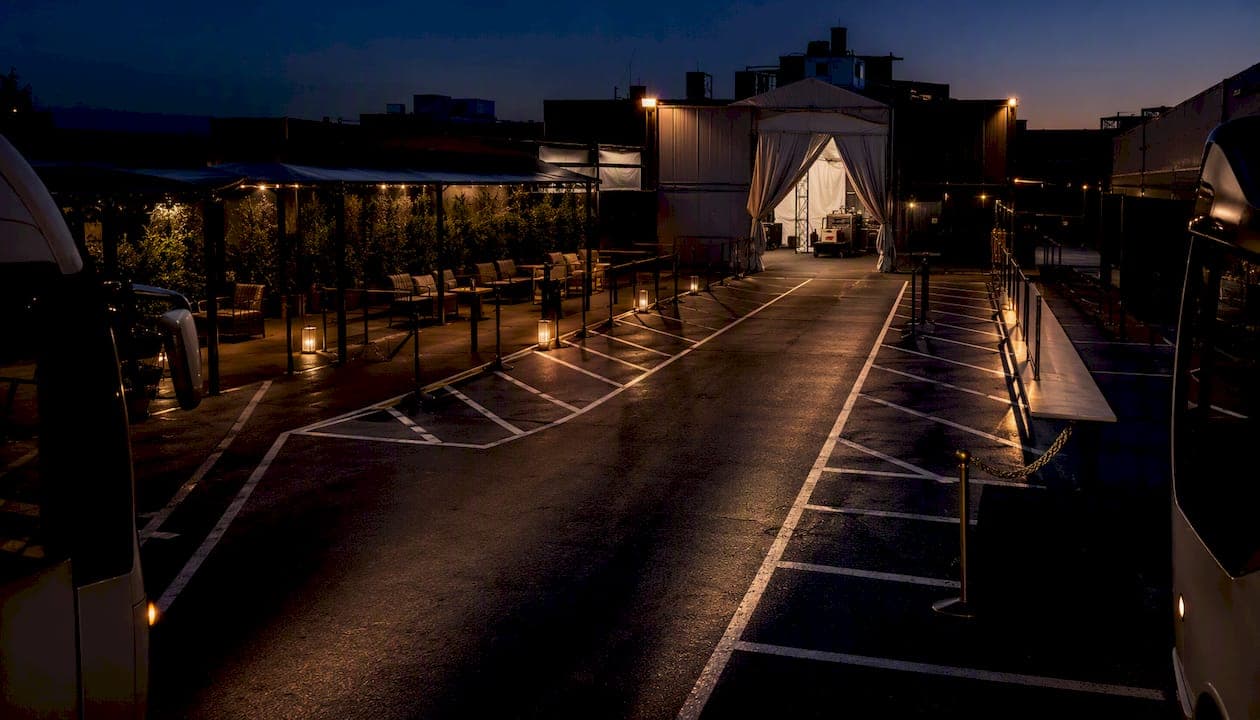
Basecamp shuttle logistics means one thing: every cast member, crew department, and piece of gear moves between basecamp, set, hotels, and airports exactly when the call sheet says it will. The production transport lead has watched enough wrap days slide sideways to know the formula. Get the movement matrix right, staff a named dispatch contact, and build in a 90-minute wrap buffer, and the rest of the shoot day takes care of itself. Skip any one of those, and congestion surcharges or a missed transfer will eat your contingency budget by lunch.
TL;DR:
- Most production schedules require a detailed movement matrix and a named dispatch contact to prevent delays and avoid congestion surcharges.
- Selecting vehicle classes should be based on seat capacity and cargo needs, not just crew size, with extra sedans for last-minute guest or executive needs.
- Shuttle frequency should match location distance and headcount, with main loops every 10 to 15 minutes and department-only loops every 5 to 8 minutes.
- A secure, adequately sized basecamp with proper staging, parking, and loading zones is critical to smooth shuttle operations and avoid bottlenecks.
- Accurate, timely tracking, a live manifest, and pre-negotiated flexible fare terms with vendors are essential to avoid surcharges and ensure safety.
Table of Contents
- What Goes Into a Basecamp Shuttle Logistics Checklist Before Day One?
- How Do You Size Your Fleet and Pick the Right Vehicle Class?
- How Often Should Shuttles Run During Call and Wrap?
- What Does a Basecamp Need to Support Shuttle Operations?
- How Do You Run Dispatch and Tracking On Shoot Day?
- What Do Basecamp Shuttle Rates and Quotes Actually Look Like?
- How Do You Avoid Surcharges and Compliance Headaches?
- How Does Shuttle Logistics Fit Into Broader Production Operations?
- What Health and Safety Rules Apply to Shuttle Operations?
- Does Basecamp Shuttle Logistics Have a Real Environmental Footprint?
- What Technology Do Productions Use to Coordinate Shuttles?
- What Training Do Shuttle Drivers and Crew Need?
- How Do You Manage the Passenger Experience and Collect Feedback?
- Why Sammy Thinks Most Productions Get Shuttle Planning Backward
- How to Request a Basecamp Shuttle Quote From Riga Global Travel
- Sources
- FAQ
What Goes Into a Basecamp Shuttle Logistics Checklist Before Day One?
Before the first shoot day, the production office needs a location map that flags congestion pricing zones, union jurisdiction lines, and any street where a teamster local controls dispatch. That map becomes the backbone of your movement matrix, the single document every driver, department head, and second AD checks each morning.
The matrix should list, for every scheduled movement:
- Vehicle class assigned (sedan, Sprinter, mini-coach)
- Pickup and drop-off points, mapped to street address, not just "basecamp"
- Call time and corresponding shuttle departure
- Passenger manifest with department and headcount
- Named contact for that leg, plus a backup number
Lock a named dispatch contact before you sign a vendor. That person owns the day-of matrix and fields every rebooking request. Build a 90-minute wrap buffer into every vehicle booking window, because call times slip and few things cost more than a driver clocked out when the last department finally wraps.
Vendors need lead time to price accurately. At minimum, give them:
- Total headcount by department
- Distances between basecamp, set, and any satellite locations
- Anticipated wrap time, including the buffer
- Any known congestion-zone or toll crossings
How Do You Size Your Fleet and Pick the Right Vehicle Class?
Vehicle selection is a math problem before it's a comfort problem. Production transport departments generally follow a role-based vehicle mapping: executive sedans for lead talent and directors, SUVs for department heads who need cargo room for monitors or personal gear, Sprinter vans for five to ten person crew runs, and mini-coaches once a single department run climbs past ten people.
Do the math per vehicle, not per person. A Sprinter rated for twelve passengers might realistically seat eight once you account for camera cases, wardrobe racks, and grip gear stacked in the aisle. Talent sedans need a second vehicle for security or personal assistants riding separately, both for privacy and to keep the manifest clean.
- Sedans: talent, executives, department heads needing privacy
- SUVs: leads with gear, small VIP groups of two to three
- Sprinter vans: five to ten crew, standard department runs
- Mini-coaches: ten to thirty person moves, background/extras call
Reach for 4x4 or armored vehicles only when the location genuinely demands it. Splitting a run into two smaller vehicles often beats a single oversized coach idling half-empty for a location with tight access.
Pro Tip: Book one more sedan than your talent count implies. A single extra car absorbs a last-minute guest star or an executive drop-in without reshuffling the entire manifest.
How Often Should Shuttles Run During Call and Wrap?
Crew shuttles running every 10 to 15 minutes during main call and wrap windows keep lines short without stacking idle vehicles at basecamp. Department-only loops, especially for hair, makeup, or background staging, often need a tighter 5 to 8 minute cadence since those crews move on their own micro-schedule.
Staggering arrivals by department, rather than dumping everyone at set at once, spreads the check-in load and prevents a bottleneck at the security tent. Run wrap in reverse call-time order: whoever arrived first leaves first, which keeps drivers from waiting on stragglers.
- Set shuttle frequency based on headcount and loop distance, not habit
- Assign one manifest owner, usually the transportation coordinator, who updates it live
- Log actual departure and arrival times against scheduled ones to support travel-time pay claims
- Build a two-line rebooking workflow: text the dispatch contact, confirm the swap, update the matrix
Manifest churn is normal, not a failure. Crew get held on set, flights shift, a scene runs long. What matters is whether one person owns the update or five people are texting five different drivers.
- Manifest owner logs every change with a timestamp
- Travel-time pay entries get flagged the moment a shuttle departs late
- Rebooking requests route through dispatch, never directly to individual drivers
What Does a Basecamp Need to Support Shuttle Operations?
A unit base that can't handle staging traffic will bottleneck your entire shuttle loop before the first sedan leaves the lot. Secure parking sized for your full fleet, plus room for gear trucks to load and unload without blocking shuttle lanes, is non-negotiable.
Many urban filming locations have no on-site parking at all, which is exactly why off-site basecamp staging with shuttle loops has become standard practice rather than a workaround. Distance between basecamp and set drives your entire scheduling math: a five-minute loop supports 10-minute shuttle frequency; a 25-minute loop demands either more vehicles or looser call windows.
- Confirm parking capacity in writing, not verbally, with the location owner
- Negotiate overnight staging if your shoot runs multiple consecutive days
- Secure power access for production trailers near the staging lot
- Verify loading zones are wide enough for gear trucks and shuttles to operate simultaneously
How Do You Run Dispatch and Tracking On Shoot Day?
Give your named dispatch contact the daily movement matrix before call time, not after the first shuttle leaves. That person should have live GPS visibility on every vehicle and a dedicated radio or chat channel separate from the general production feed, so a stuck van doesn't get buried in set chatter.
Require ETAs on every leg and log deviations the moment they happen. Live tracking paired with a single dispatch point is what actually prevents one late pickup from cascading into a blown call time three departments down the line.
- Confirm the dispatch contact has matrix access before crew call
- Require GPS pings or a check-in at every major waypoint
- Set a clear escalation path: driver to dispatch, dispatch to transportation coordinator, coordinator to UPM for overtime approval
- Pre-authorize who can approve driver overtime without a phone tree
Pro Tip: Give your dispatch contact authority to approve minor overtime on the spot, up to a set dollar cap. Waiting on a UPM signature for a 20-minute overage is how a $150 shuttle turns into a grievance.
What Do Basecamp Shuttle Rates and Quotes Actually Look Like?
Ballpark figures help you sanity-check a vendor quote before you sign it. Mini-bus shuttles typically run $300 to $500 per day including driver, single crew vehicles land around $80 to $150 per day, airport transfers price at roughly $60 to $120, and remote-access 4x4 or specialty vehicles climb to $120 to $200 per day given the added routing complexity.
Rate Snapshot: Mini-bus $300–$500/day · Single crew vehicle $80–$150/day · Airport transfer $60–$120 · Remote 4x4 $120–$200/day per Fixers' New York production transport guide.
Surcharges are where quotes diverge most. Congestion pricing, toll crossings, driver overtime, idle-hour billing, and union travel-time pay can each add a meaningful line item that a bare day rate never shows. A clean quote breaks out:
- Base vehicle and driver hours
- Mileage beyond a stated radius
- Staging or dead-time fees while vehicles wait on set
- Tolls and congestion-zone charges by name, not lumped into "fees"
- A named dispatch contact responsible for the account
Our own production shuttle cost guide breaks these line items down further if you're building a full season budget rather than a one-off day rate.
How Do You Avoid Surcharges and Compliance Headaches?
Map every congestion pricing zone and union jurisdiction boundary against your shooting schedule before you sign a single vendor contract, not after a surprise fee shows up on an invoice. This is the step most productions skip, and it's the one that causes both budget overruns and labor grievances.
Pre-negotiate flexible fare rules with your transport vendor so a scene running long doesn't trigger a full rebooking fee. Keep a rebooking float of 5 to 10 percent of your transport budget on hand, and confirm with your vendor which backup vehicles are on-call rather than assuming one will materialize at 6 p.m. on a Friday.
- Confirm permit coverage for staging lots and drop-off points before crew call
- Get insurance certificates from every vendor on file with the location owner
- Verify which union rules govern travel-time pay in your jurisdiction
- Hold at least one backup vehicle on standby for every ten vehicles booked
- Document flexible fare terms in the vendor contract, not a side email
Ground-transfer failures are rarely minor. A single missed pickup can idle an entire department and burn tens of thousands of dollars in standing crew time, which is exactly why the float and the backup vehicles matter more than they look like they should on a line-item budget.
How Does Shuttle Logistics Fit Into Broader Production Operations?
Shuttle logistics doesn't operate in a vacuum. It needs to sync with the production schedule maintained by the assistant director's department, the location agreements negotiated by the location manager, and the daily call sheet that everyone on set actually reads. When those systems don't talk to each other, shuttles run on yesterday's schedule while today's has already changed.
The fix is procedural, not technical. Whoever owns the movement matrix needs a direct feed from whoever issues the call sheet, ideally the same update, not a re-typed version an hour later. Location managers should flag basecamp and staging changes to the transportation coordinator the moment they're confirmed, since a relocated basecamp changes every mileage calculation in the matrix.
Treat the shuttle schedule as a subset of the production schedule, updated on the same cadence. If the AD department pushes call time by 30 minutes, the shuttle departure pushes with it automatically, not after someone remembers to call dispatch. Many productions assign this sync responsibility explicitly to one coordinator rather than leaving it to whoever notices first.
Site operations matter just as much. Security checkpoints, gear truck loading zones, and shuttle drop-off points all compete for the same limited real estate at a busy basecamp. Walk the site with security and the transportation coordinator together before day one, so shuttle lanes don't cross gear truck routes and drop-off points don't back up against a security checkpoint queue. A basecamp that looks fine on a location scout photo can bottleneck badly once thirty vehicles are moving through it at once.
What Health and Safety Rules Apply to Shuttle Operations?
Shuttle drivers and the vehicles they operate fall under standard commercial transport safety rules, plus whatever additional requirements the production's insurance carrier and the location's permit impose. That means valid commercial licensing for drivers operating vans or coaches, current vehicle inspection records, and insurance certificates that name the production as an additional insured party.
Fatigue is the safety risk productions underestimate most. Shuttle drivers working 14-hour days alongside the crew they're transporting face the same drowsy-driving risk as any other worker on a long call day. Build driver rest windows into the schedule the same way you build wrap buffers, and rotate drivers on multi-day, multi-location shoots rather than running the same person on back-to-back double shifts.
Loading and unloading zones need clear sightlines and designated waiting areas, especially at night exteriors where crew are moving between dark staging lots and lit set areas. A shuttle idling in a blind spot near a gear truck route is a hazard, not just an inconvenience.
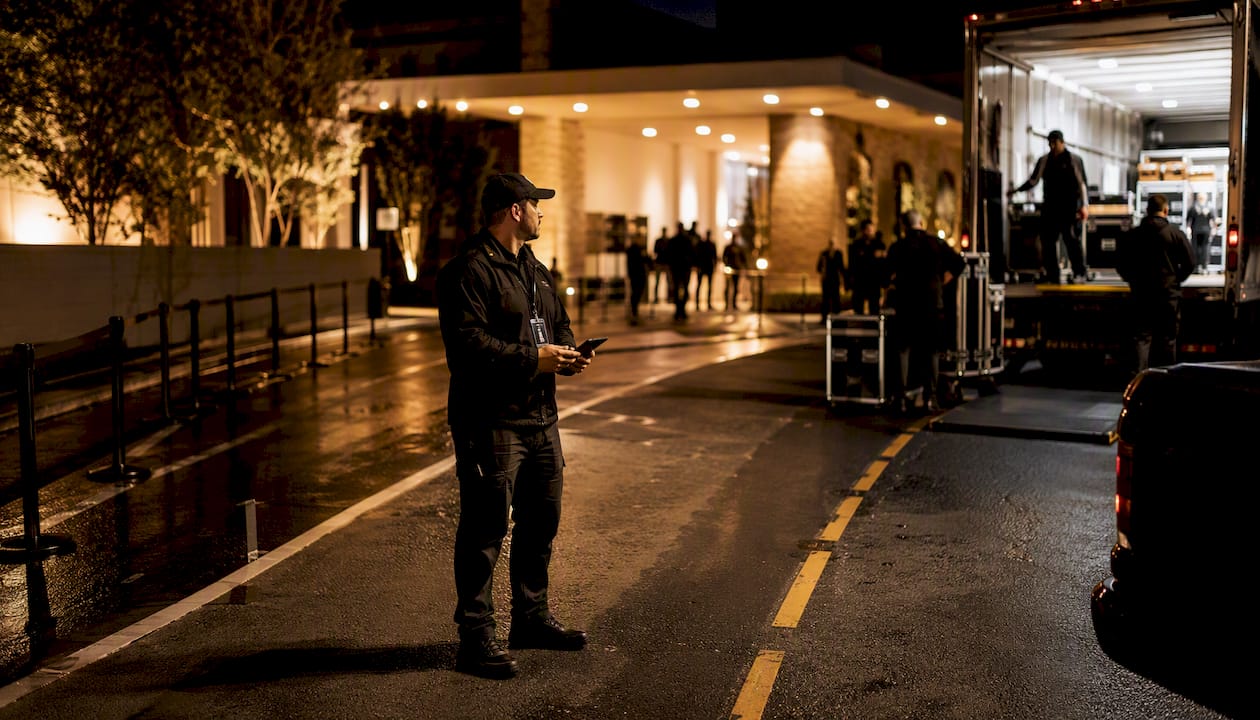
Weather and road conditions deserve a documented contingency, not an assumption someone will handle it. If a location sits on an unpaved access road or a route prone to flooding, confirm your vendor's vehicles and drivers are rated for those conditions before the shoot, not the morning a storm rolls in. Any specialty vehicle requirement, like 4x4 access for a remote location, carries its own safety checklist your transportation coordinator should confirm with the vendor in writing.
Does Basecamp Shuttle Logistics Have a Real Environmental Footprint?
A multi-week shoot with a fifteen-vehicle shuttle fleet running daily loops burns a genuine amount of fuel, and productions increasingly get asked to account for it as part of sustainability reporting requirements from studios and networks. The fix isn't dramatic. It's routing discipline.
Right-sizing vehicles matters more than any other single lever. A half-empty mini-coach running a loop that a single Sprinter could handle wastes fuel and adds unnecessary vehicles to an already congested basecamp. Reviewing your movement matrix specifically for consolidation opportunities, combining two department runs into one shared loop when call times align, cuts both cost and emissions in the same move.
Idle time adds up fast on a busy set. Vehicles sitting with engines running while crews finish a scene are a bigger contributor to fuel waste than the actual driving miles on most shoots. Setting a clear idle-shutdown policy with your vendor, and building it into the day rate discussion rather than treating it as a driver's personal call, closes that gap.
Some vendors now offer hybrid or electric options for sedan and SUV classes, which fits well for shorter basecamp-to-set loops where range isn't a concern. It's worth asking your vendor directly what's available rather than assuming a standard fleet is your only option, particularly for productions with formal sustainability commitments tied to studio or streamer contracts.
What Technology Do Productions Use to Coordinate Shuttles?
The core toolset for basecamp shuttle logistics has converged around three layers: a shared movement matrix (often a live spreadsheet or a production management platform), GPS-based vehicle tracking, and a dedicated communication channel separate from general crew chat.
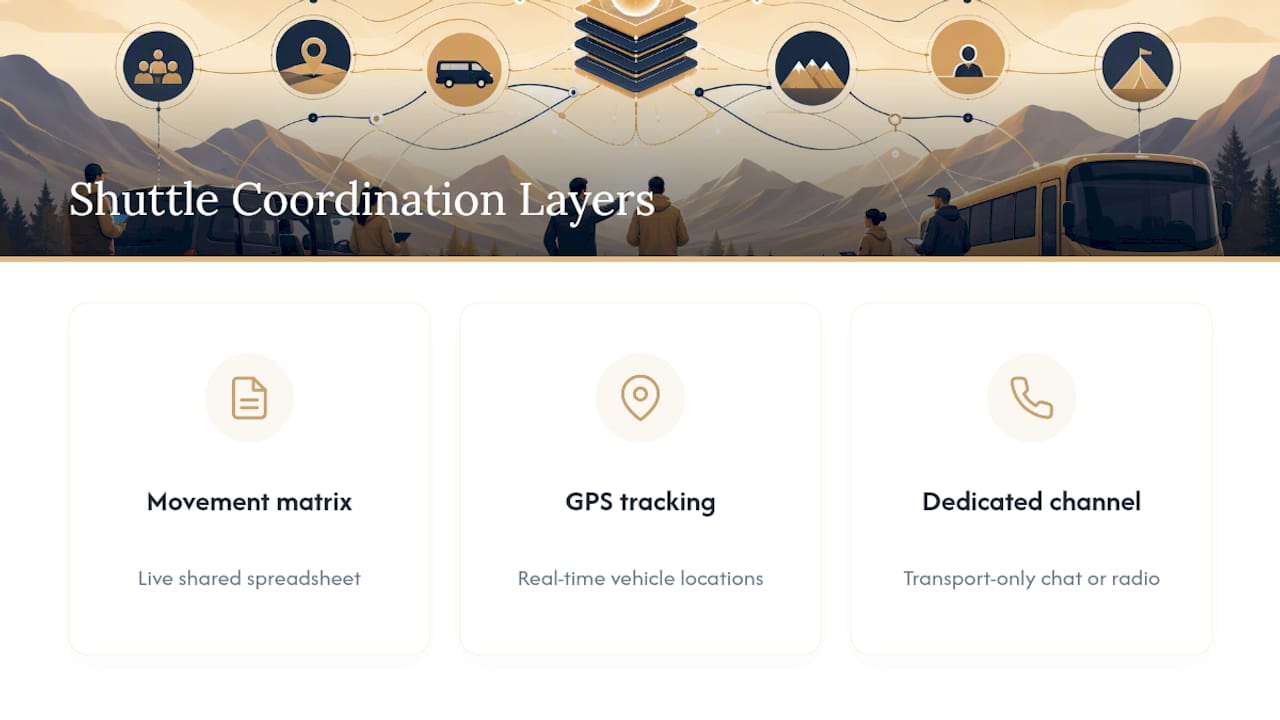
The movement matrix itself doesn't need to be complicated software. Many productions run it successfully in a shared spreadsheet that the transportation coordinator updates in real time, visible to dispatch and department heads alike. What matters is that it's the single source of truth, not a document that gets emailed once each morning and goes stale by lunch.
GPS tracking, whether through a vendor's own fleet system or a shared tracking app, gives dispatch visibility into where every vehicle actually is against where the matrix says it should be. That visibility is what turns a missed pickup from a 45-minute mystery into a 5-minute phone call.
Communication tools matter more than most productions plan for. A dedicated radio channel or a group chat app reserved strictly for transportation, separate from the general set walkie channel, keeps shuttle coordination from getting buried under unrelated set chatter. Whichever platform you choose, the requirement is the same: dispatch, drivers, and the transportation coordinator all need access to the same real-time information, and nobody outside that loop should be able to flood the channel with unrelated traffic.
What Training Do Shuttle Drivers and Crew Need?
Drivers moving cast, crew, and executives on a production need more than a clean license and a safe driving record, though both are baseline requirements. They need production-specific orientation: how call sheets work, what a wrap buffer means in practice, and how to handle a talent passenger who needs to stay off-camera during a transfer.
Confidentiality training matters more on entertainment productions than almost any other transport context. Drivers routinely overhear schedule details, casting news, or personal conversations from talent and executives, and a vendor with weak confidentiality protocols creates real risk for the production. Ask any vendor directly what their driver confidentiality policy looks like before signing.
Route familiarity training reduces wasted time more than any app can. A driver who's worked a specific basecamp-to-set route before knows which alley backs up at 6 a.m. and which gate security actually uses. Vendors who assign the same drivers to a production for its full run, rather than rotating in new faces daily, consistently run tighter loops.
Crew-facing training matters too, even though it's easy to overlook. Making sure every department head knows the manifest process, how to flag a schedule change to dispatch, and where the pickup points actually are prevents half the confusion that gets blamed on drivers but actually starts with crew not knowing the system.
How Do You Manage the Passenger Experience and Collect Feedback?
Cast, crew, and executives all experience the same shuttle system very differently, and treating every passenger group the same way is a common planning mistake. Talent needs privacy and predictability. Crew needs speed and clear communication. Executives visiting set for a day need a system that just works without them having to think about it.
A simple feedback loop catches problems before they become pattern. Asking department heads at wrap, even informally, whether their shuttle loop ran on time surfaces friction points faster than waiting for a formal complaint. Some productions build this into the daily wrap report the transportation coordinator already files.
Small touches matter disproportionately for talent and executive passengers. Confirming a driver knows a passenger's name, has water in the vehicle, and understands the drop-off location precisely (not just "the hotel" but which entrance) shapes how the entire production is perceived by people who often have no other direct interaction with the crew.
Consistency beats novelty here. A passenger who knows their shuttle runs at the same cadence every day, with the same driver whenever possible, trusts the system enough to stop worrying about it, which is exactly the outcome basecamp shuttle logistics should produce.
Why Sammy Thinks Most Productions Get Shuttle Planning Backward
Most transportation plans get built around vehicle counts first and movement patterns second. That's backward. Sammy's take, built from years watching production transport departments scramble on day three of a shoot, is that the matrix should exist before a single vehicle gets booked, not after.
The productions that avoid late-wrap chaos aren't the ones with the biggest fleets. They're the ones where a named dispatch contact had the full movement matrix 24 hours before call, and where a 90-minute wrap buffer was built into the contract instead of negotiated after the fact on a stressed-out phone call at 11 p.m. On a recent multi-location shoot, that exact buffer absorbed a two-hour schedule slip without triggering a single overtime dispute, precisely because the vendor contract already accounted for it.
Read our broadcast stadium shuttle planning guide and the production shuttle cost breakdown for the deeper mechanics behind these numbers.
— Sammy
How to Request a Basecamp Shuttle Quote From Riga Global Travel
Production ground transport vendors often operate with a named dispatch contact for every account, a multi-class fleet from executive sedans to mini-coaches, and 24/7 support for productions running unpredictable call sheets.

When you request a quote, provide the same data your movement matrix needs: total headcount by department, pickup and drop points, call and wrap times with your buffer built in, and any known congestion zones or specialty vehicle requirements. That lets a vendor return a precise proposal instead of a padded estimate. Productions running in Los Angeles or New York may benefit from providers with city-specific fleet and routing knowledge that generic quote requests miss entirely.
Start with our Los Angeles limousine service page or New York limousine service page if your shoot is based in either market, or reach out through our general contact page to start a quote for any other location.
Sources
- Production Transport & Logistics Guide New York | Fixers
- Film Production Crew Travel | Managing Large Teams
- Film Crew Shuttle Services in Los Angeles | Complete Production Guide
- Transportation Coordinator Checklist: 8 Essential Steps for 2026
FAQ
What Is a Movement Matrix in Production Transport?
It's the daily document listing every scheduled vehicle movement, including vehicle class, pickup and drop points, call times, and contacts, that dispatch uses to run shuttle operations without relying on memory or scattered texts.
How Much Does a Production Shuttle Cost Per Day?
Mini-bus shuttles typically run $300 to $500 per day, single crew vehicles cost $80 to $150 per day, airport transfers run $60 to $120, and remote 4x4 vehicles run $120 to $200 per day.
How Often Should Crew Shuttles Run During Call and Wrap?
Main crew shuttle loops generally run every 10 to 15 minutes during call and wrap, while department-only loops often need a tighter 5 to 8 minute cadence.
Why Does Basecamp Location Matter for Shuttle Scheduling?
Distance between basecamp and set drives your entire frequency and vehicle-count math, since a short loop supports tighter shuttle intervals while a long loop demands more vehicles or looser call windows.
Who Should I Contact for a Production Shuttle Quote?
Riga Global Travel handles production shuttle and ground transport quotes for shoots in Los Angeles, New York, and beyond, and returns the most accurate proposal when you provide headcount, pickup points, and call times up front through our quote request page.