
When a flight gets delayed or scrapped, the fastest fix is a pre-contracted retainer or block-booked fleet with a production-aware provider like Rigaglobaltravel, activated the moment a flight-tracking threshold is crossed. This is flight disruption contingency transport: the ground-side backup plan that keeps talent, crew, and executives moving when air travel doesn't cooperate.
Do these three things now, before the next irregular operation hits your call sheet:
- Set a flight-tracking delay threshold within a typical range that auto-notifies ground dispatch.
- Confirm a single point of contact between flight ops and your transport vendor before the trip, not during the crisis.
- Pre-stage vehicles near the airport rather than waiting for a confirmed cancellation.
A halftime show production once rerouted six crew vans mid-afternoon after a weather diversion pushed talent to a different airport entirely. The vehicles were already staged. Nobody missed call time.
Key Takeaways
A pre-contracted retainer with a production-aware ground transport provider, backed by written SLA terms and flight-tracking activation triggers, is the most reliable way to protect call sheets from flight disruptions.
| Point | Details |
|---|---|
| Activate on thresholds, not guesswork | Set a typical delay threshold that auto-notifies ground dispatch. |
| Choose retainers for high-risk windows | Standby retainers suit unpredictable wrap times better than on-demand booking. |
| Put billing terms in writing | Cap surge pricing, define overtime, and set cancellation windows before disruption hits. |
| Assign one point of contact | A single transport coordinator prevents dispatch confusion during activation. |
| Rigaglobaltravel fits production needs | Offers retainer accounts, dispatch, and airport transfer services built for entertainment clients |
Table of Contents
- What a Flight Disruption Contingency Transport Plan Must Achieve
- When Should You Activate the Contingency Transport Plan?
- Retainer, Block Booking, or On-Demand: Which Service Model Fits?
- Contract Clauses That Protect Your Production Budget
- The Runbook: What to Do in the First Three Hours
- Matching Vehicle Type to the Disruption Scenario
- Vetting a Provider: Questions That Separate Real Vendors From the Rest
- How Rigaglobaltravel Handles Flight Disruption Contingency Transport
- Frequently Asked Questions
- Sources
What a Flight Disruption Contingency Transport Plan Must Achieve
A contingency plan isn't a document, it's a set of promises your production can bank on. If it doesn't deliver these outcomes, it isn't working, no matter how polished the paperwork looks.
- Minimal downtime for talent and crew. Every hour lost to a stranded flight is an hour of overtime, a missed call time, or a blown shoot day.
- Predictable budgeting. You should know your worst-case ground transport cost before the disruption happens, not after the invoice arrives.
- Clear allocation of responsibility. Someone owns the decision to activate. Someone owns dispatch. Those can't be the same overworked coordinator juggling five other fires.
- Documented SLA and escalation. Response-time commitments in writing, with a named backup contact if the first one doesn't answer.
Driver hours-of-service limits, call-time sensitivity, and parking or staging restrictions at major airports all shape what's realistic. A plan that ignores FMCSA hours-of-service rules or assumes unlimited curbside staging will fail exactly when you need it most.
When Should You Activate the Contingency Transport Plan?
Disruption has moved from occasional nuisance to routine occurrence, and the vendors who handle it well combine flight-tracking software with a human dispatcher who actually interprets what the data means, according to Spinnaker's analysis of crew mobility disruption. Technology flags the problem; a person still has to decide what to do about it.
Common triggers worth building into your runbook:
- Flight delay exceeds a common delay threshold past scheduled arrival.
- Cancellation is announced, regardless of rebooking status.
- Diversion to an alternate airport.
- Missed connection with layover under 45 minutes.
- Crew or talent offload for mechanical or crew-rest reasons.
The response cascades differently depending on the timeline:
- First 30 minutes: monitor only, no vehicle movement yet.
- 1 to 3 hours: partial activation. Stage vehicles, hold drivers on standby, do not dispatch.
- Same-day cancellation: full activation. Dispatch confirmed, alternate routing plan triggered.
Partial activation should be authorized by the on-set transport coordinator. Full dispatch typically needs sign-off from production management, since it usually carries a cost commitment.
Retainer, Block Booking, or On-Demand: Which Service Model Fits?
Three procurement models cover almost every production scenario, and each trades cost against certainty differently.
- Standby retainer contracts guarantee vehicle and driver availability for a flat recurring fee, ideal when disruption risk is high and predictable, like award season or a tour with tight connections.
- Block-booked fleets reserve a set number of vehicles for a defined window, cheaper than a full retainer but less flexible if demand spikes beyond the block.
- Ad-hoc on-demand charters cost the most per use and carry the highest risk of unavailability during weather events or major disruptions, when everyone else is calling the same vendors.
For a six-week location shoot with unpredictable wrap times, a retainer beats on-demand booking almost every time. You're paying for certainty, not just vehicles.
Peak season changes the math. Award shows, playoff weekends, and film festivals strain every fleet in the market simultaneously. Many production travel managers combine a smaller retainer for guaranteed capacity with an on-demand overflow arrangement for surge days, a hybrid that keeps fixed costs down without leaving you exposed when demand spikes.
Contract Clauses That Protect Your Production Budget
Verbal understandings evaporate the moment a schedule shifts. Get these terms in writing before you need them, not while a vendor is quoting you emergency rates at 11 p.m.
Clauses to include, in plain language your legal team can refine:
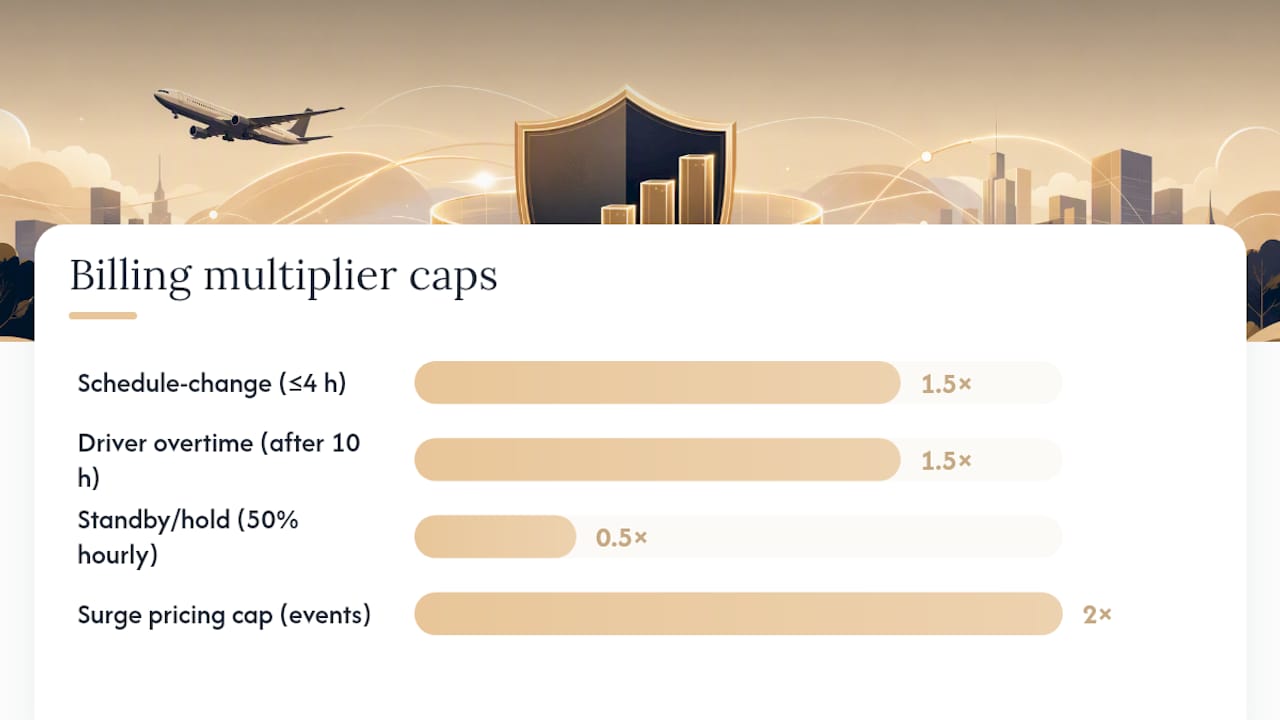
- Schedule-change billing: "Rate adjustments for schedule changes inside 4 hours of pickup are capped at 1.5x the standard hourly rate."
- Driver overtime: "Overtime billing applies after 10 consecutive hours and is calculated at the driver's standard hourly rate plus 50 percent."
- Cancellation windows: "Cancellations inside 2 hours incur a full hold fee; cancellations beyond 2 hours incur no charge."
- Standby/hold fees: "Vehicles placed on standby beyond the confirmed pickup window bill at 50 percent of the hourly rate."
- Surge pricing caps: "Surge pricing during declared weather or air traffic events shall not exceed 2x standard rates."
Standard shuttle agreements rarely include this kind of flexibility. Production-oriented charter suppliers build it in from the start, because they know schedules move.
Minimum SLA terms worth requiring: a 15-minute response commitment for activation calls, a named escalation contact if the primary dispatcher doesn't respond within that window, and written confirmation within 30 minutes of any dispatch request. Ask for proof of commercial auto insurance and, for larger fleets, umbrella coverage, along with driver licensing documentation on file.
Pro Tip: Require same-day electronic invoicing for schedule-change adjustments. Waiting until month-end reconciliation to dispute a surge charge means you've already lost the leverage to negotiate it down.
Airline disruptions create sudden spikes in ground-transport demand, and vendors using technology-driven dispatch can process rebooking requests dramatically faster than manual coordination, according to a corporate travel report on airline disruption and ground demand. That speed advantage only shows up if your contract already has the billing terms worked out. Negotiating rates during the disruption itself is how productions get overcharged.
The Runbook: What to Do in the First Three Hours
Ground transfers cause more lost shoot days than any other travel failure, largely because they get treated as an afterthought instead of being coordinated directly with air bookings, according to guidance on managing large production travel teams. A runbook closes that gap by making the sequence automatic instead of improvised.
First 0 to 3 hours:
- Flight-tracking alert triggers threshold notification to the transport coordinator.
- Coordinator confirms disruption status directly with the airline or gate agent.
- Coordinator notifies ground dispatch and shares updated passenger manifest.
- Dispatch confirms vehicle staging location and estimated arrival window.
- Coordinator sends confirmation to talent or crew liaison with new pickup details.
Next 24 hours:
- Reconcile driver hours against production wrap times to avoid overtime surprises.
- Document the disruption timeline for accounts payable and any insurance claims.
- Debrief with the vendor on what worked and what needs adjustment.
Every contact card should capture flight number, PNR, direct contact phone numbers, and a clear talent-versus-crew designation, since talent moves often require different vehicle types and privacy protocols than crew shuttles.
Pro Tip: Build overtime authorization into the runbook itself, not as a separate approval step. If a driver is approaching an hours-of-service limit and the production needs another two hours, someone needs pre-authorized signing power to approve it on the spot, not a phone tree that delays the decision by twenty minutes.
Matching Vehicle Type to the Disruption Scenario
Capacity planning fails most often when someone assumes one vehicle type covers every scenario. It doesn't.
- Chauffeured sedan or limo: single executive or talent member, privacy a priority.
- SUV: talent plus one or two support staff, or gear that won't fit in a sedan trunk.
- 12 to 15 passenger van: small crew moves, camera department, tight-turnaround airport runs.
- 24 to 30 passenger shuttle: full crew shuttle for mid-size productions.
- 50-plus motorcoach: large cast and crew moves, festival logistics, multi-day tours.
Charter buses and vans are a standard fixture in film production precisely because they consolidate movement and hold up under schedule volatility, according to planning guidance on charter buses for film crews. Mixed manifests, talent, camera crew, and equipment together, need advance staging so gear doesn't compete with passengers for cargo space. Secure storage, onboard power, and tinted privacy glass are the features production clients ask for most often, especially for talent moves that need to stay off social media.
Vetting a Provider: Questions That Separate Real Vendors From the Rest
Ask these questions before you sign, not after a disruption exposes the gaps.
- Do you have documented experience with productions, tours, or live events, not just corporate accounts?
- What's your driver vetting process, and can you show background-check documentation?
- What are your published insurance limits for commercial auto and event work?
- What's your surge capacity during a regional weather event or major air traffic disruption?
- What's your actual SLA response time, backed by a specific example?
Red flags that should end the conversation fast: no written overtime policy, no proof of insurance specific to event or production work, or an inability to name a local staging location near the airport you're using. A vendor that can't produce a sample driver run sheet on request probably doesn't have one. Production teams that plan backup vehicles and designate one single point of contact for transport issues consistently handle disruptions better, according to best practices for coordinating on-set transportation, and that single point of contact is also your fastest way to validate a vendor's claims during actual procurement calls.
Lessons From Entertainment and Sports Transport
Reliability in this business comes down to accountability, not just fleet size. The productions that never lose a shoot day to a canceled flight are the ones whose transport vendor treats a 2 a.m. diversion call the same way they'd treat a scheduled airport run. Tight call sheets and unpredictable wrap times punish improvisation. A vendor who already knows your manifest, your talent's preferences, and your usual staging spot removes half the risk before the disruption even happens.

How Rigaglobaltravel Handles Flight Disruption Contingency Transport
Rigaglobaltravel runs retainer accounts and on-call chauffeured fleets built specifically for entertainment and corporate clients who can't afford a missed pickup. Dispatch operates around the clock, and the team has handled enough tour reroutes and broadcast production moves to know what a 2 a.m. diversion call actually requires.

Setting up an account is straightforward: a corporate retainer or block-booking arrangement gets configured against your production calendar, with direct billing so accounts payable isn't chasing receipts mid-shoot. Rigaglobaltravel can also share sample contract clause language and runbook templates for productions building their own internal contingency plan from scratch. If you're coordinating airport moves in a high-traffic market, the JFK, LGA, EWR, and HPN airport transfer service covers the exact scenario this article walks through, staged vehicles, confirmed dispatch, and a dedicated contact who answers the phone when a flight gets diverted. Reach out to set up a retainer account before your next production calendar locks in.
Frequently Asked Questions
What counts as a flight disruption contingency transport trigger? Most production teams activate at a 60 to 90 minute delay, any cancellation, a diversion, or a missed connection with under 45 minutes to spare.
Should we choose a retainer or block booking for occasional productions? Block booking usually fits shorter, defined shoots better. Retainers make more sense for ongoing tours or productions with recurring disruption risk.
How fast should a ground transport vendor respond during a disruption? Fifteen minutes for initial response is a reasonable SLA standard, with written dispatch confirmation following within 30 minutes.
What vehicle type works best for a mixed talent and crew move? It depends on the manifest. Talent typically rides separately in a sedan or SUV, while crew and gear move in vans or shuttles staged for the same pickup window.
Does Rigaglobaltravel provide contract templates for productions building their own contingency plan? Yes. Rigaglobaltravel can share sample contract clauses and runbook templates on request for productions setting up an account.
Sources
- Digital Travel, Human Expertise: Navigating Crew Mobility in an Era of Global Disruption | Spinnaker
- Charter Bus for Film Production Crews: Planning Guide
- Film Production Crew Travel | Managing Large Teams
- Corporate Travel Report: Airline Disruption and Ground Demand Spikes
- Best Practices for Coordinating On Set Transportation