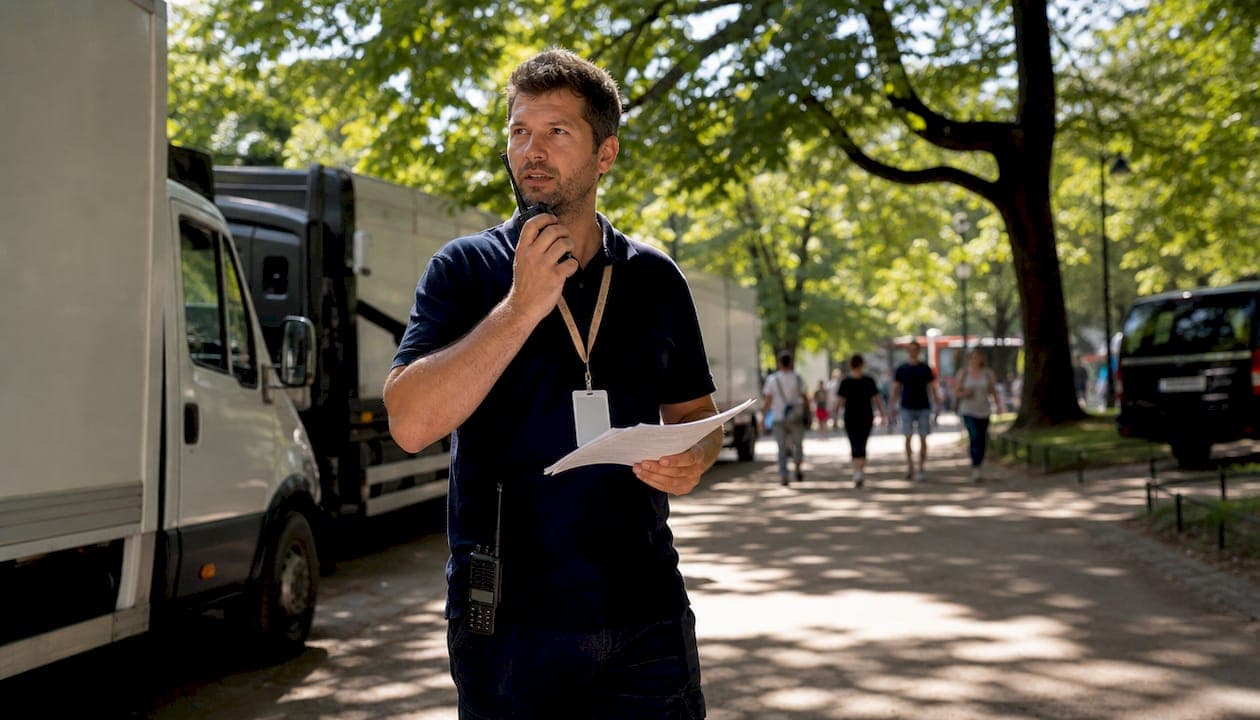
Production set transportation is the specialized logistics network responsible for moving all cast, crew, equipment, sets, and props securely and on time to their required filming locations. Known in the industry as the transportation department, this function covers everything from daily crew shuttles to multi-truck equipment convoys. It is the operational backbone of film and television production, and when it fails, entire shooting days are lost. Understanding what is production set transportation means understanding how modern productions stay on schedule and within budget.
What does production set transportation involve operationally?
Production set transportation functions as a specialized logistical network ensuring secure, on-time movement of cast, crew, equipment, sets, and props. The department operates across every phase of a shoot, from pre-production scouting runs to final wrap-day equipment returns.
The transportation department is led by a transportation coordinator, who plans routes, manages vehicle fleets, and communicates directly with the production office. Below the coordinator, transportation captains supervise specific vehicle groups or zones. Drivers operate everything from passenger vans and shuttle buses to flatbed trucks and specialized equipment trailers.
The core vehicle types used in transportation for film sets include:
- Passenger vans and SUVs for small crew groups and department heads
- Shuttle buses for large crew movements between base camp and set
- Stake-bed trucks and flatbeds for camera, lighting, and grip equipment
- Tractor-trailers for large set pieces, wardrobe, and production design materials
- Honey wagons and star trailers for talent and hair, makeup, and wardrobe departments
- Camera cars and process trailers for specialty shooting requirements
Daily scheduling is built around call sheets. Drivers receive pickup times, passenger manifests, and location coordinates the night before. The coordinator cross-references these against the shooting schedule to prevent overlap or gaps.
Pro Tip: Build a 20-minute buffer into every first-unit pickup. Traffic, parking restrictions, and last-minute script changes all compress real-world timelines faster than any call sheet predicts.
Technology plays a growing role in production set logistics. Coordinators use scheduling software, GPS fleet tracking, and group messaging platforms to keep drivers, production assistants, and department heads aligned in real time.

How does legal and safety compliance shape production transportation?
Legal compliance is not optional in production transportation. It is a hard operational requirement that carries real financial and legal consequences when ignored.
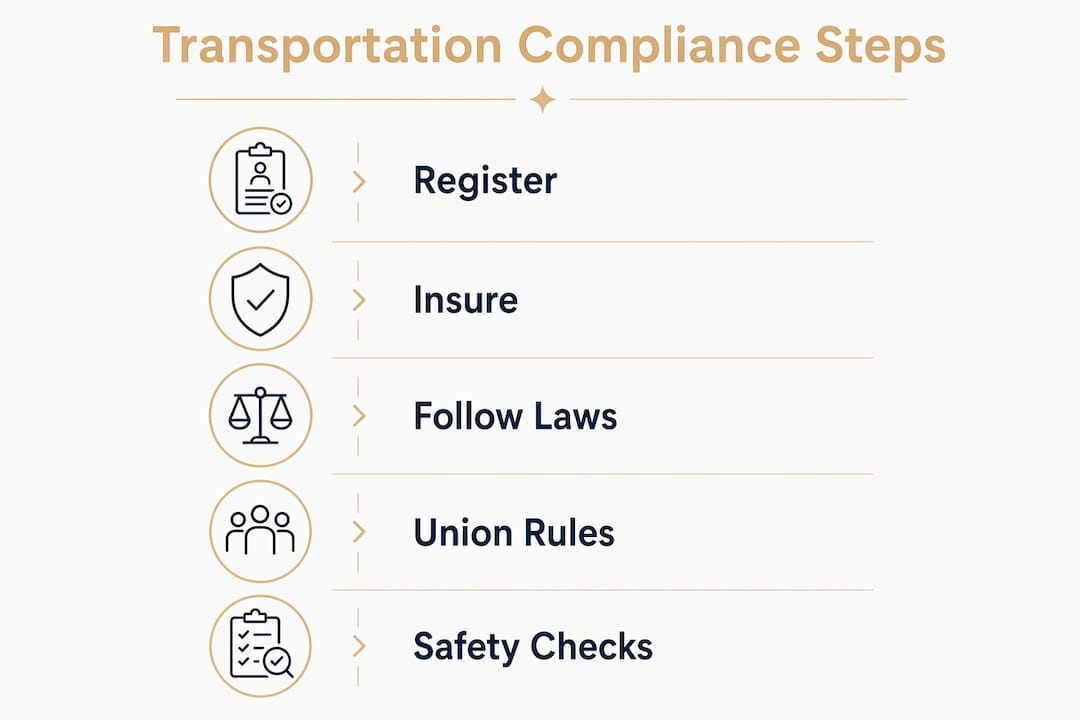
The U.S. Department of Transportation (DOT) requires that any production paying drivers to operate commercial vehicles over 10,001 pounds Gross Vehicle Weight Rating (GVWR) must register as a Motor Carrier and obtain a DOT number. This applies to rented commercial vehicles used for 30 or more consecutive days during interstate operations. Smaller productions often fail to recognize they become legal Motor Carriers under these conditions, which creates costly compliance violations.
The key compliance requirements productions must address include:
- DOT Motor Carrier registration for any commercial vehicle over 10,001 pounds GVWR
- Drivers Qualification Files (DQFs) maintained for every commercial vehicle driver
- Medical examiner certificates confirming driver fitness for commercial operation
- Hours of service logs tracking driving time to prevent fatigue-related incidents
- Vehicle inspection records maintained per Federal Motor Carrier Safety Administration (FMCSA) standards
Union labor rules add another layer of complexity. Local 399 labor agreements, which cover Teamsters in the entertainment industry, define when specialized transportation labor is required. The threshold is typically triggered when a production uses four or more vehicles. Once that threshold is crossed, union labor rates, overtime rules, and specific job classifications apply. Budget teams that overlook this trigger face significant cost overruns mid-production.
Failure to comply with DOT registration requirements incurs legal and financial penalties that can halt production entirely. Compliance planning belongs in pre-production, not as a reaction to a DOT audit on location.
What are best practices for efficient and reliable set transportation?
Efficient production logistics depend on preparation, communication, and built-in flexibility. The best transportation coordinators treat every shooting day as a contingency exercise, not a fixed plan.
The most effective practices for managing transportation in production sets are:
- Pre-plan basecamp layout diagrams before arriving at any new location, accounting for truck access, turning radii, and proximity to set
- Bundle vehicle loads by department to reduce the number of trips and minimize fuel costs
- Maintain pre-packed gear cases for camera, sound, and electrical so trucks can be loaded in under 30 minutes
- Reserve at least one backup vehicle per major vehicle category in case of mechanical failure
- Coordinate directly with location scouts to identify parking restrictions, weight limits, and access road conditions before the first truck rolls
Communication between production, transport, and set design departments is the most critical factor in preventing schedule disruptions. A transport coordinator who learns about a location change 48 hours in advance can reroute an entire convoy. One who learns about it at 6:00 AM on shoot day cannot.
Contingency planning separates good transportation departments from great ones. Experienced transportation teams maintain multiple contingency plans, bundle shipments, and reserve backup transport to handle mobile productions efficiently. That planning directly minimizes delays and protects the shooting schedule.
Pro Tip: Create a shared digital document that lists every vendor, vehicle, and driver contact for the production. Update it daily. When something breaks at 4:00 AM, no one has time to search email chains for a phone number.
Flexible scheduling is equally important when productions move between locations with different access conditions. Rural locations, urban street permits, and studio lot regulations each require a different logistical approach. A coordinator who adapts quickly keeps the production moving.
How does production set transportation add strategic value?
Transportation is not a support function. It is a production asset that directly affects budget performance and schedule adherence.
Transport acts as a critical link in the supply chain, preventing bottlenecks and reducing on-site storage needs through timely deliveries. Productions that synchronize transport with shooting schedules operate on just-in-time principles. Equipment arrives when it is needed, not days early, which eliminates the need for costly on-location storage.
The table below shows how transportation decisions affect key production outcomes:
| Transportation decision | Production impact |
|---|---|
| Synchronized delivery scheduling | Reduces on-site storage costs and clutter |
| Pre-planned basecamp layout | Speeds up crew access and reduces setup time |
| Backup vehicle availability | Prevents single-point failures from halting production |
| Early DOT compliance planning | Avoids legal penalties and unplanned production stops |
| Union threshold awareness | Controls labor costs before they exceed budget |
Delays in transport can risk losing entire shooting days. A lost shooting day on a mid-budget production can cost tens of thousands of dollars in crew wages, location fees, and equipment rentals. The importance of production transport is measured directly in dollars and schedule days.
Transportation also supports high-precision shooting requirements. When a director needs a camera car, a process trailer, or a specialty vehicle on set at a specific time, the transportation department delivers it. That precision is not incidental. It is what keeps the creative process running.
What does a well-managed film basecamp look like?
A film basecamp is, in practical terms, a town on wheels. The transportation department designs and manages its layout with the same care a city planner applies to a neighborhood grid.
Transportation coordinators act as architects of basecamp, balancing spatial needs with logistical requirements and talent privacy. A well-organized basecamp includes clearly defined zones:
- Talent Row for star trailers, positioned for privacy and quick access to set
- Hair, makeup, and wardrobe (HMW) area clustered near Talent Row for efficient prep time
- Production Row for the production office trailer, AD department, and accounting
- Catering and craft services positioned for crew access without blocking vehicle flow
- Crew parking separated from working vehicle lanes to prevent congestion
Pre-planned layout diagrams ensure smooth vehicle and crew access without interfering with filming operations. The transportation coordinator shares these diagrams with the location manager, production designer, and first assistant director before any trucks arrive on site.
The interaction between the transportation department and the location team is constant. Location managers identify access points, weight restrictions, and utility hookup positions. Transportation coordinators translate those constraints into a functional basecamp that serves the entire crew. When that collaboration works well, the production barely notices the logistics. When it breaks down, everyone feels it.
Key Takeaways
Production set transportation is the coordinated system that moves cast, crew, equipment, and materials on time, and its legal compliance, basecamp management, and contingency planning directly determine whether a production stays on schedule and within budget.
| Point | Details |
|---|---|
| Core function | Transportation moves all cast, crew, equipment, and props securely to filming locations. |
| Legal compliance | Productions using commercial vehicles over 10,001 lbs GVWR must register as DOT Motor Carriers. |
| Union thresholds | Local 399 labor rules apply once four or more production vehicles are in use. |
| Basecamp management | Pre-planned layout diagrams protect crew access and prevent filming interference. |
| Strategic value | Synchronized transport reduces storage costs and prevents costly lost shooting days. |
Why transportation is the most underestimated department on any set
I have watched productions spend weeks refining their shooting schedule and then treat transportation as an afterthought. That is the single most expensive mistake a production can make.
The transportation department does not just move vehicles. It manages the physical infrastructure of the entire production. Every trailer, truck, and shuttle represents a decision that affects how fast the crew can work, how comfortable the talent feels, and whether the day wraps on time. When the basecamp layout is wrong, the ripple effects hit every department simultaneously.
What I find most underappreciated is the compliance burden. Productions that hire drivers for commercial vehicles without registering as Motor Carriers are not just cutting corners. They are creating liability that can shut down a production mid-shoot. The DOT does not care about your shooting schedule. The FMCSA does not care about your budget. Getting compliant in pre-production costs far less than getting caught on location.
The best transportation coordinators I have seen work like air traffic controllers. They track every vehicle, every driver, and every delivery window simultaneously. They know the backup plan before the primary plan fails. That level of preparation is what separates a smooth production from a chaotic one. If you are building a production team, invest in your transportation coordinator the same way you invest in your department heads. The return is measurable in shooting days saved.
— Sammy
How Rigaglobaltravel supports film and television productions
Film and television productions need transportation partners who understand the pace, precision, and compliance demands of the industry.

Rigaglobaltravel provides professional chauffeured services and a premium vehicle fleet built for the entertainment industry. From talent transportation in New York to luxury production transport in Los Angeles, Rigaglobaltravel serves productions that require reliable, discreet, and fully compliant ground transportation. The team understands union requirements, talent contract standards, and the time-sensitive nature of production schedules. Productions that need a dependable transportation partner for cast, crew, or executive movement can contact Rigaglobaltravel directly to discuss their specific logistics requirements.
FAQ
What is production set transportation?
Production set transportation is the coordinated logistics system that moves cast, crew, equipment, sets, and props to and from filming locations on schedule. It covers everything from daily crew shuttles to large equipment convoys and basecamp management.
When does a production become a DOT Motor Carrier?
A production becomes a legal Motor Carrier when it pays drivers to operate commercial vehicles over 10,001 pounds GVWR, or rents such vehicles for 30 or more consecutive days during interstate operations. Registration for a DOT number is mandatory in these cases.
What triggers Local 399 union labor rules on a production?
Local 399 labor agreements typically apply once a production uses four or more vehicles. At that threshold, union labor rates, overtime classifications, and specific job titles govern the transportation department.
How does basecamp layout affect production efficiency?
A well-planned basecamp layout reduces crew transit time, protects talent privacy, and keeps vehicle lanes clear for working trucks. Transportation coordinators use pre-drawn diagrams to position every trailer and vehicle before the first shooting day.
Why does transportation coordination prevent lost shooting days?
Delays in moving equipment, crew, or talent to set can cause productions to miss their shooting window entirely. Experienced transportation coordinators use contingency plans, backup vehicles, and real-time communication to keep every department on schedule.