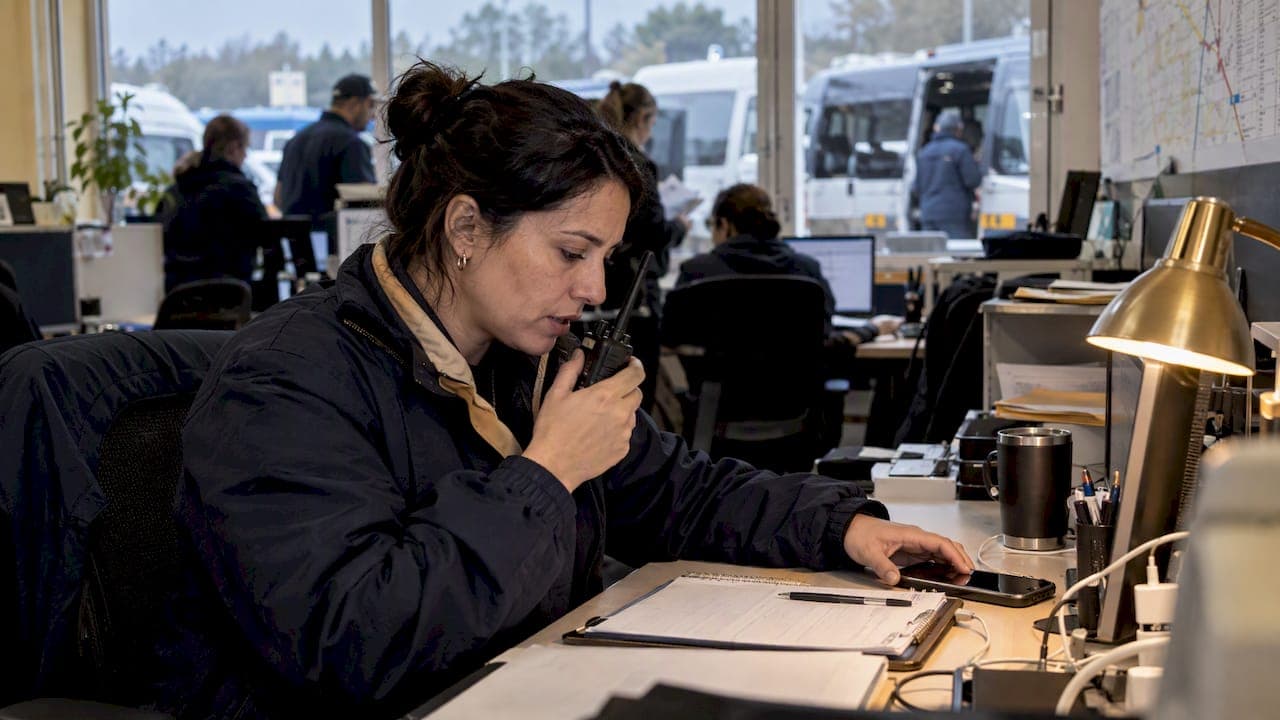
A transportation command center is the single hub that schedules, dispatches, and tracks every vehicle moving talent, crew, and equipment on a production or event. Its job is simple to state and hard to execute: get every pickup there on time, document every movement, and keep people safe. Done right, it runs on a master manifest, clear driver communications, and procedures that nod to SAG-AFTRA safety guidance and Teamsters Local #399 contract rules.
TL;DR:
- A transportation command center requires a dedicated dispatch station, a master manifest, and clear zones to prevent bottlenecks during operations.
- Key staff roles include a Transportation Manager with final authority, supported by dispatchers, manifest clerks, driver liaisons, and safety coordinators, especially in larger productions.
- Consistent pickup protocols involve timestamped confirmations and early flagging of special needs to reduce scheduling conflicts and ensure union compliance.
- Essential technology includes GPS trackers, shared read-only manifests, and secure messaging, with offline kits like printed manifests and spare radios for network failures.
- A simple, templated shift checklist and predefined contingency plans help maintain efficiency during unpredictable delays, weather shifts, or vehicle breakdowns.
Table of Contents
- Core components and layout of the command center
- Staffing, roles, and shift handoffs
- Pickup protocols, VIP handling, and union compliance
- Technology and data behind the command center
- Offline and contingency planning for when things fail
- Day-of operations checklist for the command center
- What production teams get wrong about command centers
- How RIGA Global Travel supports your transportation operations
- Sources
- FAQ
Core components and layout of the command center
A functioning command center needs defined zones, whether it lives in a trailer, a production office, or a folder of shared documents. Each zone has one job, and mixing them creates bottlenecks.
- Dispatch station: the single person or desk that assigns vehicles and resolves pickup conflicts in real time.
- Manifest desk: maintains the master list of talent, crew, call times, and pickup locations, updated from one source only.
- Driver staging area: a holding point where vehicles wait for assignment, separate from active loading zones.
- Vehicle sanitation point: where cars are checked and cleaned between runs, especially for talent vehicles.
- Medical liaison contact: a direct line to the Health Safety Supervisor for checkpoint coordination, as outlined in SAG-AFTRA's production safety guidance.
The master manifest should separate talent pickup windows from crew call times, since talent moves often carry tighter privacy and timing requirements. Communications flow one way into the dispatch desk and one way out to drivers, so nobody is chasing three versions of the same schedule. Build in a checkpoint for union coordination too: a spot on the daily rundown where transportation confirms call notifications and zone assignments against the Teamsters Local #399 agreement. Production teams researching staging logistics in more depth can review production parking and staging guidance for base camp and studio-area layouts.
Staffing, roles, and shift handoffs
Five roles cover most productions, though small shoots often combine two or three into one person.
- Transportation Manager: owns the schedule, approves manifest changes, and has final authority to pause transport for safety.
- Dispatcher: assigns vehicles to runs and tracks real-time status against the manifest.
- Manifest Clerk: enters and verifies pickup data, call sheet changes, and location updates.
- Driver Liaison: relays instructions to drivers and handles on-the-ground questions.
- Safety Liaison: coordinates with the Health Safety Supervisor on medical checkpoints and sanitation.
Only the Transportation Manager or a named deputy should be able to change the manifest once it is live, which prevents conflicting versions from circulating. Shift changes need a short checklist: outgoing staff hand over open issues, pending pickups, and any incident notes before leaving. A small production might run with two people covering all five roles; a large multi-location shoot often needs six to eight staff across dispatch, manifest, and liaison duties.
Pro Tip: Write the handoff checklist on one page and tape it to the dispatch desk. Nobody reads a five-page SOP at 5 a.m.

Pickup protocols, VIP handling, and union compliance
Every pickup should follow the same sequence regardless of who is riding: confirm the booking, timestamp the driver's arrival, confirm the passenger is aboard, and log departure. That timestamped confirmation habit is one of the practices that reduces missed pickups and scheduling disputes, according to best practices for coordinating on-set transportation.
- Confirm pickup location and ETA with the driver 30 minutes before call time, not after.
- For talent, route sanitation and privacy screening through the Safety Liaison before the vehicle is cleared.
- Hand off medical checkpoint status to the driver liaison discretely, never over an open channel.
- Flag special-needs transport requests early so the right vehicle, not just any available car, is assigned.
- Check mileage, overtime, and zone definitions against your local Teamsters Local #399 agreement before finalizing driver schedules.
Vehicle-mounted camera work and free driving sequences carry their own safety meeting requirements, typically led by the 1st AD, and should never be folded into standard pickup logistics. For deeper manifest-first procedures around talent privacy, see the talent transportation protocol guide.
Technology and data behind the command center
The right tool stack for a command center is boring on purpose: a GPS/ETA tracker, a dispatch board, a shared manifest, a secure messaging channel, and a vehicle assignment dashboard. That is the full list.
- GPS/ETA tracking keeps dispatch aware of real delays instead of guesses.
- A single shared manifest, read-only for drivers, prevents accidental overwrites.
- Secure messaging channels keep talent location data away from general crew chat.
- A vehicle assignment dashboard shows which cars are staged, loaded, or in transit at a glance.
Keep the manifest as the one source of truth and give drivers view-only access with timestamped confirmation buttons rather than edit rights. At remote or low-connectivity locations, a spreadsheet paired with SMS often outperforms a complex platform that drops connection. Capturing ETA variance and vehicle utilization data over a shoot also feeds better staffing decisions on the next production, a point echoed in guidance on data-driven shuttle coordination.
Pro Tip: If your location has one bar of signal, plan around SMS and radio, not an app that needs a live connection to load the manifest.
Offline and contingency planning for when things fail
Cellular networks fail at remote locations, vehicles break down, and weather shifts a call time with no warning. An offline kit at every command post and in every vehicle keeps operations running regardless.
- Printed master manifest, updated and reprinted at each shift change.
- Spare radios and a paper contact list for drivers, liaisons, and the Health Safety Supervisor.
- Pre-planned secondary meeting points for every major pickup location.
- A standby vehicle and driver ready to reassign within minutes, not after a call.
Weather delays and medical events route through the Safety Liaison and the production's Health Safety Supervisor, matching the checkpoint coordination described in SAG-AFTRA's safety guidelines. Every incident, however small, gets logged with time, location, and resolution, and reviewed briefly at the next shift change so the same gap does not repeat.
Day-of operations checklist for the command center
A short, repeatable checklist keeps the command center predictable even when the day is not.
- Pre-start: inspect vehicles, confirm drivers and call times, verify permits, and stock sanitation supplies.
- During the day: update the manifest as changes come in, monitor ETAs against call sheet times, and run radio checks each hour.
- Base-camp handoffs: confirm which liaison is covering each zone before shift overlap begins.
- Closeout: fuel and clean vehicles, log any incidents from the day, and pre-book tomorrow's first pickups before anyone leaves.
What production teams get wrong about command centers
The most common failure is vague pickup windows: "around 6 a.m." instead of a timestamped 5:55 a.m. confirmation. The second is betting everything on cellular connectivity, which collapses the moment a location has weak signal. The third is a sloppy shift handoff where the outgoing dispatcher just says "it's all good" and walks off.
The fix is almost always templated: a standard manifest format, a one-line driver pre-brief script, and a simple rule for when to call a standby car instead of waiting. Adapt a template rather than building one from scratch, and check RIGA Global Travel's internal guides for working examples.
— Sammy
How RIGA Global Travel supports your transportation operations
Running a command center from scratch takes staff, tools, and a few hard-won lessons. RIGA Global Travel has spent more than 40 years handling ground transportation for major production companies and studios, which means the manifest discipline and driver screening are already built in, not improvised on day one.
Chauffeured vehicles, shuttle coordination, airport transfers, and on-site dispatch support are available with rapid response, and production teams can reach ownership and management directly rather than an app. For productions weighing whether to run their own command center or hand off the vehicle side, start at RIGA Global Travel or review the celebrity transportation page for talent-specific privacy protocols.
Sources
Review SAG-AFTRA's production safety guidelines and the Teamsters Local #399 agreement for full contract and safety language, plus RIGA's production transportation planning guide.
- Production Safety Guidelines (SAG-AFTRA)
- Agreement of August 1, 2018 Between Producer and Studio Transportation Drivers, Local #399
- Best practices for coordinating on-set transportation
- Efficient shuttle services for film productions
FAQ
What is a transportation command center on a production?
It is the dispatch and coordination hub that manages vehicle assignments, driver communications, and the master manifest for talent, crew, and equipment moves. It exists to keep pickups on time and documented, with escalation paths for safety issues.
Who should run the transportation command center?
A named Transportation Manager should hold final authority, supported by a dispatcher, manifest clerk, driver liaison, and safety liaison on larger shoots. Smaller productions often combine these roles into one or two people without losing the core structure.
How do union rules affect command center setup?
Studio transportation agreements like the Teamsters Local #399 contract cover call notification windows, daily rundowns, zone definitions, and mileage or overtime rules. Build these checkpoints directly into your dispatch schedule rather than treating them as a separate compliance step.
What should go in an offline contingency kit?
A printed master manifest, spare radios, a paper contact list, and pre-planned secondary meeting points cover most network or vehicle failures. Keep one kit in the command post and one in every vehicle, since cellular networks commonly drop at remote locations.
Does RIGA Global Travel handle command center transportation needs?
Yes, RIGA Global Travel provides chauffeured vehicles, talent transport, shuttle coordination, and on-site dispatch support for productions, with rapid response. Details on specific services are available at RIGA Global Travel.