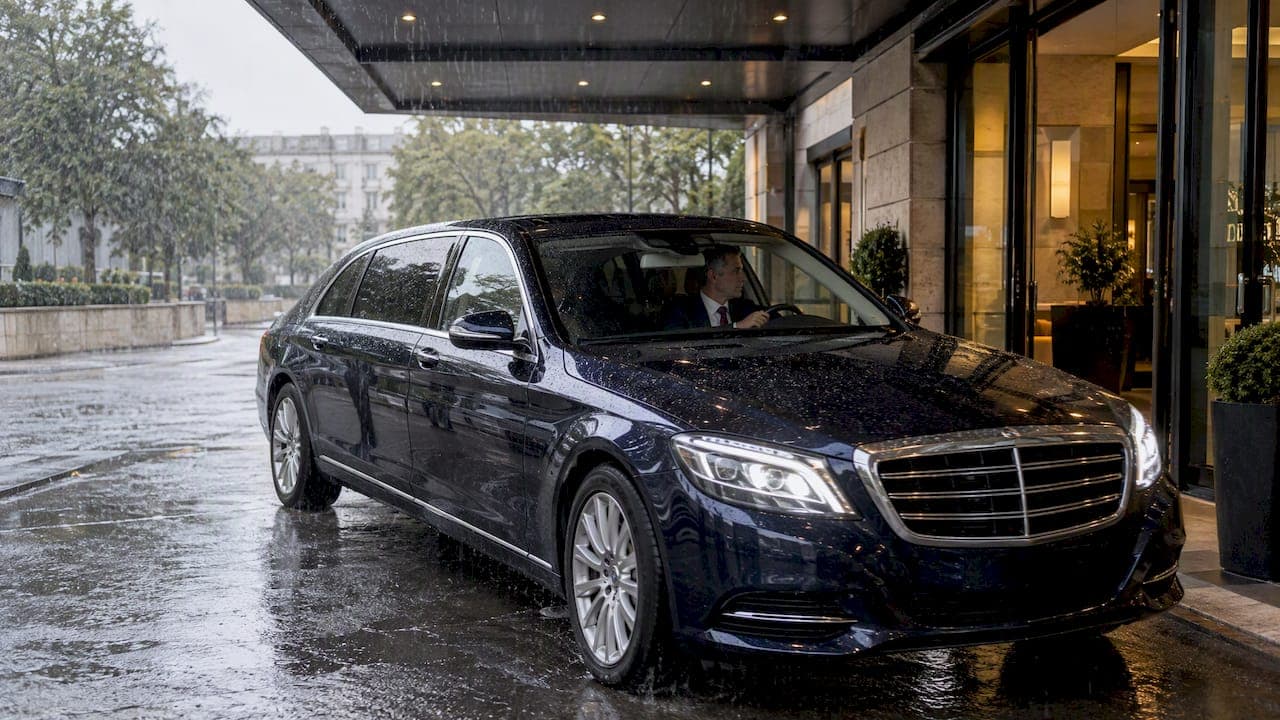
If rain threatens your trip, pick the lowest-exposure mode you have access to, add a time buffer, and set one clear decision point for switching to a booked transfer. Lean on National Weather Service flood guidance for safety thresholds, and when the schedule cannot slip, a managed chauffeured service gives you a dry, predictable fallback.
TL;DR:
- Check forecasts at 72, 48, and 24 hours before departure, name one decision maker, and switch when written rain or access thresholds are met.
- Allow 15 to 30 extra minutes for local trips and 45 to 90 minutes for airport runs, adjusting for local traffic and typical airport delays.
- Never cross flooded roads or barricades on foot or by vehicle; retreat to shelter, reroute around closures, or cancel rather than estimate water depth.
- Rain slows transit boarding and can disrupt schedules, so use live operator updates and favor covered platforms; drivers should double following distance on wet roads.
- Reserve dedicated transfers 48 to 72 hours ahead when traveling in groups, facing heavy rain, or keeping a fixed start time.
Table of Contents
- Build a Rain-Ready Transport Plan With Plan A, Plan B, and Decision Nodes
- Driving, Transit, Walking, and Rideshare: What Changes When It Rains
- Flood Safety: When to Turn Around and When to Call for Help
- Packing and Gear Checklist for Rainy Travel
- Timing and Booking: How Much Buffer Time Rain Actually Needs
- Decision-Node Templates and Operational Checklists
- Keeping Limousines and Luxury Vehicles Rain-Ready
- Coordinating With Event and Venue Staff on Contingency Transport
- Handling Sudden Weather Changes Mid-Trip
- Rain Protocols for Celebrity and VIP Clients
- How Experienced Planners Actually Think About Rain Plans
- When a Booked Chauffeured Transfer Is the Right Call
- FAQ
- Sources
Build a Rain-Ready Transport Plan With Plan A, Plan B, and Decision Nodes
A workable rain plan needs three things: a forecast check schedule, two named routes, and one person who gets to call an audible. Start checking the forecast at T-72 hours, confirm again at T-48, and lock your final call at T-24. Layer your alerts: a government source for raw data and your transit operator or ride service for real-time disruptions.
- Plan A is your normal route and mode, used when rain is light or forecast confidence is low.
- Plan B is your low-exposure backup: covered transit, a prebooked car, or a shortened walking route with indoor anchors along the way.
- Decision-maker is the one person (you, a trip lead, or an event coordinator) authorized to trigger the switch without a group vote.
Two examples make this concrete. For a solo commute: if radar shows sustained rain over 10 millimeters per hour at your T-2 hour mark, switch to Plan B automatically, no discussion needed. For a group event: if the primary outdoor walk from parking to venue exceeds eight minutes in steady rain, the operations lead confirms the switch to covered drop-off within ten minutes of the alert. Write these down before you need them. A plan you invent mid-downpour is a plan that fails.
Pro Tip: Store your Plan B route and backup contact numbers in a note on your phone's lock screen so you can act without unlocking and searching.
Driving, Transit, Walking, and Rideshare: What Changes When It Rains
Each mode has its own failure points in wet weather, and knowing them ahead of time keeps a bad forecast from turning into a bad day.
- Driving: Slow down smoothly rather than braking hard, and double your following distance in wet conditions, a recommendation echoed by state transportation guidance like NCDOT's wet-weather rules. If you hydroplane, ease off the gas and steer gently into the skid rather than overcorrecting. Choose routes that avoid known low-lying intersections or bridges with poor drainage, especially on trips you make often enough to know the trouble spots.
- Public transit: Expect longer dwell times as doors stay open longer and boarding slows, so build that into your schedule rather than cutting it close. Use your operator's real-time app instead of a printed schedule, and favor stations with covered platforms and indoor transfer points, since rain exposure during transfers is often the worst part of the trip.
- Walking and biking: Shrink your route to the shortest reasonable path and avoid exposed intersections with poor visibility or standing water. Traction-soled shoes and a waterproof outer layer matter more than an umbrella once wind picks up, and bikers should slow well before turns since wet paint and metal grates get slick fast.
- Rideshare and shuttle: Choose pickup points that minimize your walk to the curb, even if that means a slightly longer wait. A scheduled shuttle or private transfer is the better call when you are traveling with a group, carrying equipment, or working against a fixed start time, since a booked vehicle removes the uncertainty of surge pricing and driver cancellations.
Choosing the right transfer type before the weather turns, rather than during it, saves the most time and stress.
Flood Safety: When to Turn Around and When to Call for Help
The National Weather Service states plainly that it is never safe to drive or walk through flooded roadways. A small amount of moving water can knock a person off their feet, enough water can float most passenger cars, and deeper water can carry away SUVs and trucks, according to the Turn Around Don't Drown campaign. Treat any barricaded road or standing water across a lane as a hard stop, not a judgment call.
You can often spot flood-prone segments ahead of time: underpasses, low bridges, and intersections near creeks or storm drains flood first and fastest. If you hit a barricade or water you cannot judge the depth of, do not attempt to cross. Pull back, find shelter, and either wait out the worst of it or call for a booked transfer that can route around the closure. Canceling a leg entirely is sometimes the right call, and it is always better than guessing at water depth.
Packing and Gear Checklist for Rainy Travel
A short prep routine before you leave does more for your comfort than any amount of worrying about the forecast.
- Pack a compact umbrella or packable poncho, waterproof shoes, and a dry sack or sealed bag for your phone.
- Bring a microfiber towel for wiping down wet surfaces and a power bank in case delays run your battery down.
- If you are taking transit, add a bag cover, a lightweight seat cover for bike commutes, and a spare pair of socks.
Pro Tip: Pre-charge devices to full, photograph or save digital copies of important documents, and save your transfer company's contact template in your phone before you leave, not after you're already standing in the rain.
Timing and Booking: How Much Buffer Time Rain Actually Needs
Lead time matters more in rain than almost any other condition, because both traffic and transit slow down together. Booking a dedicated transfer at T-72 to T-48 hours gives you priority scheduling before the vehicles with the best coverage and routing get claimed by other travelers.
- Add 15 to 30 minutes of buffer for a local commute in steady rain.
- Add 45 to 90 minutes for an airport run, depending on local traffic patterns and how that specific airport historically handles wet weather.
- Prefer a booked chauffeured transfer when you are traveling as a group, facing a forecast of heavy or sustained rain, or working against a schedule that cannot absorb a delay.
Our guidance on airport transfer lead times breaks this down further for travelers coordinating flights around uncertain weather.
Decision-Node Templates and Operational Checklists
Two templates cover most situations. For a commute: if the forecast shows steady rain intensity above a set threshold at your two-hour mark, switch to Plan B automatically. For an event: if the main outdoor walk exceeds eight minutes in rain, the operations lead confirms the switch within ten minutes. Pair these with a checklist covering covered drop-off mapping, a designated staging zone, and a short written message template to notify everyone at once.
Our winter weather transportation playbook walks through fuller checklist examples that adapt directly to rain scenarios.
Keeping Limousines and Luxury Vehicles Rain-Ready
A luxury vehicle needs more than a quick wipe-down before a rainy-day assignment. We treat tire tread depth and wiper blade condition as pre-dispatch checks, not annual maintenance items, since both degrade faster with regular wet-weather driving. Door seals and trunk gaskets get inspected for leaks before any job where garment bags, instruments, or equipment will ride in the trunk.

Interior protection matters just as much as mechanical readiness. We lay down protective floor mats and seat covers for wet-weather runs, since leather and fine upholery show water staining quickly, and chauffeurs carry dry towels to wipe down door handles and seats between passenger stops. Exterior chrome and paintwork get a fast rinse after any drive through salted or heavily treated roads, since standing water often carries runoff that dulls a finish over time.
Visibility and tracking round out the preparation. Headlight and taillight lenses are checked for clarity, since fogged or dirty lenses lose effectiveness fast in low-visibility rain. Chauffeurs also run a final check of GPS and live traffic feeds immediately before departure, since rain-driven route closures can appear and disappear within the hour. None of this is a one-time setup. It is a routine we repeat before every rain-forecast dispatch, because a vehicle that looks ready and a vehicle that has actually been checked are not always the same thing.
Coordinating With Event and Venue Staff on Contingency Transport
Rain contingency plans fail most often at the handoff between transportation and venue staff, so we build that coordination in early. Before an event with outdoor elements, we confirm covered drop-off zones directly with venue operations, map the shortest indoor path from that drop-off to the event space, and share that map with every driver assigned to the job.
We also agree on a single point of contact on the venue side, someone who can confirm in real time whether an outdoor ceremony or photo session is moving indoors, so our drivers and dispatch are never working from outdated information. A shared communication template, sent the moment conditions change, keeps guests, vendors, and chauffeurs aligned instead of each group hearing about a change secondhand. For weddings and similar events, this coordination often starts days ahead, matching our wedding-day transportation planning to the venue's own rain contingency, including staging extra vehicles near covered entrances when the forecast calls for it.
Handling Sudden Weather Changes Mid-Trip
Rain that arrives after a trip is already underway calls for a different kind of response than a planned contingency. The first move is always the same: slow down and increase following distance immediately, before deciding anything else about the route. Once the vehicle or group is stable, the decision-maker named in your plan checks the nearest indoor anchor or covered waiting area and redirects there if the rain intensity or visibility has worsened past your threshold.
Communication has to move faster than the weather does. We keep drivers and dispatch connected in real time specifically so a route change mid-trip gets confirmed in minutes rather than requiring a passenger to make the call alone from the back seat. If a scheduled stop, like an outdoor photo session or a walking segment between venues, is no longer safe, the fallback is to skip it and adjust the itinerary rather than wait it out roadside. A trip that arrives ten minutes late is a minor inconvenience. A trip that stalls in standing water is a much bigger problem.
Rain Protocols for Celebrity and VIP Clients
High-profile clients add layers that an ordinary rain plan does not need to account for. Privacy stays a priority even when weather forces a change of route or drop-off point, so any rerouting gets communicated through secure, pre-agreed channels rather than open group messages. Our screened chauffeurs and confidentiality protocols, including NDA-based references, carry through regardless of whether the day goes exactly to plan or requires a last-minute covered entrance instead of a red-carpet arrival.
Timing discipline matters even more under rain, since a VIP schedule often has no slack built in for delays. We build extra buffer into these itineraries specifically because reshuffling a route around weather takes a few extra minutes that a tight schedule cannot always absorb. Staging a backup vehicle nearby, rather than relying on a single car for the entire engagement, means a mechanical issue or access problem never becomes a visible scramble. Decades of coordinating with production companies and studios have shaped how we plan these moves quietly, keeping the client's day on track without drawing attention to the adjustment itself.
How Experienced Planners Actually Think About Rain Plans
Thresholds beat improvisation. The planners and chauffeurs who handle rain well are not the ones reacting fastest in the moment, they are the ones who removed the decision entirely by setting the trigger days earlier. A named decision-maker and a written threshold mean nobody has to debate conditions while standing in them.
That discipline comes from repetition, not instinct. Our executive roadshow planning guide shows how the same decision-node logic scales from a single commute to a multi-city schedule.
— Sammy
When a Booked Chauffeured Transfer Is the Right Call
When the forecast turns and your schedule has no room for error, a managed chauffeured transfer removes the guesswork entirely. We provide door-to-door covered pickup, routing adjusted around flooded or closed segments in real time, and a driver who already knows the contingency plan before the car arrives.

Teams coordinate staging and backup vehicles the same way for a single airport run as for a full production schedule, so a sudden downpour never becomes your problem to solve alone. Check vehicle availability or request a quote through our Riga Global Travel booking page, and get a confirmed, weather-ready ride locked in before the rain does.
FAQ
Does Medicare offer free transportation for seniors?
Medicare Part B covers ambulance transportation only when it is medically necessary, not as a general free-ride benefit for seniors, according to Medicare's own coverage guidance. Routine appointment transportation typically falls outside standard Medicare coverage and requires a separate local or state program.
What are the three types of transportation plans?
A practical rain-ready framework uses three components: a primary route (Plan A), a low-exposure backup route (Plan B), and a decision node that defines exactly when to switch between them. This structure works for a solo commute or a full event itinerary.
Where can I get free rides to doctor appointments?
Free or low-cost medical rides are typically arranged through state Medicaid transportation brokers or local community transit programs rather than Medicare itself. Availability and eligibility rules vary by state and program, so checking with a local Area Agency on Aging or Medicaid office is the most reliable way to confirm options.
What is a rain contingency plan?
A rain contingency plan is a predefined set of steps, routes, and decision points that take effect automatically once certain rain conditions are met, removing the need to improvise mid-trip. It typically includes a primary and backup route, a named decision-maker, and clear thresholds for when to switch, cancel, or redirect to shelter.
How much extra time should I add for a trip in rain?
A good rule of thumb is 15 to 30 extra minutes for a local commute and 45 to 90 extra minutes for an airport trip, depending on local traffic and that airport's typical rain-weather delays. Heavier forecast rain or group travel pushes that buffer toward the higher end of the range.
Sources
- Turn Around Don’t Drown — National Weather Service
- Wet-weather driving — NCDOT
- Medicare coverage of ambulance services — Medicare