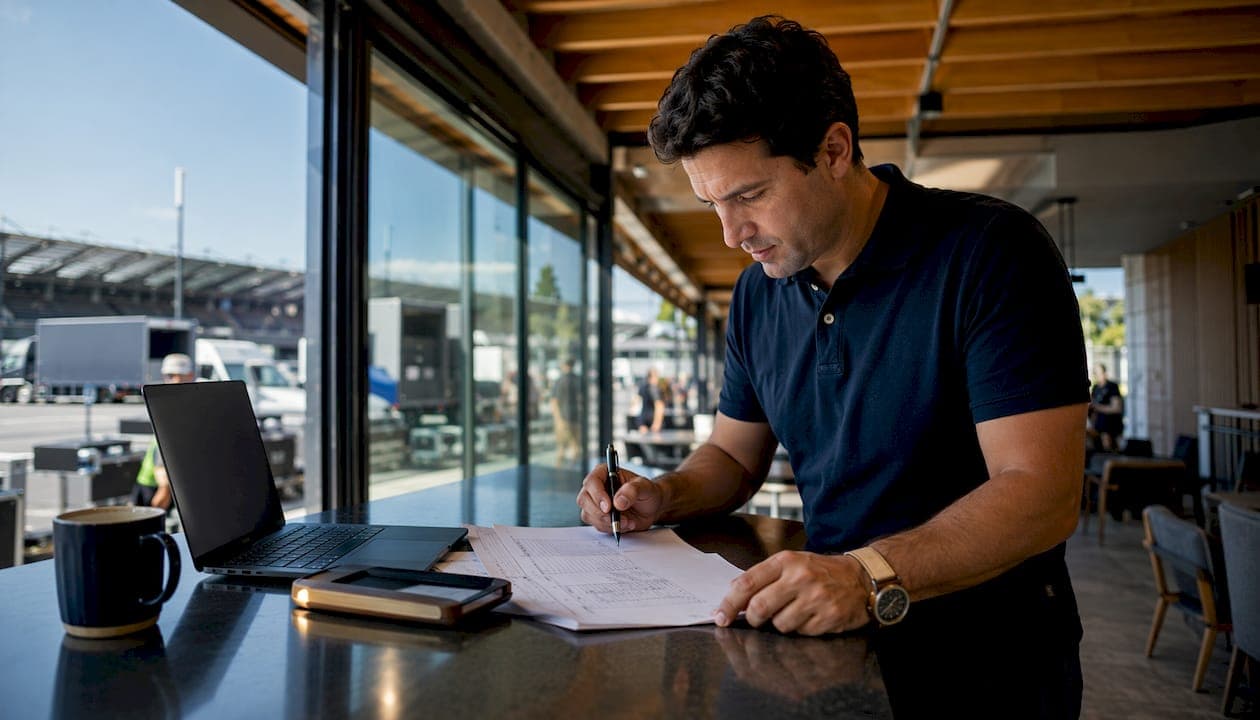
Halftime show transport is a time-critical logistics operation that moves prebuilt staging modules, broadcast equipment, crew, and talent onto and off a playing surface within a window that can be as short as six minutes. Production teams that treat it as anything less than a full field-deployment exercise tend to find out the hard way. The priorities, in order: turf protection, sequencing, and credentialing. Get those three right and the rest of the show has a fighting chance.
TL;DR: Design for the field first. Prebuild and prewire everything off-site. Sequence trucks and carts by dock and tunnel constraints. Lock credentials weeks out. Assign a chauffeured concierge partner for talent movement so your field team never has to split focus.
Table of Contents
- What halftime show transport actually includes
- Playing-surface and stadium constraints that drive every transport decision
- How preloading, color-coding, and rehearsal create a snap-together field move
- Vehicle types, cart specs, and wheel choices that protect the turf
- Credentialing, access lanes, and coordinating with stadium operations
- Rehearsals, contingency planning, and what happens when things go wrong
- Operational checklist and sample halftime timeline
- Key Takeaways
- The part most production teams underestimate
- Rigaglobaltravel handles the talent side so your field team doesn't have to
- Useful sources
What halftime show transport actually includes
The scope is wider than most first-time production coordinators expect. A major halftime production can represent months of prep, dozens of trucks, and near-military coordination for a roughly dozen-minute on-field performance.
Core transport categories:
- Semitrucks and trailers: bulk haul for scenic modules, structural steel, and rigging
- Field carts (staging modules): prebuilt, pre-wired stage sections rolled directly onto the field; Super Bowl LX used 35 carts for stage setup alone, not counting camera jibs, audio towers, or lighting rigs
- OB vans and broadcast trucks: mobile production control, replay, and network feed units
- Crew vans and shuttles: moving rigging teams, cart crews, broadcast engineers, and grounds staff between staging areas and field access points
- Talent and escort cars: chauffeured vehicles for artists, VIPs, and production executives, coordinated separately from field logistics
- Equipment pallets: audio consoles, lighting fixtures, cable runs, and spare parts staged in dock order
- Generators and power distribution: independent power for field electronics when stadium tie-ins are unavailable or restricted
Key roles on the manifest: cart team leaders, field managers, rigging crews, broadcast engineers, stadium grounds crew, security officers, and credentialing staff. Rigaglobaltravel adds concierge and talent liaison roles to that list, keeping artist movement completely off the field team's plate.
Each cart entry on the manifest should note whether it is preloaded or built on-field, its weight distribution, and who signs off before it rolls.
Playing-surface and stadium constraints that drive every transport decision
The physical field is the single biggest design constraint in halftime show logistics. Every cart count, wheel spec, and access route flows from what the turf manager will allow.
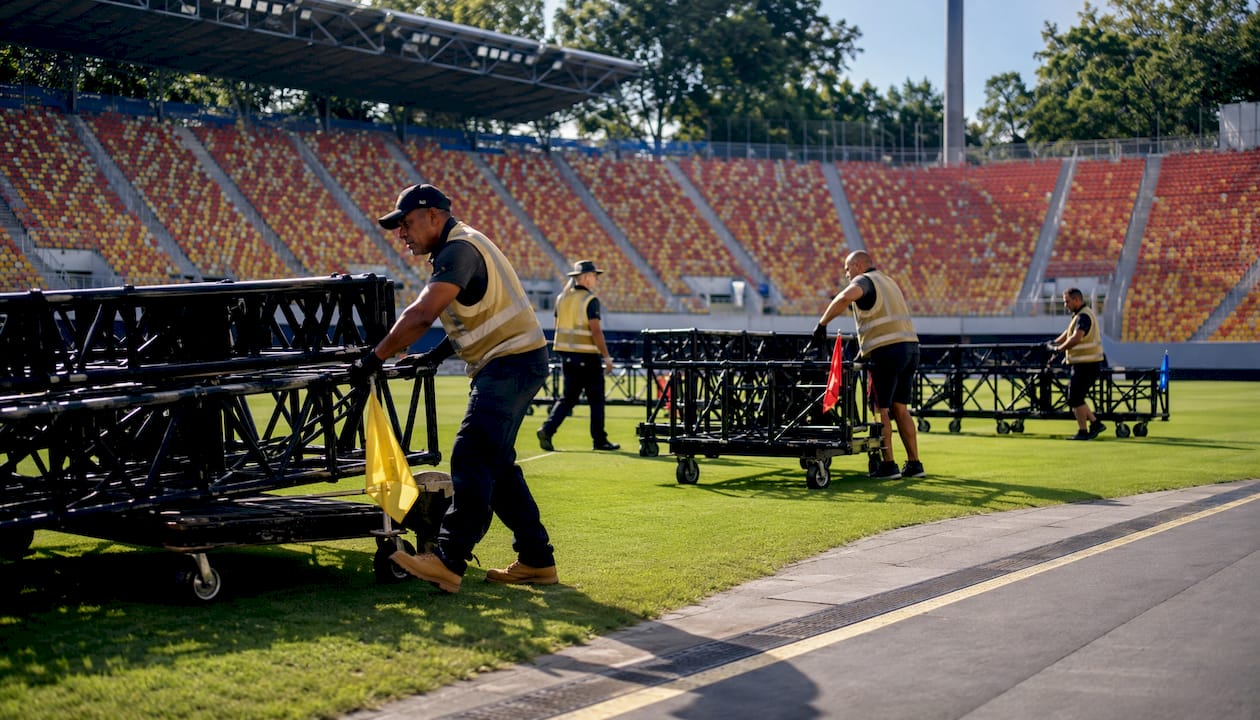
Natural grass vs. artificial turf: Natural grass is more restrictive. The FIFA World Cup Final halftime show director Hamish Hamilton described grass as influencing "everything for halftime, from what stage sets are possible to what sorts of cameras they could use." Artificial turf tolerates higher point loads but still has manufacturer weight limits that stadium operations will enforce.
Stadium-specific hard limits to confirm early:
- Tunnel height and width (determines whether carts must hinge or fold for clearance)
- Number of approved field access points and dock width
- Permitted minutes on the playing surface during load-in and strike
- Staging-area square footage outside the tunnel mouth
Permits and approvals: Stadium operations, the league's field manager, and the broadcast technical director all hold sign-off authority. Get load and weight approvals in writing before fabrication begins.
Pro Tip: Request the turf manager's wheel-pressure spec sheet before you finalize cart design. Discovering a weight limit conflict after fabrication is an expensive fix.
How preloading, color-coding, and rehearsal create a snap-together field move
The halftime move works because every cart has a predetermined route, a stop point, and a connection checklist. Nothing is figured out on the field.
Prebuild and prewire strategy:
- Build full scenic modules off-site; test all electronics before the cart leaves the shop
- Label every power, audio, and video tie point for sub-60-second connections on-field
- Divide reinforced ground cloth panels into manageable sections for rapid deployment without damaging field graphics
Sequencing techniques:
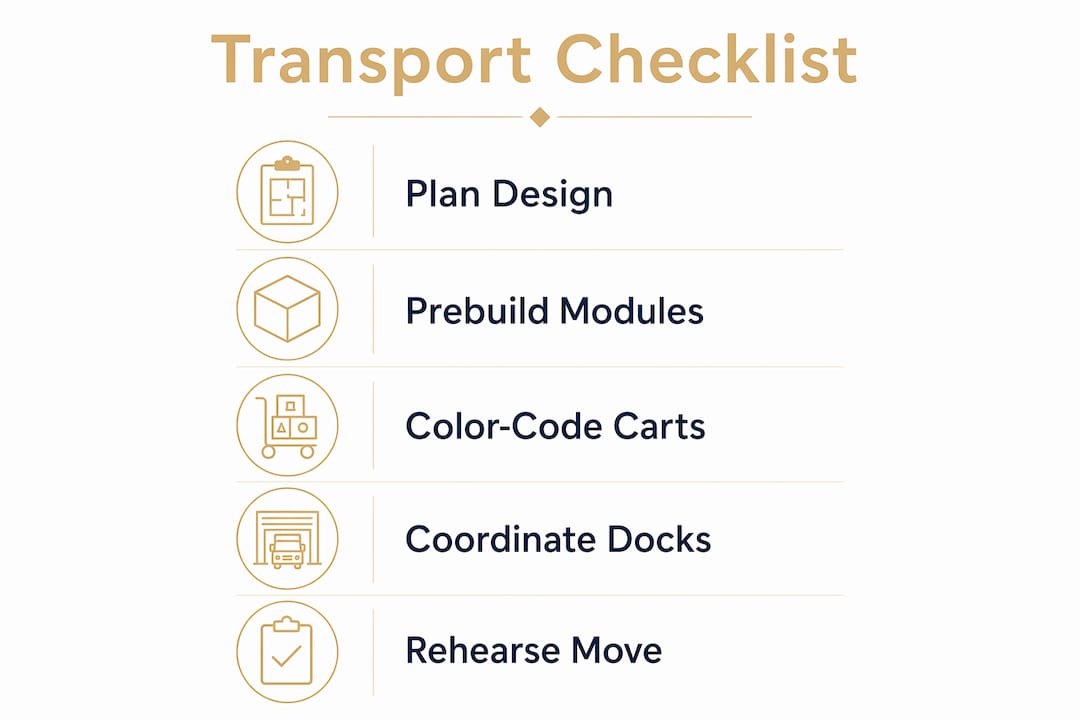
- Assign each cart a color code that maps to a field zone and a team leader
- Issue headsets to every cart team leader; designate a traffic-control channel separate from show comms
- Post route maps at every tunnel mouth and staging area
- Place on-field marshals at merge points where cart paths cross
- Rehearse push patterns until the crew executes them without verbal cues
Rehearsal cadence:
- Full run-through with all carts and crew, timed against the halftime window
- Partial runs targeting the highest-risk connection points
- Dress rehearsal with stadium crew present the day before
- Safety and timing check the morning of the event
Freight staging follows the same logic: trucks are called to docks in a precise sequence because the wrong truck at the wrong dock causes cascading delays across the entire load-in.
Vehicle types, cart specs, and wheel choices that protect the turf
| Category | Recommended Spec | Primary Purpose |
|---|---|---|
| Semitrucks | — | Bulk scenic and structural transport |
| Field carts | Modular frames, hinged scenic elements for tunnel clearance | Stage module roll-in |
| Turf wheels | Pneumatic turf wheels, 360° swivel casters | Weight distribution, precise placement |
| Crew shuttles | Passenger vans, 12–15 seat capacity | Field crew movement between zones |
| Talent cars | Chauffeured executive sedans or SUVs | Artist and VIP transport |
| OB vans | Full broadcast production units | Network feed and replay |
Wheel and load guidance:
- Standard casters concentrate point loads and can tear natural grass; specify wide pneumatic turf wheels or proprietary turf-wheel systems
- 360° swivel casters allow precise cart placement without dragging or pivoting on the surface
- Confirm static and dynamic load limits with the stadium turf manager and the cart manufacturer before sign-off
For specialty equipment transport, confirm wheel-type certification in writing from both the fabricator and stadium operations.
Credentialing, access lanes, and coordinating with stadium operations
Security and credentialing failures are among the most common causes of halftime delays. A vehicle without the right pass at the right time blocks an entire dock sequence.
Credential and access checklist:
- Submit vehicle manifests and crew lists to stadium operations at least three weeks out
- Assign a dedicated credentialing officer who tracks every vehicle pass and resolves denials before show day
- Confirm dedicated access lanes for talent escort vehicles, separate from freight lanes
- Establish radio and hand-signal backup protocols for lane marshals if comms fail
Talent escort protocols: High-profile artists require discreet, secure routing from holding areas to the field entrance. Police or stadium escorts coordinate with the chauffeured vehicle, not the field crew. Rigaglobaltravel handles staggered pickups, secure route planning, and waiting protocols so the production team's attention stays on the field.
Network production coordination: Share load-in schedules with the broadcast technical director early. Cross-check dock assignments against OB van positions to avoid conflicts. Assign a single liaison who can resolve dock or on-field conflicts in real time.
Pro Tip: Build a 15-minute credential buffer into your talent arrival window. If a pass is denied at the gate, you need time to resolve it without touching the halftime clock.
Rehearsals, contingency planning, and what happens when things go wrong
The setup and strike sequence is planned to the minute, which means a single stalled cart or electrical fault can cascade quickly. Contingency planning is not optional.
- Hot-spare carts: Stage at least one fully preloaded spare cart per major scenic element at the tunnel mouth
- Alternate power feeds: Pre-run a secondary power path to every field position; test it during dress rehearsal
- Rapid-fix kits: Station welding, carpentry, and scenic repair capability at the field entrance for show-day adjustments
- Reduced-cart configuration: Pre-approve a stripped-down show layout with the director in case turf limits tighten on show day
- Turf restoration team: Contract a rapid turf-surgery crew to begin post-show inspection the moment strike is complete
- Insurance and permits: Carry event liability, equipment, and turf-damage coverage; present permit documentation to stadium operations before load-in begins
Sign-off authority for go/no-go on any configuration change belongs to three people: the production lead, the stadium field manager, and the broadcast technical director.
Operational checklist and sample halftime timeline
Pre-show checklist:
- Arrival windows confirmed for all trucks and talent vehicles
- Dock sequence locked and posted at every staging area
- Cart-team assignments distributed and rehearsed
- Credentials confirmed for all vehicles and personnel
- Talent transport windows confirmed with chauffeured partner
- Turf manager sign-off on wheel specs and cart count
Sample halftime timeline (adaptable to 6–15 minute windows):
- T-minus 30 min: All carts staged at tunnel mouth; cart team leaders check in on headset
- T-minus 10 min: Talent vehicle departs holding area with escort
- T-minus 5 min: Field cleared of game personnel; grounds crew in position
- T-0 (halftime whistle): First cart wave enters field on marshal signal
- T+2 min: All carts locked into position; connection teams begin tie-ins
- T+4 min: Audio, video, and power live; broadcast TD confirms signal
- T+13 min (show end): Strike begins; carts exit in reverse sequence
- T+20 min: Field cleared; turf inspection begins
Customize dock call order and tunnel routing for each stadium based on tunnel length, approved access points, and broadcast truck positions. For broadcast crew shuttle logistics, build crew movement windows into the same run sheet.
Key Takeaways
Halftime show transport succeeds when turf constraints drive every design decision, carts are prebuilt and pre-wired off-site, and talent movement is handled by a dedicated chauffeured partner so the field team stays focused.
| Point | Details |
|---|---|
| Design for turf limits first | Confirm wheel specs and cart counts with the turf manager before fabrication begins. |
| Prebuild and prewire off-site | Every cart should be a self-contained, labeled module ready for sub-60-second field connections. |
| Sequence by dock and tunnel constraints | Truck and cart order matters more than speed; wrong sequencing causes cascading delays. |
| Lock credentials weeks out | Submit vehicle manifests and crew lists at least three weeks before the event. |
| Use Rigaglobaltravel for talent movement | A dedicated chauffeured concierge partner keeps artist logistics off the field team's run sheet entirely. |
The part most production teams underestimate
The field logistics get the attention. The talent transport gets treated as an afterthought. That is the wrong order of priority.
A stalled cart is visible, fixable, and rehearsed for. A talent vehicle that arrives at the wrong gate, gets held at a credential checkpoint, or sits in a freight lane because nobody mapped a dedicated route? That failure is invisible until it is too late to fix. The field team cannot solve it because they are managing 35 carts and a six-minute clock.
The productions that run cleanest separate those two problems completely. Field logistics has its own chain of command. Talent movement has its own dedicated team, its own routes, and its own comms. Staggered pickups, pre-cleared secure routes, waiting protocols, and a rapid re-route plan for lane closures are not luxury items. They are the difference between a talent arrival that the field team never has to think about and one that pulls a field manager off the cart sequence at the worst possible moment.
Rigaglobaltravel operates exactly in that gap, handling VIP hospitality transport with the same run-sheet discipline the field team applies to carts. That coordination is what keeps the two halves of a halftime show from colliding.
Rigaglobaltravel handles the talent side so your field team doesn't have to
Production teams running halftime logistics already have enough moving parts. Rigaglobaltravel takes the entire talent and VIP transport layer off the field team's plate, providing vetted chauffeurs, pre-cleared vehicle manifests, and dedicated concierge liaisons who operate on the production's run sheet, not their own schedule.

From chauffeured talent transport in Los Angeles to executive car service in New York, Rigaglobaltravel brings a single point of contact, discreet routing, and stadium-compatible vehicle specs to every engagement. No credential surprises, no freight-lane conflicts, no field manager pulled off a cart sequence to deal with an artist's car. Contact Rigaglobaltravel to request a production transport brief or schedule a site-specific operations call before your next show.
Useful sources
- Reuters: 13 minutes, $13 million — the logistics of a Super Bowl halftime show — cite for overall scale, prep time, and truck counts
- Long Island Press: Inside the army that built the Super Bowl LX halftime show — cite for cart counts (35 carts, Super Bowl LX) and field choreography detail
- All Access: Behind-the-Build, Bad Bunny Halftime Show — cite for turf-wheel systems, pneumatic wheels, and cart specs
- All Access: Behind-the-Build, Super Bowl LIX — cite for hinged cart design, tunnel clearance, and ground cloth panels
- KSM Carrier Group: How many trucks does a 12-minute halftime show take? — cite for dock sequencing and freight staging logic
- DivexTop: How the NFL builds a halftime stage fast — cite for the timed choreography and headset coordination approach
- Hollywood Reporter: FIFA World Cup Halftime Director — cite for grass-surface constraints and the "gargantuan logistical undertaking" framing
- Rigaglobaltravel: Sports network ground transport examples — operational templates and run-sheet examples for sports and broadcast ground transport
- Rigaglobaltravel: Game day VIP transport types — VIP and talent transport workflows that integrate with event logistics