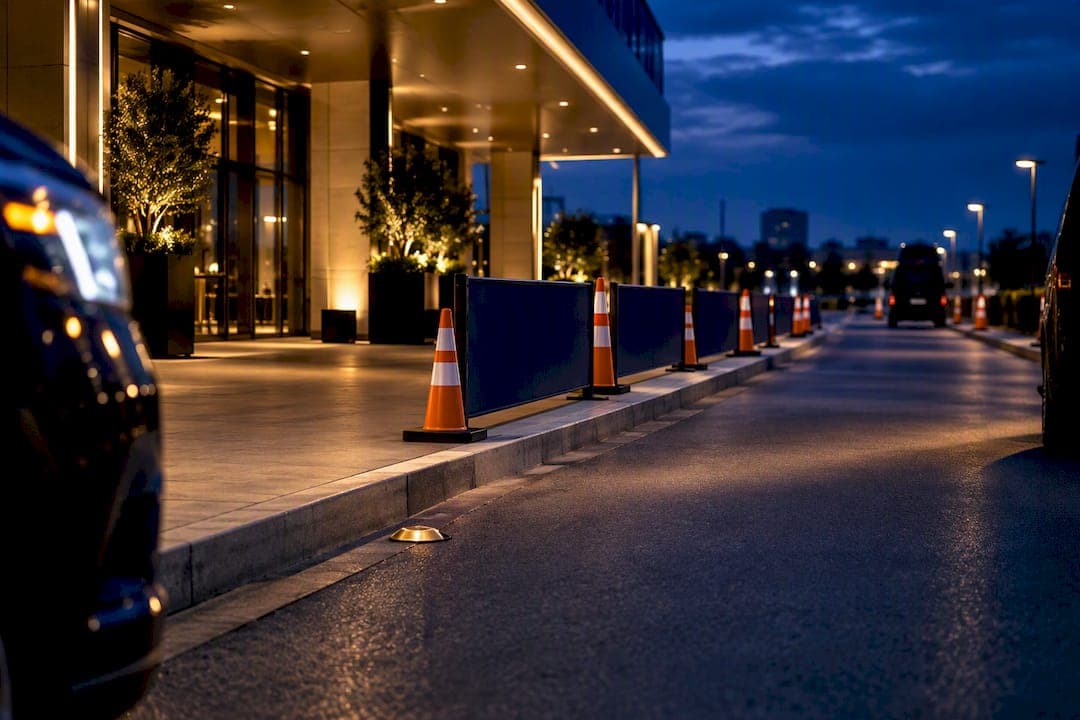
Shuttle staging succeeds or fails on one decision made before the first van arrives: publish a staging map that separates drop-off, holding, and pickup, and assign one person to own it. That single move, backed by early confirmation with venue operations and a flagged accessibility review, prevents most of the delays and confusion planners associate with event transportation.
TL;DR:
- Confirm venue-specific access rules in writing to ensure proper staging zones and avoid delays caused by misunderstandings or restrictions.
- Calculate shuttle loop times with real traffic data, including sufficient buffers and excess vehicles, to prevent schedule slippage during peak moments.
- Vet vendors thoroughly for accessible vehicle availability, staff training, and clear fallback plans, as legal compliance hinges on operational readiness.
- Designate a single transportation lead responsible for staging maps, driver communication, and contingency management to prevent operational breakdowns.
- Implement real-time communication channels and tracking tools to quickly address breakdowns, delays, or emergencies during the event.
Table of Contents
- Staging zones and the staging map: drop-off, holding, and pickup
- Routing and timing: building shuttle loops and setting frequencies
- Vehicle selection and assignment: matching vehicle type to route and guest profile
- Accessibility and compliance: concrete ADA/FTA checks for planners
- Coordination and responsibilities: stakeholder matrix and deliverables
- Day-of operations and contingencies: driver briefings, manifests, and failure modes
- Sammy and RIGA Global Travel: field-tested templates and tracking best practices
- Security protocols for passenger safety during staging and transit
- Communication systems for real-time updates between drivers, dispatchers, and venue staff
- Load balancing strategies to optimize shuttle usage during peak times
- Environmental considerations such as emissions and noise management in shuttle staging
- First-person perspective: the difference one transportation lead makes
- How a professional ground transportation provider can plan and manage your venue shuttle staging
- Sources
- FAQ
Staging zones and the staging map: drop-off, holding, and pickup
Every staging plan rests on three distinct areas, and treating them as interchangeable is where most delays start. Drop-off is a short-dwell zone where guests exit quickly and vehicles move on. Holding is where vehicles queue between runs, out of guest sightlines and away from active traffic. Pickup is a separate, clearly marked area timed to the event's end, ideally with more capacity than drop-off since guests tend to leave in a shorter window than they arrive.
Before drawing anything, confirm venue-specific rules. Many venues restrict commercial vehicles to remote lots and set narrow operating windows, so verbal assurances from a venue contact are not enough. Get it in writing.
- Identify every access point vehicles can legally use, including height and turning restrictions.
- Note which zones require credentials or a staging pass, and who issues them.
- Record the operating window during which shuttles may load and unload.
- Mark pedestrian routes separately from vehicle lanes to avoid crossing conflicts.
- Include at least one emergency egress route that stays clear of staged vehicles.
Once these details are confirmed, turn them into a single-page staging map with labeled zones, arrows showing vehicle flow, and a legend for credentials or passes. Distribute it to drivers, venue staff, and any greeters working the event. Festivals that manage large volumes of vehicle traffic, such as the operation described on Stagecoach's shuttle information page, rely on exactly this kind of published routing to keep drop-off, pickup, and holding zones from colliding.
Pro Tip: Walk the actual route with a phone camera the week before the event and annotate the map with photos of tricky turns or blind corners, not just lines on a diagram.
Routing and timing: building shuttle loops and setting frequencies
A shuttle loop is only as reliable as the math behind it. Loop time is the sum of drive time between stops, dwell time at each stop for boarding and unloading, and a buffer for traffic or weather. Skipping the buffer is the most common reason shuttles fall behind schedule within the first hour.
- Measure round-trip drive time between every staged stop under realistic traffic conditions, not a map app's best-case estimate.
- Add dwell time per stop, typically longer at pickup than drop-off since guests take longer to board than to exit.
- Add a buffer of several minutes per loop to absorb delays without cascading into the next run.
- Divide your target headway (the gap between shuttle arrivals) by the total loop time to calculate how many vehicles you need running simultaneously.
- Recalculate headway for the ceremony start, cocktail hour, and reception exit separately, since guest volume shifts sharply between those windows.
Timed departures work well for smaller guest lists with a known headcount, since you can schedule fewer, fuller vehicles at set intervals. Continuous loops suit larger or open-ended events, such as receptions where guests leave in waves rather than all at once. Align your staging windows to the actual event timeline rather than a generic schedule: a ceremony with a hard start time needs tighter early headways, while a reception with a rolling exit benefits from a longer, steady loop that runs until the last guests leave.
Vehicle selection and assignment: matching vehicle type to route and guest profile
Vehicle choice depends on guest count, route conditions, and what the venue site itself can physically accommodate. A shuttle van suits small guest lists and tight venue access. A minibus in the 14 to 25 seat range balances capacity with maneuverability for most mid-sized weddings. A full coach makes sense only when guest volume is high and the route offers wide turning space and clear overhead clearance.
- Check turning radius and overhead clearance with the venue before booking any vehicle larger than a minibus.
- Confirm the access road surface can handle vehicle weight, especially for gravel or grass venues.
- Assign larger vehicles to routes serving hotel blocks with high guest counts, and smaller vehicles to VIP or bridal party pickups.
- Flag any guest with a wheelchair or mobility device in advance so an accessible vehicle is assigned to their pickup point, not added as an afterthought.
- Build in slack for luggage-heavy routes, such as airport transfers bundled into wedding weekend transportation.
A simple assignment template works: list each route, the vehicle type assigned, the guest group it serves, and the departure window. Keep it on one page so drivers and dispatch can reference it without digging through separate documents. Driver-hours and booking windows also need early attention. Multi-day wedding weekends often require drivers booked across nonconsecutive shifts, and locking that in weeks ahead avoids last-minute vendor substitutions.
Accessibility and compliance: concrete ADA/FTA checks for planners
Accessibility is not a box to check once and forget. It has to be operational: someone assists at boarding, an accessible vehicle is staged where it is needed, and there is a clear escalation path if equipment fails. Federal guidance on major-event coordination stresses this directly. The FTA major-event playbook advises planners to confirm that lifts function, securement devices are in place, and staff are trained to assist boarding, not just to have accessible vehicles somewhere in the fleet.

Enforcement history backs this up. A settlement agreement between the United States and Monterey Airbus required the operator to acquire or retrofit accessible vehicles and revise its reservation policies after failing to reliably provide accessible service. A separate consent decree against Greyhound Lines required routine equipment maintenance checks, staff training on lifts and securement, and reservation parity for passengers with disabilities. These are not abstract legal footnotes. They describe exactly what a planner should ask a shuttle operator to confirm in writing.
Before you sign a contract, require these commitments:
- Written confirmation of how many accessible vehicles are available and where they will be staged.
- A description of driver training specific to lift operation and mobility-aid securement.
- A stated reservation procedure for guests who need an accessible vehicle, published to guests in advance.
- A documented fallback plan if a lift fails, including an alternate vehicle and boarding point.
- Recordkeeping proof of recent equipment checks, not just a verbal assurance.
Federal guidance on accessible operations shows a consistent pattern: enforcement actions like the Monterey Airbus settlement and the Greyhound consent decree both centered on the same gaps, functioning equipment and trained staff, that planners can catch during vendor vetting rather than on event day.
Coordination and responsibilities: stakeholder matrix and deliverables
Staging breaks down when responsibility is spread across too many people with no single owner. The transportation lead should be the one person accountable for the staging map, vehicle assignments, and day-of dispatch, with authority to make real-time calls if a route needs to change.
- The transportation lead confirms the final staging map, owns vendor communication, and runs the day-of handoff briefing.
- Venue operations delivers written staging rules, confirmed access windows, and any credentialing requirements before the event.
- Local transit or police involvement becomes necessary when staging affects public roads, requires lane closures, or overlaps with regular transit routes; in those cases, present the shared staging map early so all parties are working from the same document.
- Dispatch owns the passenger manifest, driver check-in process, and a live contact list connecting drivers, the transportation lead, and venue staff.
For larger events layered onto existing transit infrastructure, FTA guidance on public transportation during major events recommends exactly this kind of shared staging map circulated to every operator involved, public and private. If your event plans to route through or near a public transit corridor, check the FTA's charter bus service regulations first, since transit agencies face legal limits on when they can provide chartered service outside their normal routes. A vendor operating guide to production staging covers similar handoff structures for teams managing vehicle movement across a complex site.
Day-of operations and contingencies: driver briefings, manifests, and failure modes
The day-of run sheet is where all the earlier planning either holds up or falls apart. A short, consistent driver briefing before shuttles start running prevents most confusion.
- Confirm each driver has the current staging map, their assigned route, and the day's headway schedule.
- Walk through the manifest format: grouped pickups by hotel block or guest party, with named timed calls rather than a loose guest list.
- Review the emergency contact chain: who drivers call first, and who escalates to the venue if a route is blocked.
- Confirm the accessible vehicle assignment and boarding point one more time, out loud, as part of the briefing.
- Set a check-in cadence, such as a short radio or text update at the top of every loop.
Manifests work best grouped by pickup location and timed call, so drivers know exactly who to expect and when, rather than waiting for stragglers at every stop. Common failure modes are predictable: traffic delays push the loop past its buffer, a lift malfunctions, or a vehicle breaks down mid-route. Each needs an immediate, pre-agreed response rather than an improvised one. Traffic delays call for a text update to the next stop's waiting guests. Lift failures call for the pre-arranged alternate vehicle and boarding point discussed during vendor vetting. Breakdowns call for a spare vehicle held in reserve, which is why fleet math should always include one more vehicle than the bare minimum loop requires.
Front desk staff and greeters need a short script too: where the next shuttle is, roughly how long the wait will be, and who to flag down if a guest needs accessible boarding assistance. A field-tested guide to basecamp shuttle logistics breaks down similar buffer and holding-lot procedures for teams managing multi-vehicle operations under time pressure.
Pro Tip: Print the manifest and staging map on paper as a backup. Cell service at outdoor venues is unreliable exactly when you need it most.
Sammy and RIGA Global Travel: field-tested templates and tracking best practices
Running shuttles for production-level events taught a simple lesson: the loop schedule you plan on paper needs a real buffer, not a hopeful one. Building in extra minutes per loop, and staging one spare vehicle beyond the calculated minimum, absorbs the delays that always show up somewhere, whether that is a late bridal party or a closed access road.
Tracking matters as much as the schedule itself. Equipping dispatch with a live vehicle-tracking feed and a simple shared dashboard cuts down guest calls dramatically, since front desk staff can answer "where's my shuttle" without radioing a driver mid-route. A guide to tracking shuttle buses covers how this setup works in practice.
- Build a one-page staging checklist covering zones, vehicle assignments, and the accessible boarding plan.
- Keep a dispatch brief with the manifest, contact chain, and escalation path in one document.
- Choose a managed concierge or limousine provider over stitching together separate charter vendors when the event has multiple stakeholders, tight timing, and accessibility requirements that need a single point of accountability.
Security protocols for passenger safety during staging and transit
Staging areas concentrate guests, vehicles, and drivers in one place, which makes basic safety protocols worth spelling out rather than assuming. Drivers should be briefed to keep engines off during extended holding to reduce fire risk and noise, and to never leave a vehicle unattended in an active loading zone.
Guests waiting in holding or pickup zones need clear separation from vehicle lanes, ideally with a barrier or rope line rather than just a painted line on pavement. Lighting matters as much at night events: pickup zones for evening receptions should be lit well enough for drivers to see guests and for guests to see vehicle numbers or signage confirming which shuttle is theirs.
Screened, trained chauffeurs reduce risk at every stage of staging, from verifying guest counts before departure to knowing how to handle a medical concern during transit. Any operator working a wedding or large event should be able to describe their driver screening process without hesitation, and that answer belongs in your vendor vetting conversation, not discovered after booking.
For events involving public figures or heightened privacy needs, staging plans should also account for controlling who has visibility into pickup points and timing, since predictable staging locations can become a security liability if guest lists include anyone requiring discretion.

Communication systems for real-time updates between drivers, dispatchers, and venue staff
A staging plan is only as good as the information flowing through it in real time. Drivers need a direct line to dispatch, whether that is a dedicated radio channel or a group messaging thread, so a delay on one route can trigger an adjustment on another before guests start noticing.
Dispatch needs equally direct access to venue staff, particularly the person managing the ceremony or reception schedule, since a five-minute delay in vows can shift the entire pickup loop. Build this connection before the event, not during it: a single named venue contact with a phone number, not a general venue office line, prevents messages from getting lost.
Guest-facing communication should stay simple. Front desk staff and greeters need a one-line update they can repeat without checking a group chat every time a guest asks where their shuttle is. Keeping the technical dispatch communication separate from the guest-facing script avoids both confusing guests with radio chatter and overloading dispatch with individual guest questions during peak loading times.
Load balancing strategies to optimize shuttle usage during peak times
Guest flow is never even across an event. Ceremony start and reception exit create sharp spikes, while the hours in between see light, steady traffic. Planning a single fixed headway for the whole event wastes vehicles during slow periods and creates bottlenecks during peak ones.
Instead, map guest volume against the event timeline before finalizing headways. Ceremony arrival typically needs the tightest headway of the day, since most guests arrive in a narrow window. Reception exit often needs even more capacity, since departures tend to compress into a shorter span than arrivals as guests leave in a wave near the event's natural end point.
Holding a reserve vehicle that can flex onto whichever route is running heaviest, rather than assigning every vehicle a fixed route for the full event, gives dispatch a way to absorb an unexpected surge without asking guests to wait through an extra full loop. Reassigning a vehicle from a Sunday afternoon airport run to help cover an unexpectedly heavy reception exit, for instance, keeps wait times even without adding vehicles you do not need for the rest of the day.
Environmental considerations such as emissions and noise management in shuttle staging
Holding zones with multiple vehicles idling for extended periods generate noise and emissions that matter both for guest experience and for neighboring venues, particularly at residential or historic sites with noise restrictions. Briefing drivers to turn off engines during holding, rather than idling for air conditioning or convenience, cuts both problems at once.
Venue selection and staging layout can also reduce environmental impact indirectly: positioning holding lots away from ceremony seating keeps engine noise from bleeding into the event itself, which matters as much for guest experience as for any formal noise ordinance. Some venues, particularly historic properties or those in residential zones, include noise or idling restrictions in their venue contract, and those terms should be captured in the same written staging rules as access points and operating windows.
Fewer, better-loaded vehicles running efficient loops also reduce total emissions compared to a larger fleet running under capacity, which is one more reason accurate headcount and loop math pay off beyond just guest convenience.
First-person perspective: the difference one transportation lead makes
I have watched two nearly identical weddings run very differently because of one decision. At one, three different people, a planner, a venue coordinator, and a groomsman, each thought someone else was tracking the shuttle schedule. Guests waited forty minutes in the rain before anyone noticed the loop had stalled.
At the other, one transportation lead held the staging map, the manifest, and the driver contact list. When a lift malfunctioned, she rerouted a guest to the backup vehicle without anyone else noticing a delay. The lesson holds for any event: staging plans do not fail from bad vehicles. They fail from unclear ownership.
— Sammy
How a professional ground transportation provider can plan and manage your venue shuttle staging
Coordinating drop-off zones, accessible vehicle assignments, and driver briefings across a wedding weekend takes a level of hands-on management most charter vendors are not built to provide. Some transportation providers work directly with planners on staging, from confirming venue access windows to assigning trained chauffeurs who can handle a mixed guest list, mobility needs included.
When you are vetting any transportation provider for an event, ask direct questions: do they guarantee on-time arrival, how do they train drivers on accessibility equipment, and who is your single point of contact on event day. Reliable transportation providers may offer direct access to ownership rather than a call center, screened chauffeurs, and have experience in production-level logistics work.
If you are planning shuttle staging for a wedding, start with a conversation about your venue and guest count on the wedding-day transportation page.
Sources
FAQ
How much should I tip my wedding shuttle driver?
Tipping practices vary by region and vendor, so check whether gratuity is already included in your contract before adding more. When it is not included, a cash tip to each driver at the end of the event is a common courtesy, particularly for long shifts or extra help with mobility needs.
Which is the best shuttle company?
The right shuttle company depends on your guest count, accessibility needs, and how much on-site coordination you want handled for you rather than managed yourself. Look for an operator that can document driver training, confirm accessible vehicle availability in writing, and name a single point of contact for your event.
What is the average cost for wedding transportation?
Wedding transportation costs vary widely based on vehicle type, guest count, hours booked, and location, and no single published figure applies across the industry. Request a quote based on your specific guest list and route plan, since fixed-fee and hourly pricing structures both exist depending on the provider.
Is it rude not to provide wedding transportation?
Providing shuttle transportation is a courtesy rather than an obligation, and many couples skip it for smaller or more accessible venues where guests can easily drive or arrange their own ride. It becomes more expected for venues with limited parking, remote locations, or guests unfamiliar with the area, since the lack of an easy alternative is what guests actually notice.