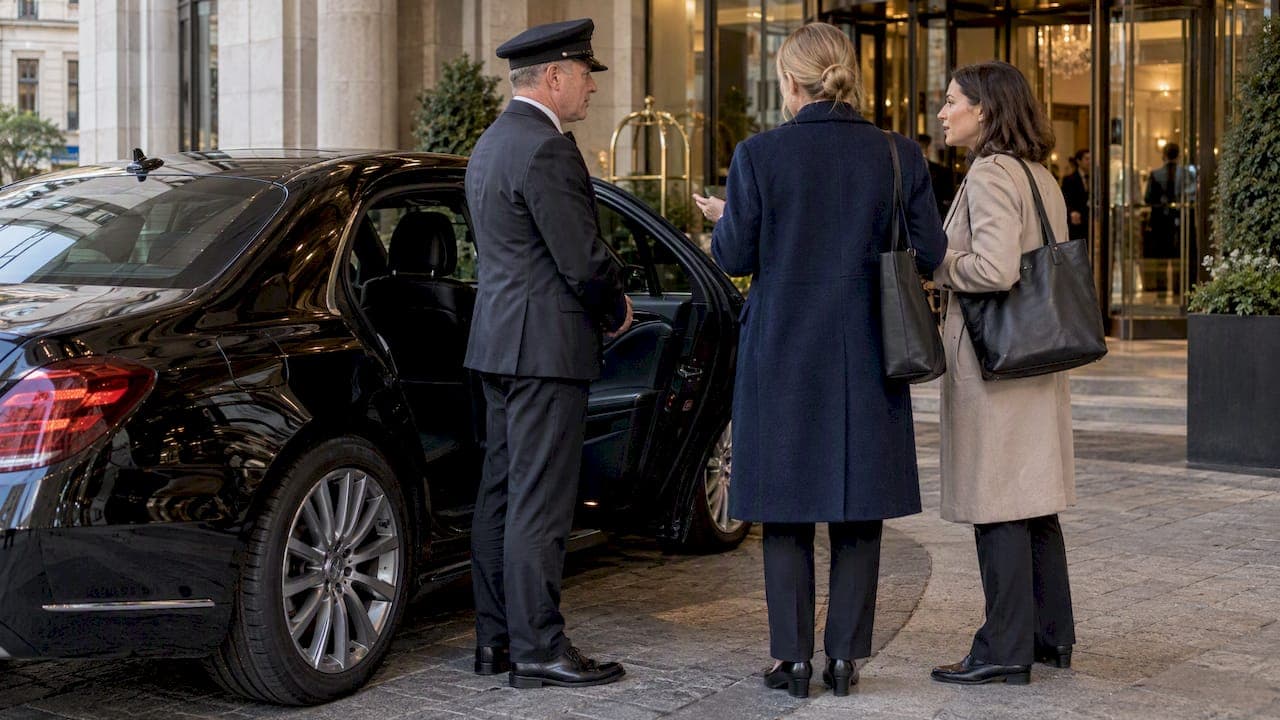
The most reliable way to plan an executive roadshow is purpose-driven and scheduled backward from the non-negotiable meeting times, not forward from the first pickup. When a day includes multiple stops or any real schedule uncertainty, an hourly chauffeur or executive-day booking becomes the practical default over point-to-point rides. Start by confirming the absolute arrival times and naming one primary on-site contact. What follows covers the checklists, a sample itinerary, and the travel risk references you need to build the rest.
TL;DR:
- Building an executive roadshow schedule backward from fixed meeting times ensures punctuality and helps manage delays or schedule shifts effectively.
- For days with multiple stops or airport legs, use hourly chauffeur services rather than point-to-point to provide flexibility for delays and unpredictable schedule changes.
- A driver brief must include absolute arrival times, contact details, venue entry instructions, and escalation protocols to prevent start-of-day slip-ups.
- Contingency plans for flight delays should be triggered after 30 minutes of tarmac delay notification and three hours of delay, prompting schedule adjustments and ground support activation.
- Incorporating travel risk management standards from the start enhances safety, especially for high-profile travelers, by assigning tracking, escalation matrices, and post-trip reviews.
Table of Contents
- Start with purpose and outcomes: define non-negotiables and stakeholder alignment
- Build the schedule backward from the non-negotiables: timing, buffers, and transfer math
- Airport transfer coordination and what flight delays mean for your schedule
- Choosing the transportation model: hourly chauffeur vs point-to-point
- Create a chauffeur-ready, usable itinerary and driver brief
- Contingency planning and travel risk management for executive roadshows
- Protecting the guest experience: privacy, vehicle standards, and smooth transitions
- Short sample day: annotated single-city multi-stop roadshow itinerary
- What I've learned planning transport for entertainment industry roadshows
- How we support executive roadshows from first pickup to last drop-off
- FAQ
- Sources
Start with purpose and outcomes: define non-negotiables and stakeholder alignment
Before anyone books a vehicle, the schedule needs a reason to exist. Every stop on an executive roadshow should trace back to a specific outcome: close a deal, record an interview, meet a regulator, appear at a premiere. Write that outcome down, because it determines everything downstream, including vehicle class, staffing, and how much buffer you can afford to lose.
Treat each meeting as a set of fixed constraints rather than a flexible appointment. An absolute arrival time, required on-site conditions such as AV setup or staging, and any security screening at the venue all shape the transportation plan before a single mile is driven.
- Document the meeting's intended outcome and the absolute arrival time, not just a target window.
- Note on-site conditions in advance: security checkpoints, loading dock access, AV or staging needs, and whether the venue requires advance clearance.
- Identify who must sign off on the plan, typically the executive assistant, a security lead if one is assigned, the on-site point of contact, and a hotel or venue liaison.
- Build a one-page trip brief that lists every non-negotiable alongside a fallback option for each one.
That one-page brief becomes the reference document every other part of the plan gets measured against. If a proposed pickup time threatens a non-negotiable, the brief tells you immediately rather than after the car is already en route.
Build the schedule backward from the non-negotiables: timing, buffers, and transfer math
Once the non-negotiables are locked, the schedule gets built in reverse. Start at the latest safe arrival time for the first meeting and work backward through every step that has to happen before the executive walks in the door.
- Set the latest safe arrival time for the meeting, which should be a few minutes earlier than the stated start time, not the start time itself.
- Add preparation time the executive needs on arrival, such as a few minutes to review notes or meet a host before the meeting begins.
- Add time for secure entry, badge processing, or parking and walk-in time at the venue.
- Add the estimated drive time for that leg, using current traffic patterns rather than free-flow estimates.
- Subtract all of that from the arrival time to get the required pickup time, then add a buffer specific to that city and hour.
Buffer size should flex with conditions, not stay fixed across the whole day. A downtown leg during evening rush hour needs a wider buffer than a suburban transfer at mid-morning, and any day that overlaps with a parade, convention, or stadium event needs extra padding on every leg that crosses the affected zone. When buffers have to shrink because the schedule is already tight, that is the signal to notify the executive assistant and the on-site contact in advance rather than hoping traffic cooperates.
A short validation checklist keeps this honest: confirm the drive-time estimate against a live traffic check an hour before pickup, confirm the venue's walk-in time hasn't changed, and confirm the chauffeur has the updated pickup time in writing. Repeating this for each leg, rather than only the first one, is what prevents a single delay from cascading through the rest of the day.
Airport transfer coordination and what flight delays mean for your schedule
Airport legs carry the most risk in any roadshow because they depend on a system the ground team doesn't control. A workable airport leg checklist includes a defined meet point, confirmed curb access or short-term parking rules for that specific airport, meet-and-greet timing that accounts for walk time from the gate, and a clear baggage handoff process so the chauffeur isn't waiting at the wrong door.
- Confirm the exact meet point and whether it changes for international arrivals versus domestic.
- Build in meet-and-greet timing that assumes a longer than average walk from gate to curb.
- Clarify baggage handoff responsibilities before the flight lands, not after.
- Set a trigger point for switching to a contingency ground plan, such as a missed connection or an extended tarmac delay.
A domestic tarmac delay that exceeds three hours can trigger mandatory deplaning, and carriers must notify passengers every 30 minutes once the delay passes the 30-minute mark, according to U.S. DOT tarmac-delay guidance. That threshold matters operationally: once a delay crosses the 30-minute notification mark, the executive assistant should already be checking whether the next meeting needs to be pushed, and by the three-hour mark, a ground contingency plan should be active rather than theoretical. Our guide to contingency ground transport walks through how to keep an itinerary intact when a flight disruption hits mid-roadshow.
Private aviation changes the coordination pattern somewhat, since departure times are more flexible and the chauffeur can often hold closer to the aircraft, but the same discipline applies: confirm the hold point, confirm who notifies whom if the departure slips, and never assume a private flight removes the need for a buffer.

Choosing the transportation model: hourly chauffeur vs point-to-point
Point-to-point service books a car for a single trip from one address to another. An hourly chauffeur, often arranged as an executive-day booking, keeps the same vehicle and driver on call for a defined block of hours, moving between stops as the schedule requires and waiting between meetings without a new booking each time.
The right choice depends on how much the day's structure can shift. A single meeting with a known start and end time, no return trip needed, and low schedule risk works fine as point-to-point. A day with three or more stops, any chance of a meeting running long, or dependencies on an airport leg earlier in the day calls for an hourly or day-rate booking, because the same vehicle and chauffeur can absorb a delay without a second dispatch.
- Point-to-point fits single-destination trips with firm start and end points and minimal risk of schedule drift.
- Hourly or executive-day bookings fit multi-stop days, roadshows with more than two meetings, or any leg following an airport pickup.
- Check minimum hour requirements, how travel time between stops is billed, and whether deadhead mileage (the driver's travel to and from the pickup) is included.
- Confirm cancellation terms before the day begins, since same-day changes are common on roadshows.
Pro Tip: Book the hourly or day-rate option whenever the day has more than two stops, even if the individual legs look simple on paper, because the value is in the buffer the model gives you, not the mileage.
Create a chauffeur-ready, usable itinerary and driver brief
A chauffeur can only protect your schedule if the itinerary actually tells them what they need to know. A usable brief goes well beyond addresses and times.
- List the point of contact's name and direct phone number for each stop, not just a general office line.
- State the absolute arrival time for each leg, distinct from the scheduled meeting time.
- Include building entry instructions, parking or loading zone details, and any secure route notes for that address.
- Note passenger preferences, any approved stops along the way, and the communication protocol if the schedule shifts.
- Define an escalation path: who the chauffeur calls first if a pickup point is wrong or a passenger can't be located.
| Itinerary field | What it should contain |
|---|---|
| Point of contact | Name and direct phone number for that stop |
| Arrival time | Absolute time, separate from the meeting's start time |
| Entry instructions | Building access, loading zone, parking location |
| Communication protocol | Preferred contact method and escalation contact |
For multi-city legs, each city should get its own version of this table rather than one combined document, since entry instructions and local contacts rarely carry over between cities. Our piece on why directors require private transport covers why this level of detail matters most for high-profile travelers specifically.
Contingency planning and travel risk management for executive roadshows
Duty of care isn't a separate workstream from the itinerary. It's part of the same plan, and the firms that treat it as an afterthought are the ones scrambling when something goes wrong mid-roadshow. ISO 31030:2021 is the international standard for travel risk management, and it lays out organizational responsibilities for exactly this kind of planning, which gives travel planners a framework to point to when asking for the time or budget to do it properly.
GBTA's five pillars of travel risk management include policy, traveler information, traveler tracking, restrictions, and incident or crisis plans, and the common failure GBTA points to is integrating risk management too late, after the itinerary is already locked.
- Assign traveler tracking for any leg considered higher risk, with a defined check-in cadence rather than an open-ended "check in if something happens."
- Build an incident escalation matrix before the roadshow starts: who gets called first, second, and third.
- Run a short after-action review once the roadshow wraps, even for days that went smoothly.
A team approach, emergency response planning, and benchmarking are the practical steps that improve a travel risk management program. GBTA Risk Committee
Folding these steps into the trip brief from the start, rather than bolting them on later, is what separates a roadshow plan that holds up under pressure from one that only works when nothing goes wrong.
Protecting the guest experience: privacy, vehicle standards, and smooth transitions
A well-timed schedule still fails the executive if the vehicle itself creates friction. Noise control, working Wi-Fi, charging ports, and seating that fits the group without crowding luggage are baseline expectations, not upgrades.
- Confirm the vehicle has reliable Wi-Fi and charging before the day starts, not after a complaint.
- Require an NDA with any ground transportation vendor handling a high-profile traveler.
- Keep meet points discreet, with minimal signage and no public-facing vehicle branding.
- Use hold points or staging lanes near venues so the vehicle isn't idling in a visible spot between stops.
Pro Tip: Assign a pre-arrival liaison at each venue to confirm the hold point and entry path a few minutes before the vehicle arrives, which prevents the awkward loop of circling a block while someone finds the right door.
Staging matters as much for a press event as it does for a closed-door meeting. Our guide to luxury transport for press conferences covers staging and meet-and-greet logistics in more depth.
Short sample day: annotated single-city multi-stop roadshow itinerary
- 6:45 AM pickup from the hotel for a 7:30 AM airport arrival ahead of a 9:10 AM departure, with a 15-minute buffer built in for downtown traffic.
- 11:40 AM landing, meet-and-greet at baggage claim, driver brief already includes the terminal's curb rules and a backup pickup point in case of a gate change.
- 12:15 PM to 1:00 PM meeting, hourly chauffeur holds nearby rather than returning to a stand, avoiding a second dispatch.
- 1:15 PM departure for a 1:45 PM meeting across town, buffer shortened to 10 minutes because the route avoids the afternoon rush corridor.
- 3:30 PM contingency check: if the 1:45 meeting runs long, the chauffeur brief already lists the fallback route to the 4:30 PM stop.
- 6:00 PM drop-off at the hotel, with mileage and wait-time logged for billing and handed off to the next day's vendor if the roadshow continues in a new city.
What I've learned planning transport for entertainment industry roadshows
The biggest mistake I see is treating the chauffeur as a line item instead of a logistics partner. A good chauffeur who has the full brief, not just an address, can absorb a surprising amount of schedule chaos without the executive ever noticing.
An executive-day booking means one vetted chauffeur, one point of contact on our side for the whole day, and on-call support if anything shifts. That structure, built over decades of working with production schedules that change by the hour, is what makes a multi-stop roadshow feel calm instead of chaotic.
— Sammy
How we support executive roadshows from first pickup to last drop-off
Hourly chauffeur service and executive-day bookings are designed so the same driver stays with you through every stop instead of handing off between bookings. Corporate concierge support, airport transfers, and multi-vehicle coordination for larger traveling parties round out what we offer when a roadshow involves more than one executive or a production crew alongside them.
If you're building a roadshow schedule now, send us your non-negotiable meeting times and one primary contact, and ask for a sample driver brief so you can see the format before you commit. You can review our full range of services, including corporate chauffeur service and airport transfers, or start directly at Rigaglobaltravel to request a quote for your next roadshow.
FAQ
What is the best way to start planning an executive roadshow?
Start by defining the outcome of each meeting and locking the absolute arrival time, then build the rest of the schedule backward from those fixed points. This prevents the common error of planning forward from the first pickup and discovering too late that a later meeting can't be reached on time.
Should I book hourly chauffeur service or point-to-point rides?
Hourly or executive-day bookings work better for any day with more than two stops or meaningful schedule risk, since the same vehicle and driver can absorb delays without a new dispatch. Point-to-point service is fine for a single destination with a firm start and end time and little chance of the schedule shifting.
What should a chauffeur's itinerary include beyond addresses and times?
A usable driver brief needs the point of contact's name and direct phone number for each stop, the absolute arrival time, building entry and parking instructions, and an escalation path if something goes wrong. Leaving these out is one of the most common reasons a roadshow day starts to slip.
How does travel risk management apply to a one-day executive roadshow?
Travel risk management applies at any length, and GBTA's five pillars (policy, traveler information, tracking, restrictions, and incident response) work the same for a single day as for a multi-week trip, per GBTA's travel risk guidance. The key is building traveler tracking and an escalation plan into the itinerary from the start rather than adding it after a problem occurs.
What happens if a flight delay disrupts the rest of the roadshow schedule?
Once a tarmac delay passes 30 minutes, airlines must notify passengers every 30 minutes, and a domestic delay beyond three hours can trigger mandatory deplaning, according to U.S. DOT contingency plan rules. That timeline should trigger an immediate check on whether later meetings need to shift and whether a ground contingency plan should activate.
Sources
- ISO 31030:2021 travel risk management — BSI
- The five pillars of travel risk management — GBTA
- Submission of Air Carrier Contingency Plans — U.S. Department of Transportation