
Book a same-day airport transfer only when you accept some risk; 24 to 48 hours ahead is the reliable default for most trips. Reserve 1 to 2 weeks out for early-morning departures, larger vehicles, or a preferred driver, and lock in 3 or more months ahead for holiday travel and major events. Airport size, flight type, group size, and vehicle choice all shift these airport transfer lead times, sometimes by days.
TL;DR:
- Booking a same-day airport transfer involves higher risk and less reliability, especially for peak travel times, groups, or early-morning departures.
- For solo travelers, one checked bag, or domestic flights, booking 24 hours in advance is generally sufficient, but international arrivals need at least 48 hours.
- Larger projects, group bookings, or special vehicles require booking several weeks to months ahead to ensure availability and proper planning.
- Airport size, terminal complexity, time of day, and traffic significantly influence the optimal lead time, with larger airports and busier times demanding longer buffers.
- Using flight numbers and a documented wait-time policy improves punctuality and reduces the likelihood of waiting fees or missed pickups.
Table of Contents
- Recommended Lead Times by Trip Type and Complexity
- Why Timing Varies: Airport Size, Time of Day, and Handoffs
- Special Cases: Groups, Vehicles, and Early Flights
- The Booking Checklist That Prevents Waiting Fees
- Three Rules to Remember When You Book
- How Riga Global Travel Manages Airport Transfer Timing
- A Note on Cost, Risk, and Convenience
- Book Your Airport Transfer With a Documented Wait-Time Policy
- Tools to Calculate Your Exact Leave-By Time
- Sources
- FAQ
Recommended Lead Times by Trip Type and Complexity
A solo traveler with a carry-on and a 10 a.m. domestic flight has very different needs than a wedding party moving through JFK on Thanksgiving weekend. Matching your booking window to your actual trip cuts both cost and stress.
Here's how the timing breaks down by scenario:
- Solo domestic, hand luggage only: same-day or next-day booking usually works. Vehicle allocation is simple, and most operators can slot in a single sedan with a few hours' notice.
- Solo domestic with checked luggage: aim for 24 hours. It gives the dispatcher time to confirm a vehicle with adequate trunk space and match you with a driver who isn't racing between two other pickups.
- Solo international: book 48 hours ahead. International arrivals involve passport control and baggage reclaim, which stretches the pickup window and makes accurate flight tracking more important.
- Early-morning departures (before 6 a.m.): reserve 1 to 2 weeks out. Overnight and pre-dawn shifts are harder to staff, and providers often need lead time to assign a dedicated driver rather than pull one from a shared rotation.
- Long-distance pickups (a suburb 45 minutes from the airport, for instance): give 48 to 72 hours. The vehicle has to be positioned correctly, and traffic variability on longer routes eats into any buffer.
- Planned groups (wedding parties, production crews, corporate delegations): book 1 to 2 weeks minimum, and 3+ months for peak holiday or event dates.
| Scenario | Recommended lead time | Same-day realistic? |
|---|---|---|
| Solo domestic, carry-on only | Same-day to 24 hours | Yes, in most cities |
| Solo domestic, checked bag | 24 hours | Sometimes |
| Solo international | 48 hours | Rarely |
| Early-morning departure | 1 to 2 weeks | No |
| Long-distance pickup | 48 to 72 hours | Rarely |
| Group or special vehicle | 1 to 2 weeks (3+ months peak) | No |
Same-day booking can work in cities with deep driver networks and light demand, but you're trading reliability for convenience. If your flight is non-negotiable, that trade rarely pays off.
Why Timing Varies: Airport Size, Time of Day, and Handoffs
No single number covers every airport transfer. A sedan pickup at a small regional airport with one terminal behaves nothing like a pickup at a sprawling international hub with multiple terminals connected by a train.
A few variables consistently move the needle:
- Airport complexity: long terminal walks, inter-terminal trains, and unpredictable security queues at major hubs add unplanned minutes that a smaller airport simply doesn't have.
- Time of day: morning and evening flight banks, when dozens of departures cluster within an hour, strain both curbside space and driver availability.
- Day of week: Sunday evenings and Monday mornings tend to run heavier than midweek, since that's when most business travel starts and ends.
- Handoffs: a hotel shuttle to a rental car return, then a terminal shuttle to your gate, each adds its own buffer requirement, and the BoardingGate arrival calculator recommends starting from a two-hour domestic or three hour international baseline before adding those extra legs.
- Road access: construction, event traffic near stadiums or convention centers, and airport-specific drop-off restrictions can add real delay on the approach, independent of anything happening inside the terminal.
A checklist-based approach that accounts for airport size, transport type, and number of handoffs produces a more dependable leave-by time than a flat rule, and it explains why more handoffs always call for a bigger buffer, not a smaller one.
Special Cases: Groups, Vehicles, and Early Flights
Some bookings simply need more runway than others. Here's where to add time and why:
- Group transfers. Book a pickup window, not a single minute. Coordinating six people through security and baggage claim means someone is always slower than expected, and a window built around the slowest person avoids a missed pickup entirely.
- Special vehicles. Stretch limousines, buses, and accessible vehicles exist in smaller fleets than standard sedans. Reserve these at least a week out, and 3+ months ahead for weddings or major productions, since the right vehicle may already be booked elsewhere.
- International arrivals. Passport control lines and baggage reclaim can add 30 to 90 minutes beyond your flight's listed arrival time. Build that into your pickup window instead of treating "landed" as "curbside ready."
- Early-morning flights. A 5 a.m. departure often means booking your driver a week or more in advance, simply because fewer chauffeurs want that shift and dispatchers need time to guarantee coverage.
Pro Tip: For any group of five or more, ask your provider whether they plan around the slowest arriving member rather than an average. That single question tells you a lot about how the company handles real-world chaos versus how it looks on paper.
The Booking Checklist That Prevents Waiting Fees
Most airport transfer complaints trace back to missing information, not bad drivers. A complete booking eliminates most of the guesswork on both sides.
Provide these details every time:
- Flight number and airline (this lets the provider track your flight in real time, not just your scheduled departure)
- Arrival or departure designation, plus terminal
- Passenger count and luggage count, including anything oversized
- Any accessibility or child-seat requirements
- Preference for meet-and-greet inside the terminal versus curbside pickup
Meet-and-greet costs a bit more but includes a driver holding a sign past security or customs, which matters most for first-time visitors or VIP arrivals. Curbside pickup is faster and cheaper but requires you to text or call once you're outside.
Grace periods matter more than most travelers realize. Professional operators typically build in a complimentary waiting period measured from actual landing time, not the scheduled arrival time, with additional charges kicking in after that window closes. Ask for the exact grace period in minutes before you book, and confirm it in writing.
Three Rules to Remember When You Book
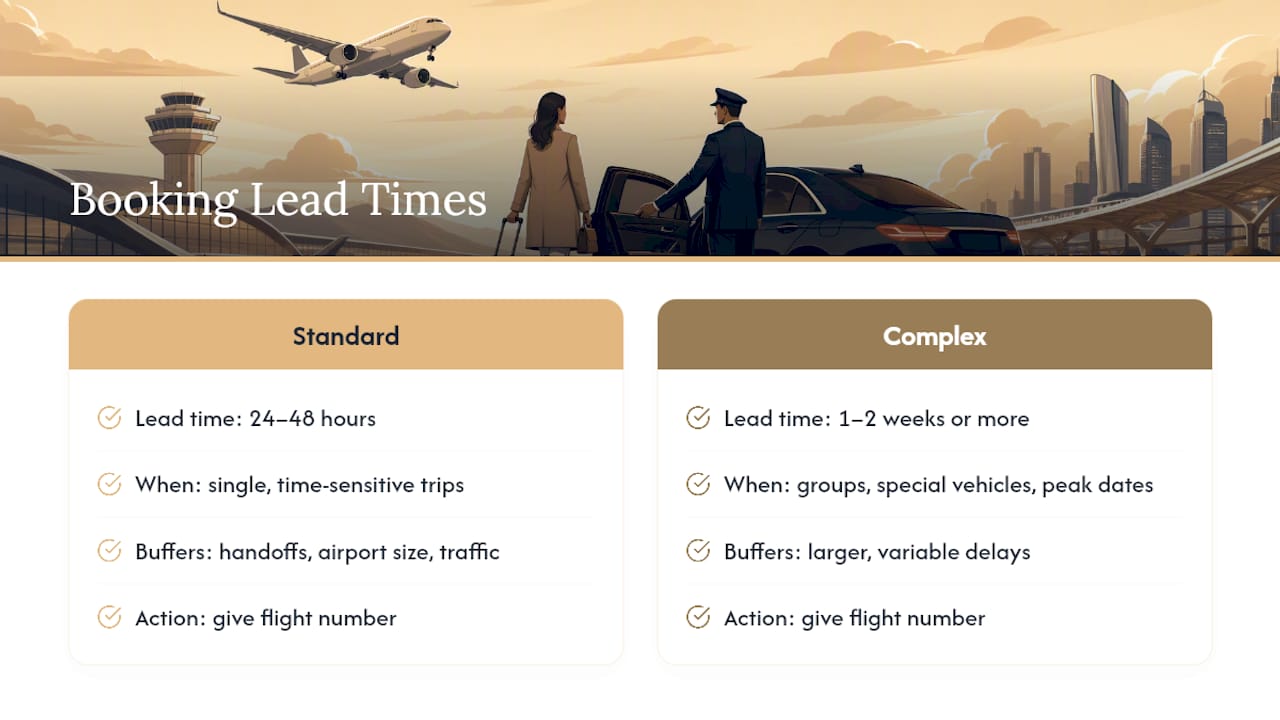
Work backward from your flight time, then add buffers for handoffs, airport size, and traffic. Default to 24 to 48 hours for a standard trip, and move to 1 to 2 weeks or more for groups, special vehicles, or peak travel dates. Always give your provider a flight number, and always confirm the wait-time policy before you need it.
How Riga Global Travel Manages Airport Transfer Timing
Airport transfers at JFK, LGA, EWR, and HPN run on the same principles covered above, applied at scale for entertainment industry clients who cannot afford a missed pickup. Riga Global Travel treats flight-number monitoring as a standing operational control, adjusting driver timing as a flight's actual status changes rather than relying on the printed schedule.
That approach shows up in a few concrete ways:
- Group pickups (a production crew, a talent entourage) get planned around a window, not a fixed minute, matching how complex logistics are handled industry-wide.
- Early-morning departures get a dedicated driver assignment in advance rather than a shared rotation slot.
- Wait times follow a documented policy rather than an improvised judgment call at the curb.
A published Chauffeur Wait Time Policy spells out the grace period and fee structure before a passenger ever gets in the car, which removes the ambiguity that causes most airport pickup disputes.
A Note on Cost, Risk, and Convenience
Booking timing is really a risk decision dressed up as a logistics question. If missing your flight or standing curbside with no ride is unacceptable, book early and pay for the certainty. If you're flexible and traveling light, a same-day reservation in a well-served city is a reasonable gamble.
Where I'd draw the line: anything tied to a hard deadline, a live production, or a group you're responsible for gets booked at least a week out. Everything else can wait until 24 to 48 hours before departure. One habit worth keeping regardless: reconfirm your pickup details 24 hours ahead, every time.
— Sammy
Book Your Airport Transfer With a Documented Wait-Time Policy
Some limousine and concierge services serve production companies, talent, executives, and corporate travel managers, backing pickups with flight-number monitoring and a written wait-time policy instead of a driver's best guess at the curb.

That coverage runs through JFK, LGA, EWR, and HPN, with the same operational discipline applied to corporate transportation and production logistics more broadly. If you know your travel dates, request a quote now and lock in a driver before the lead time window closes on you.
Tools to Calculate Your Exact Leave-By Time
Once you know your booking window, pin down the exact time to leave for the airport itself.
- BoardingGate's Airport Arrival Calculator applies the two-hour domestic, three-hour international baseline and adds your drive time.
- OnTimer's calculator factors live traffic and TSA wait estimates for a more personalized leave-by time.
- The Schedules walks through airport size, transport type, and buffer for multi-leg trips.
- For event or production crews juggling multiple handoffs, this buffer-time framework from event logistics planning applies just as well to group airport transfers.
Sources
- Airport Arrival Calculator — When to Leave | Boarding Gate
- Airport Time-to-Leave Calculator | What Time Should I Leave? | OnTimer
- Airport Transfer Time Checklist for Flights
- Heathrow Airport Transfer Guide: Pickup & Booking Tips
FAQ
What Is the Airport 45 Minute Rule?
There's no official "45 minute rule," but many airlines and airports use roughly 45 minutes as the minimum recommended gap between connecting flights at the same terminal. It's a rough floor, not a guarantee, since a delayed first leg or a long walk between gates can eat that cushion fast.
How Long Is a Typical Connecting Flight Transfer?
Most airports recommend about two hours before domestic flights and three hours before international flights as a baseline. Airports with a single terminal and no security recheck tend toward the shorter end.
Is 20 Minutes Enough Time for a Connecting Flight?
Twenty minutes is tight for almost any connection and risky if your gates are in different terminals or you need to clear security again. It can work only when both flights are at adjacent gates in the same terminal with no rescreening required.
Is 40 Minutes Enough for a Connecting Flight?
Forty minutes is workable at smaller airports with gates close together, but it leaves little room for a delayed arrival or a crowded terminal train. Larger hubs with inter-terminal transport need a larger buffer to stay comfortable, as noted with handoff issues above.
How Far in Advance Should I Book My Airport Transfer?
Book 24 to 48 hours ahead for a standard solo or small-party trip, and 1 to 2 weeks or more for groups, special vehicles, or early-morning flights. Peak holiday periods and major events call for booking 3 or more months out to guarantee vehicle availability.
Does Riga Global Travel Offer Airport Transfers?
Yes, Riga Global Travel provides airport transfer service covering JFK, LGA, EWR, and HPN, built around flight-number monitoring and a documented wait-time policy. Pricing is available directly through the company rather than published as a flat rate.