
A production transportation budget covers every cost of moving talent, crew, equipment, and gear across a shoot: chauffeured sedans, crew shuttles, airport transfers, equipment trucks, permits and surcharges, and a contingency line for the delays that will happen. The rule that separates a budget that holds from one that blows up mid-shoot is simple: price for reliability first, and let cost savings come from consolidation and contract terms, not from shaving the hourly rate on talent transport.
TL;DR:
- Reliable scheduling and contingency planning for standby vehicles and standby hours are crucial to prevent costly delays and schedule disruptions.
- Pricing models should match the type of vehicle use, with hourly or daily retainers suited for unpredictable days and flat rates ideal for one-off trips.
- Building transportation into the schedule and sharing plans early reduces redundant bookings and minimizes budget leaks caused by miscommunication.
- Verifying insurance, permits, and local compliance in advance prevents unexpected costs from fines, liability issues, or permit violations.
- Using tracking technology and centralized invoicing helps maintain accurate budgets and mitigates delays that can escalate downstream costs.
Table of Contents
- What Goes Into a Production Transportation Budget?
- Which Pricing Model Fits Your Shoot?
- How Do Wrap-Time Buffers and Standby Protect the Budget?
- What Should Be in the Vendor Contract and Insurance Checklist?
- Where Can You Cut Cost Without Adding Risk?
- What Happens to the Budget When Transportation Runs Late?
- What Permits and Compliance Rules Affect Transportation Costs?
- How Should Transportation Budgeting Connect to the Production Schedule?
- Do Green Transportation Options Change the Budget?
- What Technology Helps Manage Transportation Budgets?
- Where Can You Find Templates and Vendor Briefing Guidance?
- A Few Things I've Learned About Production Transport Budgets
- Book Production Transport Through Riga Global Travel
- Sources
What Goes Into a Production Transportation Budget?
Every line-item transportation budget starts the same way: list the vehicle categories you actually need, then attach a formula to each one. This is the part production accountants call the transportation subtotal, and it's the single most-referenced structure in working budget templates used across film and television.
A practical version, adapted from the John August short working budget, breaks down into these lines:
- Talent sedans: 1 to 3 vehicles, priced per hour or per day, for principal cast pickups and set transfers.
- Talent SUVs: used for larger groups or when a client wants extra cargo space; priced the same way as sedans.
- Crew Sprinter or shuttle vans: one van per 8 to 12 crew members, usually a flat day rate.
- Charter bus: for crews above 25 to 30 people, priced as a day or multi-day rate rather than per seat.
- Equipment truck: separate from passenger vehicles, priced by truck size and mileage.
- Airport transfers: flat rate per trip, multiplied by the number of cast and executive arrivals/departures.
- Permits, tolls, and parking: location-dependent, usually estimated per shoot day.
- Wrap-time contingency: a buffer row covering unplanned overtime hours.
The formula for hourly lines is straightforward: vehicles × hours per day × hourly rate × number of shoot days. For flat-rate lines like airport transfers, it's trips × flat rate per trip. Say a shoot books two talent sedans at $85 an hour for 10 hours across 5 days: that's 2 × 10 × $85 × 5, or $8,500, before surcharges. Add four airport transfers at $150 flat and you're at $9,100. Layer in a 10 to 15% wrap contingency, per the framework in the transportation coordinator checklist, and your working subtotal lands closer to $10,300. That gap between the raw hourly math and the contingency-adjusted number is exactly where most first-time budgets fail.
Which Pricing Model Fits Your Shoot?
Ground transport vendors sell three basic pricing shapes, and picking the wrong one is how budgets quietly bleed money.
- Hourly or daily retainers fit volatile schedules, especially talent transport where call times shift and wrap runs long. You pay for flexibility, and on unpredictable shoot days that flexibility is worth more than the marginal savings of a fixed quote.
- Per-trip flat rates work for one-off movements: a single airport pickup, a courthouse run, a location scout. There's no ambiguity about what you owe, and it's the cleanest line item on a budget.
- Multi-day charter or coach contracts become the better buy once crew headcount and shoot length both climb. The charter bus planning guide notes that multi-day bookings routinely reduce the effective daily rate compared to reimbursing individual mileage or rideshare receipts for a full crew.
A rough rule of thumb: if a vehicle is booked frequently for multiple hours on several consecutive days, price it as a retainer or charter, not a per-trip rate. Below that threshold, per-trip pricing usually wins.
How Do Wrap-Time Buffers and Standby Protect the Budget?
Reliability costs money upfront and saves money downstream. Treat transportation failures the way you'd treat any other production risk: something that compounds fast once it starts. A driver who leaves at his scheduled end time because no overtime was budgeted, mid-shoot, with talent still on set, doesn't just create an awkward moment. It creates a re-booking scramble, a delayed call time tomorrow, and a domino effect through the whole day's schedule, a dynamic laid out in OnTimeElite's breakdown of set transportation duties.
Build these controls into the budget as actual line items, not verbal understandings with the vendor:
- A guaranteed driver assignment clause, so the same driver covers the same call sheet start to finish.
- A minimum booking window that assumes overtime is likely, not exceptional.
- At least one backup vehicle on standby for multi-vehicle days.
- A standby-hours row and a driver lodging row for multi-day charters, per the charter bus guide's recommendation to negotiate lodging and per diem into the vendor contract upfront.
Pro Tip: Share the transportation plan with department heads during the budgeting phase, not the week before shooting. A centralized plan shared early stops assistant directors and location managers from booking their own redundant cars, which is one of the most common sources of budget leakage on mid-size productions.
What Should Be in the Vendor Contract and Insurance Checklist?
Before signing anything, verify the paperwork. A certificate of insurance (COI) should show liability minimums that match your production's insurance requirements, plus workers' compensation coverage for drivers.
Check the contract for these clauses specifically:
- Overtime rates stated as a number, not "billed as incurred."
- Cancellation terms and the exact cancellation window before penalties apply.
- Deposit amount and refund conditions.
- Equipment liability and who's responsible for damage during equipment moves.
- Permit, congestion charge, and toll pass-through language, so location-specific fees don't show up as a surprise invoice line later.
The transportation coordinator checklist recommends documenting every verified item before the vendor is approved, not after. A short checklist that a coordinator can run through in 15 minutes per vendor beats a verbal assurance every time, and it's the difference between catching a coverage gap in preproduction versus discovering it after an incident.
Where Can You Cut Cost Without Adding Risk?
Cost control on ground transport comes down to a handful of levers, and none of them involve simply booking the cheapest hourly rate available.
- Centralize bookings through one coordinator instead of letting departments book independently; consolidating pickup points and routes is a common practice among experienced line producers and it's also the strategy Riga Global Travel's New York production coverage points to for capturing volume discounts.
- Separate equipment transport from passenger shuttles. Equipment moves typically carry higher insurance requirements and different labor needs, and mixing the two lines obscures where the money actually goes.
- Negotiate flat weekly rates that build in wrap-time coverage, so you're not renegotiating overtime terms every single day.
- Accept a higher hourly rate when it buys reliability. A vendor with dedicated drivers and standby vehicles costs more per hour than an ad-hoc rideshare arrangement, but the true-cost comparison from Detailed Drivers shows professional services running 15 to 25% higher upfront while cutting downstream delay and administrative costs, which is usually the better trade for a production on a tight schedule.
Route consolidation tactics from outside the entertainment industry apply here too. Trade show logistics planners use the same fleet-utilization principle: fewer, fuller vehicle runs beat more vehicles running half-empty.
What Happens to the Budget When Transportation Runs Late?
A late pickup doesn't cost you the price of one ride. It costs you crew idle time, a shifted lighting setup, sometimes a full company move pushed back an hour, and on a union set, overtime charges that dwarf the original transportation line. That's the real math behind why reliability gets priced into the budget as its own category, not treated as a free assumption.
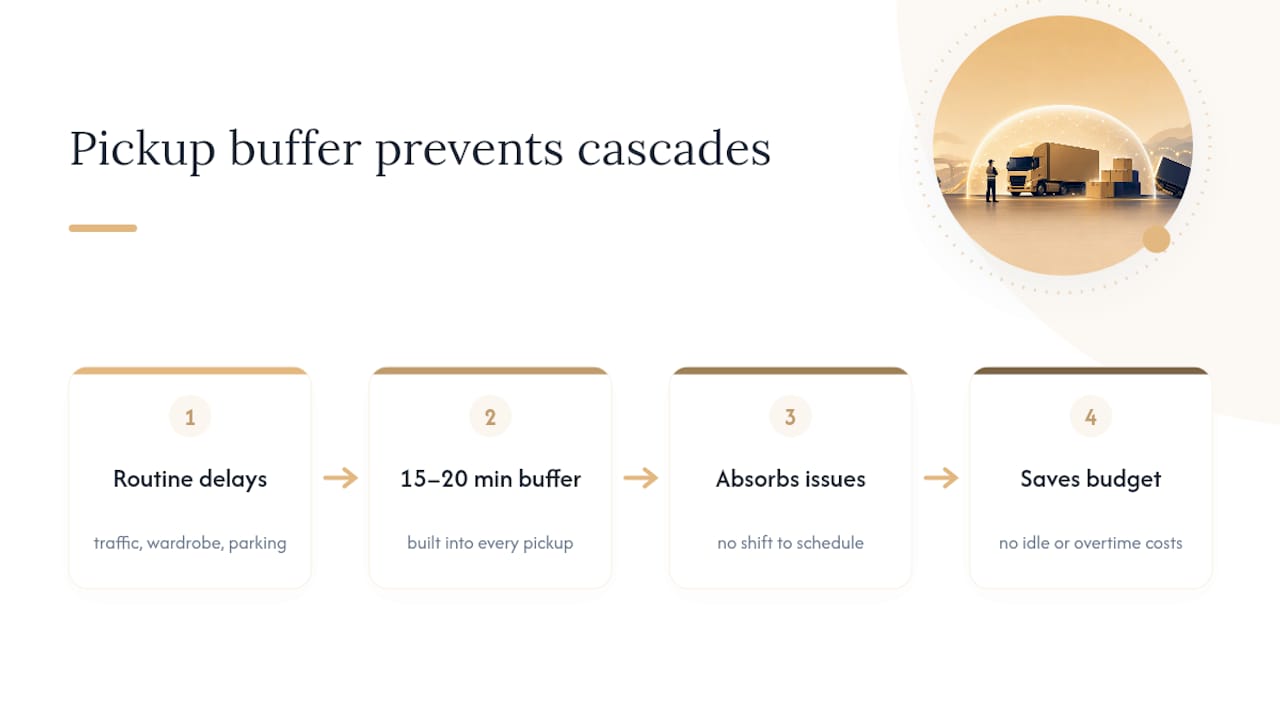
Mitigation starts with buffer time built into every pickup window, not just the ones that feel risky. A 15 to 20 minute cushion on talent pickups absorbs the routine variables: traffic, a wardrobe delay, a driver circling for parking near a location with no dedicated loading zone. Multiply that cushion across dozens of moves in a shoot week and it becomes a real budget line, not a rounding error.
The second lever is communication protocol. Vendors who provide real-time tracking and a direct line to the coordinator let you catch a delay before it compounds. A driver stuck 20 minutes out who calls ahead gives the AD time to adjust the shot order; a driver who says nothing until arrival gives you nothing but a blown call time. Contract language should specify communication expectations alongside the usual liability terms, because a vendor's responsiveness during a delay matters as much as their rate card.
Budget for this by treating standby hours and driver overtime as planned costs rather than emergency ones. A production that assumes zero delays every day is a production that will blow its transportation line by the second week.
What Permits and Compliance Rules Affect Transportation Costs?
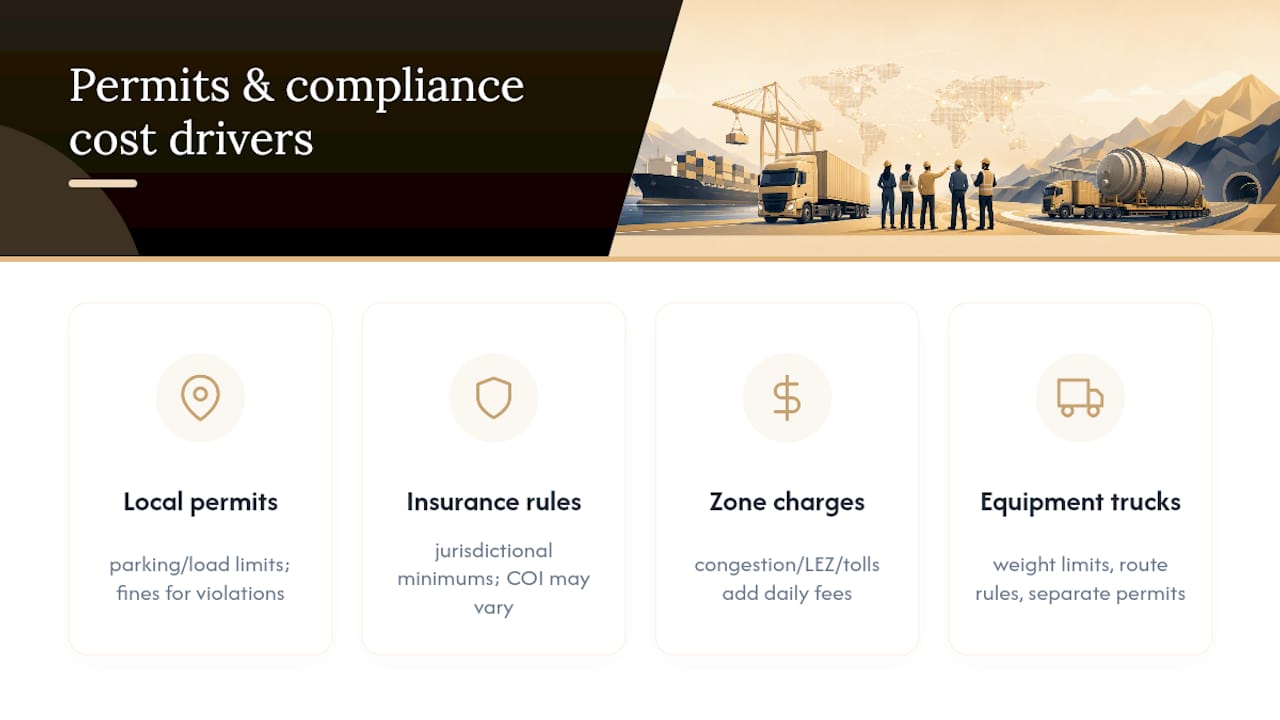
Vehicle compliance and permitting aren't paperwork you handle once and forget. Local filming permits frequently dictate where vehicles can park, load, and stage, and violating those terms can mean fines that land directly on the production's books rather than the vendor's.
Commercial passenger vehicles used for chauffeured production transport typically need to carry specific licensing and insurance minimums set by the jurisdiction they operate in, and those minimums vary by state and sometimes by city. A COI that satisfies a shoot in one market may not satisfy the requirements in another, so verifying insurance limits against local rules, not just your production's general policy, is a step that belongs in preproduction, not the week of the shoot.
Congestion pricing zones, low-emission zones, and location-specific toll structures also affect the budget directly. Some urban markets charge entry fees for certain vehicle classes during specific hours, and a production running multiple vehicle moves through a congestion zone all day can rack up fees that weren't accounted for in the original estimate. Building a permit and compliance line into the transportation subtotal, rather than lumping it into a general locations budget, keeps the true cost of ground transport visible to whoever is signing off on the numbers.
Equipment trucks carry their own compliance layer: weight restrictions, route limitations for oversized vehicles, and sometimes separate permitting from passenger vehicle permits entirely. Treating equipment moves as a subset of "transportation" without accounting for these separate rules is how budgets miss real costs.
How Should Transportation Budgeting Connect to the Production Schedule?
Transportation budgeting works best when it's built alongside the shooting schedule, not bolted on after the schedule is locked. A call sheet that puts talent at three separate locations in one day multiplies vehicle needs and driver hours in ways a standalone transportation estimate, built weeks earlier, won't capture.
The practical fix is treating the transportation coordinator as part of the scheduling conversation, not a downstream vendor manager. When the assistant director and the transportation coordinator review the shooting schedule together, they can flag high-risk days early: company moves, night-to-day turnarounds, multiple unit splits, all of which spike vehicle and driver requirements. A centralized transportation plan shared with department heads during budgeting prevents the common failure mode where locations, art, and talent departments each book their own vehicles for the same day, duplicating cost and confusing routing.
Resource allocation runs both directions. A tight transportation budget can force schedule compromises, consolidating locations, adjusting call times to cut vehicle hours, and a locked schedule with heavy company moves can force the transportation budget higher regardless of what was planned in preproduction. Treating the two as separate spreadsheets that only meet at the final budget review is how productions get blindsided by a transportation overage they could have seen coming three weeks earlier.
Do Green Transportation Options Change the Budget?
Electric and hybrid vehicle fleets are becoming more available in major production markets, and the cost picture is mixed rather than uniformly better or worse than traditional fleets.
On the savings side, electric sedans and SUVs typically cost less per mile in fuel or charging costs than gas-powered equivalents, and some municipalities offer reduced or waived fees for low-emission vehicles entering congestion or low-emission zones. That can offset part of the permit and compliance costs discussed earlier, particularly for productions doing heavy urban location work.
On the cost side, electric and hybrid vehicle availability in premium chauffeured categories is still catching up to demand in some markets, which can mean paying a premium for guaranteed access rather than a discount. Charging logistics also matter for multi-day charters: a coordinator booking an electric shuttle fleet needs to confirm charging infrastructure along the route, not just at the base location, or risk a vehicle going offline mid-shoot day.
The realistic approach for most productions right now is treating green transportation as a case-by-case decision tied to the specific market and vehicle category, rather than a blanket cost-saving mandate. A production shooting primarily in a dense urban core with congestion pricing may see real savings from an electric fleet. A production covering wide geographic distances with tight schedule windows may find traditional vehicles still deliver better reliability per dollar, at least until charging infrastructure catches up in more markets.
What Technology Helps Manage Transportation Budgets?
Spreadsheet templates still do most of the heavy lifting on smaller productions, and a well-built one, with formulas for vehicle count, hourly rate, and shoot days already wired in, remains one of the fastest ways to keep a transportation subtotal accurate as the schedule changes.
Beyond spreadsheets, a few categories of tools show up repeatedly in how coordinators manage larger transportation operations. Fleet and dispatch software used by chauffeured transport vendors gives coordinators real-time visibility into vehicle location and driver status, which turns the delay mitigation discussed earlier from guesswork into an actual monitoring process. Production management platforms that integrate call sheets, budgets, and vendor contacts in one place reduce the risk of a transportation line item getting updated in one document and missed in another.
For coordinators managing multiple vendors across a season or a multi-location shoot, invoiced direct billing through a single production account, rather than a stack of individual receipts, simplifies reconciliation considerably and gives the production accountant a cleaner audit trail. The technology matters less than the discipline behind it: whatever system you use, the transportation subtotal needs to be visible and current, not reconstructed at wrap from a folder of receipts.
Where Can You Find Templates and Vendor Briefing Guidance?
Riga Global Travel's own resources cover the practical side of this in more depth than a single article can. The production shuttle cost guide walks through sample rates and spreadsheet-ready formulas for U.S. markets, and the production transportation coordinator overview breaks down the verification steps a coordinator should own before booking.
Before requesting a quote from any vendor, gather your call sheets, total headcount by department, vehicle mix needed, equipment list with dimensions and weight, and a location map showing every pickup and drop point. Vendors quote more accurately, and more competitively, when they see the full picture upfront rather than a single "we need cars" request. The luxury transport booking guide covers exactly what to include in that brief.
A Few Things I've Learned About Production Transport Budgets
One production I reviewed nearly lost a full shoot day when a talent sedan's driver hit his contracted end time with no overtime clause in place. A wrap-contingency line, budgeted from day one, would have prevented the scramble entirely. Three moves worth making before your next booking cycle: centralize every vehicle request through one coordinator, add a wrap-time contingency row to every estimate, and request full COI documentation before you sign. Check the transportation coordinator resource for the verification steps in full.
— Sammy
Book Production Transport Through Riga Global Travel
Riga Global Travel is built for exactly the budgeting problems this article covers: chauffeured sedans, crew shuttles, and airport transfers priced as hourly retainers, daily rates, or weekly charters, so your transportation subtotal matches how your shoot actually runs instead of forcing every day into a one-size quote.

Production accounts get invoiced direct billing, which keeps a season's worth of vehicle costs on one clean statement instead of scattered receipts. When you request a quote, send your call sheet, headcount, and pickup locations upfront. Productions working in Los Angeles can start with the Los Angeles limousine and executive transport page, and New York productions can check ground transport options in New York for talent and executive moves. Reach out with your shoot dates and vehicle mix to get a scoped quote before your next production budget is locked.
Sources
- Short working budget (John August)
- Charter bus for film production crews: planning guide (CharterBusesUSA)
- Transportation coordinator checklist: 8 essential steps for 2026 (JetCharterBus)