
Chauffeured car services run on four commercial pricing models: hourly, flat/point-to-point, packaged or event rates, and corporate accounts. Each fits a different trip shape: hourly suits uncertain or multi-stop days, flat rates suit predictable single routes, packages suit bundled events, and corporate accounts suit high-volume programs. The model name matters less than what's baked into the contract, since overtime rules, inclusions, and billing terms usually swing the final invoice more than the headline rate.
TL;DR:
- Flat rates work best for predictable, direct trips like airport transfers, especially when flight delays are monitored and included in the contract.
- Hourly pricing is more suitable for flexible, multi-stop plans but can quickly become expensive due to overtime and standby charges if trips run late.
- Package rates are advantageous for events with fixed windows, bundling hours, vehicle types, and gratuity into a lower overall cost.
- Contract terms such as overtime calculation, wait-time grace periods, and invoice format are more critical to controlling costs than the pricing model itself.
- Request detailed written policies on overtime, wait time, cancellation, insurance, and invoice format before comparing quotes to avoid hidden expenses.
Table of Contents
- How Do Car Service Pricing Models Actually Work?
- Which Pricing Model Fits Your Trip?
- What Does It Actually Cost? Three Worked Examples
- What Contract Terms Protect Your Budget?
- Why This Guide Is Built for Production and Corporate Buyers
- The Model Matters Less Than the Contract Around It
- Get a Rate Sheet Built for Your Production or Account
- Sources
How Do Car Service Pricing Models Actually Work?
Each model calculates cost differently, and the fine print inside each one is where budgets get blown.
Hourly pricing charges by the block of chauffeur time, not the mile. Most operators set a minimum booking, often two to four hours depending on vehicle class and city, then bill in set increments after that. The clock typically starts when the vehicle arrives (or at the scheduled pickup time, whichever the contract specifies) and stops at drop off. Hourly pricing works best for flexible, multi-stop plans, but overtime and standby charges kick in fast if a show wraps late or a talent pickup slides. Rounding practices vary. Some providers round up to the next quarter hour, others to the half hour, so ask before you sign.
Flat, or point-to-point, pricing covers one route for one fixed price, calculated by zone, distance, or estimated drive time. This model tends to save money on direct, predictable routes like airport transfers, but it loses its edge once you add stops or extend the hold time. Good flat-rate contracts include flight monitoring and a meet-and-greet clause so a delayed landing doesn't trigger a separate wait fee.
Package rates bundle hours, vehicle type, and sometimes a driver gratuity into one number for a defined event window, like an awards show or a full production day. Packages usually carry passenger and vehicle caps, and the effective hourly rate is often lower than booking the same hours à la carte.
Corporate accounts shift the relationship from per-trip pricing to a standing arrangement. Expect consolidated monthly invoicing, Net-30 terms, and volume discounts tied to trip counts or monthly spend, plus a dedicated account manager who handles scheduling across a production or a travel department.
Across all four models, watch for the line items that live outside the headline rate:
- Gratuity (often 20 percent, sometimes built in, sometimes not)
- Tolls and parking
- Vehicle cleaning fees
- Wait-time charges beyond the grace period
- After-hours and holiday surcharges
Vehicle class also reshapes the math: a sedan and an SUV price close together, but a Sprinter van or a shuttle bus usually moves to a day rate or package structure because hourly billing on a 14-passenger vehicle rarely makes sense for a full crew move.
Which Pricing Model Fits Your Trip?
Match the model to the shape of the trip before you request a quote, not after.
- Count your stops. One pickup, one drop off, points to flat pricing. Three or more stops, or a schedule that could change same-day, points to hourly.
- Rate your certainty. If call times are locked and confirmed, flat or package pricing protects your budget. If a shoot day could run long, hourly with a known overtime rate is safer than a flat quote that assumes a clean exit.
- Check passenger turnover. Talent arriving and departing at different times during one event usually needs a package with hold time, not four separate point-to-point bookings.
- Match vehicle class to headcount. A single executive moves on a sedan hourly rate; a ten-person crew moves on a Sprinter day rate or shuttle package.
- Estimate hold time honestly. Awards shows and premieres often need a driver standing by for hours between drop off and pickup. Bake that into the quote instead of negotiating it after the invoice arrives.
Before you book, ask every provider the same five questions: What's the overtime rate per increment? What counts as wait time, and how long is the grace period? Is gratuity included or added? What's the cancellation window? And can multiple bookings roll into one invoice? Wait-time grace periods vary widely between operators, and that variance is usually where a "cheap" quote turns expensive.
Decline or renegotiate any quote that won't specify overtime terms in writing, that quotes flat pricing for a trip with an undefined number of stops, or that can't confirm chauffeur credentials and insurance on request.
Pro Tip: When a trip's shape is genuinely unclear, request both an hourly and a flat quote using the same inputs, stops, expected wait time, tolls, gratuity, and compare the totals instead of the headline numbers.
What Does It Actually Cost? Three Worked Examples
Real budgeting means running the math on your specific trip, not trusting a rate card in isolation.
Airport transfer, single executive. A flat quote for LAX to Beverly Hills might land at one price covering the drive, tolls, and 30 minutes of complimentary wait time for flight delays. The hourly alternative, with its typical two to four hour minimum, often costs more for the same short run unless the flight lands hours late and eats into standby time.
Awards show, one talent, extended hold. Hourly pricing with a four-hour minimum plus two hours of standby usually beats a flat rate here, because the vehicle isn't moving, it's parked and waiting through the red carpet and after-party window. A package rate built specifically for the event, hours plus hold time bundled, often lands cheapest of the three.
Production roadshow, multi-city, multi-stop. A day rate or roadshow package that pre-negotiates hold time and a standby window avoids the repeated overtime charges that pile up when a crew runs behind schedule at every stop, which is common on multi-day roadshows.
To estimate quickly, build a checklist before you call anyone:
- Number of stops and estimated drive time between each
- Expected hold or wait time, padded generously
- Passenger count and required vehicle class
- Tolls, parking, and gratuity policy
- Cancellation or change window
Run those five inputs against hourly, flat, and package math side by side, and the cheapest model on paper usually reveals itself fast.
What Contract Terms Protect Your Budget?
The contract, not the rate sheet, decides what you actually pay. Before signing, require written terms covering cancellation windows, how overtime gets calculated and rounded, grace periods for delays, vehicle substitution rights if a car breaks down, and exactly which services are included versus billed separately.
On invoicing, push for consolidated monthly billing with Net-30 terms and line-item receipts formatted for expense systems like Concur or Expensify. That single change saves a production accounting team hours every month compared to reconciling dozens of individual receipts.
Negotiation levers worth using:
- Volume discounts tied to monthly trip counts or spend thresholds
- Guaranteed minimum vehicle availability during peak season
- A service-level agreement covering response time and substitute vehicles
- Coded invoice fields by project or traveler for faster internal approval
Ask providers for insurance documentation and safety records up front rather than after an incident. A corporate chauffeur vetting checklist is worth building once and reusing on every new vendor.
Why This Guide Is Built for Production and Corporate Buyers
Sammy covers ground transport logistics for productions and corporate travel programs, the kind of booking where a wrong pricing model costs thousands across a multi-week shoot, not dollars on a single ride. Riga Global Travel operates chauffeured, shuttle, and concierge programs for entertainment productions and corporate accounts, which shapes this guide's focus on contract mechanics over consumer tips.
Before hiring any provider, request three things: proof of commercial insurance coverage, references from a comparable production or corporate client, and a documented safety record. Any operator confident in its service will hand these over without hesitation.
The Model Matters Less Than the Contract Around It
Most guidance on this topic treats pricing models like a multiple-choice quiz, pick hourly or flat and you're done. That's backwards for production and corporate buyers. The real budget risk lives in what's undefined: how overtime rounds, what counts as wait time, whether gratuity is baked in, and whether your invoices arrive in a format your accounting team can actually process without a week of manual coding.
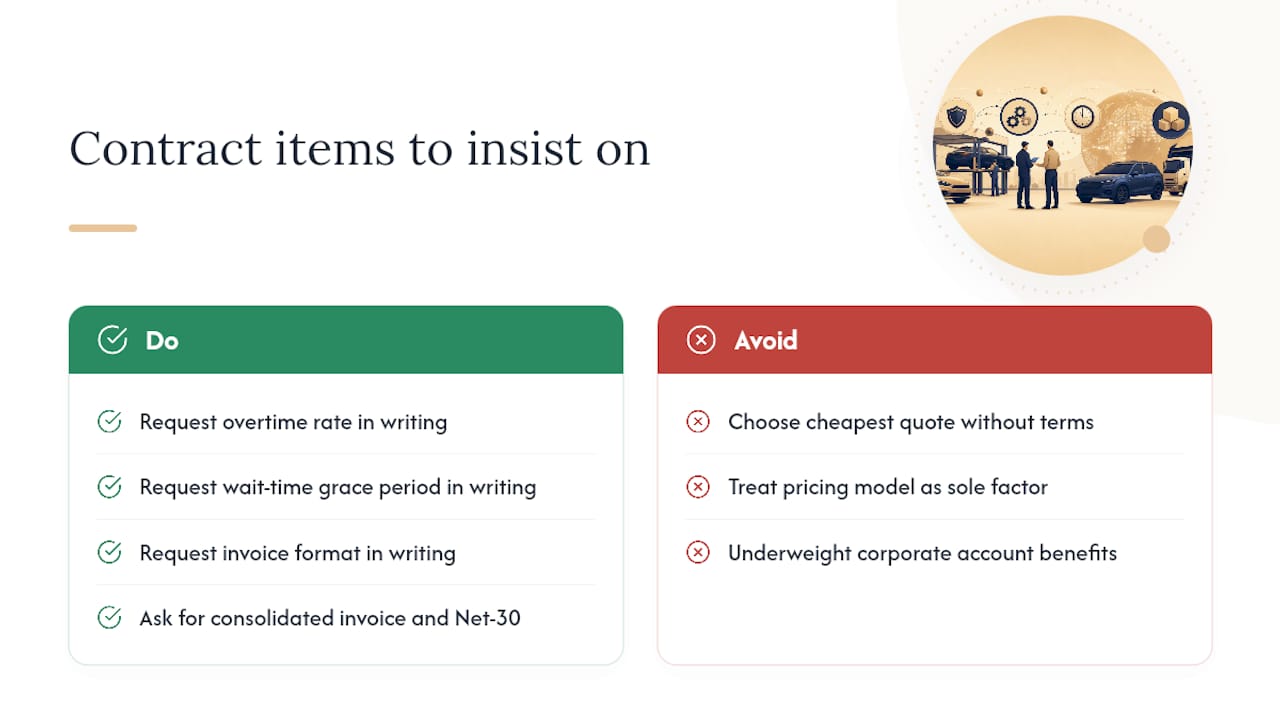
Conventional advice also underweights the corporate account, treating it as a loyalty perk rather than a cost-control tool. For any organization booking ground transport more than a few times a month, the consolidated invoice and Net-30 terms often save more than any per-ride discount ever will, simply by cutting the administrative overhead on the finance side.
If you take one thing from this guide, make it this: request the overtime rate, the wait-time grace period, and the invoice format in writing before comparing a single dollar figure. The cheapest quote on paper is frequently the most expensive one after a long shoot day.
— Sammy
Get a Rate Sheet Built for Your Production or Account
Riga Global Travel runs chauffeured, shuttle, and concierge transport specifically for productions, talent, and corporate travel programs, not the walk-up rental market, which means the pricing conversation starts from your call sheet or travel policy instead of a generic rate card. Default service includes flight monitoring on airport runs, meet-and-greet handling, and a choice of consolidated monthly invoicing or per-trip billing depending on how your accounting team prefers to process expenses.
For a production roadshow, a recurring talent pickup schedule, or a corporate travel program logging more than a few trips a month, request a tailored rate sheet through the corporate car service page or start with a market-specific quote through the New York limousine service or Los Angeles limousine service pages. Either path gets you a real quote built around your actual trip shape, not a rate card that assumes you're average.
Sources
- Understanding Limo Rental Pricing: Hourly Rates, Flat Fees and Package Options
- Chicago Corporate Car Service Guide: Billing, Accounts & Costs