A small production shuttle program, one or two vehicles running crew and talent for a typical 20 day shoot, runs a few thousand to several tens of thousands of dollars per month whether you hire a chauffeured provider or own the vehicles outright. Hired programs cluster near the low end once you factor in a provider's insurance and maintenance overhead; owned fleets look cheaper on paper until you add driver payroll, storage, and unscheduled repairs.
Here's the one-line verdict production accountants can carry into a budget meeting: for anything shorter than a multi-month tour, hiring a chauffeured provider costs less in total and carries dramatically less risk than buying vehicles.
Ownership only pencils out when you have predictable, year-round demand for the same routes. Everything else is a hire decision dressed up as a purchase decision.
Three moves turn this range into a number you can actually commit to a line producer:
- Request a firm quote from at least two vendors with your exact route, dwell time, and days-per-week baked in, not a generic day rate.
- Model a 10% contingency on top of the base estimate for off-hour premiums, holding time, and schedule slips.
- Run a sample route test during prep week so the vendor's mileage and time assumptions match reality before you sign anything.
Key Takeaways
A production shuttle program in the U.S. typically costs $8,000 to $28,000 per month for a small fleet, and hiring a chauffeured provider almost always beats ownership for anything shorter than a multi-month tour.
| Point | Details |
|---|---|
| Daily hire range | Typical hire rates for a 25-seat shuttle vary depending on market and season. |
| Build in contingency | Reserve 8% to 12% of total operating cost for off-hour premiums and schedule slips. |
| Prioritize two line items | Driver labor and insurance drive the largest share of monthly operating cost; get firm numbers on both first. |
| Fixed costs dominate per-trip pricing | Maximize schedule density since fixed costs like insurance and storage get allocated whether you run one trip or four. |
| Separate capital from operating costs | Ownership shifts spend into payroll and maintenance reserves; hiring converts it into a single predictable day rate. |
| Work with a specialist provider | Rigaglobaltravel bundles driver, insurance, and dispatch into one quoted rate for production clients across major U.S. markets. |
Table of Contents
- Production Shuttle Cost by Vehicle Type and Hire Model
- What It Actually Costs to Run a Shuttle Every Month
- What Actually Moves Your Production Shuttle Price
- How to Build a Production Shuttle Budget Step by Step
- Should You Buy Vehicles or Hire a Provider?
- Permits, Insurance, and Driver Requirements You Can't Skip
- A Sample Monthly Budget You Can Copy
- Production Planning Checklist That Actually Prevents Overruns
- The Surprises That Blow Up a First-Draft Shuttle Budget
- Simplify the Estimate: Work With a Specialist Provider
- Sources
Production Shuttle Cost by Vehicle Type and Hire Model
The number you land on depends almost entirely on two choices: what size vehicle you need, and whether you're buying it or renting the driver's time along with it.
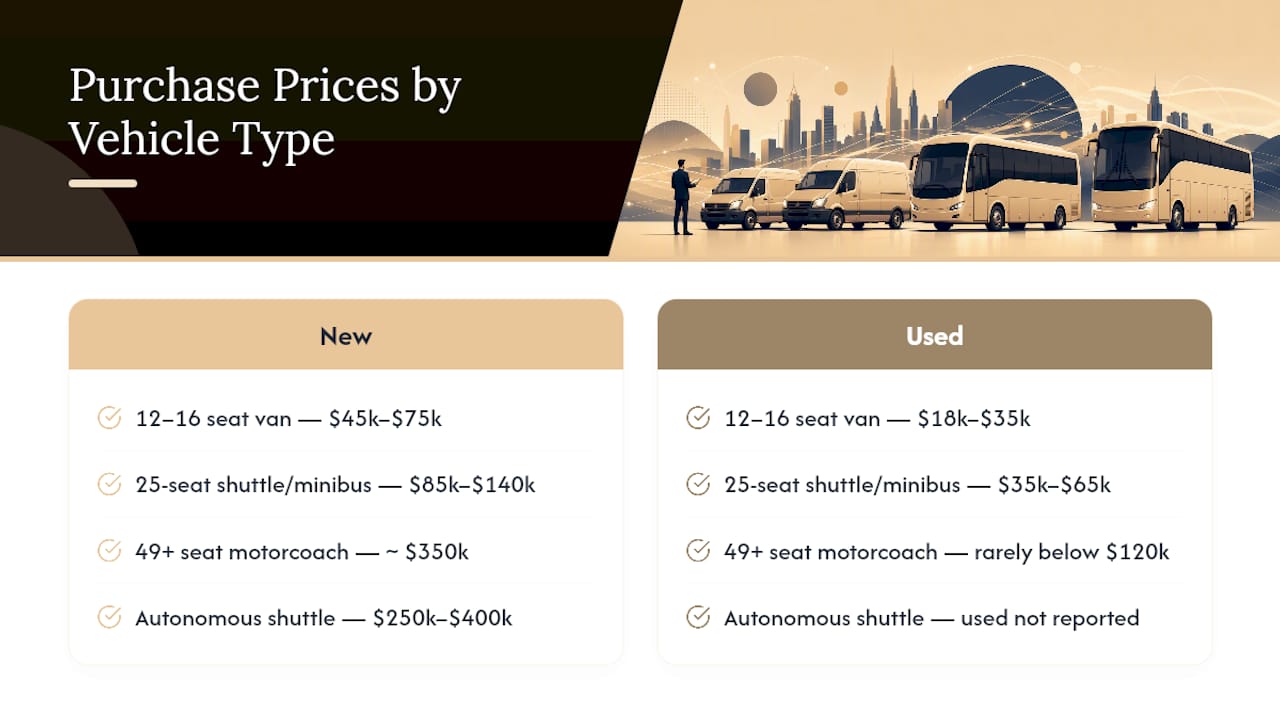
Purchase prices vary widely by vehicle class. A 12 to 16 seat passenger van, new, typically runs $45,000 to $75,000; used units in good condition can be found for $18,000 to $35,000. A 25 seat shuttle bus or minibus, the workhorse of most production fleets, runs $85,000 to $140,000 new and $35,000 to $65,000 used. A 49-plus seat motorcoach starts around $350,000 new and rarely drops below $120,000 even used with high mileage. Autonomous shuttle pilots, still rare outside controlled campuses and closed lots, have been reported in the $250,000 to $400,000 range per unit, with operating cost still uncertain because so few programs have run long enough to generate real maintenance data.
Hire pricing works on a different logic entirely, and this is where most productions actually spend their money:
Notice that the purchase figures above are capital costs, one-time or amortized over years, while the hire figures are pure operating costs, billed per use. That distinction matters more than it looks. A retrospective life-cycle cost analysis of the Space Shuttle Program put the program's total lifetime cost at roughly $254.5 billion in 2024 dollars, and operations and sustainment, not the original vehicle build, made up the majority of that figure. Scale is different, but the lesson transfers directly: the sticker price on a vehicle is rarely the number that determines your total spend. The recurring costs of running it do that.
What It Actually Costs to Run a Shuttle Every Month
Buying or hiring the vehicle is only step one. The line items below are what actually eat a production transportation budget, month after month, whether the vehicle is yours or a vendor's.
- Driver wages and scheduling: hourly drivers in most U.S. production markets run $28 to $48 per hour depending on region and whether the role requires a commercial license; expect overtime past 8 to 10 hours and call-out minimums (often 4 hours) even for short runs.
- Fuel or energy: diesel-powered coaches average 6 to 9 miles per gallon; a 25 seat shuttle idling for extended holding periods between set moves can burn 30% more fuel than its posted mileage would suggest, since idle time doesn't show up on a route sheet.
- Maintenance and tires: budget 8% to 12% of a vehicle's purchase value annually for routine service, plus an unscheduled repair reserve, since production schedules push vehicles harder than typical commercial routes.
- Insurance: commercial auto liability, physical damage, and hired-and-non-owned auto coverage together run $8,000 to $22,000 per vehicle annually depending on coverage limits and driving record history.
- Storage, dispatch, and permits: secured overnight parking near set runs $200 to $600 per month per vehicle in major production markets; dispatch software and two-way radio systems add $50 to $150 per vehicle monthly.
- Contingency: hold 8% to 12% of total operating spend for breakdowns, last-minute route changes, and schedule slips that push drivers into overtime.
Pro Tip: The line item most productions forget is overnight lay-down and standby time. If a driver holds a vehicle on location past an official wrap for a possible pickup, that's billable driver time even if the shuttle never moves, and vendors will invoice for it whether or not it was in your original quote.
A NASA technical report on launch vehicle economics makes a related point in a very different context: propulsion and design choices that look minor upfront can drastically inflate recurring ground operations costs. Translate that to a shuttle fleet and the message is the same. Every bespoke feature, a custom paint job, a specialty rack, an unusual seating configuration, adds a maintenance and parts-sourcing tax that shows up every month, not just once.
What Actually Moves Your Production Shuttle Price
Two productions running identical vehicle counts can end up with wildly different bills. The gap almost always traces back to a handful of decisions made in prep, not to the vendor's base rate card.
- Route profile. A shuttle that sits idle for 90 minutes between a hotel pickup and a lot call effectively costs more per useful mile than one running continuous loops, because you're paying for the driver's time either way.
- Capacity utilization. Booking a 25 seat shuttle to move eight crew members on a quiet day wastes two-thirds of your paid capacity; matching vehicle size to actual headcount is the single easiest lever to pull.
- Schedule density. More turns per day (say, four loops instead of two) spreads fixed vehicle and driver costs across more trips, lowering your effective cost per rider.
- Show-call timing. Early call sheets (4:00 AM pickups) and late wraps trigger off-hour premiums that can add 15% to 25% to a standard day rate.
- Labor and staging requirements. Union call rules, secured staging lot requirements near sensitive sets, and mandated rest periods for drivers all add cost that a generic hire quote won't reflect until you specify them.
- Customization. Branding wraps, AV systems for talent comfort, or a wheelchair lift add capital cost upfront and extend vehicle lead time, sometimes by several weeks, if you're sourcing a specialty unit rather than a standard shuttle.
How to Build a Production Shuttle Budget Step by Step
You don't need a finance degree to build a defensible estimate, just a formula and a willingness to plug in real numbers instead of round ones.
Total monthly cost = (hired vehicle fees, or amortized ownership cost) + driver labor + fuel + maintenance + insurance + storage + technology + permits + contingency.
Here's how to source each input:
- Estimate driver hours from your call sheet, not your route map. Count door-to-door time including staging and holding, not just drive time between points.
- Calculate miles using the actual route, then add 15% for detours, traffic, and repositioning between stops.
- Account for idle time separately from drive time. Idle time still costs driver wages and fuel; it just doesn't show up as mileage.
- Pull utilization data from a route test during prep week to confirm your capacity assumptions before committing to vehicle size.
- Add contingency last, after every other line is filled in, at 8% to 12% of the subtotal.
Worked example: two 25-seat shuttles, two daily loops each, running 20 production days per month.
That figure assumes a fully hired program with insurance and maintenance bundled into the vendor's day rate, which is the norm for chauffeured providers.
Should You Buy Vehicles or Hire a Provider?
This is the decision that determines whether your budget is a fixed capital line or a flexible operating expense, and it deserves more thought than most productions give it.
- Capital exposure: buying ties up $85,000 to $140,000 per 25-seat shuttle before you've moved a single crew member; hiring converts that into a daily rate you only pay when you need it.
- Depreciation and resale: owned vehicles lose 15% to 20% of value in year one alone, a cost hire providers absorb, not you.
- Lead time: a standard shuttle can often be sourced from a hire provider within days; a new or customized purchase can take 8 to 16 weeks depending on specification and manufacturer backlog.
- Vendor responsibility: insurance, maintenance, and driver management shift entirely to the provider under a hire agreement, which matters enormously if your production doesn't have in-house fleet management expertise.
- When ownership wins: multi-year franchise productions or studios running the same daily lot shuttle year-round can justify the capital outlay because utilization stays consistently high.
- When hire wins: single productions, variable schedules, tours that move between cities, or anything under six months of continuous need.
- Autonomous shuttles remain an outlier: reported purchase prices in the $250,000 to $400,000 range come with operating cost uncertainty since so few units have logged enough hours to establish a reliable maintenance baseline. Treat any autonomous pilot as an experiment, not a budget line you can forecast confidently.
Permits, Insurance, and Driver Requirements You Can't Skip
Compliance costs are the line item most first-time budget owners underestimate, mostly because they don't show up until a vendor or a location manager asks for proof.
- Driver qualifications: vehicles seating 16 or more passengers generally require a Commercial Driver's License (CDL) with passenger endorsement; check your specific state's threshold, since requirements vary by seat count and vehicle weight class.
- Insurance coverage: commercial general liability, hired-and-non-owned auto coverage (critical if you're contracting rather than owning), and physical damage coverage together typically run $8,000 to $22,000 per vehicle annually, with premiums rising for drivers under 25 or with recent claims history.
- Permits and staging access: secured lots near stadiums or sensitive sets often require separate access permits, and municipal staging permits for street-side loading can run $150 to $800 depending on the city and duration.
- Accessibility requirements: productions that transport talent or crew with mobility needs should confirm ADA-compliant vehicle availability with the vendor well ahead of shoot dates, since retrofitted lift-equipped units are a smaller share of most fleets and book up faster.
A GAO review of Space Shuttle cost estimating practices found that NASA's average cost per flight, over $400 million in the early 1990s, was driven roughly 90% by fixed costs, with the marginal cost of an additional flight significantly lower. Apply that same logic to your shuttle program: your fixed costs (insurance, base vehicle day rates, storage) get allocated whether you run one trip a day or four, so maximizing schedule density is the fastest way to bring your effective per-trip cost down. This is a budgeting principle, not legal guidance. Confirm CDL thresholds and insurance minimums with your state's motor vehicle authority before finalizing a contract.
A Sample Monthly Budget You Can Copy
Here's a fuller sample budget for a two-vehicle, 20-day production month, with every assumption stated so you can swap in your own local rates.
Assumptions: two 25-seat shuttles, hired with driver included; 20 production days; average 8 hours per shift per vehicle; 200 miles per vehicle per day; secured overnight parking; standard commercial insurance bundled into vendor rate.
The two assumptions that drive the biggest swing in this table are off-hour premiums and staging fees, both of which depend entirely on your call sheet pattern. Stress-test the budget by running the numbers twice: once with your best-case shoot schedule, once assuming every call is an early or late one.
Production Planning Checklist That Actually Prevents Overruns
Every line item above only holds up if you've collected the right information before you request quotes. Vendors price against uncertainty, and uncertainty costs you money.
- Passenger manifests: confirm expected headcount per shuttle run, including any last-minute additions like visiting network executives or press.
- Hold and standby time: flag any days where talent security requires a vehicle to remain on standby rather than returning to base.
- Security constraints: note any routes requiring background-checked drivers or NDA-signed staff, since this narrows your available driver pool and can raise cost.
- Loading zones and access: confirm whether locations have dedicated loading areas or require street permits, which affects both cost and schedule reliability.
- Required vehicle features: specify ADA lifts, AV equipment, or branding needs in your first vendor conversation, not after a contract is signed.
Operationally, three habits save more money than any single negotiating tactic: consolidate runs so you're not sending two half-empty vehicles on overlapping routes, enforce strict turn windows so drivers aren't burning paid hours waiting past a scheduled pickup, and batch talent movement whenever call times allow it. For long shoot days, negotiate a flat day rate upfront rather than hourly billing, since flat rates protect you from the overtime creep that hourly billing almost guarantees on a 14-hour shoot day.
Pro Tip: Ask any vendor you're evaluating how they handle a last-minute schedule extension past the contracted hours. Their answer, a flat overage rate versus an unpredictable premium, tells you more about total cost risk than their base day rate ever will.
Related planning resources worth reviewing before you finalize a vendor: studio lot transportation logistics, production shuttle requirements for film crews, and stadium and broadcast crew shuttle planning.
The Surprises That Blow Up a First-Draft Shuttle Budget
Every production budget I've reviewed that came in over target had the same three gaps, not one exotic one-off problem.
The first is off-hour premiums nobody priced into the original quote. The second is idle time. Route planners map drive time beautifully and forget that a shuttle sitting outside a location for 90 minutes waiting on a delayed scene is still burning paid driver hours. The third, and the one that catches even experienced production accountants, is holding time for talent. If a vehicle is held on standby "just in case" past an official wrap, that's billable time, and it rarely gets flagged until the invoice arrives.
None of these are vendor tricks. They're gaps between how a route looks on paper and how a shoot day actually unfolds. The fix is structural, not tactical: build a pre-run walk-through into the vendor contract before day one, and require that the contract explicitly states how contingency hours and standby time are billed. Get that in writing before the first call sheet goes out, not after the first invoice arrives.
Simplify the Estimate: Work With a Specialist Provider
Everything above assumes you're building a budget from scratch, sourcing quotes, tracking fuel surcharges, chasing down insurance certificates. Rigaglobaltravel removes most of that uncertainty by bundling driver, insurance, maintenance, and dispatch into a single quoted rate, so the number you see in prep is the number that shows up on the invoice.

Rigaglobaltravel works directly with productions across major U.S. markets, offering flexible fleet sizing from executive sedans to 25-seat shuttles, drivers experienced with call sheet logistics and talent handling protocols, and invoiced corporate billing that fits production accounting workflows without a retainer or long-term commitment. Because insurance, permits, and dispatch are handled in-house rather than split across multiple vendors, budget owners avoid the coverage gaps and surprise fees that come from stitching together separate providers. If your production runs through the Northeast, the Connecticut chauffeured service page and New York service page cover both regions under one account. West Coast productions based near studio lots can review the Los Angeles service page for fleet availability. To move from estimate to a firm number, request a production shuttle quote with your route, headcount, and call sheet pattern, and Rigaglobaltravel will return a fixed day rate you can drop straight into your budget.
Sources
- Space Shuttle Program life‑cycle cost analysis: retrospective assessment
- To be economically viable the operations cost of new launch vehicles must be reduced
- NSIAD-93-115 Space transportation: the content and uses of shuttle cost estimates