
Luxury transport booking for film sets is defined as the coordinated hiring of licensed, chauffeured vehicles to move cast, crew, and equipment between locations on a production schedule. Getting it right is not optional. Poor transport management causes costly set delays, and production insiders warn that the financial risks compound fast when vehicles are not aligned with call sheets from day one. Rigaglobaltravel specializes in exactly this kind of high-stakes coordination, providing limousine and concierge services built for the entertainment industry. This guide covers every step production teams and event planners need to book luxury transport for a film set with confidence.
What are the prerequisites for booking luxury transport on a film set?
Before you contact any provider, you need a clear picture of your production's transport demands. The call sheet is your foundation. It tells you who needs to be where, at what time, and with how much gear. Without it, no provider can give you an accurate quote or guarantee coverage.
Key requirements to confirm before booking
- Production schedule and call sheets: Share the full shoot schedule, including early calls, overnight shoots, and location changes.
- Passenger and cargo counts: Know how many people need transport and whether equipment or wardrobe cases travel with them.
- Budget parameters: Chauffeur rates in Europe start at CHF 120 per hour for sedans, with 3-hour minimums as standard. Build your budget around hourly rates, waiting time, tolls, and fuel.
- Regulatory compliance: Confirm local permit requirements, restricted access zones, and union driver hours rules before finalizing any booking.
- Licensed operators only: Direct contracts with licensed operators guarantee adherence to driver hours and union labor rules. Brokers cannot reliably ensure this, and the risk of a production shutdown is real.
Pro Tip: Request a written confirmation of vehicle age and backup fleet availability. Professional operators guarantee vehicles less than 3 years old and 24/7 support as standard.
| Point | Details |
|---|---|
| Call sheet coordination | Share full schedule with the provider before confirming any booking. |
| Passenger and cargo count | Confirm exact numbers to match vehicle capacity to actual needs. |
| Budget with minimums | Account for hourly rates, 3-hour minimums, waiting time, and tolls. |
| Compliance check | Verify local regulations, restricted zones, and union driver hour rules. |
| Direct operator contract | Avoid brokers; contract directly with licensed, regulated providers. |
How do you select the right vehicles for cast and crew transport?
Vehicle selection is where production teams most often make expensive mistakes. Matching the vehicle to the role matters as much as matching the actor to the part. An executive sedan works for a lead actor traveling solo. A luxury van or minibus serves a crew of eight moving between locations with equipment.

Vehicle categories and their best uses
The luxury van sits at the center of most film set transport plans. It balances capacity, comfort, and discretion in a way that sedans and full-size buses cannot. For talent, executive sedans with tinted windows and leather interiors signal the level of care that keeps morale high. For larger crew groups, sprinter vans or minibuses with climate control and USB charging are the practical choice.
Chauffeured services outperform self-drive options on set for one clear reason: accountability. A professional chauffeur tracks schedule changes in real time, waits without complaint, and knows how to handle restricted access points without creating noise on set. Self-drive rentals shift that burden onto your production coordinator.
Electric and hybrid vehicles are now an operational requirement for urban and sound-sensitive locations. A combustion engine idling outside a recording location can ruin a take. Quieter vehicles reduce noise complaints and filming downtime. Many premium fleet operators now include electric options as standard.
| Vehicle type | Capacity | Best use | Key advantage |
|---|---|---|---|
| Executive sedan | 1–3 passengers | Lead talent, directors | Discretion, comfort |
| Luxury SUV | 3–5 passengers | Department heads, VIPs | Space, privacy |
| Luxury van or sprinter | 6–12 passengers | Crew groups, equipment | Capacity, flexibility |
| Minibus | 12–20 passengers | Large crew shuttles | Cost efficiency at scale |
| Electric or hybrid sedan | 1–3 passengers | Sound-sensitive locations | Silent operation |
What is the step-by-step process to book luxury transport for a film set?
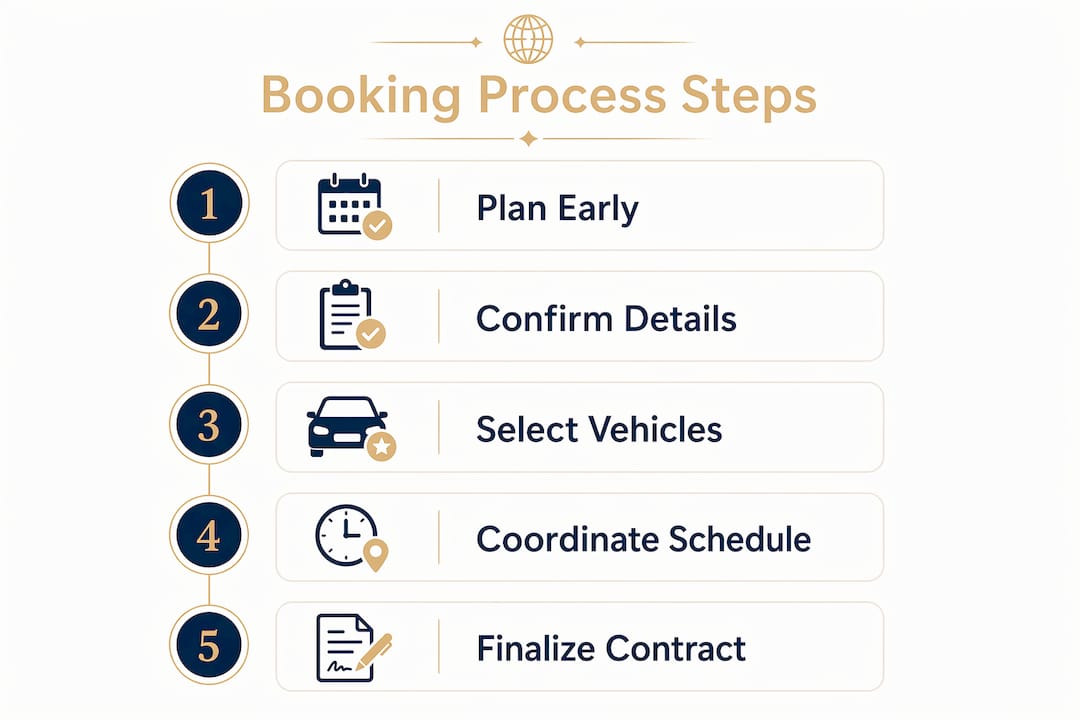
A structured booking process prevents the last-minute scrambles that derail shoots. Transport operations function like a town on wheels, coordinating arrivals, late finishes, and split schedules without constant producer oversight. That level of coordination requires early planning.
- Define transport requirements during pre-production. Identify all locations, shoot days, and crew tiers that need dedicated vehicles. Do this before the budget is locked.
- Contact licensed providers with your call sheets. Send the full schedule, not just the first week. Providers need the complete picture to assign the right fleet and drivers.
- Negotiate rates and confirm all inclusions. Clarify what is covered: fuel, tolls, waiting time, and any applicable taxes. Get everything in writing before signing.
- Confirm 24/7 support and urgent adjustment protocols. Production transport providers accept urgent adjustments via phone or messaging and operate on call sheet schedules with same-day reservation availability. Verify this before committing.
- Coordinate vehicle arrivals and shuttle loops for shoot days. Map out pickup windows, holding areas, and return routes. Share this with both the transport provider and your AD team.
- Assign a single point of contact on your production side. One person owns all transport communication. This eliminates conflicting instructions and missed pickups.
Pro Tip: Build a 15-minute buffer into every pickup window on shoot days. Sets run late, and a driver who has been briefed on this expectation will wait calmly rather than leave.
For TV production ground transportation in New York specifically, Rigaglobaltravel manages these workflows end to end, including multi-location coordination and split-schedule support.
How do you troubleshoot common luxury transport challenges on film sets?
Even well-planned transport operations hit friction. Knowing where the pressure points are lets you solve problems before they stop a shoot.
Restricted site access is the most common issue. Production planners must communicate precise access instructions to drivers in advance. A vehicle that cannot reach the holding area on time creates a cascade of delays. Share gate codes, parking permits, and contact names for location managers with every driver before shoot day.
Split call sheets and overnight shoots require providers who operate around the clock. Continuous shuttle support for early calls and overnight schedules is a non-negotiable feature of any film-grade transport provider. Confirm this capability explicitly, not just in the contract fine print.
Driver hours compliance is a legal issue, not just a logistical one. Union rules cap driving hours, and violations can trigger production shutdowns. Direct contracts with licensed operators are the only reliable way to manage this risk. Brokers often lack the operational control to enforce compliance.
Last-minute schedule changes happen on every shoot. The solution is a provider with a dedicated dispatch team reachable by phone at any hour. Establish that contact protocol on day one, not when a crisis hits.
"The transport department is the unseen backbone of any production. It anticipates what the shoot needs before anyone else realizes the need exists. When it works, nobody notices. When it fails, everyone does." — Veteran unit production manager insight, via Fort Worth Star-Telegram
For white-glove studio transport best practices, the consistent theme is proactive communication between the transport coordinator and the AD department throughout the shoot day.
Key Takeaways
Booking luxury transport for a film set requires early planning, direct operator contracts, and vehicle selection matched to crew roles and location requirements.
| Point | Details |
|---|---|
| Start in pre-production | Lock transport requirements and provider contracts before the budget is finalized. |
| Contract directly | Avoid brokers; only direct contracts with licensed operators guarantee compliance. |
| Match vehicle to role | Use sedans for talent, vans for crew groups, and electric vehicles on sound-sensitive sets. |
| Confirm 24/7 support | Providers must accept urgent adjustments at any hour via phone or messaging. |
| Assign one contact | A single production-side transport coordinator eliminates miscommunication on shoot days. |
Why transport is the backbone your production cannot afford to ignore
I have watched productions treat transport as an afterthought, something to sort out the week before principal photography. That choice costs more than money. It costs time on set, and time on set costs everything.
The transport department's proactive role is one of the most underappreciated facts in production management. Veteran unit managers describe it as anticipating production phases before others realize the need. That is not an exaggeration. The best transport coordinators I have worked alongside knew the next day's schedule better than most department heads.
What I have found actually works is treating transport as a creative department, not a vendor category. When you brief a provider the way you brief a gaffer, giving them context, not just addresses, the results are different. Drivers know to wait. Dispatch knows to call the AD, not the producer. The whole operation runs quieter.
My honest advice: budget for transport early, choose a provider who specializes in entertainment, and give them the same access to your schedule that you give your location manager. The cost of getting it right is always lower than the cost of getting it wrong.
— Sammy
Rigaglobaltravel: built for film and TV transport
Film and TV productions run on precision. Rigaglobaltravel delivers luxury chauffeur services built specifically for the entertainment industry, covering New York, Los Angeles, Miami, and Connecticut with a fleet of executive sedans, luxury vans, and SUVs.
Every booking includes 24/7 dispatch support, direct operator contracts, and drivers experienced in call sheet coordination and restricted set access. Whether you need a single talent vehicle or a full shuttle program for a large crew, Rigaglobaltravel handles the logistics so your production team can focus on the shoot. Contact Rigaglobaltravel to discuss your film set transport needs and get a custom quote for your next production.
FAQ
What does it cost to book luxury transport for a film set?
Rates for professional chauffeur services start at CHF 120 per hour for executive sedans, with 3-hour minimums as standard in 2026. Final costs depend on vehicle type, shoot duration, waiting time, and location-specific fees like tolls and permits.
Why should production teams avoid brokers for film set transport?
Brokers lack direct control over driver hours and union compliance, which creates real risk of production shutdowns. Direct contracts with licensed operators are the only way to guarantee regulatory adherence and operational reliability.
What vehicle types work best for film set transportation?
Executive sedans suit lead talent and directors traveling solo or in small groups. Luxury vans and sprinters handle crew groups of 6–12, while electric or hybrid vehicles are the best choice for sound-sensitive or urban filming locations.
How early should you book luxury transport for a film production?
Book during pre-production, before the budget is locked. Early demand signals align transport capacity with production needs and prevent costly delays caused by inadequate crew movement planning.
What should a luxury transport contract for a film set include?
The contract should specify hourly rates, minimum hours, fuel and toll coverage, waiting time charges, 24/7 support availability, vehicle age guarantees, and protocols for last-minute schedule changes.