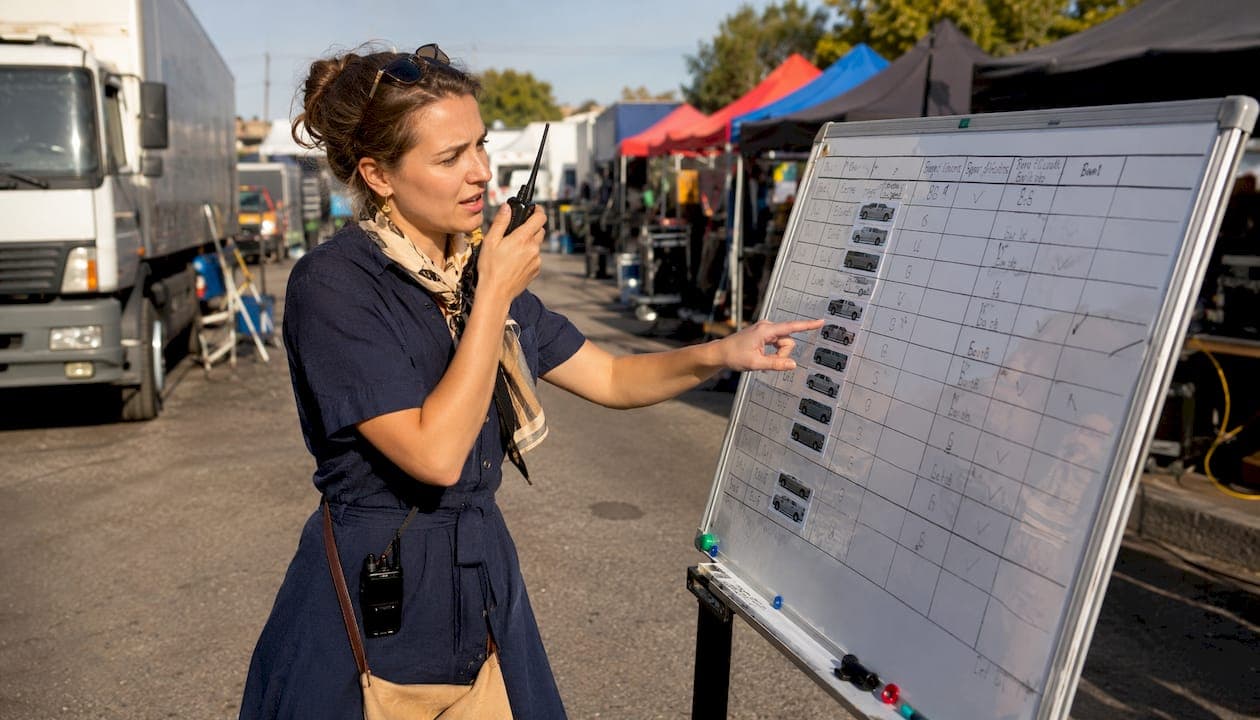
What does a production transportation coordinator actually do?
The production transportation coordinator is the person responsible for every vehicle that moves on a production, from the first grip truck rolling out at 4:00 AM to the last actor's car leaving set at midnight. The role sits at the intersection of logistics management and production operations, and it demands both the precision of a supply chain professional and the adaptability of someone who can solve a crisis before the director notices one exists.
At its core, the job covers four functions: fleet management, scheduling, regulatory compliance, and stakeholder communication. In film and television, that means coordinating picture cars and equipment trailers alongside cast and crew vehicles. In general logistics, the same title covers freight carrier bookings, route planning, and delivery execution across a product's full life cycle.
Key facets of the role include:
- Managing and dispatching a fleet of vehicles, including specialized production vehicles
- Scheduling driver assignments and coordinating pickup and drop-off times against production call sheets
- Monitoring compliance with road safety laws and driver hours-of-service regulations
- Communicating with department heads, location managers, vendors, and drivers in real time
- Resolving last-minute changes without disrupting the shooting schedule or delivery window
The distinction from a broader production coordinator matters. A production coordinator manages full production logistics including budgeting and scheduling across all departments. The transportation coordinator owns only the vehicular and physical movement side, but owns it completely.
Daily responsibilities and the skills that make or break the job
A transportation coordinator's day starts before most of the crew arrives and ends after most have gone home. The first task is confirming driver assignments against the call sheet, then verifying vehicle availability and condition. From there, the day becomes a live exercise in managing competing priorities.
Core daily responsibilities include:
- Dispatching drivers and vehicles according to production schedules or freight windows
- Fielding transportation requests from department heads and resolving conflicts between overlapping needs
- Monitoring in-transit shipments or on-set vehicle movements and communicating ETAs to stakeholders
- Handling exceptions: a driver running late, a vehicle breakdown, a carrier rejection on a freight load
- Auditing vendor invoices and maintaining accurate records in a transportation management system (TMS)
- Coordinating with warehouse teams, location managers, or production offices on timing and access
The skills that separate a strong coordinator from an average one are less about technical knowledge and more about judgment under pressure. Organization keeps the day from collapsing. Multitasking keeps five simultaneous problems from becoming one large failure. Negotiation matters when a carrier rejects a load two hours before pickup and you need to source alternatives fast. Problem-solving is the job description, not a line on a résumé.
Pro Tip: When managing high-pressure scheduling conflicts, build a 15-minute buffer into every driver assignment and keep a pre-approved list of backup carriers or drivers you can activate without a new approval chain. The coordinators who look calm under pressure usually have contingency options ready before the crisis hits.
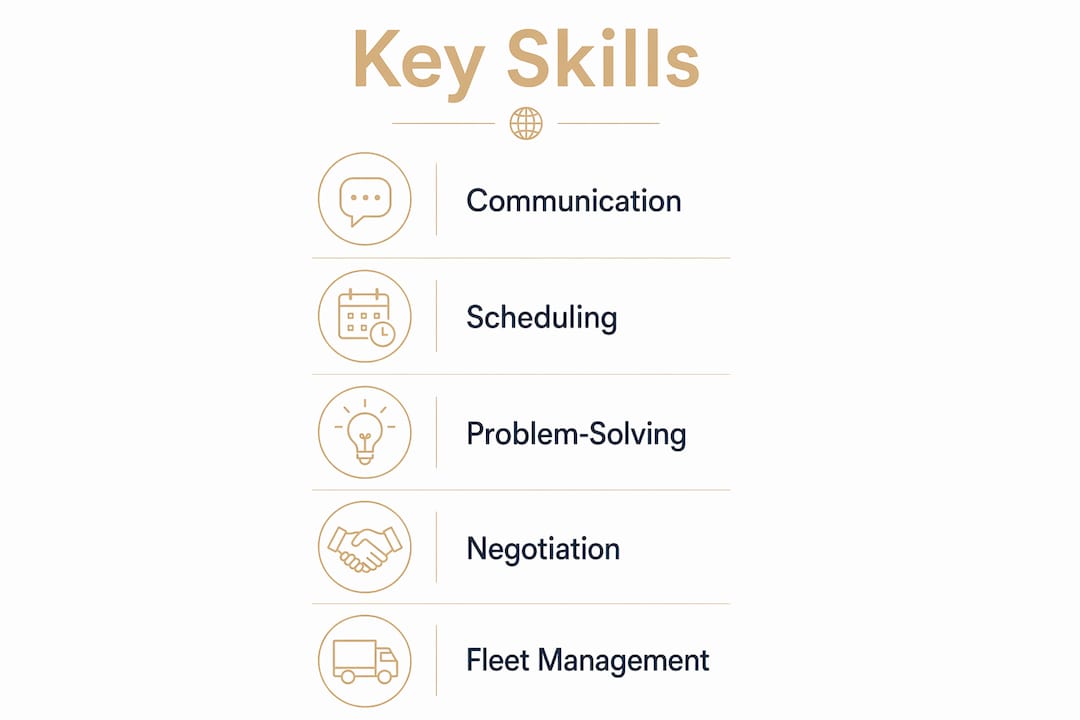
Communication sits above every other skill. On a typical day, a coordinator might handle a driver calling about an appointment change, update a major client on three separate in-transit shipments, and resolve a billing dispute with a regional carrier, all before lunch. Managing all of that simultaneously while keeping records current is what the job actually requires.

How film production coordination differs from general logistics roles
The title "transportation coordinator" covers genuinely different jobs depending on the industry, and conflating them leads to mismatched expectations on both sides of a hire.
In film and television, the coordinator manages a hybrid fleet that can include picture cars (vehicles that appear on camera), equipment trailers, camera trucks, generator vehicles, and individual cars for cast and crew. The Texas Film Commission describes the role as requiring deep knowledge of regulations across multiple jurisdictions, since productions frequently cross state lines with specialized trailers. The schedule is the script: every vehicle movement ties directly to a shot list, and a delayed truck can cost tens of thousands of dollars in idle crew time.
In general logistics and supply chain, the coordinator's focus shifts to the goods themselves. The role involves booking freight with approved carriers, scheduling pickup and delivery appointments, resolving in-transit exceptions, and auditing carrier invoices. Route optimization and cost control are primary KPIs rather than secondary concerns.
Key stakeholder differences by industry:
- Film production: drivers, transportation captain, production office, location managers, art department (for picture cars), studio executives
- General logistics: freight carriers, warehouse teams, procurement, customer service, customs brokers for cross-border freight
The hybrid operational-and-managerial nature of the film role is its defining feature. A film transportation coordinator is simultaneously a manager directing a team of drivers and an on-the-ground fixer handling whatever the day throws at them. In supply chain logistics, the role tends to be more desk-based, with coordination happening through a TMS rather than face-to-face on a location.
Career path and how to get into production transportation coordination
Most people in this role did not start by applying for it. The standard path runs through field experience, not a classroom.
Common entry routes and progression steps:
- Start as a production driver or transportation captain. This is the apprenticeship model the industry runs on. Drivers learn fleet operations, scheduling rhythms, and production culture from the inside.
- Build proficiency in logistics software. Modern productions and logistics companies both require scheduling and TMS competency. Tools like McLeod Software, Oracle Transportation Management, and production-specific scheduling platforms are common.
- Develop knowledge of traffic laws and hours-of-service regulations. A coordinator who doesn't understand Federal Motor Carrier Safety Administration (FMCSA) rules is a liability, not an asset.
- Pursue relevant certifications. The American Society of Transportation and Logistics (AST&L) offers credentials that signal formal competency. For film-specific roles, union membership through the International Brotherhood of Teamsters (IBT) Local 399 in Los Angeles is often a prerequisite.
- Advance to coordinator from captain. Once a transportation captain demonstrates scheduling and management ability, the step to coordinator is typically a matter of opportunity and reputation.
Formal degrees are not required, but they can accelerate advancement. A background in supply chain management, business logistics, or operations management gives candidates a framework for cost analysis and vendor negotiation that pure field experience sometimes misses. Franklin University's logistics programs and Appalachian State University's supply chain curriculum are examples of pathways that feed directly into coordinator roles.
Career advancement beyond the coordinator level typically moves toward transportation manager, production logistics manager, or director of operations, depending on the industry. In film, experienced coordinators often move into unit production manager roles or launch their own transportation companies.
Rigaglobaltravel's perspective on film production transportation coordination
Rigaglobaltravel operates at the intersection of luxury concierge service and entertainment industry logistics, which means the team has seen firsthand what separates a coordinator who keeps a production running from one who becomes the reason it stops.
A few observations from that experience:
- Contingency planning is not optional. Weather, traffic, and mechanical failures are not edge cases in production transportation. They are scheduled disruptions that a prepared coordinator absorbs without escalating to the production office. Having backup vehicles, pre-vetted alternate drivers, and pre-negotiated emergency rates with vendors is standard practice, not exceptional preparation.
- Vendor relationships determine your ceiling. When capacity is tight, the coordinator who has a real relationship with their fuel supplier, their mechanic, and their third-party logistics partners gets the vehicle. The one who treats vendors as interchangeable gets a voicemail.
- Driver hours-of-service compliance is non-negotiable. Productions run long days, and the pressure to push drivers past legal limits is real. A coordinator who holds that line protects the production from liability and protects drivers from dangerous conditions.
- The best coordinators are invisible. When transportation challenges don't impact the shooting schedule, the coordinator has done the job perfectly. Nobody calls to say the trucks arrived on time.
- Communication cadence matters as much as communication content. Proactive updates before a problem becomes visible to the director or producer are what build trust. Reactive explanations after a delay has already cost the production time do the opposite.
Rigaglobaltravel's work with film and TV productions in New York, Los Angeles, and Connecticut reinforces one consistent truth: the productions that run smoothly are the ones where the transportation coordinator was empowered to make decisions in real time, not the ones where every call required approval from three levels up.
Which industries hire the most transportation coordinators?
Transportation coordination is not a niche role. Supply chain was the top specialized skill sought by employers across 152,047 job postings related to transportation coordinators, with 36% of all postings specifically seeking that expertise. The role appears across a wide range of sectors.
The industries with the strongest demand include:
- Film and television production: Coordinators manage cast and crew vehicles, equipment trucks, and picture cars on union and non-union productions.
- Third-party logistics (3PL) and freight brokerage: The core market for the role, where coordinators book and manage freight across carrier networks.
- Manufacturing and distribution: Companies with high outbound freight volume need coordinators to manage carrier relationships and delivery windows.
- Healthcare and pharmaceutical logistics: Temperature-controlled and time-sensitive freight requires coordinators with compliance expertise.
- Event production and live entertainment: Large-scale events require vehicle coordination for talent, equipment, and staging that mirrors film production in its complexity.
- Government and defense contracting: Logistics coordination for equipment and personnel movement at scale.
The TV production ground transportation sector in major markets like New York is particularly active, with productions running year-round and a consistent need for experienced coordinators who know the city's permitting and traffic patterns.
What are the hardest challenges production transportation coordinators face?
The job description makes the role sound manageable. The reality is that most of the difficulty comes from factors outside the coordinator's control.
Last-minute schedule changes are the most common source of stress. A location change announced the night before a shoot means rerouting an entire fleet, rebooking drivers, and potentially sourcing different vehicles, all before 6:00 AM. In freight logistics, a carrier rejection two hours before pickup creates the same kind of scramble.
Weather and traffic don't negotiate. A coordinator managing a production in a city like New York or Los Angeles has to build contingency time into every schedule because delays are not a possibility; they are a certainty on enough days to plan for.
Driver availability and fatigue create compliance pressure. Productions run long, and the pool of qualified drivers is finite. Coordinators have to balance crew needs against hours-of-service regulations, which sometimes means telling a producer that a driver cannot legally work another shift.
Budget constraints create friction between what the production needs and what it can afford. Sourcing vehicles, negotiating vendor rates, and managing fuel costs all fall to the coordinator, often with limited authority to approve spending.
Communication breakdowns between departments are a consistent problem. When the art department changes a picture car at the last minute without notifying transportation, the coordinator absorbs the consequences. Building reliable communication channels with every department head is a preventive measure, not a luxury.
How do you measure success in this role?
KPIs for transportation coordinators vary by industry, but the underlying logic is consistent: did the freight or the vehicle get where it needed to go, on time, within budget, and without incident?
| KPI | What it measures |
|---|---|
| On-time delivery rate | Percentage of shipments or vehicle arrivals meeting scheduled windows |
| Fleet utilization | How efficiently vehicles are deployed relative to available capacity |
| Cost per mile or cost per move | Efficiency of transportation spend against volume |
| Exception rate | Frequency of disruptions requiring manual intervention |
| Driver compliance rate | Adherence to hours-of-service and safety regulations |
| Vendor invoice accuracy | Rate of billing errors caught before payment |
In film production, the most telling metric is one that doesn't appear on any dashboard: whether transportation issues ever reached the director's attention. A coordinator whose work is truly invisible has hit the highest standard the role has.
What tools and software do transportation coordinators rely on?
The technology stack for this role has shifted considerably over the past several years. Automated load booking, AI-assisted carrier matching, and real-time visibility platforms have taken over much of the routine transaction work, pushing coordinators toward exception management and relationship-building rather than manual data entry.
Commonly used tools include:
- Transportation Management Systems (TMS): McLeod Software, Oracle Transportation Management, and MercuryGate are widely used in freight logistics for booking, tracking, and invoice auditing.
- Real-time visibility platforms: Tools like project44 and FourKites give coordinators live shipment tracking and predictive ETA data.
- Scheduling and dispatch software: In film production, Movie Magic Scheduling and Showbiz Software are industry standards for coordinating call times and vehicle assignments.
- Communication platforms: Slack, Microsoft Teams, and production-specific apps keep coordinators connected to drivers, department heads, and vendors simultaneously.
- Spreadsheet and data tools: Microsoft Excel remains one of the most sought-after skills in coordinator job postings, used for route planning, cost tracking, and schedule management.
The coordinators who advance fastest are the ones who treat technology as a tool for better judgment, not a replacement for it. Software flags the exception; the coordinator decides what to do about it.
How does a transportation coordinator affect overall production efficiency?
A transportation coordinator who is operating at full capacity functions as a force multiplier for every other department. When vehicles arrive on time, crew members start work on schedule. When equipment trucks hit their marks, the camera department doesn't wait. When freight moves without exceptions, manufacturing lines don't idle.
The logistics coordinator's operational value lies specifically in the ability to manage delays actively and implement contingencies immediately, keeping the supply chain or production schedule moving rather than stalling while waiting for direction. That proactive posture is what separates a coordinator who adds value from one who simply reports problems.
In supply chain terms, a strong coordinator reduces carrying costs by tightening delivery windows, cuts freight spend by negotiating spot rates effectively, and protects customer relationships by communicating proactively during exceptions. In film production, the financial stakes are even more direct: idle crew time is billed by the hour, and a delayed truck can cost more in one morning than the coordinator's weekly salary.
How does the role change between small and large production companies?
The scope of the job scales dramatically with the size of the production or company, and the difference is not just volume. It's the nature of the work itself.
At a small production company or independent film, the transportation coordinator often handles everything personally: booking vehicles, driving when necessary, managing vendor relationships, and filing paperwork. The role is hands-on by necessity, and the coordinator may report directly to the producer with no transportation captain or department structure beneath them.
At a large studio production or major logistics company, the coordinator manages a team. Transportation captains handle day-to-day driver supervision, and the coordinator focuses on scheduling, vendor contracts, compliance oversight, and communication with other departments. The luxury fleet management demands of a major studio production, for example, require a coordinator who can oversee dozens of vehicles across multiple locations simultaneously.
The administrative burden also grows with scale. Large productions generate more paperwork, more vendor invoices, more compliance documentation, and more stakeholder communication than a small operation. Coordinators at large companies tend to spend more time in systems and meetings; coordinators at small companies tend to spend more time on the ground.
For professionals building a career in this field, starting small provides the breadth of experience that makes the transition to large-scale coordination much easier. You learn every part of the job when you have to do every part of the job.
Working with Rigaglobaltravel on production transportation

Productions that need reliable, professional transportation for cast, crew, and talent in New York, Los Angeles, Connecticut, and Miami work with Rigaglobaltravel for a reason. The team understands production schedules, union protocols, and the kind of discretion that talent transportation requires. Whether you need celebrity and talent transportation for a New York shoot or luxury chauffeur service in Los Angeles near the studios, Rigaglobaltravel operates as a true production partner, not just a car service.
Key Takeaways
The production transportation coordinator is the operational backbone of any production's physical logistics, and the role demands equal parts planning, compliance knowledge, and real-time problem-solving.
| Point | Details |
|---|---|
| Core responsibility | Coordinators manage all vehicle movements, fleet scheduling, and driver compliance for production or freight operations. |
| Film vs. logistics | Film coordinators manage hybrid fleets including picture cars; logistics coordinators focus on freight booking, carrier management, and cost control. |
| Career entry | Most coordinators start as production drivers or transportation captains, building skills through an apprenticeship model rather than formal degrees. |
| Success metric | In film production, the highest standard is transportation that never reaches the director's attention because nothing went wrong. |
| Technology shift | TMS platforms, real-time visibility tools, and scheduling software have moved the role toward exception management and away from manual data entry. |