
Rigaglobaltravel is the strongest production-grade alternative for U.S. film, TV, and corporate productions that need chauffeured transport with real on-set coordination built in, not bolted on.
Two reasons it stands out immediately:
- Production coordination depth: Rigaglobaltravel accepts and acts on call sheets submitted 48+ hours ahead, assigns a dedicated transportation coordinator for large crews, and builds daily movement matrices to keep shuttle loops tight.
- Fleet breadth: Sedans and SUVs for talent, Sprinter vans for equipment and small crew runs, and full-size buses for unit moves — all under one account with consolidated invoicing.
Next step: contact Rigaglobaltravel directly at rigaglobaltravel.com to request a COI, confirm your regional coverage, and set up a pilot shoot day.
Table of Contents
- What are the best hoytlivery.com alternatives for production transport?
- How do you choose the right production transport partner?
- What do production transport pricing and lead times actually look like?
- What does on-set transport logistics actually require?
- How does Rigaglobaltravel meet production requirements?
- Key Takeaways
- Why Rigaglobaltravel publishes this shortlist
- Rigaglobaltravel: production-grade transport, ready to book
- Useful sources
What are the best hoytlivery.com alternatives for production transport?
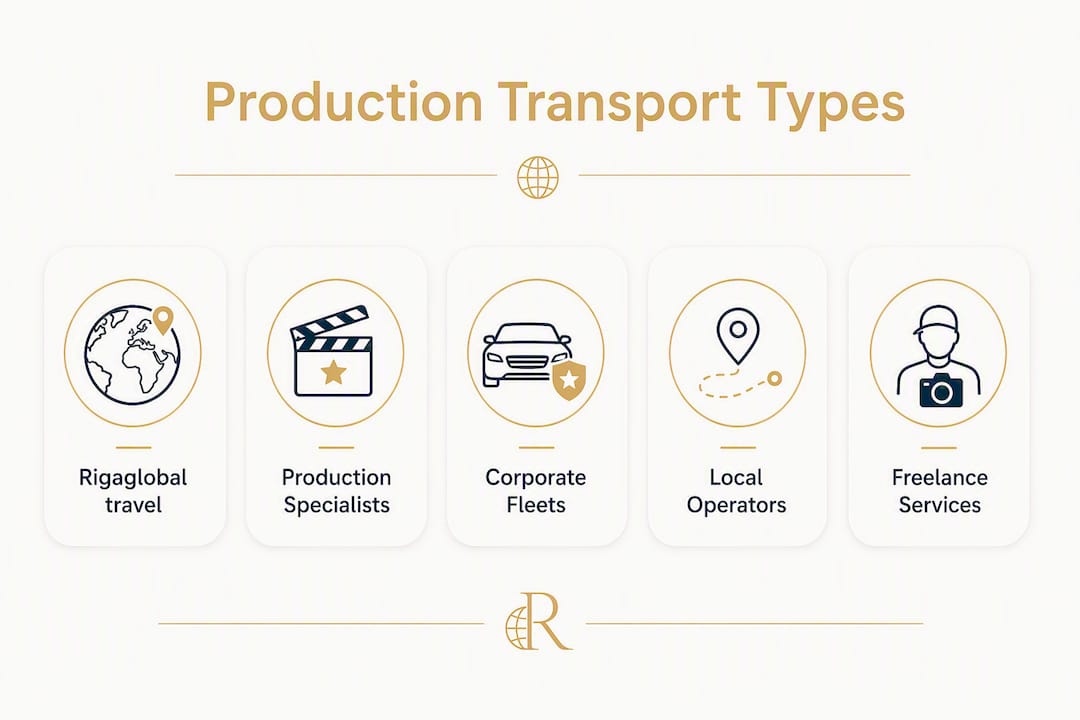
The table below maps the five provider types production buyers typically evaluate. Rigaglobaltravel appears as the recommended option for productions that need full coordination.

| Best for (use case) | Services offered | Geographic / studio & airport coverage | Fleet types & capacity | Booking lead time & call-sheet handling | Pricing model | Production-specific features | Trust signals |
|---|---|---|---|---|---|---|---|
| Production-specialist operators | Hourly/day rates, crew shuttles, talent runs | Regional; limited multi-market reach | Sedans, SUVs, Sprinters | 24–48 hrs; call sheets accepted | Hourly or day-rate | Transport coordinator; movement matrix | COI, background checks |
| Full-service corporate fleet partners | Executive transfers, airport runs, some shuttles | National; major airports | Sedans, SUVs, some vans | 24 hrs; limited call-sheet integration | Hourly; account billing | Minimal production-specific coordination | COI; DOT compliance |
| Production-focused shuttle specialists | Crew shuttles, base-camp loops | Studio-adjacent markets | Vans, minibuses, coaches | 48+ hrs; route-based scheduling | Day-rate or flat charter | Route optimization; staging support | Vehicle logs; operator license |
| In-house studio transport teams | Internal crew moves only | Single studio lot | Mixed fleet | Integrated with production schedule | Internal cost center | Full lot familiarity | Studio-managed |
| Rigaglobaltravel (recommended) | Hourly/day, flat-rate, retainer; buses, shuttles, concierge, airport transfers | Los Angeles, New York, Miami, Connecticut; commercial and private aviation | Sedans, SUVs, Sprinters, talent buses | 48+ hrs; call-sheet SLA; flight tracking | Hourly, day-rate, flat-rate, corporate retainer | Dedicated transport coordinator; daily movement matrix; security clearance handling; concierge | COI, background-checked chauffeurs, vehicle maintenance records |
Production-specialist operators work well for single-location shoots with predictable schedules, but their regional footprint often becomes a problem the moment a production moves markets.
Full-service corporate fleet partners handle executive travel cleanly. Where they fall short is the production-specific layer: no movement matrix, no transport coordinator, and call-sheet handling that amounts to a note in a booking form.
Rigaglobaltravel covers the full stack: multi-class fleet, a dedicated coordinator who owns the daily movement matrix, VIP production crew transport protocols, and corporate billing that production accountants can actually work with.
How do you choose the right production transport partner?
Start with a short decision checklist before you talk to any vendor.
Operational must-haves:
- Written call-sheet SLA confirming 48+ hours lead time for route optimization and pre-positioning
- Named dedicated transportation coordinator for any crew over 20 people
- Documented daily movement matrix capability
- Real-time flight tracking and dispatch for airport pickups
- Current COI and background-checked chauffeurs on file
- After-hours dispatch contact with a documented escalation path
- DOT compliance where applicable
Interview questions to ask every vendor:
- Who is my single dispatch contact on shoot day, and what is the escalation path if they are unavailable?
- Can you share a sample COI and confirm you can add our production company as an additional insured?
- How do you handle call-sheet changes submitted less than 24 hours before a shoot?
- Walk me through your vehicle staging process for a multi-location day.
- How do you minimize deadhead runs between locations?
- What are your wrap-time and hold-time billing policies, in writing?
- Do you provide real-time vehicle tracking that my line producer can access?
- Can you supply references from productions of similar size and complexity?
Red flags to watch for:
- No written call-sheet SLA; verbal commitments only
- No dedicated coordinator; a general dispatcher handles all clients
- Surge pricing applied to wrap time without a written cap
- Unable to produce production references on request
- No tracking or dispatch transparency beyond a driver's personal cell number
- Rideshare-based dispatch for talent runs — rideshare lacks hold-time flexibility and consistent driver assignment
Pro Tip: Before committing to a multi-week contract, book a single pilot shoot day. Send the call sheet exactly 48 hours out, note how fast the coordinator responds, and check whether drivers arrive 15 minutes early as industry practice requires. That one day tells you more than any proposal.
What do production transport pricing and lead times actually look like?
Pricing in production transport follows a few distinct models, and knowing which one fits your shoot structure saves real money.
Common pricing models:
- Hourly charter: Most flexible for unpredictable shoot days; minimums typically apply per vehicle class. Sedans and SUVs usually carry a 3–4 hour minimum; Sprinters and talent buses run longer minimums given driver and vehicle commitment.
- Flat-rate transfers: Best for airport pickups and point-to-point talent runs where timing is predictable. Flight tracking and a written grace-period policy are non-negotiable here.
- Day-rate: Preferred for full shooting days where a vehicle and driver are dedicated to one department. Eliminates hourly clock-watching and simplifies wrap-time disputes.
- Corporate retainer / account billing: The right structure for multi-week productions. Consolidated invoicing, net terms, and line-item transparency are what production accountants expect.
Fleet class pricing tiers (descriptive ranges, not vendor quotes):
| Vehicle class | Typical use | Pricing structure |
|---|---|---|
| Sedan / Executive sedan | Talent, executives, single-person runs | Hourly or flat-rate transfer |
| SUV | Small talent groups, producers | Hourly or flat-rate |
| Sprinter van (7–12 pax) | Small crew shuttles, equipment runs | Hourly or day-rate |
| Talent bus / Coach | Full unit moves, base-camp shuttles | Day-rate or charter |
Matching vehicle class to department need reduces rescheduling and equipment risk. Sending a sedan for a grip department run is the kind of mismatch that creates a second trip and a budget line nobody planned for.
Lead-time expectations: Call sheets go to your transport vendor at least 48 hours before the shoot for route optimization, security clearance, and vehicle pre-positioning. Airport pickups require flight numbers at booking. Multi-week productions should set up a retainer and a recurring call-sheet submission schedule in week one.
Billing practices: Production teams should expect consolidated invoicing per shoot week, net-30 terms on corporate accounts, and line-item detail by vehicle and run. Wrap-time and hold-time policies must be in writing before the first shoot day.
What does on-set transport logistics actually require?
The daily movement matrix is the operational core of any multi-location shoot. A dedicated transportation coordinator owns that matrix, mapping every shuttle drop and pickup against the shooting schedule to eliminate empty vehicle runs between locations.
Staging and security:
- Drivers arrive approximately 15 minutes before their first pickup, with vehicles pre-checked and fueled
- Staging areas are confirmed with the location manager the day before; studio lot protocols vary by facility and require advance clearance
- Talent vehicles stage discretely, away from crew and equipment traffic
- Security liaisons handle clearance paperwork before vehicles enter restricted zones
Contingency planning:
- Backup vehicles on standby for mechanical issues or last-minute crew additions
- Real-time flight tracking integrated into dispatch reduces missed airport pickups
- Weather and traffic contingencies built into the movement matrix with buffer windows
- On-call escalation path documented and shared with the line producer before day one
Pro Tip: Ask your vendor for a sample daily movement matrix from a previous production (redacted for confidentiality). A vendor who cannot produce one has probably never built one.
How does Rigaglobaltravel meet production requirements?
Rigaglobaltravel maps directly to the procurement checklist above.
Capabilities that match production must-haves:
- Multi-class fleet: sedans, SUVs, Sprinters, and talent buses under one account
- Dedicated transportation coordinator who owns the daily movement matrix
- Flight tracking and digital dispatch with real-time visibility for line producers
- Invoiced corporate billing with net terms and consolidated weekly statements
- COI available on request; chauffeurs are background-checked; vehicles undergo documented maintenance checks
Sample scenario: A multi-location daytime shoot in New York requiring two sedans for talent, a Sprinter for the camera department, and a talent bus for full-unit moves. Rigaglobaltravel's coordinator builds the movement matrix the day before, stages vehicles at each location 15 minutes ahead of call time, and eliminates three deadhead runs by syncing the Sprinter loop with the talent bus schedule. The production accountant receives one consolidated invoice at week's end.
How to validate during procurement:
- Request a sample COI and confirm your production company can be added as an additional insured
- Ask for the name and direct contact of the transportation coordinator assigned to your shoot
- Confirm the written SLA for call-sheet handling and wrap-time billing policy
- Request a reference from a production of comparable size
Regional service pages for production bookings: New York, Los Angeles, Miami, and Connecticut.
Key Takeaways
For production transport, the vendor who can handle a call sheet, assign a coordinator, and invoice cleanly beats the vendor with the lowest per-trip rate every time.
| Point | Details |
|---|---|
| Call-sheet lead time | Submit call sheets at least 48 hours ahead for route optimization and vehicle pre-positioning. |
| Coordinator threshold | Productions with more than 20 crew members need a dedicated transportation coordinator to manage the movement matrix. |
| Pricing model fit | Day-rates and corporate retainers with consolidated invoicing suit multi-day shoots better than per-trip hourly billing. |
| Red flag to avoid | No written call-sheet SLA or no dedicated coordinator are disqualifying — not negotiating points. |
| Rigaglobaltravel | Covers Los Angeles, New York, Miami, and Connecticut with multi-class fleets, a dedicated coordinator, and corporate billing suited to studio workflows. |
Why Rigaglobaltravel publishes this shortlist
Production buyers deserve a straight answer, not a neutral comparison that leaves them doing more research. My background is in entertainment transport, and the clients I work with — production companies, talent agencies, and corporate travel managers — consistently face the same problem: they find a vendor that looks fine on paper and then discover on shoot day that there is no coordinator, no movement matrix, and no escalation path when something goes wrong.
This shortlist exists to give procurement teams the right questions before that happens, and to recommend a provider that has the operational depth to handle a real production. Rigaglobaltravel is available for productions across New York, Los Angeles, Miami, and Connecticut, including after-hours support. If you want to test the workflow before committing, request a single pilot shoot day and send the call sheet 48 hours out.
Rigaglobaltravel: production-grade transport, ready to book
Productions that need more than a car service — a coordinator, a movement matrix, consolidated invoicing, and a fleet that scales from a talent sedan to a full crew bus — will find that Rigaglobaltravel is built for exactly that workflow.

Regional booking pages cover the four major U.S. production markets: New York, Los Angeles, Miami, and Connecticut. For corporate accounts and retainer billing, the corporate service page is the right starting point.
To get started: request a COI, ask for your assigned transportation coordinator's contact, and book a pilot shoot day. The team at Rigaglobaltravel handles production inquiries directly — reach out to confirm availability for your shoot dates.
Useful sources
- On-set transportation best practices (Coative)
- Ground travel for TV and film production units (Programming Insider)
- Production transportation coordinator role (Rigaglobaltravel blog)
- Content production shuttle guide (Rigaglobaltravel blog)
- Multi-city production tour transport (Rigaglobaltravel blog)