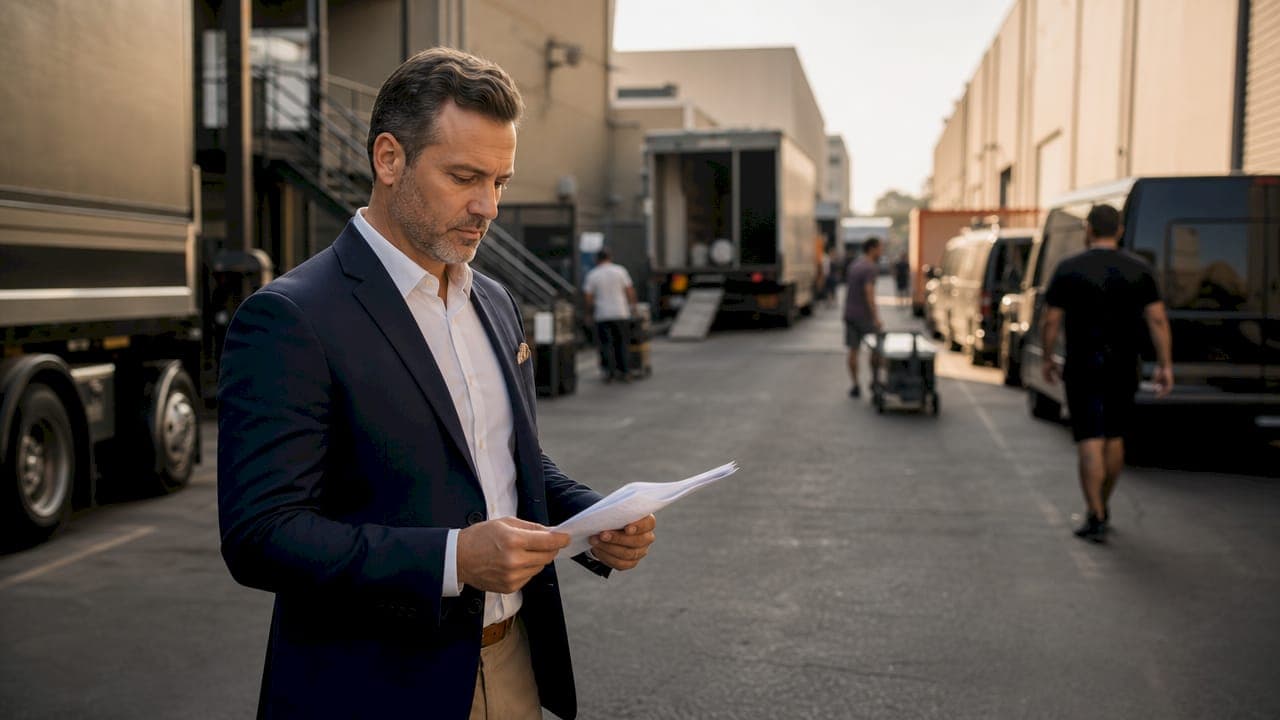
Studio lot transportation is defined as the coordinated operation of vehicles and drivers tasked with moving cast, crew, equipment, and materials throughout a film or television production environment to maintain schedule and minimize delays. The role of studio lot transportation extends far beyond shuttling people from point A to point B. Warner Bros. Studios Burbank operates over 270 vehicles including passenger vans, cargo vans, shuttle buses, tractors, and forklifts, all maintained on a 90-day inspection cycle. That scale reflects how seriously major studios treat ground logistics as a production-critical function, not an afterthought. Every missed pickup, misrouted cargo van, or late driver creates a ripple that can stall an entire shooting day.
What is the role of studio lot transportation in production efficiency?
Studio lot transportation is the operational backbone of any production schedule. When vehicles run on time and routes are pre-planned, directors and department heads can focus entirely on creative work. When transportation fails, the cost compounds fast.
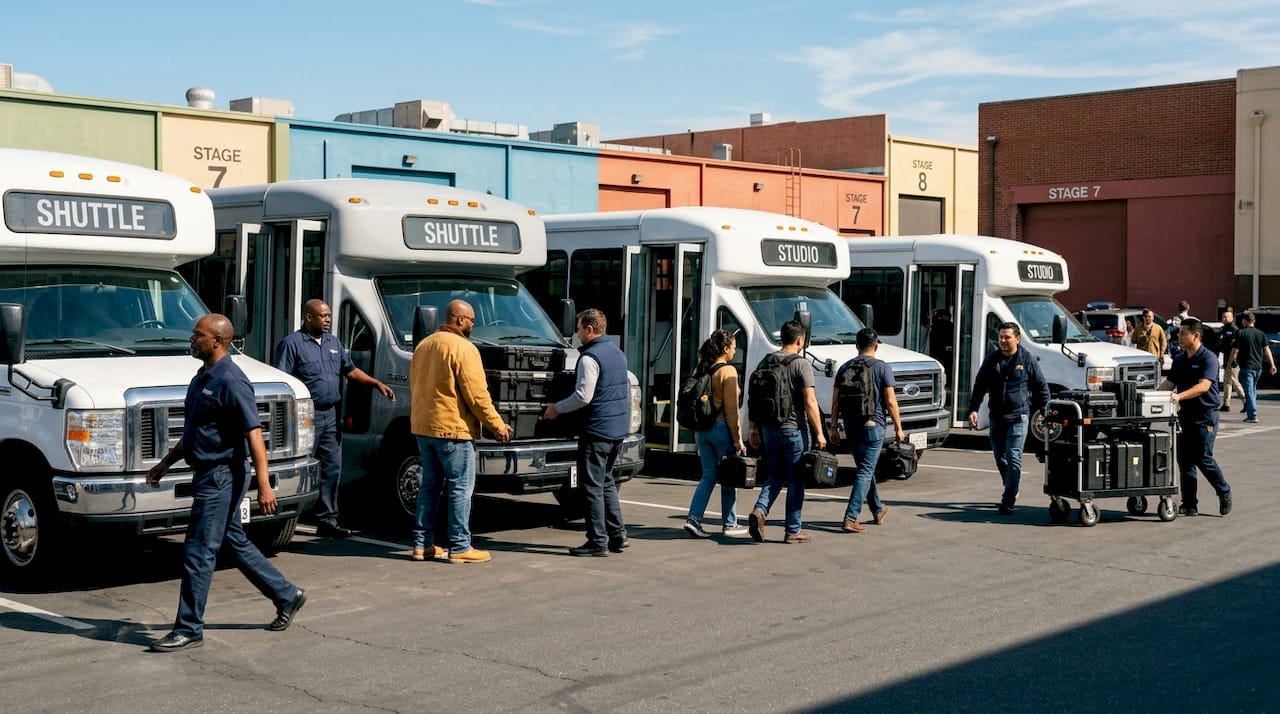
Shuttle loops covering 1–5 miles from set to off-site parking are a standard tool for managing crew movement on large productions. These loops reduce congestion around active sets, satisfy neighborhood permit requirements, and create a repeatable flow that crew members can depend on. A predictable loop is not a luxury. It is a scheduling instrument.
The vehicle mix matters as much as the routes. A typical studio lot deployment includes:
- Passenger vans and shuttle buses for crew movement between base camp, stages, and parking structures
- Cargo vans for wardrobe, props, and small equipment runs between departments
- Tractors and forklifts for moving heavy set pieces, lighting rigs, and grip packages
- Executive vehicles for talent, producers, and studio executives requiring point-to-point service
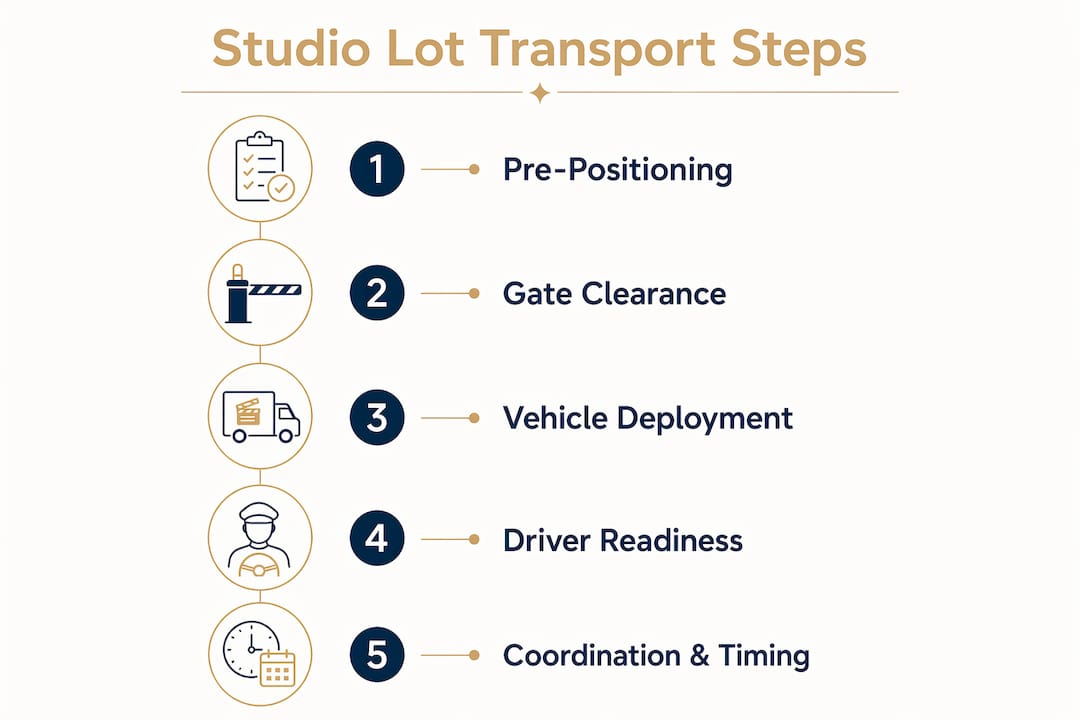
Pre-positioning is where most transportation departments separate good from great. Professional chauffeurs arrive 15 minutes early to confirm vehicles are fueled, clean, and temperature controlled before the first call time. That 15-minute buffer prevents the kind of cascading delay that costs far more than the driver's hourly rate.
Pro Tip: Build vehicle pre-positioning into the transportation call sheet as a hard deadline, not a suggestion. Treat it the same way you treat a camera department call time.
Coordination with local permit conditions adds another layer. Many studio lots sit in residential or mixed-use neighborhoods where truck traffic is restricted to specific hours. Transportation coordinators must map routes and timing windows against permit language before the first shooting day, not during it.
What are the key logistical challenges in studio lot transportation?
Production logistics differ from every other form of commercial transportation. Filming sites feature high variability in staff arrivals, shift overlaps, and peak servicing demands that resemble freight operations more than office commutes. That distinction matters enormously when planning vehicle counts and driver schedules.
The five most demanding challenges transportation coordinators face on studio lots are:
- Staggered call times. A single production day may involve six different crew calls spread across four hours. Each call requires a separate vehicle deployment plan, not a single bulk pickup.
- Freight-like servicing demands. Lighting rigs, catering trucks, and wardrobe deliveries require cargo-rated vehicles and drivers trained to handle specialized loads safely.
- Peak load surges. Set build and strike days generate the highest vehicle demand of any production phase. Transportation plans that work during principal photography often collapse during these periods.
- Gate clearance and access control. Studio lots require strict gate clearance protocols registering specific driver names, vehicle plates, and production IDs in advance. Any gap in that documentation stops a vehicle at the gate during filming hours.
- Labor agreements. Teamsters and other union agreements govern which drivers can operate which vehicle classes. Misassigning a driver to the wrong vehicle type creates both a labor grievance and a safety liability.
Pro Tip: Submit gate clearance documentation at least 48 hours before any new vehicle or driver enters the lot. Studio security does not make exceptions for last-minute additions, regardless of how urgent the production need feels.
Transportation operations must be modeled on actual production rhythms including staggered calls, shift changes, and peak loads. Generic traffic models borrowed from office park planning are insufficient. Production-specific logistics require a different analytical framework entirely.
Why do consistent transportation partners improve production outcomes?
Recurring partnerships with the same transportation providers deliver measurable operational advantages. Experienced providers already know lot-specific security and staging protocols, which cuts onboarding time on each new project and reduces the risk of gate delays or misrouted vehicles.
The benefits of working with a consistent transportation partner include:
- Reduced briefing time. A provider who has worked your lot before does not need a full orientation on gate procedures, staging areas, or restricted zones.
- Faster adaptation to changes. When a shooting location shifts or a call time moves, a familiar provider adjusts without requiring a full re-brief.
- Established trust with studio security. Drivers whose credentials are already on file move through access points faster, which matters during tight turnarounds between scenes.
- Institutional knowledge of talent preferences. For celebrity and talent transportation, a provider who knows a principal actor's preferences for vehicle temperature, privacy, and routing eliminates friction on set.
Productions that treat transportation as a commodity and rotate providers constantly pay a hidden cost in coordination time and execution errors. The relationship between a production and its transportation partner functions like any other skilled crew relationship. Familiarity produces efficiency.
What are the best practices in studio lot transportation for 2026?
The most significant shift in studio lot logistics management is the move away from generic traffic modeling toward production-specific transport assessments. Planning teams that apply standard office traffic templates to studio environments consistently underestimate peak load demands and create gate bottlenecks that violate neighborhood permits.
Current best practices center on three operational priorities:
Data-driven scheduling. Transportation coordinators now build shuttle loops and vehicle deployment plans around actual production call sheets, not estimated crew sizes. Real call data produces accurate vehicle counts and eliminates the over-ordering that inflates transportation budgets.
Technology integration. Scheduling software that syncs with production management platforms lets transportation departments update routes and vehicle assignments in real time as the shooting schedule shifts. That responsiveness is the difference between a transportation department that leads and one that reacts.
Driver readiness standards. Punctuality is the primary performance metric in film set transportation. A missed shuttle loop does not just inconvenience crew members. It can cause cascading schedule failures and six-figure cost overruns on high-budget productions. Driver readiness protocols, including pre-shift vehicle inspections and mandatory early arrival windows, are non-negotiable at the professional level.
White-glove concierge integration is also growing as a standard expectation for talent and executive transportation. Productions working with services like Rigaglobaltravel benefit from white-glove studio transport practices that cover vehicle presentation, driver conduct standards, and real-time communication with production assistants. That level of service protects the production's relationship with its principal talent.
For productions managing ground transportation in New York or other major markets, the same principles apply. Production rhythms in New York differ from Los Angeles in permit structure and traffic patterns, but the core discipline of modeling transport around actual call sheets remains constant.
Key Takeaways
Studio lot transportation is a production-critical function where punctuality, pre-planning, and consistent partnerships directly determine whether a shooting day runs on schedule or generates costly overruns.
| Point | Details |
|---|---|
| Scale reflects priority | Major studios like Warner Bros. operate 270+ vehicles, signaling that transportation is a core production function. |
| Model on real call sheets | Generic traffic templates fail on studio lots; use actual production rhythms to plan vehicle counts and routes. |
| Gate clearance is non-negotiable | Submit driver names, vehicle plates, and production IDs at least 48 hours before any new vehicle enters the lot. |
| Consistent partners reduce risk | Recurring transportation providers cut onboarding time and adapt faster to last-minute schedule changes. |
| Punctuality drives budget outcomes | A single missed shuttle loop can trigger cascading delays and six-figure overruns on high-budget productions. |
Why transportation planning belongs at the top of the production budget conversation
Productions that treat transportation as a line item to minimize are making a category error. I have seen shoots where the transportation budget was cut in pre-production, only to spend three times that amount in overtime and reshoot costs because drivers were late or vehicles were misassigned. The math never works in favor of cutting transportation.
The part that most production professionals underestimate is how early transportation planning needs to start. By the time you are building the shooting schedule, your transportation coordinator should already be mapping gate clearance requirements, shuttle loops, and vehicle classes against the call sheet. Waiting until the week before principal photography is too late to catch permit conflicts or union assignment issues.
The future of studio lot logistics will be shaped by tighter integration between transportation management software and production scheduling platforms. Productions that build that connection early will run leaner and faster. Those that keep transportation siloed from the rest of production planning will keep paying the same avoidable costs.
My strongest advice: treat your transportation coordinator the way you treat your first assistant director. Give them the same access to the schedule, the same seat at the pre-production table, and the same authority to flag problems before they become crises.
— Sammy
How Rigaglobaltravel supports studio productions on the lot and beyond
Productions working across Los Angeles, New York, and other major studio markets need a transportation partner who understands production schedules, not just traffic patterns. Rigaglobaltravel specializes in limousine and concierge transportation for the entertainment industry, with direct experience serving film and television productions at the highest level.
From limousine service in Los Angeles covering LAX, Beverly Hills, and studio lots to talent and executive transport across production hubs, Rigaglobaltravel brings the driver readiness standards, gate clearance familiarity, and white-glove service protocols that productions depend on. Every vehicle is pre-positioned, every driver is briefed on production-specific requirements, and every booking is backed by a team that treats your call sheet as seriously as you do.
FAQ
What is studio lot transportation?
Studio lot transportation is the coordinated movement of cast, crew, equipment, and materials within and around a film or television production environment using a managed fleet of vehicles. It includes shuttle services, cargo runs, and executive transport, all timed to the production call sheet.
How does studio transportation affect the production budget?
Delays caused by late or misrouted vehicles directly increase overtime costs and can trigger six-figure overruns on high-budget productions. Punctuality is the primary performance metric in film set transportation because every idle crew member on set costs money.
What vehicles are used in studio lot transportation?
Studio lots typically deploy passenger vans, shuttle buses, cargo vans, executive sedans, tractors, and forklifts. The vehicle mix is determined by crew size, equipment freight requirements, and the specific demands of each production phase.
Why does gate clearance matter for studio transportation?
Studio security requires driver names, vehicle plates, and production IDs registered in advance. Any missing documentation stops a vehicle at the gate during filming hours, which can delay an entire department's arrival on set.
What makes a transportation partner valuable for film productions?
A transportation partner with prior experience on a specific lot already knows security protocols, staging areas, and restricted zones. That familiarity reduces onboarding time, speeds up gate clearance, and improves the provider's ability to adapt when the shooting schedule changes.