Any chauffeured car or limousine vendor you hire must carry a for-hire livery commercial auto policy — not a rideshare endorsement, not a personal auto policy. That classification is the baseline. On top of it, you need specific endorsements and minimum limits before a vendor should ever move your talent, crew, or executives. Here is the exact package to require on every certificate of insurance (COI):
Minimum coverages to request:
- Commercial auto liability (for-hire livery classification): a combined single limit (CSL) minimum recommended for vehicles based on passenger capacity, with higher requirements for larger vehicles
- Physical damage: collision and comprehensive on every vehicle in service
- Hired and non-owned auto (HNOA): covers subcontracted or rented vehicles the operator does not own
- Workers' compensation: mandatory in most states for employed chauffeurs
- Umbrella/excess liability: $5M or higher for celebrity talent, alcohol onboard, or high-profile productions
- Liquor/host liability: required any time alcohol is served in the vehicle
- Sexual abuse and molestation (SAM) coverage: relevant for talent transport, especially involving minors
Reject the vendor immediately if you see: an expired COI, a rideshare endorsement in place of livery classification, no MCS-90 endorsement for any carrier operating across state lines, or drivers without documented chauffeur licensing.
Pro Tip: Request the actual policy declarations page alongside the COI. A COI is a summary document — the declarations page shows the real exclusions and endorsements that a COI can obscure.
Key Takeaways
Any chauffeured car vendor you hire must carry for-hire livery commercial auto coverage with the correct limits, endorsements, and state filings — a COI alone is not sufficient verification.
| Point | Details |
|---|---|
| Federal baseline limits | FMCSA sets combined single limit (CSL) minimums for passenger groups, with lower limits for smaller capacities and higher for larger on interstate routes. |
| MCS-90 is non-optional interstate | Any carrier crossing state lines must have an MCS-90 endorsement on file with FMCSA before operating. |
| COI is not enough | Request the declarations page and endorsement pages — that is where exclusions and additional insured status actually appear. |
| State rules vary significantly | California, New York, and Washington each have separate permit and filing requirements beyond the federal baseline. |
| Umbrella for high-exposure work | For talent or celebrity transport, require $5M total coverage through a primary policy plus umbrella layer. |
Table of Contents
- How car service insurance requirements differ: federal vs. state rules
- What coverages should a chauffeured car service carry?
- Federal baseline limits and what buyers should actually require
- What to require on the COI and in your vendor contracts
- How to verify a vendor's coverage before hiring
- What drives limo insurance premiums and how long filings take
- Red flags and questions to ask every vendor
- What most buyers get wrong about vetting a car service
- Work with a provider that already meets the standard
- Sources
How car service insurance requirements differ: federal vs. state rules
The FMCSA's 49 CFR Part 387 governs interstate for-hire passenger carriers — any operator crossing state lines to carry paying passengers. These carriers must hold a USDOT number, obtain operating authority (MC number), and have the MCS-90 endorsement on file before FMCSA grants that authority. No MCS-90, no legal interstate operation.
Intrastate operators — those staying within one state — fall under state public utilities commission (PUC), transportation network authority, or DMV rules instead. The requirements vary considerably:
- California: TCP (Transportation Charter Party) permit from the CPUC, with proof of insurance filed directly with the commission
- New York: FH-1 or FH-1B certificate forms filed with the NY DMV; livery operators must keep a current for-hire certificate in each vehicle at all times
- Washington State: limousine carrier business license, vehicle certificates, proof of insurance, vehicle inspections, and chauffeur qualification records including background checks and drug testing participation — all required before operating
- Maine: state-specific for-hire insurance filings by passenger capacity, with evidence of coverage required before registration
To tell whether a vendor is interstate or intrastate: ask for their USDOT/MC number and look them up on the FMCSA SAFER system. If they have operating authority, they are subject to federal minimums. If they operate only within one state, request their state carrier certificate or local livery permit instead.
What coverages should a chauffeured car service carry?
Commercial auto with for-hire livery classification is the foundation. Standard rideshare policies and personal auto policies exclude commercial passenger transport — a claim filed under either will be denied. Industry sources confirm that livery classification places the vehicle in a higher-risk tier, which is exactly why it provides the coverage production and corporate accounts need.
Liability limits and CSL: A combined single limit policy pays bodily injury and property damage from a single pool. For passenger claims — where multiple occupants can each sustain serious injuries — CSL is the right structure. A split-limit policy (e.g., $300K per person / $1M per occurrence) can be exhausted quickly in a multi-passenger incident.
Physical damage covers the vehicle itself. Collision handles accidents; comprehensive covers theft, weather, and non-collision damage. For high-end sedans and specialty vehicles, confirm the declared value matches the actual fleet.
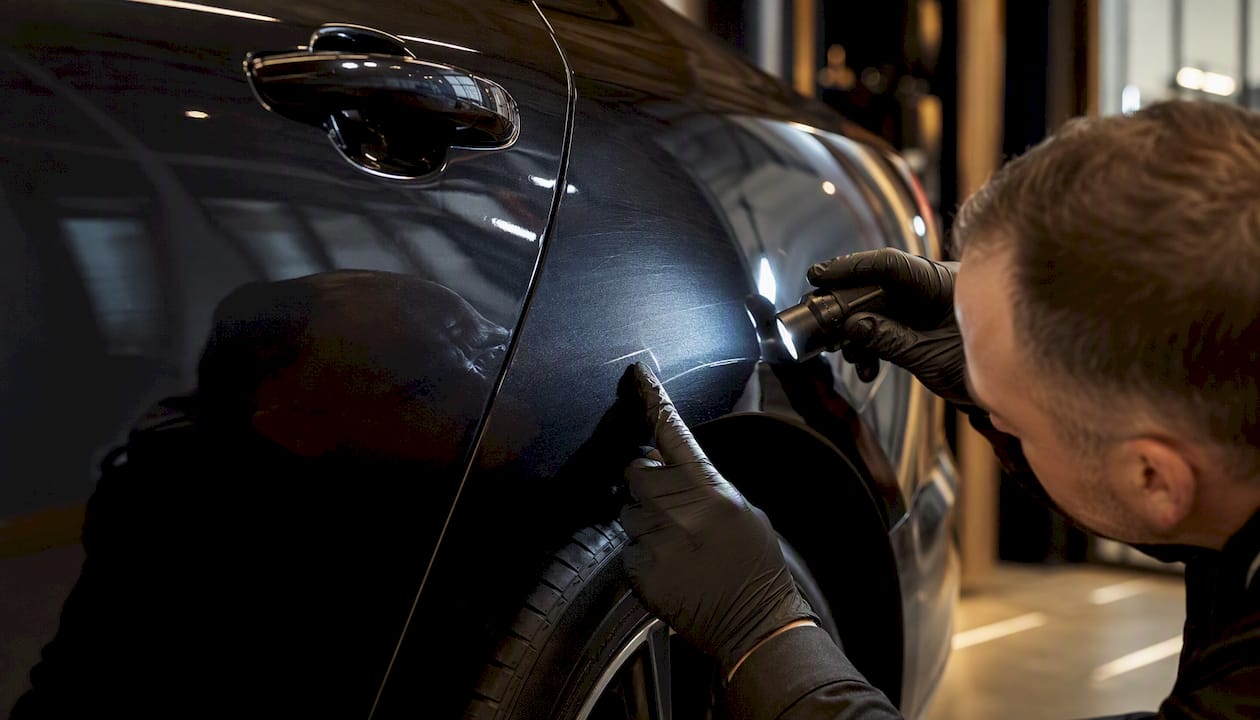
HNOA matters whenever a vendor subcontracts a run or rents a vehicle. Without it, a vehicle the operator does not own carries zero coverage under the primary policy.
Workers' compensation rules are state-specific, but most states require it for W-2 chauffeurs. Independent contractor classification does not automatically eliminate the exposure — misclassification claims are common in the livery industry.
Umbrella/excess liability sits above the primary commercial auto limit. For talent transport and executive work, many corporate accounts require $5M total, achieved through a $1.5M primary plus a $3.5M umbrella layer.
Pro Tip: For any production involving alcohol in the vehicle, confirm the liquor/host liability endorsement is on the policy — not just noted on the COI. Some carriers add it as a rider that can lapse independently of the main policy.
Federal baseline limits and what buyers should actually require
FMCSA 49 CFR Part 387 sets the federal floor for interstate passenger carriers. Many corporate and production buyers should require more.
| Scenario | FMCSA Baseline | Recommended Buyer Minimum |
|---|---|---|
| Sedan/SUV, 1 to 14 passengers, interstate | $1.5M CSL + MCS-90 | $1.5M CSL + umbrella to $5M |
| Van/shuttle, 15 or more passengers, interstate | $5M CSL + MCS-90 | $5M CSL + umbrella |
| Intrastate sedan/SUV | State minimum (varies) | $1.5M CSL minimum |
| High-profile talent or celebrity transport | $1.5M CSL baseline | $5M+ total with umbrella |
| Alcohol onboard / special event | $1.5M CSL baseline | $5M+ plus liquor liability |
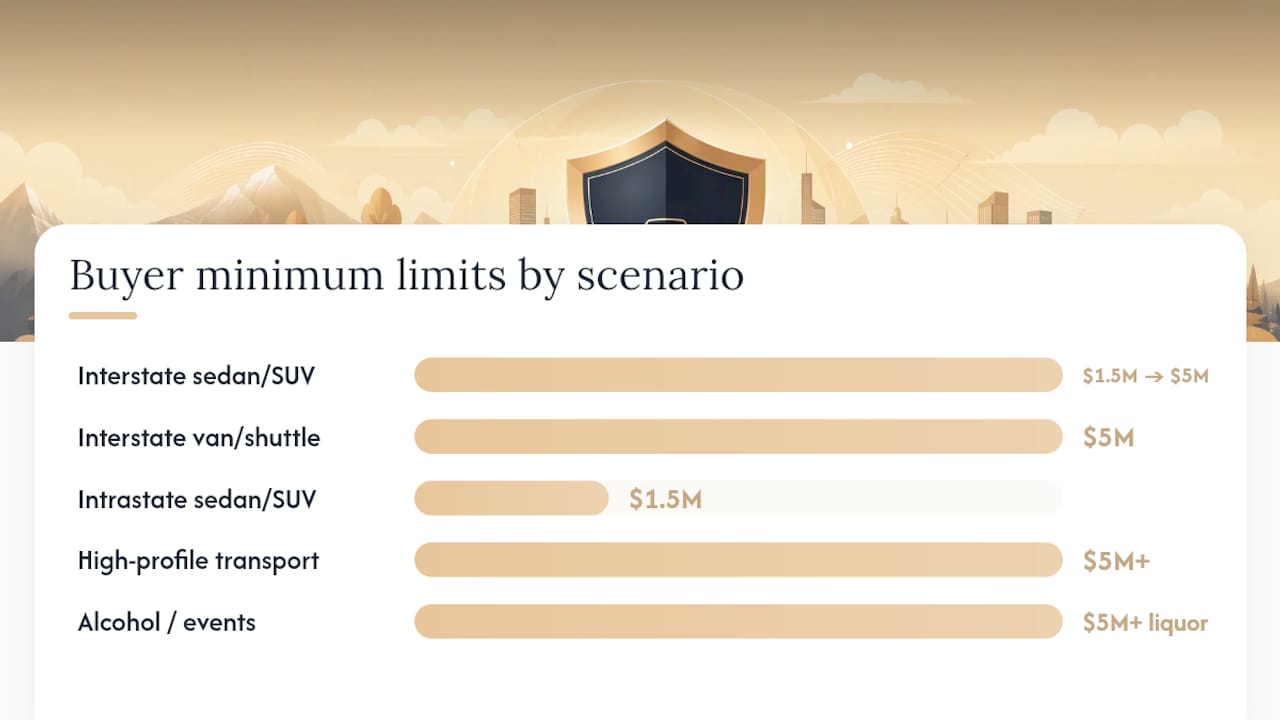
State and venue requirements can push limits higher still. California TCP permits, NYC TLC rules, and many studio lot requirements already mandate $1.5M or above — so the federal baseline is often the floor, not the ceiling.
What to require on the COI and in your vendor contracts
A COI is only as useful as what it actually documents. Here is the checklist:
COI checklist:
- Insurer name and NAIC number (confirms the carrier is a real, licensed company)
- Policy number and policy period (confirm it covers your event dates)
- Named insured matches the legal entity you are contracting with
- Vehicle schedule or blanket livery language covering the fleet
- Liability limits shown as CSL, not split limits
- MCS-90 endorsement noted (for interstate carriers)
- Certificate holder line naming your company
- 30-day written cancellation notice to the certificate holder
Required policy endorsements (request the actual endorsement pages, not just COI notation):
- Additional insured status for your company
- Primary and noncontributory wording (your policy does not contribute first)
- Waiver of subrogation in your favor
- MCS-90 endorsement for any interstate operator
- Liquor liability endorsement if alcohol is foreseeable
Contract clause concepts to include:
- Vendor represents that all vehicles are covered under a for-hire livery commercial auto policy meeting specified minimum limits
- Vendor agrees to provide certified copies of endorsements within five business days of request
- Indemnity scope tied to vendor negligence and passenger claims
- Audit right: buyer may request current insurance documentation at any time during the contract term
For talent contract transport clauses, the indemnity and insurance representations sections deserve particular attention from your legal team.
How to verify a vendor's coverage before hiring
- Request the COI, policy declarations page, and all endorsement pages. Review the declarations for exclusions — particularly any "livery exclusion" language, which would void coverage for paying passengers.
- Confirm endorsements exist as standalone documents. A COI that notes additional insured status is not the same as a policy endorsement that grants it. Ask for the endorsement page.
- Verify carrier solvency. Look up the insurer on the NAIC Company Search and confirm it is admitted in the state where the vehicle operates.
- For interstate carriers: run the USDOT/MC number through the FMCSA SAFER system to confirm active operating authority and MCS-90 filing on record.
- For intrastate carriers: request state PUC/TLC filing receipts or the state-issued carrier certificate. Washington State's limousine carrier requirements illustrate the kind of documentation package to expect.
- Build a vendor evidence file. Store the COI, declarations, endorsements, and license/permit images in one folder per vendor. Set a calendar reminder 60 days before each policy renewal to reverify.
What drives limo insurance premiums and how long filings take
Typical timelines:
- COI and document exchange: 1–3 business days
- Insurer endorsement issuance: 3–10 business days depending on carrier
- State permit or vehicle certificate processing: days to several weeks, depending on the state
Primary premium drivers:
- Vehicle type and declared value (a Sprinter van costs more to insure than a sedan)
- Alcohol exposure and special-event use
- Passenger capacity
- Driver records and screening rigor (background checks, MVR pulls, drug testing)
- Geographic exposure (airport runs, city corridors, interstate routes)
- Claims history and fleet loss ratios
- Whether the carrier uses a limo-specialty market versus a generalist insurer
Published industry ranges put annual premiums at roughly $3,500–$8,500 per vehicle for solo chauffeur operations, with higher figures for party buses and stretch limousines. These are illustrative benchmarks — actual quotes depend on the factors above.
Requiring higher limits, more endorsements, or faster filing turnarounds increases carrier pricing. Multi-year or portfolio agreements can sometimes offset that increase for established vendors.
Red flags and questions to ask every vendor
Immediate disqualifiers:
- Expired COI or policy period that does not cover your event dates
- Rideshare endorsement instead of for-hire livery classification
- No MCS-90 for a carrier that crosses state lines
- Drivers without documented chauffeur licensing or background checks
- Named insured on the COI does not match the contracting entity
Operational red flags:
- Evasive or delayed answers when you ask for endorsement pages
- Carrier refuses to add additional insured or primary/noncontributory language
- Policy contains narrow use exclusions that could apply to your specific transport scenario
- Subcontracted vehicles with no HNOA coverage documented
Questions to ask every vendor:
- "Do you carry for-hire livery commercial auto, and can you confirm the policy excludes rideshare classification?"
- "What is your CSL limit, and do you carry an MCS-90 if you operate interstate?"
- "Can you provide the declarations page and endorsement pages showing additional insured, primary/noncontributory, and waiver of subrogation?"
- "How do you document driver background checks and licensing?"
Escalate to legal or procurement when: the transport involves celebrity or named talent, alcohol is onboard, specialty equipment is being moved, or the policy shows exclusions you cannot immediately interpret. For field production and specialty transport scenarios, the risk profile shifts enough that a quick legal review of the vendor's policy is worth the time.
Pro Tip: Ask the vendor who their insurer is before you request the COI. A vendor who hesitates or gives a vague answer ("some company in Florida") is signaling that their coverage may not hold up to scrutiny.
What most buyers get wrong about vetting a car service
The standard advice is to "ask for a COI." That is the beginning of the process, not the end of it. A COI is a summary document issued by the vendor's broker — it reflects what the broker told the insurer, not necessarily what the policy actually covers. The declarations page and the endorsement pages are where the real terms live, and most buyers never ask for them.
The second gap: buyers treat the FMCSA baseline as the target rather than the floor. A $1.5M CSL is the federal minimum for a sedan carrying paying passengers across state lines. For a production company moving a lead actor through three states with a full security detail, that limit is thin. A single serious accident with multiple injured occupants can exceed $1.5M before litigation costs. Requiring a $5M umbrella layer is not overcaution — it is standard practice for any account where the people in the vehicle are both high-value and high-visibility.
The third thing buyers consistently underestimate is the state-level complexity. FMCSA rules cover interstate operations cleanly. But a vendor who only works within Los Angeles answers to the CPUC, not the FMCSA, and the TCP permit filing is a separate document entirely. A vendor who works only in New York City answers to the TLC. Knowing which regulator controls your vendor determines which documents you ask for — and a vendor who cannot produce the right state-level paperwork is not compliant, regardless of what their COI says.
The practical fix is simple: build a one-page vendor insurance checklist, require it to be completed and documented before any booking is confirmed, and reverify at every policy renewal. Rigaglobaltravel applies this process across its production and corporate accounts — the COI, declarations, endorsements, and state permits all go into a single vendor file before a vehicle is dispatched.
Work with a provider that already meets the standard
Production companies and talent agencies in New York and Connecticut regularly work with Rigaglobaltravel's chauffeured car service because the insurance documentation is already in order before the first booking. The COI, endorsements, and state filings are on file — not something you have to chase.
For Connecticut-based productions and corporate accounts, Rigaglobaltravel's Connecticut service covers Greenwich, Stamford, and Fairfield with the same documentation standards. Los Angeles productions can reach the team at Rigaglobaltravel's LA service for studio and airport transport with verified coverage.
Sources
- Insurance Filing Requirements | FMCSA
- Limousine Insurance: Cost & Coverage Guide (2026)
- Obtaining Your Limousine Carrier
- For-Hire Insurance Requirements | NY DMV
- For-Hire Insurance | SOS