
A professional no-show policy for contracted chauffeured car service is a written set of waiting-time thresholds, cancellation windows, fee triggers, and MSA override clauses that determines when a chauffeur may legally release a vehicle and when a full charge applies.
A professional no-show policy typically covers grace periods by pickup type, tiered cancellation fees, documented contact attempts before release, invoicing and dispute procedures, and acknowledges that bespoke MSA terms override public-facing terms and conditions. The one action your booking team should take today: embed release thresholds and pre-authorized contact names directly into every booking confirmation and corporate account MSA.
- Grace periods must differ by pickup type (airport vs. non-airport vs. production set)
- Cancellation windows must be tiered, not binary
- Every contact attempt requires a timestamp
- MSA terms always override retail T&Cs
- Disputes require documented proof of attempted contact, not just a driver's verbal account
Pro Tip: Add a "release authorization contact" field to your booking form. Without a named alternate contact on file, a single unreachable traveler can trigger a disputed charge that takes weeks to resolve.
Key Takeaways
A professionally enforced no-show policy for contracted car service requires numeric grace periods, tiered cancellation fees, timestamped contact-attempt logs, and MSA terms that explicitly override retail T&Cs.
| Point | Details |
|---|---|
| Grace periods must be numeric | Airport: 60 min from wheels-down; non-airport: 15 min; production set: hold until named authorizer confirms. |
| Tiered cancellation fees reduce disputes | More than 48 hours: no charge; 24–48 hours: partial; fewer than 24 hours or chauffeur dispatched: full charge. |
| Timestamped logs are non-negotiable | Two documented contact attempts with delivery timestamps are required before any release decision. |
| MSA terms override retail T&Cs | Bespoke contract terms, signed addenda, and pre-authorized release contacts must be recorded at account setup. |
| Rigaglobaltravel manages this end-to-end | Rigaglobaltravel provides MSA clause integration, automated reminders, and monthly KPI reporting for production and corporate accounts. |
Table of Contents
- What must your no-show policy for car service include?
- How do the core policy components actually work?
- How to implement a no-show policy without disrupting production logistics
- How do MSAs and corporate accounts change the rules?
- When should no-show fees be waived?
- Sample no-show policy language you can copy
- How Riga Global Travel handles no-shows for production accounts
- What KPIs should you track to measure no-show policy effectiveness?
- Why no-show fees are a last resort, not a revenue line
- Rigaglobaltravel's managed policy integration for production accounts
- Sources
What must your no-show policy for car service include?
Use this checklist as a quick audit before your next production booking or MSA renewal.
Waiting-time and grace-period rules
- Airport pickups: flight-tracked grace window (commonly 60 minutes from wheels-down, per representative provider terms)
- Non-airport pickups: generally a short grace period varying by operator; production accounts may negotiate longer waits with prior authorization
- Set and studio pickups: release only after a named authorizer confirms via documented channel
Cancellation windows and deposit rules
- Clients cancelling with sufficient advance notice generally avoid charges or receive deposit returns
- Cancellations within an intermediate window often incur a partial charge
- Fewer than 24 hours or chauffeur already dispatched: full charge or deposit forfeiture, per industry benchmark guidance
- High-value or multi-vehicle event bookings: require a deposit at booking
Communication requirements
- Booking confirmation with policy language attached
- 24-hour reminder with driver name and contact
- En-route notification when chauffeur departs
- On-location arrival alert with timestamp
Invoicing and dispute steps
- No-show invoice issued within 24 hours of release
- Dispute window: 5 business days from invoice date
- Credits applied to account, not refunded to card, unless MSA states otherwise
MSA and corporate account fields to populate
- Pre-authorized release contact (name, mobile, email)
- Preferred notification channel (SMS, email, or dispatch app)
- Agreed grace-period overrides and fee waivers for production stalls
Pro Tip: For production accounts, build a two-column MSA addendum: left column lists the standard policy term; right column lists the negotiated override. Signed addenda prevent disputes at the invoice stage.
How do the core policy components actually work?
Industry benchmarking shows chauffeurs commonly arrive on site roughly 15 minutes early, and that waiting thresholds in practice range from 15 minutes to 60 minutes depending on booking type. Operators combine automated arrival notifications with staged contact attempts before any release decision, following industry best practices.
Grace periods by pickup type
Fee structure and invoicing
Per-minute wait-time billing kicks in after the included grace window. Provider policies document that once the grace period expires and the chauffeur is released, the booking is non-refundable. Your invoice should itemize: base trip fee, wait-time accrued (per-minute rate × minutes), and any applicable no-show surcharge.
Proof-of-contact requirements
Operational defensibility depends entirely on timestamped evidence. Without it, most B2B disputes favor the client. Required documentation before any release:
- Automated SMS or email log with delivery timestamp
- Chauffeur's written arrival report (time on site, location)
- Dispatch call log if phone contact was attempted
- Screenshot of any app-based notification sent
The VDSI industry definitions draw a clear line between a driver no-show (operator fails to arrive within the agreed period, triggering a refund or rebooking obligation) and a passenger no-show (client fails to appear within the waiting period, triggering a fee). That distinction determines who owes what, and it belongs in your MSA language explicitly.
Pro Tip: Store all contact-attempt logs in your dispatch platform, not just in a driver's phone. Logs that live only on a personal device are nearly impossible to produce in a chargeback dispute.
How to implement a no-show policy without disrupting production logistics
-
Pre-booking setup. Capture the pre-authorized release contact, preferred notification channel, and any MSA grace-period overrides at account creation. Flag production accounts separately from standard corporate accounts in your dispatch system.
-
Automated confirmation. Send a booking confirmation within 15 minutes of booking. Include: pickup time, driver name (once assigned), grace-period length, cancellation deadline, and the no-show fee amount. Automated confirmations and driver-assignment notifications are the single most effective tools for reducing no-shows — they convert an abstract reservation into a concrete obligation.
-
Reminder cadence. Send a 24-hour reminder and a 2-hour reminder. Both should include the driver's name, mobile number, and a one-tap cancellation or change link.
-
Day-of flow. Driver departs → en-route notification sent → arrival notification sent with timestamp → first contact attempt at T+5 minutes past scheduled pickup → second attempt at T+10 → dispatch call at T+15 → release authorization requested from pre-authorized contact at T+[grace period].
-
Release decision. Release is authorized only by a named contact or dispatch supervisor. Log the authorizer's name, method of authorization, and exact timestamp.
-
Dispute handling. If a client disputes a charge, pull the full contact-attempt log, driver arrival report, and release authorization record. Issue a credit only when documentation supports an exception. Escalate to the account manager for corporate accounts; never adjust invoices unilaterally at the dispatcher level.
For guidance on limo dispatcher workflows in entertainment specifically, the operational sequencing differs from standard corporate runs.
How do MSAs and corporate accounts change the rules?
MSA terms override public-facing car service terms and conditions. That is not a courtesy — it is a contractual precedence clause that should appear verbatim in every corporate agreement. Any exception, waiver, or custom threshold negotiated with a production company or talent agency must be recorded in a signed addendum or confirmed in writing by both parties.
MSA clauses worth negotiating
- Named release authorization contacts (minimum two, with mobile numbers)
- Custom grace-period lengths by pickup type
- Fee waiver triggers for verified production holds or on-set overruns
- Preferred notification channels (some productions require dispatch-app alerts, not SMS)
- Credit-to-account terms instead of card refunds for disputed charges
- Chargeback dispute window (recommend 5 business days from invoice)
Corporate account holders are contractually responsible for the actions of passengers they book. That means a talent agency booking a car for a client owns the no-show fee if the client fails to appear, unless the MSA says otherwise. Production accounts should require pre-authorized communication channels to prevent premature no-show classification when a set runs long.
For context on how transport obligations appear in talent contracts, the clause structure mirrors what belongs in a transportation MSA.
Procurement checklist for MSA negotiation
- Confirm grace-period lengths are stated numerically, not descriptively
- Confirm fee amounts are fixed dollar figures, not percentages of an unstated base
- Confirm the release authorization contact field is mandatory, not optional
- Confirm the dispute window is defined and mutual
- Confirm force majeure language covers production-specific delays
When should no-show fees be waived?
Legitimate exceptions exist. The key is a consistent authorization flow so account teams make defensible decisions rather than ad hoc ones.
Common waivable exceptions
- Flight diversion or documented delay beyond the grace window
- Verified production hold communicated by the production office before release
- On-set overrun confirmed by a named on-set contact
- Documented security or safety incident preventing client departure
- Driver no-show or late arrival (operator fault triggers a refund or rebooking, per VDSI definitions)
Verification required for each waiver
- Flight delay: flight-tracking screenshot with timestamp
- Production hold: email or text from the production office, naming the authorizer
- On-set overrun: dispatch call log or app message from a named on-set contact
- Security incident: written report from the client's security team
Authorization flow
Only a named account manager or operations supervisor may approve a waiver. The dispatcher logs the waiver request, the verification document received, the approver's name, and the timestamp. Partial charges apply when the chauffeur has been on site for a significant portion of the grace period before the exception is confirmed.
Sample no-show policy language you can copy
Short form (for booking confirmations)
Extended MSA clause
Confirmation email snippet
Place the extended MSA clause in Schedule B of your master agreement, cross-referenced from the main service terms. Add the short form to every booking confirmation and invoice footer.
How Riga Global Travel handles no-shows for production accounts
A representative production pickup at Rigaglobaltravel follows this sequence:
- Booking confirmed → automated confirmation sent within 15 minutes, including driver name, grace period, and cancellation deadline
- 24 hours before pickup → reminder sent to booker and pre-authorized release contact
- 2 hours before pickup → second reminder with driver mobile number
- Driver departs → en-route notification sent automatically
- Driver arrives → on-location alert timestamped in dispatch system
- T+5 minutes past scheduled time → first contact attempt (SMS to traveler and release contact)
- T+10 minutes → second contact attempt (call to release contact)
- T+[grace period] → release authorization requested from pre-authorized contact; dispatcher logs authorizer name and method
Outcome examples
- Production hold verified by email from the production office before grace period expires: waiver approved, no charge, chauffeur reassigned
- Client unreachable, no response from release contact within grace period, release authorized by dispatch supervisor: full trip fee invoiced, contact-attempt log attached
Rigaglobaltravel's MSAs record pre-authorized release contacts and communication channels at account setup, so the day-of flow never depends on reaching a single unreachable phone. Teams managing TV production ground transportation in New York can see this workflow applied to multi-vehicle production days.
Lessons other teams can adopt
- Require two release contacts at account setup, never one
- Log every contact attempt in the dispatch platform, not the driver's personal device
- Issue no-show invoices within 24 hours while documentation is fresh
- Review waiver decisions monthly to catch patterns before they become policy gaps
What KPIs should you track to measure no-show policy effectiveness?
Track these monthly, segmented by booking type (airport, non-airport, production set) and by account. High no-show rates on a specific account type usually point to a gap in the reminder cadence or a missing release contact field, not a client behavior problem.
Most disputes cluster around two failure points: no timestamped contact-attempt log, or a release authorized by someone not named in the MSA.
Pro Tip: Add "booking type" and "MSA flag" as mandatory fields in your dispatch platform. Without those tags, month-over-month analysis collapses into a single undifferentiated no-show rate that tells you nothing about where the problem actually lives.
Why no-show fees are a last resort, not a revenue line
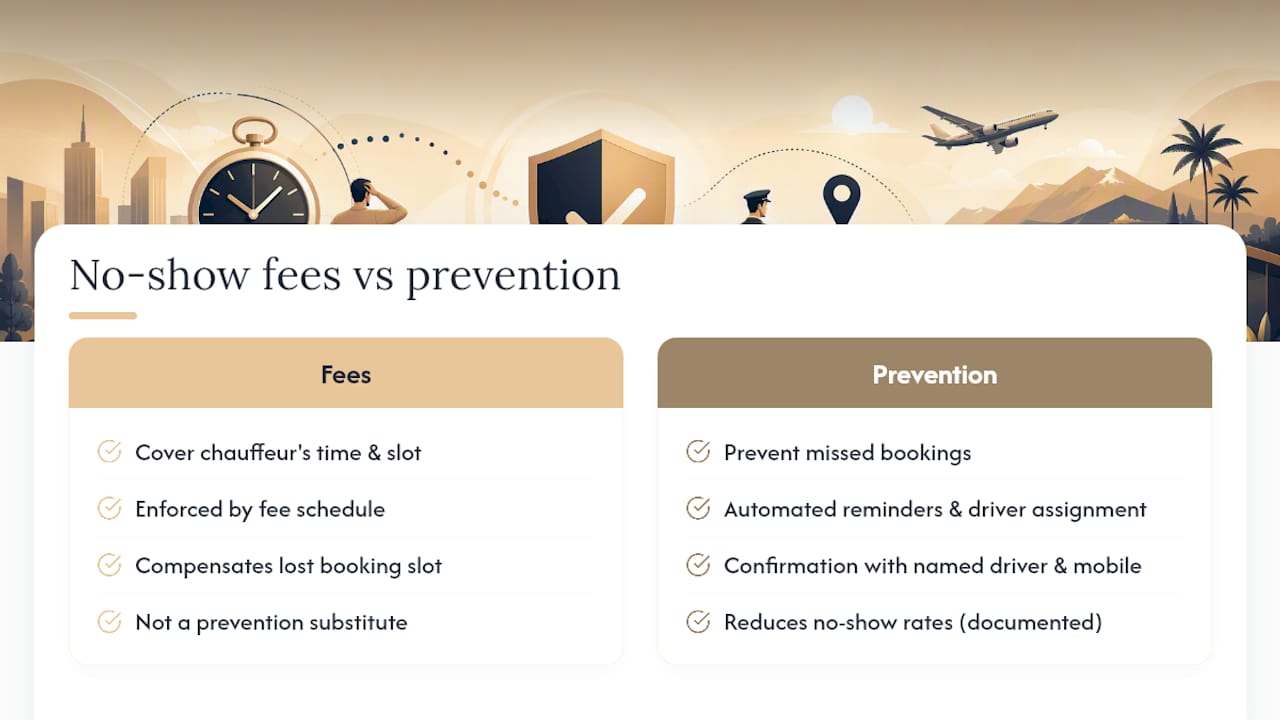
No-show fees exist to cover a real cost: a chauffeur's time, a vehicle held off the dispatch board, and a booking slot that could not be filled. They are not a profit center. The firms that handle enforcement best treat every fee as a failure of communication somewhere upstream, and they build their systems accordingly.
Automated reminders and driver-assignment notifications do more to prevent no-shows than any fee schedule. When a client receives a confirmation with a named driver, a direct mobile number, and a two-hour reminder, the booking stops feeling abstract. That psychological shift is documented as the mechanism behind reduced no-show rates across the chauffeured transport sector.
The harder discipline is consistency. A policy enforced selectively, or waived informally without documentation, stops being a policy. It becomes a negotiation, and clients learn quickly which operators will fold under pressure. Transparent documentation, a clear dispute window, and a named escalation path protect the client relationship more reliably than a soft enforcement posture ever does.
Rigaglobaltravel's managed policy integration for production accounts
Production and corporate travel teams that want policy enforcement handled at the operator level, not the procurement level, get exactly that with Rigaglobaltravel. The difference from a standard car service is operational: MSA clause drafting assistance, pre-authorized release contact setup at account creation, automated confirmation and reminder delivery, and monthly KPI reporting on no-show rate, disputed charges, and driver on-time arrival.
For teams managing multi-vehicle production days or executive travel across markets, Rigaglobaltravel's corporate car service covers New York and Connecticut with direct-billed corporate accounts and policy-integrated dispatch. West Coast productions can access the same managed account structure through Rigaglobaltravel's Los Angeles services. Contact Rigaglobaltravel to configure your account, embed your MSA terms, and get your first no-show report within 30 days.
Sources
- Benchmark & Best Practices – Early Morning Pickups, No-Shows
- How to Reduce No-Shows in Your Limo Business — DrivOQ Blog | DrivOQ
- Benchmark & Best Practices – Cancellation Policies - Chauffeur Driven
- Terms and Conditions – Noir Executive
- Terms & Conditions | LuxShuttle Luxury Chauffeur Atlanta