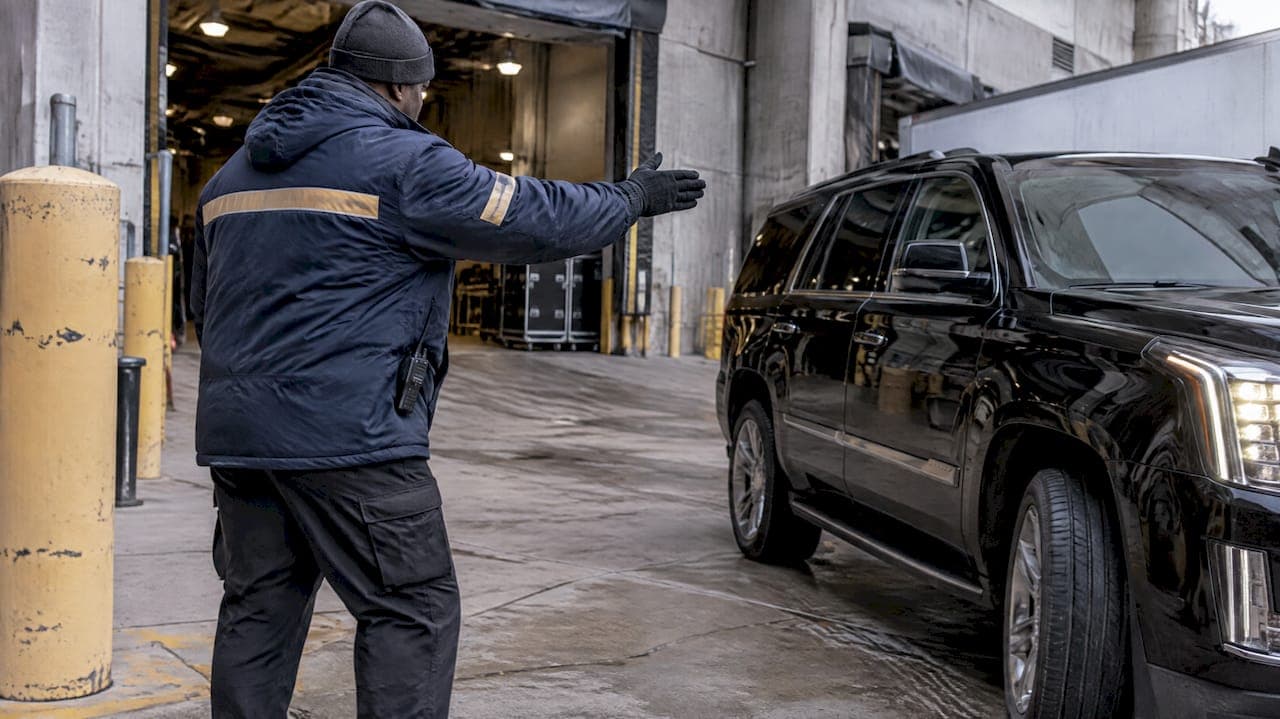
A backstage transportation plan has one job: get performers, crew, and staff where they need to be, on time and without crossing paths with the audience. That means five things working together: route separation between artist and public traffic, scheduled arrival windows, credentialed vehicles, a clear communication protocol, and backup plans for when something breaks.
TL;DR:
- Begin planning 9 to 12 months ahead for a festival in its first year, or 6 to 9 months ahead for an established event.
- Schedule vendor and transport arrivals within windows lasting 30 to 60 minutes, stagger shared gates by at least 30 minutes, and buffer stage runs.
- Keep a current manifest, vehicle roster with driver contacts, staging map, and phone or radio contact tree available at every gate on show day.
- Assign each vehicle a dedicated driver and keep at least one backup of each type on standby; inspect carts and ATVs daily.
- Use shore power where site capacity permits to prevent idling, but have a qualified electrician make connections that meet NFPA 70 and NFPA 70E.
Table of Contents
- The backstage transportation planning checklist
- Setting up artist zones and route geometry
- Scheduling, arrival windows and the transport manifest
- Vehicle management and shore power guidance
- Staffing, roles, and on-site accountability
- Communication protocols and credentialing
- Safety, regulatory and specialty scenarios
- What production-grade transport operations get wrong most often
- How chauffeured transport and concierge support take this off your plate
- FAQ
- Sources
The backstage transportation planning checklist
Treat backstage transportation the way you treat lighting or sound: a production department with its own timeline, deliverables, and sign-offs. The work starts long before load-in and ends with a signed contact tree posted at every gate.
A site survey and CAD site map come first. According to Towerhouse Global's production checklist, this survey should document power access, road and semi-truck clearance, ground surface conditions, and emergency vehicle routes, giving every department a single source of truth instead of five conflicting assumptions. Your map needs to show:
- Power connections and shore power hookup points
- Access roads, turning radii, and semi-truck clearance zones
- Pedestrian flow lines and where they cross vehicle routes
- Emergency vehicle lanes kept clear at all times
- Loading docks and staging areas marked by use
Timing matters as much as geography. Per the same Towerhouse Global research, production-grade logistics planning typically begins 9 to 12 months before a first-year festival and 6 to 9 months out for an established event, with artist advancing and transport specifics intensifying in the final 3 months. Build your timeline around these checkpoints:
- Artist advance and initial transport requirements: 8 to 12 weeks out
- Transport manifest draft shared with stage management and security: 3 to 6 weeks out
- Final vehicle, driver, and credential confirmations: 1 to 4 weeks out
- Day-of briefing and manifest distribution: morning of the event
By show day, four documents need to exist in final form: the transport manifest, a vehicle roster with driver contacts, a staging area map, and a contact tree that reaches every coordinator by phone or radio. Skipping any one of these is how a 15-minute delay turns into a missed set time.
Setting up artist zones and route geometry
Separating performer movement from audience flow is the single highest-leverage decision in the whole plan. Entertaining Safety's guidance on backstage logistics recommends separate entry and exit points for performers wherever the site allows, both to protect privacy and to reduce the risk of crowd surges near vehicle lanes.
Start by marking artist-only routes directly on your CAD site map, including any sight-line shielding (fencing, draping, or parked trailers) that keeps performers out of public view during transfers. From there, work through the physical details:
- Mark turnaround radii large enough for the largest vehicle in your fleet, not the average one
- Check ground surface conditions on artist routes after rain or heavy foot traffic
- Light every artist route and staging area at the same brightness as the main compound
- Place barriers and directional signage at every point where an artist route could be mistaken for a public one
- Assign staff marshals to hold routes clear during high-traffic windows, not just at load-in
Staging and holding areas need their own criteria. For reference layouts, our guide on venue shuttle staging zones walks through how to size these areas and place signage so drivers and marshals read the same map the same way.
Pro Tip: Walk every artist route yourself at the time of day it will actually be used, since lighting and crowd density change completely between a 2 p.m. soundcheck and a 9 p.m. encore.

Scheduling, arrival windows and the transport manifest
Bottlenecks at a single access point are almost always a scheduling failure, not a capacity one. Azavista's onsite logistics research recommends assigning 30 to 60-minute arrival windows to vendors and transport staff, and staggering those windows by at least 30 minutes whenever multiple parties share the same access point.
Build your manifest around these fields:
- Act or crew name and tour manager contact
- Vehicle type and plate or unit ID
- Driver name and direct phone number
- Scheduled set time and corresponding arrival time
- Access pass ID tied to the credential system
- Pickup location (hotel, airport, or on-site)
| Manifest field | Example entry | Why it matters |
|---|---|---|
| Arrival window | 6:30 PM | Prevents overlap at shared gates |
| Vehicle type | Sprinter van | Matches gate width and parking assignment |
| Driver contact | Direct cell number | Enables real-time rerouting |
| Access pass ID | AA-01 | Confirms credential before gate release |
Sequence hotel and airport shuttles separately from on-site stage runs, since the two have different failure points: traffic and flight delays affect the first, equipment changeovers affect the second. Abastio's event logistics guide makes the broader case for splitting transportation plans by people versus materials, since equipment deliveries and personnel arrivals compete for the same loading zones if they share one schedule. Add a 15-minute buffer to every stage-adjacent arrival window to absorb normal delay without cascading into the next act's slot.
Vehicle management and shore power guidance
Every parked vehicle backstage is a hazard until it is accounted for. Document the position of every vehicle on your staging map, cap the number allowed in the backstage compound at once, and require every driver to remain on-call and listed on the manifest for the full window they are assigned.
Idling engines create both a safety and air quality problem in enclosed or tented backstage areas. Shore power eliminates the need to idle vehicle engines for onboard electrical systems, and Entertaining Safety's backstage vehicle guidance names it as a best practice wherever site power capacity allows. Any shore power hookup should follow NFPA 70 and NFPA 70E guidelines, and a qualified electrician should handle the connection rather than production staff.
For fleet composition, build in redundancy from the start:
- Confirm golf carts, ATVs, and shuttle vans are fueled or charged before doors open
- Assign a dedicated driver to each vehicle, not a shared pool
- Keep at least one backup vehicle per vehicle type on standby, a practice TicketFairy's festival transport guide recommends for covering mechanical failures or last-minute schedule shifts
- Inspect brakes and tires on carts and ATVs daily during multi-day events
- Keep a running log of which vehicle served which transfer, timestamped
Staffing, roles, and on-site accountability
Transportation only runs smoothly when every action has a named owner. A transport coordinator manages the manifest and the vehicle roster; an artist liaison handles direct communication with talent and their teams; a stage manager owns the handoff from vehicle to stage; and a vehicle marshal or security staffer enforces route access at each gate.
Drivers stay on-call for their full assigned window and check in at the start and end of every shift, not just when a run is scheduled. Define the emergency vehicle move procedure in advance, including who can authorize moving a vehicle off its marked spot and how that change gets logged.
Start each shift with a short briefing and a signoff sheet:
- Confirm each coordinator has the current manifest version
- Review any schedule changes since the last briefing
- Verify radio channels and phone numbers are current
- Walk through the emergency vehicle move procedure once per shift
Communication protocols and credentialing
A transportation plan fails quietly when the right people do not have the right information in time. Keep the tech stack simple: dedicated radio channels for transport staff, a mobile group for coordinators and drivers, and a published phone tree that starts with the transport coordinator. For scheduled text updates to larger groups of artists, drivers, and crew, a platform like TextMyGuests can handle broadcast messages and group organization without exposing personal phone numbers.
Credentials should be color-coded by access level so security can verify a vehicle or person at a glance, without reading fine print under stage lighting. Our guide on tying transport access to VIP credentials covers how to build that system so transport passes and venue credentials match up cleanly.
- Assign one radio channel exclusively to transport and vehicle movement
- Color-code passes by access zone, not by individual name
- Route all schedule changes through the transport coordinator before reaching drivers or artists
- Confirm receipt of any last-minute change verbally, not just by text
Pro Tip: When a set time shifts, update the manifest first and the phone tree second, so anyone checking the document mid-change sees the correct version.
Safety, regulatory and specialty scenarios
A few standards show up repeatedly in backstage transport planning, and each one shapes a concrete decision. On-site vehicle speed is commonly capped around 5 mph in pedestrian-heavy backstage zones, with marshals enforcing pedestrian separation at every crossing point.
- Keep vehicle speed low and consistent across the entire backstage compound, not just near the stage
- Route any shore power hookup through NFPA 70 and NFPA 70E compliance checks, with a qualified electrician making the connection
- Plan helicopter arrivals around FAA temporary landing zone requirements, treating the landing as a discrete, secured operation separate from general backstage traffic
- Keep the audience clear of rotor wash and noise impact zones during any helicopter arrival, as outlined in Entertaining Safety's guidance
- Brief security on any specialty vehicle (armored, oversized, or low-clearance) before it arrives on site
None of these replace a conversation with your venue's safety officer or a licensed electrician for site-specific requirements, but they define the baseline most production teams plan around.
What production-grade transport operations get wrong most often
Most transportation failures we see trace back to one thing: treating the vehicle schedule as a logistics afterthought instead of a production department with its own deliverables. The plans that hold up under pressure share a pattern, and it is not more vehicles or bigger budgets. It is tighter manifests, named owners for every handoff, and a buffer built into the schedule before anyone needs it.

The most common pitfall is a manifest that exists but never gets updated in real time, so the printed version in a marshal's hand by hour three no longer matches reality. The second is assuming one driver can cover two overlapping windows because the two runs "shouldn't" overlap. They do, often at the exact moment a set runs long.
Good backstage transportation is unglamorous by design. The plan that nobody notices is usually the one that worked.
— Sammy
How chauffeured transport and concierge support take this off your plate
Building the fleet, roster, and on-call driver network described above from scratch is a full logistics project on its own, which is why many production teams and venue managers bring in a transport partner instead of assembling one internally for a single event. We provide chauffeured vehicles, manifest support, and on-call drivers built around the exact structure this plan describes: route separation, staggered arrivals, and credentialed access.

What that looks like in practice:
- Chauffeurs who work from your manifest and access credentials, not a generic dispatch queue
- Direct access to our management for day-of schedule changes, rather than an app or call center
- Confidentiality protocols, including NDA-based references, for artist and executive movements
- A fleet ready to cover hotel-to-venue, airport, and on-site stage runs under one coordinated schedule
When you request quotes for an event, ask specifically about driver on-call windows, backup vehicle availability, and how schedule changes get communicated. If you want a starting point for your own manifest, request a sample from our corporate and production services team, or look at our celebrity transportation page for the privacy and security details built into talent-focused bookings.
FAQ
What should a backstage transportation plan include?
A backstage transportation plan needs route separation between performer and audience traffic, scheduled arrival windows for every vehicle, a transport manifest with driver contacts, a communication protocol, and backup vehicles for delays or mechanical failures. Towerhouse Global's logistics checklist frames the site survey and CAD map as the foundation these elements build on.
How far in advance should artist transport be arranged?
Artist advancing and transport specifics typically intensify 8 to 12 weeks before the event, following a broader planning timeline that starts 6 to 12 months out depending on whether the event is new or established. Final driver and vehicle confirmations usually happen in the last 1 to 4 weeks.
How do you prevent bottlenecks at backstage access points?
Assign 30 to 60-minute arrival windows and stagger them by at least 30 minutes whenever multiple vehicles share the same gate, a practice Azavista's onsite logistics guidance recommends to avoid pileups. Pairing staggered windows with a current manifest at the gate keeps marshals from guessing which vehicle belongs where.
What vehicles are commonly used for backstage movement?
Golf carts, ATVs, and shuttle vans cover most backstage movement needs, and TicketFairy's festival transport guide recommends assigning dedicated drivers to each along with backup units for mechanical issues or schedule shifts. Larger productions add chauffeured vehicles for artist and executive transfers between hotels, airports, and the venue.
Does a backstage transportation plan need to address shore power?
Yes, shore power removes the need to idle vehicle engines for onboard electrical systems in backstage compounds, which Entertaining Safety's backstage guidance lists as a best practice where site power allows. Any hookup should follow NFPA 70 and NFPA 70E standards, with a qualified electrician making the connection.
Sources
- Must-do onsite logistics moves on event day — Azavista
- Backstage areas, arrival and departure logistics, and vehicle management for performers — Entertaining Safety
- Music festival logistics: The complete production checklist — Towerhouse Global
- Event logistics planning guide for organizers — Abastio
- The festival guide to artist transport and stage logistics — TicketFairy