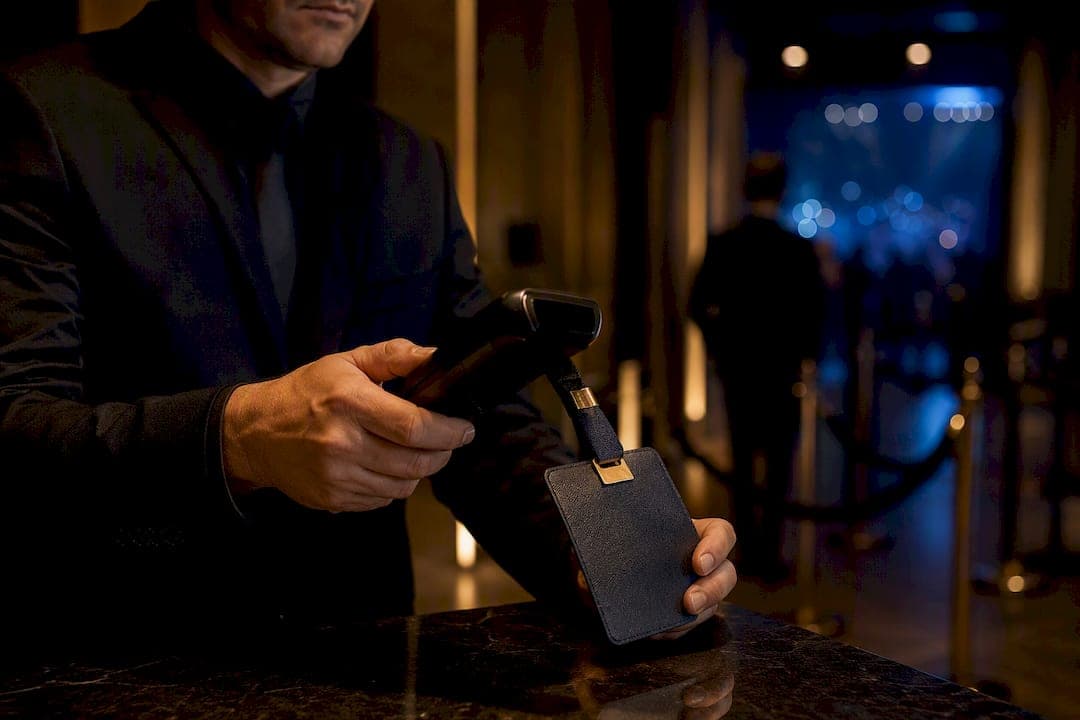
Deliver VIP access by building a run-of-show–driven credential system and naming a credential owner today. That single artifact controls who enters which zone, when, and under whose authority. Publish zone definitions with activation windows before you print a single badge, and treat Rigaglobaltravel as an operational partner for the transport side of that same access chain.
TL;DR:
- Ensure credential zones have explicit activation and expiry times, and publish these details in the run-of-show to prevent gate disputes.
- Build your printing window with a 48-hour buffer to accommodate last-minute guest list changes and avoid rushed reprints.
- Use a credential platform supporting offline scanning and real-time dashboards to prevent delays due to venue Wi-Fi failures or schedule discrepancies.
- Assign clear, named owners for each access point, with a defined escalation process, to resolve disputes efficiently during live events.
- Coordinate transport timing with credential activation windows and assign a dedicated transport lead to prevent last-minute logistical issues.
Table of Contents
- VIP Ticket Access Guide: Pre-Event Credentialing Checklist and Timeline
- Embed Credentials in the Run-of-Show: Zones, Windows, and Named Owners
- Credential Production and On-Site Validation
- Transport and Arrival Coordination: Syncing Vehicles With Credential Windows
- Data Privacy and Security Considerations for Credential Holders
- Training Guidelines for Credential Distribution and Access Staff
- Integration With Digital Credentialing Platforms and Apps
- Lessons from the access side of the business show most credential failures aren't technology problems. They're timing problems dressed up as technology problems. A late guest list change, a transport lead who never got the updated activation window, a scanner nobody tested offline. The transport side frequently faces situations where a manifested vehicle shows up on time, but the credential system hasn't caught up to recent schedule changes.
- Book VIP-Credentialed Transport Through Rigaglobaltravel
- Sources
VIP Ticket Access Guide: Pre-Event Credentialing Checklist and Timeline
Credential production is not a task you knock out during load-in week. Planning should start weeks before doors open with a site assessment, an integrated security plan, and an all-team briefing that assigns escalation authority before anyone touches a laminator, according to ACCESS Event Solutions. Waiting until the final 72 hours is the single most common way productions end up hand-writing names on blank passes at the loading dock.
Four roles need names attached early, not job titles: a credential owner, an accreditation lead, a transport lead, and a venue security owner. Each needs a phone number the others actually have, because a long contact sheet without decision rights solves nothing when a gate dispute happens at 6:45 PM.
Here's the sequence that keeps a mid-size production on schedule:
- Weeks out: Site assessment, credential zone design, and vendor confirmation for printing and RFID stock.
- 10 to 14 days out: Guest list cut-off, photo collection for talent and VIP badges, and final approval of zone activation windows.
- 5 to 7 days out: Variable-data printing run, quality check against the credential owner's master list, and secure packaging by recipient group.
- Event week: Distribution through a controlled chain (never a general staff mailbox), plus a scanner and hardware test at the actual venue.
- Day of: Pre-event briefing for all access staff, final validation pass, and a live headcount check before the first credential activates.
Every task needs an owner, a due date, and a documented backup, matching the phase-based structure the EventSuite run-of-show playbook recommends for production checklists that mature from pre-production through post-event reconciliation.
Pro Tip: Build your printing window with a 48-hour buffer even when the guest list looks locked. Talent adds a plus-one the night before more often than any production wants to admit, and a rush reprint under pressure is where duplicate credentials start circulating.
Embed Credentials in the Run-of-Show: Zones, Windows, and Named Owners
Credentials only work when they live inside the run-of-show instead of floating around as a separate spreadsheet. A run-of-show should carry a shared clock, stage lanes, named owners, and access control logic in one document, functioning as the single operational spine the entire team checks against, per the EventSuite playbook. If your gate logic lives in one file and your talent schedule lives in another, you have already built the conditions for a credential failure.
Zone definitions need explicit activation and expiry times, not vague descriptions like "backstage access." A green room credential commonly activates well before a set and expires some time after it ends, giving security a hard window instead of a judgment call. Publish that logic against every ROS block so gate staff know exactly which badge is valid at exactly which minute.
What belongs on the ROS credential layer:
- Zone name, activation time, expiry time, and the credential tier authorized for entry.
- Named owner for each gate or checkpoint, plus a designated deputy.
- Change notification protocol: who updates the document, and who gets pinged when a window shifts.
- Incident ownership line for each zone, so a dispute has a clear decision-maker instead of three people pointing at each other.
When artists or executives carry protective requirements, an artist security advance should convert that risk information into named owners, defined routes, and explicit access rules shared with venue and promoter leads before doors, according to WeNotIfT. That advance document and your ROS credential layer need to say the same thing. Two conflicting versions of "who can be backstage at 8:15" is how green room access gets breached.
A simple handoff table between the tour-side lead and the venue security owner, listing zone, window, and escalation contact side by side, resolves more gate disputes in real time than any radio call.
Credential Production and On-Site Validation
The right credential technology depends on what you are protecting against. RFID credentials resist sharing because each badge ties to a unique chip signal, which matters most for talent and executive access where one shared laminate could put an unauthorized person backstage. Photographic badges work better where a security team needs to visually confirm identity against a face, not just scan a code. QR credentials are the lowest-friction option for general VIP seating or hospitality zones where speed matters more than anti-sharing rigor. Large-scale productions have deployed RFID photographic credentials at awards shows and heads-of-state events, producing and managing thousands of secure credentials without a breakdown in verification.
On-site validation needs a documented exception path, not improvisation:
- A staffed reprint station, separate from the main entry lanes, for lost or damaged credentials.
- An identity check requirement before any replacement credential gets issued, plus immediate voiding of the original in the system.
- A logged process for duplicate-scan alerts, since two activations of the same credential number usually means a copy is circulating.
- A recorded override log any time staff manually admit someone without a valid scan, including who authorized it.
Pre-validating credentials through mobile QR checks, running multiple lanes for turnover, and staffing a dedicated exception lane for invalid badges keeps VIP flow smooth without compromising security, per Bizzabo's access control guidance.
Pro Tip: Test offline mode on every scanner before doors, not just at setup. A dropped venue Wi-Fi signal during a talent arrival is the worst possible moment to discover your scanners can't store and forward scans locally. Testing offline mode alongside labeled spare scanners and charged power packs prevents the gate delays that frustrate talent managers and VIPs alike, according to Bizzabo.
Transport and Arrival Coordination: Syncing Vehicles With Credential Windows
Vehicle arrival timing has to match credential activation, not the other way around. If a green room credential activates 90 minutes before a set, the vehicle carrying that talent needs to arrive with enough buffer to clear security and reach the zone inside that window, not right at the edge of it.
Route planning matters as much as timing. A private arrival route that crosses a dense public entry flow creates both a security risk and a delay, so map vehicle paths against expected crowd density before finalizing the plan, a lesson covered in detail in Rigaglobaltravel's route planning framework.
A few operational habits separate clean arrivals from chaotic ones:
- Manifest every vehicle against the active credential list, and cross-check passengers at the vehicle hold before departure, a practice Rigaglobaltravel's transport guidance treats as standard for talent and executive movements.
- Assign a named transport-to-venue handoff contact who confirms arrival with the credential owner in real time.
- Set radio channels and call signs in advance, with a backup phone number for every driver in case radios fail.
- For high-risk moves, plan last-mile escorting from the vehicle door to the credentialed zone entrance instead of leaving talent to walk unescorted.
Coordinate security briefings well before doors open, since venue security protocols can override production preferences the moment a principal of note is on the arrival list. ACCESS Event Solutions
Data Privacy and Security Considerations for Credential Holders
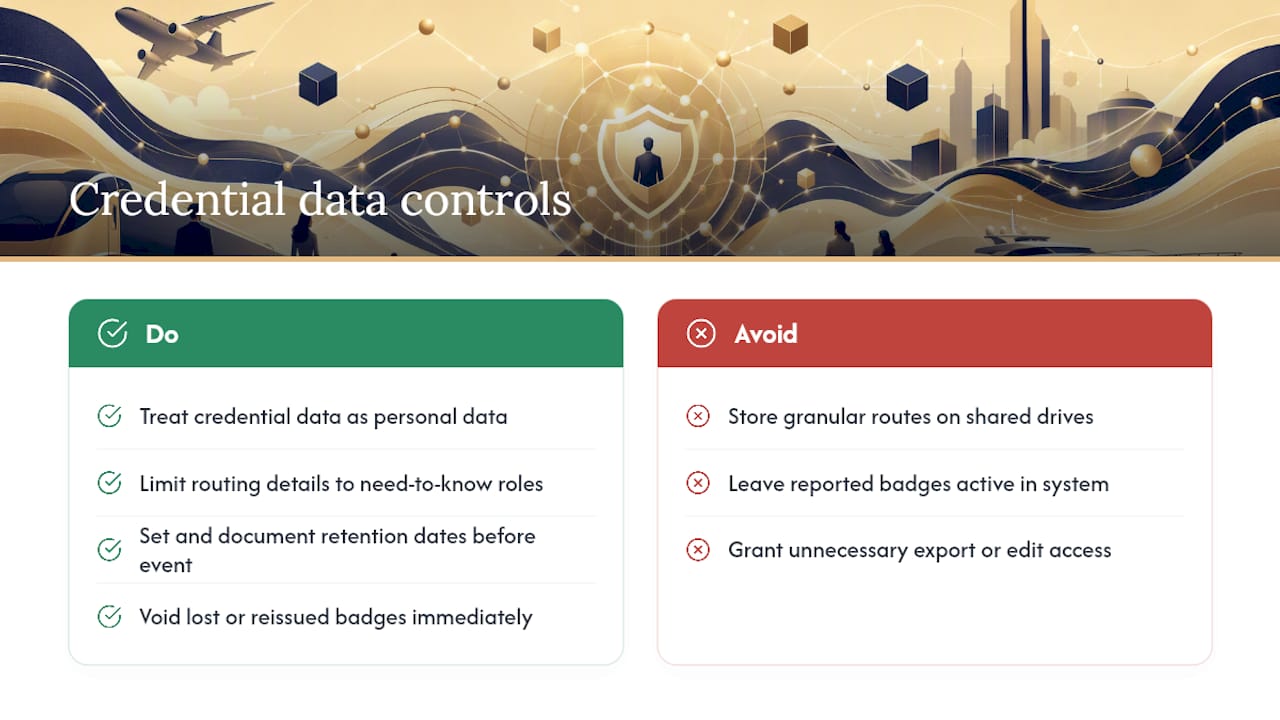
Credential data is personal data, and it needs to be treated that way from collection through disposal. Names, photos, contact numbers, and sometimes travel itineraries all sit inside a credentialing system, and that system is only as secure as the least careful person with login access.
Limit distribution of sensitive routing and movement information to the roles that actually need it. An artist security advance should link tour-side needs with venue, promoter, and security contractor contacts, but the granular route detail belongs in a controlled channel, not a shared drive open to the full event staff, per WeNotIfT's guidance on advance documents. Separating operational facts from protective detail keeps a leaked spreadsheet from becoming a security incident.
Set a retention policy before the event, not after. Photo IDs, credential photos, and guest list data should have a defined deletion date once the event closes out, and that date should be documented in the same checklist that tracks printing and distribution. Voiding credentials in the system immediately after a lost or reissued badge report closes the most common data exposure window, since an unvoided credential remains a valid, scannable identity token even after it is reported missing.
Access to the credentialing platform itself should be role-based. A photographer capturing badge images does not need edit rights to the guest list, and a temporary gate staffer does not need export access to the full database.
Training Guidelines for Credential Distribution and Access Staff
A credential system is only as reliable as the least-trained person holding a scanner. Every access staffer needs a briefing that covers three things before doors open: how to read a credential tier, what the exception process looks like, and who to call when something does not match.
Run the all-team briefing recommended for pre-event planning as a working session, not a memo, with staff physically handling sample credentials and practicing scans on test badges, an approach ACCESS Event Solutions frames as essential to defining escalation and decision authority before the event starts. Staff who have never seen a duplicate-scan alert on the actual hardware will freeze the first time it happens live.
Cover these points in every access staff briefing:
- Which credential tiers grant access to which zones, using the actual badge samples, not a printed reference sheet.
- The exact reprint and identity-check steps for a lost credential, including who has authority to approve one.
- The escalation contact for a gate dispute, by name and phone number, not by title alone.
- What a duplicate-scan alert means and the immediate action required when one fires.
Distribution staff need separate training from scanning staff. The person handing out credentials at check-in should never be the same person approving exception overrides at a gate, since that separation is what keeps the override log meaningful instead of a formality.
Integration With Digital Credentialing Platforms and Apps
Most modern credentialing runs through a platform that ties registration, badge design, printing, and scanning into one system rather than three disconnected tools. That integration matters because a change to the guest list should update the print queue and the scanner database at the same time, not require someone to manually sync three spreadsheets.
Look for platforms that support offline store-and-forward scanning, since venue Wi-Fi and cellular coverage both fail often enough to matter, a capability Bizzabo's access control research treats as a baseline requirement rather than a premium feature. Live occupancy dashboards that feed VIP zone headcounts and duplicate-scan alerts in real time give directors the information they need to make a safety call before it becomes an incident, a feature highlighted in StampIQ's VIP access management guide.
A few integration checks worth running before you commit to a platform for a given event:
- Confirm the platform supports variable-data photographic printing if talent or executive credentials require photo verification.
- Test the mobile app's offline mode on the actual venue Wi-Fi network, not just at the office.
- Verify the platform logs manual overrides with a timestamp and staff ID, since that log is your incident record if a dispute happens later.
Lessons from the access side of the business show most credential failures aren't technology problems. They're timing problems dressed up as technology problems. A late guest list change, a transport lead who never got the updated activation window, a scanner nobody tested offline. The transport side frequently faces situations where a manifested vehicle shows up on time, but the credential system hasn't caught up to recent schedule changes.
The fast fixes are almost always the same three: an immediate reprint lane staffed before doors, a hard void policy the moment a credential is reported lost, and one named transport lead who owns the handoff, not a rotating assignment. Simple fixes, consistently skipped.
— Sammy
Book VIP-Credentialed Transport Through Rigaglobaltravel
Some transport services handle the piece of VIP access that most credentialing platforms can't: getting talent and executives physically into the zone their credential activates, on time, without crossing a public entry flow. Chauffeured transport, secure arrival coordination, and timed transfers built around your run-of-show windows are often core offerings, along with credential pick-up and delivery so badges reach talent before the vehicle door opens.
To get a scoped quote fast, send over your run-of-show, guest list, arrival windows, and any special protective requirements. That's enough for Rigaglobaltravel to map vehicle timing against your credential activation windows before event week starts. Productions working in New York can start with the celebrity and talent transportation page, while teams staging in Los Angeles can request arrival coordination through the Los Angeles limousine service page. Either way, the next step is the same: send the ROS, get the timing locked, and stop treating transport and credentials as two separate problems.
Sources
- Run-of-Show Playbook for Multi-Stage Events | EventSuite
- Access control & session scanning — Bizzabo
- Artist security advance & venue handoff — WeNotIfT