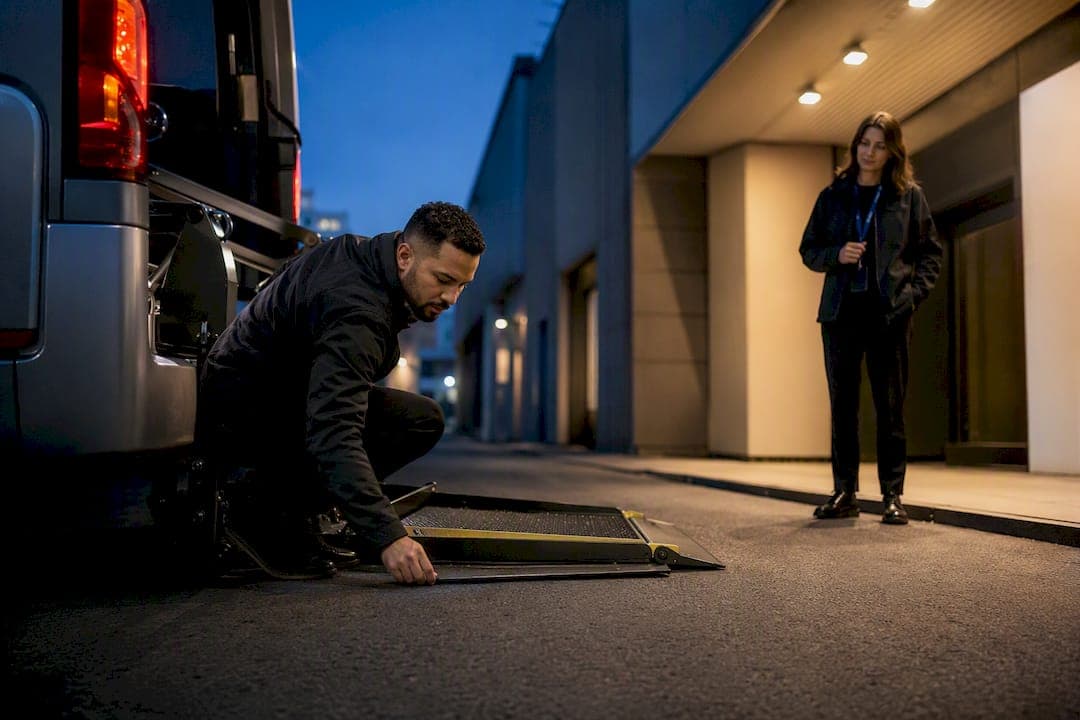
Booking ADA transportation for productions comes down to three things: an accessible vehicle with a working lift or ramp and proper securement, a driver trained in assisted boarding, and a site plan that lets the lift actually deploy on location. Get the vehicle right, get the crew right, and get the ground surface right. Everything else in the booking process exists to confirm those three points before call time.
TL;DR:
- Accessible vehicles must have a lift or ramp rated for combined passenger and device weight, with securement stations and enough interior space for safe boarding.
- Book ADA transport early, ideally as soon as your schedule is set, and include detailed information about call times, pickup coordinates, passenger mobility needs, and gear.
- Verify vendor credentials by asking about lift type, securement systems, driver training, insurance, and whether the fleet is owned or subcontracted, especially for last-minute requests.
- Site setup should ensure the drop-off point has a hard, level surface, sufficient space for parking and deployment, and clear paths free of hazards, with portable solutions ready if needed.
- Integrate mobility-impaired talent into the main crew transport to maintain dignity, and coordinate with an accessibility lead to manage securement, staging, and last-minute routing changes.
Table of Contents
- What Does ADA-Compliant Production Transport Include?
- How Do You Spec and Book ADA Transport for a Shoot?
- What Site Prep Do You Need for On-Set Accessibility?
- How Do You Keep Accessibility Dignified, Not Separate?
- Riga Global Travel: Production Experience and Quick Fixes We Use
- Book ADA Transportation for Your Next Production
- A Few More Pages Worth Bookmarking
- Sources
- FAQ
What Does ADA-Compliant Production Transport Include?
ADA-capable production transport starts with the vehicle itself. Most providers offer some combination of accessible Sprinters, minibuses or mini-coaches with lifts, larger lift-equipped buses, ramp-style shuttle buggies for base camp movement, and, on bigger builds, assisted-access trailers for talent with more complex mobility needs. The right choice usually comes down to crew size, whether the location demands quiet operation, and how much gear travels with the passenger.
Vehicles built for production transport in New York typically carry these equipment features as standard, not upgrades:
- Electric lifts or fold-out ramps rated for the weight of the passenger and their mobility device combined
- Securement stations with four-point tie-downs and a working restraint system, not improvised straps
- Wide doors and enough interior headroom to board without maneuvering awkwardly
- Climate control that runs independently of engine idle, since some passengers wait onboard during setup
- Enough interior floor space to reposition a wheelchair or scooter without unloading
Matching vehicle to shoot matters more than most call sheets reflect. A single talent member with a compact power chair might only need an ADA Sprinter van. A larger cast and crew move, especially one with several mobility devices plus camera and grip gear, usually calls for a lift-equipped mini-coach. Sound-sensitive exteriors, meanwhile, often push productions toward quieter shuttle options rather than diesel buses idling near a live take.
How Do You Spec and Book ADA Transport for a Shoot?
The booking request is where most delays start. Vendors can't quote accurately, and can't guarantee the right vehicle shows up, when the request is vague about who's riding and what they're riding in. A strong RFQ functions almost like an accessibility rider: it names the equipment, not just the headcount.
Include these fields in every request:
- Shoot dates and exact call times, including any early staging window before cast call
- Pickup and drop addresses with GPS coordinates, especially for locations without a clean street address
- Total passenger count, broken out by mobility device make, model, width, and length
- Whether each passenger travels in their device or transfers to a vehicle seat
- Luggage, wardrobe, or equipment traveling alongside passengers
- Preferred seating placement and any transfer assistance needs
That last point matters more than it sounds. Listing a mobility device's make and model, not just "wheelchair," removes the guesswork that causes lift-capacity mismatches on the day, according to guidance in Riga Global Travel's talent transport protocol.
Once the RFQ is out, vet the vendor directly. Ask about lift type and weight capacity, the securement system used, and whether drivers are trained specifically in assisted boarding, not just general chauffeuring. Confirm insurance limits, hourly versus day-rate pricing, minimum booking windows, and cancellation terms before you sign anything.
Pro Tip: Ask providers how many ADA-equipped vehicles they actually own versus subcontract. Owned fleets tend to have tighter maintenance records on lifts, which matters when a broken ramp shows up two hours before call time.
Lead times vary by market, but ADA-equipped vehicles are a smaller slice of most fleets than standard sedans or vans. Book as early as possible, and if you have a last-minute request, indicate its urgency explicitly in your communication. Vendors who run production set transportation regularly can often reshuffle a rig, but only if they know it's urgent.
What Site Prep Do You Need for On-Set Accessibility?
An accessible vehicle is only half the equation. A lift can't deploy safely on gravel, mud, or a steep grade, and no amount of vehicle spec fixes a bad drop-off point.
Walk the site, or have your location manager walk it, with these questions in mind:
- Is the surface at the drop-off point hard and reasonably level, not loose gravel or soft turf?
- Is there enough clearance for the vehicle to park, extend a ramp, and turn without blocking base camp traffic?
- What's the actual slope from parking to base camp, and does it exceed a wheelchair user's comfortable grade?
- Is the route from drop-off to holding or set clear of cables, sandbags, or other trip hazards?
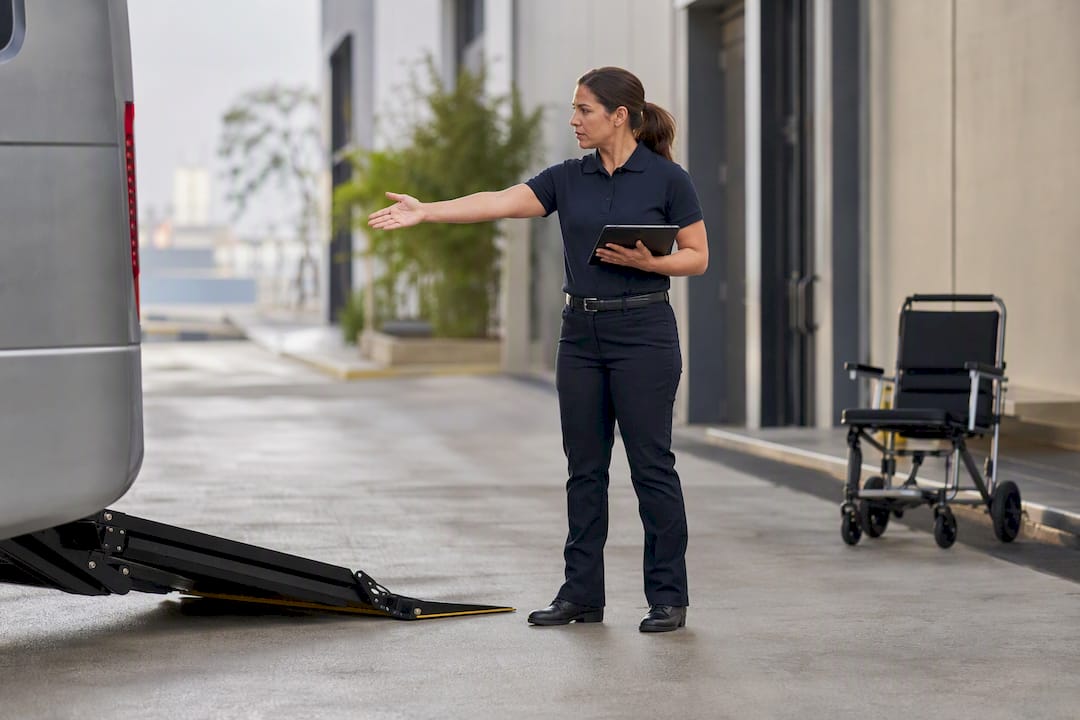
On-site accessibility often needs more than the vehicle can provide on its own. Portable bridging or matting is a common fix when ground conditions would otherwise block safe lift deployment, particularly on backlots, fields, or older buildings without graded entries.
Assign one person, not a rotating PA, as the accessibility lead for the day. That person coordinates with the driver on securement procedure, manages staging so the vehicle isn't blocked in, and runs point if a lift jams or a ramp can't extend at the scheduled location. Have a backup plan ready: a secondary drop point, a hand-carried transfer chair, or a short delay built into the call sheet rather than a scramble. Quiet electric buggies are also worth considering for moving people across large lots, since near-silent shuttles reduce the noise risk that diesel engines create near a live set.
How Do You Keep Accessibility Dignified, Not Separate?
The biggest mistake productions make isn't a broken lift. It's routing one crew member into a separate van while everyone else rides together. Accessible transport works best when it's built into the daily movement plan, not bolted on as an afterthought.
Practical ways to keep people integrated:
- Move mobility-impaired talent or crew with their team in one vehicle rather than a solo accessible shuttle trailing behind
- Coordinate seat placement in advance so boarding doesn't turn into a visible negotiation in front of the group
- Confirm trailer or base camp restrooms are roll-in accessible, or schedule accessible restroom access at a nearby location if not
- Loop in talent or their representative on any last-minute routing changes before the van shows up, not after
Privacy matters here too. If a cast member requests confidentiality around a mobility need, treat that request the same way you'd treat any NDA-covered detail.
Pro Tip: If a passenger needs hands-on transfer assistance, book a second attendant rather than asking the driver to split attention between the wheel and the securement station. It's a small cost against a real safety gap.
Riga Global Travel: Production Experience and Quick Fixes We Use
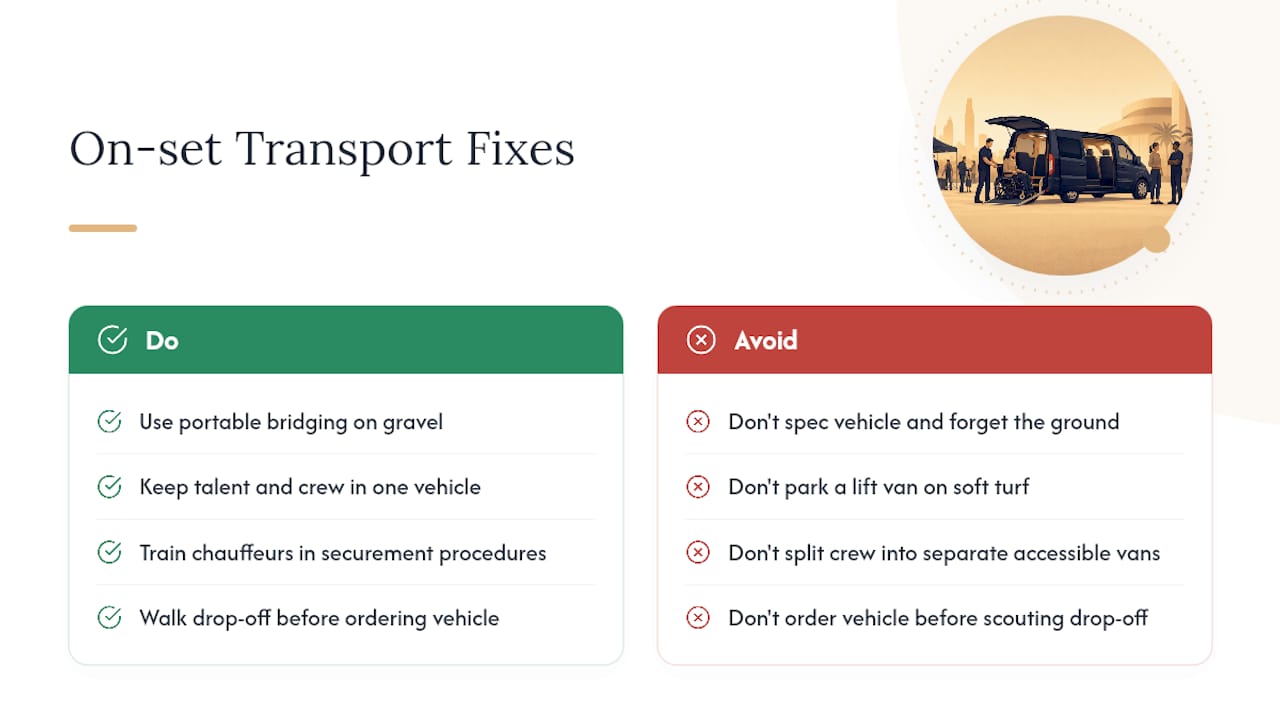
We've booked enough shoot days to know the theoretical checklist and the actual set floor rarely match. Portable bridging over a gravel lot, keeping talent and crew in one vehicle instead of splitting off into an "accessible van," a chauffeur trained to handle securement without holding up the call. These are the fixes that show up in talent transportation protocols built from real production days, not a manual.
The lesson producers miss most often: they spec the vehicle and forget the ground. A lift-equipped van parked on soft turf is functionally useless. Walk the drop-off point before you lock the vehicle order, not after.
— Sammy
Book ADA Transportation for Your Next Production
Some transportation providers treat ADA requests as an afterthought, but specialized production transport services aim to provide more attentive handling of accessibility needs. Experienced companies in the industry provide on-time guarantees and rapid responses for accessibility requests, often managed directly by ownership rather than through automated systems.
To get an accurate quote fast, send the same fields covered in the RFQ checklist above: shoot dates, call times, pickup and drop coordinates, passenger count with mobility device specs, and any luggage or gear traveling with the group. Riga's meticulously screened chauffeurs handle high-profile and accessibility-sensitive bookings under the same privacy and NDA-based confidentiality protocols used for celebrity transport. Visit Riga Global Travel to request a production quote and lock in vehicles before your shoot dates fill up.
A Few More Pages Worth Bookmarking
For planning multi-vehicle shoot days, review the daily movement matrix framework. For high-profile crew privacy considerations, see the VIP production crew transport guide.
FAQ
What Vehicle Features Are Required for ADA Production Transport?
An ADA-capable production vehicle needs an electric lift or ramp rated for the passenger's device weight, a working four-point securement system, wide doors, and enough interior room to reposition a wheelchair without unloading.
How Far in Advance Should I Book ADA Transport for a Shoot?
Book as early as your shoot schedule allows, since accessible vehicles make up a smaller share of most fleets than standard sedans and vans. For last-minute needs, flag urgency directly in your request so the provider can prioritize sourcing the right vehicle.
What Should Go in an ADA Transport RFQ for Productions?
List shoot dates, call times, pickup and drop coordinates, total passenger count with mobility device make and model, whether each passenger travels in their device, and any gear or luggage needs.
Does Riga Global Travel Offer ADA-Compliant Vehicles for Productions?
Riga Global Travel arranges accessible ground transport as part of its production and executive travel services, staffed by screened chauffeurs. Contact Riga directly at Rigaglobaltravel to confirm vehicle availability and pricing for your specific shoot.
What Happens if a Lift Can't Deploy on Location?
Have a backup plan before call time: a secondary drop point with a better surface, portable bridging or matting on hand, or a hand-carried transfer chair as a short-term workaround while the crew adjusts staging.