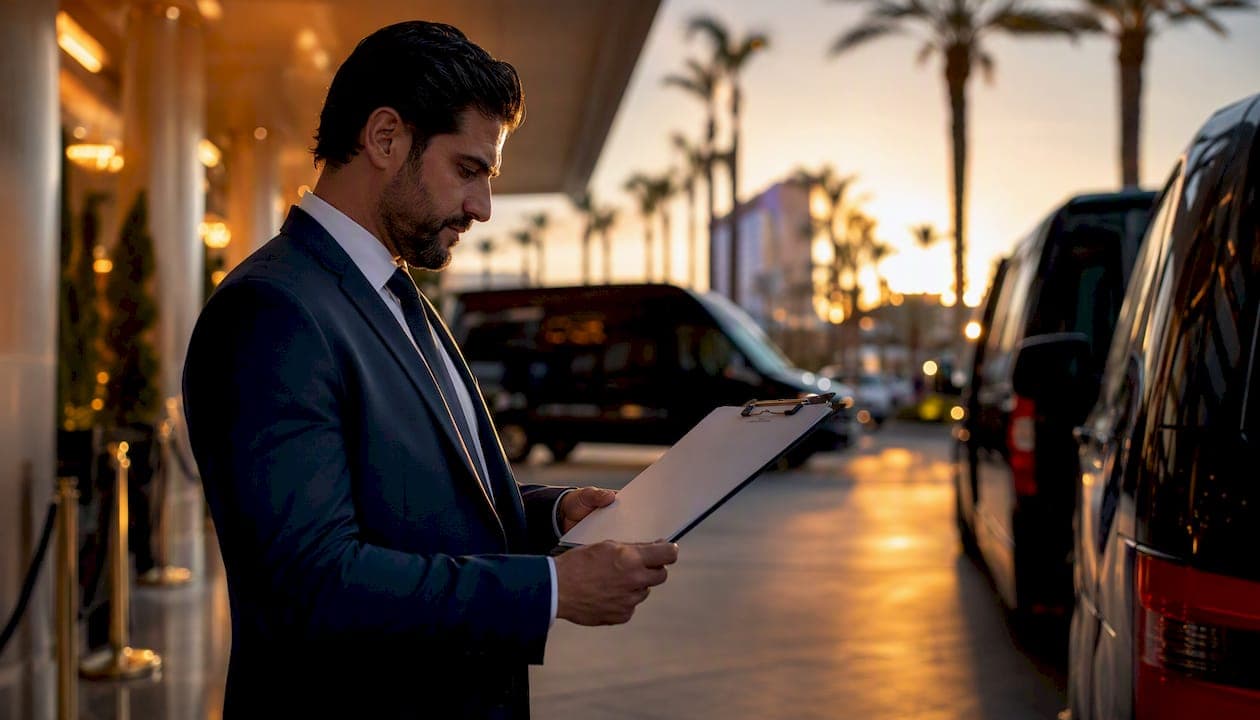
For Las Vegas event shuttle planning, the right call is a chauffeured concierge partner that runs manifest-based airport meet-and-greets at Harry Reid International Airport, staged on-set shuttle windows, and day-rate vehicle blocks scaled to role: sedans for talent, SUVs for executives, Sprinters for crew, and mini-coaches for support. Book 4–8 weeks out for trade shows and major events, 2–3 weeks for standard shoots, per HUSTL Media's production timeline guidance. The single most important buffer: add 30 minutes to every Strip-adjacent pickup window.
Immediate procurement checklist:
- Confirmed pickup windows and staging point per shooting day
- Vehicle mix by role: talent (sedan/SUV), broadcast crew (Sprinter), support (mini-coach)
- Certificate of Insurance (COI) and additional insured endorsement from the carrier
- Permit contact names: Nevada Film Office and City of Las Vegas film office
- Manifest format, cutoff times, and who owns updates on shoot day
- Backup vehicle plan and dispatcher direct line
Pro Tip: Request a named, on-site dispatcher, not just a dispatch center. On a multi-unit shoot, a single point of contact on the ground prevents the cascade of missed pickups that kills a morning call sheet.
Key Takeaways
Effective Las Vegas event shuttle planning comes down to one thing: a chauffeured concierge partner who treats the manifest as a production document, not a passenger list.
| Point | Details |
|---|---|
| Book early | 4–8 weeks for major events, 2–3 weeks for standard shoots, per HUSTL Media. |
| Vehicle mix by role | Sedans for talent, SUVs for executives, Sprinters for crew, mini-coaches for support. |
| COI before day one | Require the certificate of insurance naming your production as additional insured before the first shoot day. |
| Traffic buffers | Add 30 minutes minimum for Strip-adjacent pickups; 45 minutes during peak airport windows. |
| Rigaglobaltravel | Provides manifest-based airport transfers, staged shuttle windows, and PO-friendly billing for production clients. |
Table of Contents
- What insurance and SAG-AFTRA requirements mean for your transport contract
- How manifests, dispatching, and backup plans keep shoots on schedule
- What your transport contract must include
- How to vet and select a qualified production transport provider
- Las Vegas traffic patterns that affect your shuttle schedule
- ADA-compliant vehicles and accessibility planning
- Coordinating with law enforcement and security for VIP transport
- What most production transport guides get wrong
- Rigaglobaltravel for Las Vegas productions: services and how to book
- Sources
What insurance and SAG-AFTRA requirements mean for your transport contract
Every carrier you hire must provide a COI naming your production company as an additional insured. Production vehicle providers routinely require proof of insurance before confirming a booking, and the same standard applies to chauffeured transport. Minimum commercial auto liability for entertainment productions typically runs a substantial amount per occurrence; confirm the exact threshold with your production insurer before issuing an RFP.
SAG-AFTRA agreements do not regulate which car service you use, but they do govern talent call times, turnaround, and travel-time compensation. A late pickup that pushes a performer past their contractual turnaround time creates a financial penalty for the production, not the driver. That makes on-time performance a union compliance issue, not just a logistics preference. Build that language into your transport contract: on-time performance tied to call-sheet windows, with a documented escalation path if a vehicle is delayed more than 10 minutes.
How manifests, dispatching, and backup plans keep shoots on schedule
Manifest-based planning is the operational standard for high-density event windows in Las Vegas. A production manifest lists every passenger by name, pickup location, vehicle assignment, and window. Cutoff for manifest updates should be no later than 10:00 PM the night before a shoot day; anything later and your dispatcher cannot confirm vehicle assignments before the morning rush.
Assign one dispatcher who owns all transport communication. That person holds the master manifest, has direct lines to every driver, and is the only contact your AD or production coordinator calls when something changes. Redundancy matters: confirm a backup vehicle for talent and at least one crew Sprinter on standby, especially during peak Las Vegas event windows when available vehicles disappear fast.
What your transport contract must include
Negotiate these clauses before signing:
- Pickup window definition: exact time, not an arrival range
- Overtime rate: hourly rate beyond the contracted day-rate block
- Cancellation terms: 48-hour and 24-hour cancellation penalties stated in dollars, not percentages
- Backup vehicle obligation: carrier's written commitment to provide a substitute within 30 minutes of a breakdown
- COI delivery deadline: certificate due before the first shoot day, not on it
- Manifest ownership: who submits updates, by what time, and through which channel
How to vet and select a qualified production transport provider
Start with licensing: every chauffeured carrier operating in Nevada must hold a Nevada Transportation Authority (NTA) certificate. Ask for it. Then request references from at least two productions of comparable scale, specifically asking about manifest compliance and on-day responsiveness.
Integrated logistics planning that covers permits, crew accommodations, and local regulations is the mark of a provider who understands production timelines, not just point-to-point driving. Ask whether the provider has worked with union crews and whether their invoicing supports purchase-order billing, which most production finance teams require.
Las Vegas traffic patterns that affect your shuttle schedule
The Strip corridor between Tropicana Avenue and Spring Mountain Road runs at near-capacity from 10:00 AM to midnight on weekends and during major convention weeks (CES in January, NAB in April, SEMA in November). Airport arrivals at Harry Reid International spike between 8:00 AM and 10:00 AM and again between 5:00 PM and 8:00 PM. Schedule talent airport pickups outside those windows when possible, or add a 45-minute buffer when you cannot.
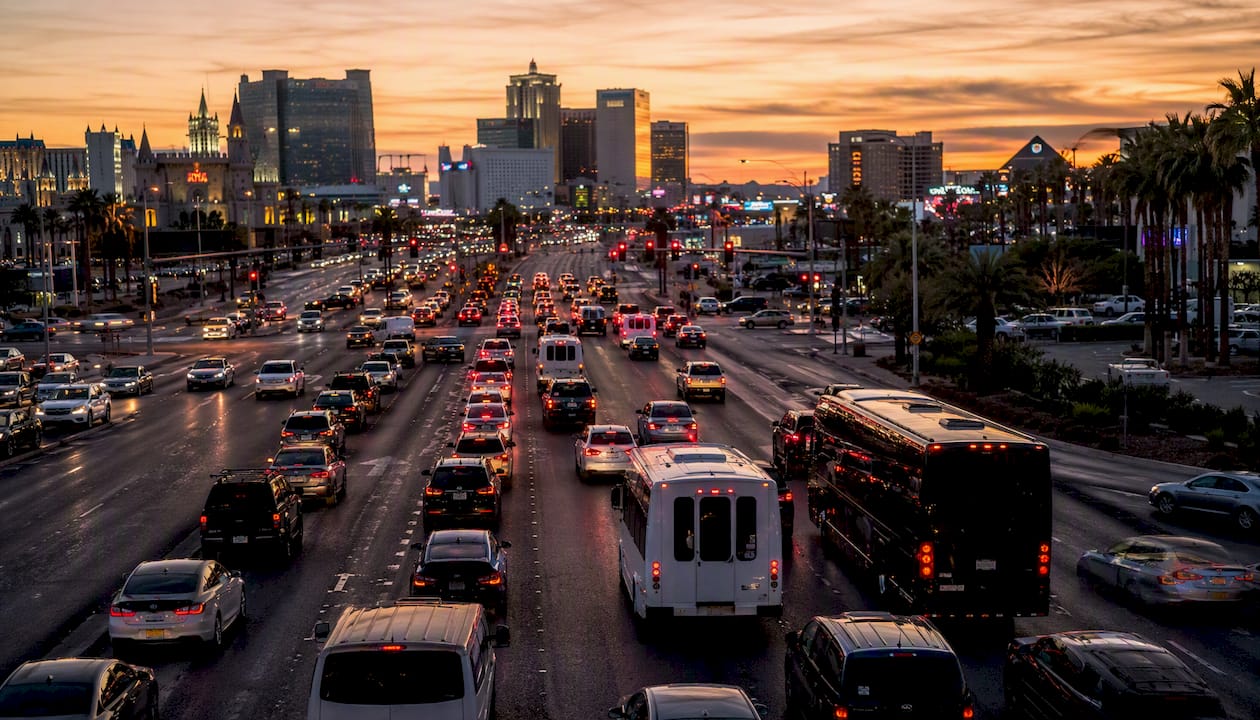
Downtown Las Vegas and the Arts District move faster, but load-in windows near Fremont Street require coordination with venue security. The I-15 corridor to Henderson and the Las Vegas Motor Speedway area adds 20–35 minutes during event days.
ADA-compliant vehicles and accessibility planning
Any production transporting talent, crew, or clients with mobility needs must confirm ADA-compliant vehicle availability at the quote stage, not the day before. Wheelchair-accessible vehicles (WAVs) with ramp or lift access are available through qualified carriers but require advance notice of several days minimum. Confirm interior dimensions against the specific mobility device being transported.
For productions subject to network or studio accessibility standards, document WAV availability in the transport contract and name the specific vehicle type. A verbal assurance is not sufficient.
Coordinating with law enforcement and security for VIP transport
For high-profile talent or executives requiring a security escort, contact the Las Vegas Metropolitan Police Department's Special Events unit at least two weeks before the shoot. LVMPD coordinates motorcade permits and can advise on route clearance for time-sensitive arrivals.
Your transport provider should have an established protocol for working alongside private security details. Confirm that the lead driver has experience with principal protection workflows: no unscheduled stops, pre-driven routes, and a direct line to the security lead. VIP sequencing and discreet handling require a carrier who treats the security brief as part of the job, not an afterthought.
What most production transport guides get wrong
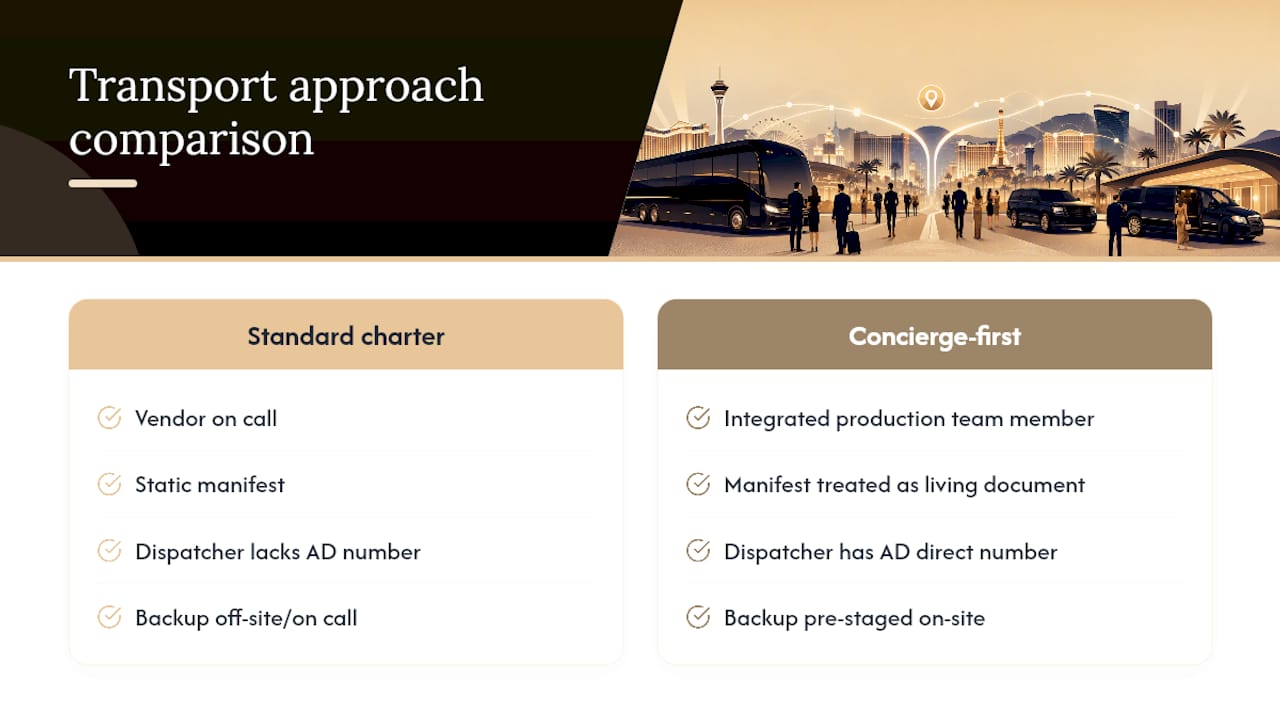
The standard advice is to book early and get insurance. Both are correct and both are insufficient. The real failure point in Las Vegas production transport is the handoff between the transport provider and the production's own logistics chain.
Productions that run smoothly treat the transport lead as part of the production team, not a vendor who shows up when called. The manifest is a living document. The dispatcher needs to know the AD's direct number. The backup vehicle needs to be pre-staged, not on call across town. None of that happens automatically with a standard charter booking. It requires a provider who has worked in production environments and knows what a call sheet actually means.
The concierge-first model, where the transport partner manages the manifest, communicates directly with the production coordinator, and holds backup capacity as a contractual obligation, is not a premium add-on. For a Las Vegas shoot, it is the baseline that prevents a transport delay from becoming a union grievance.
Rigaglobaltravel for Las Vegas productions: services and how to book
Rigaglobaltravel handles the full ground transport stack for entertainment productions: manifest-based airport meet-and-greets at Harry Reid International, staged on-set shuttle windows, dedicated on-site dispatchers, and a vehicle pool that scales from executive sedans to Sprinters and mini-coaches. Corporate account billing and purchase-order invoicing are standard, which means your production finance team does not need a workaround.
Chauffeurs carry commercial credentials and COI issuance is part of the booking process, not a follow-up request. Pricing runs on hourly and day-rate blocks with flat airport fees and clearly stated overtime and cancellation terms. To get a production-ready quote, contact Rigaglobaltravel directly at Rigaglobaltravel with your shoot dates, vehicle mix, and manifest requirements.