
The single most effective way to plan luxury transit wrap parties is to lock one integrated transport-and-production partner before any other vendor conversation happens. Do that first, and the rest of the plan falls into place.
Three fastest actions to reduce risk:
- Select your vehicle class based on guest count and onboard experience goals (limo/sedan for 1–6 VIPs, executive Sprinter for 8–14, party bus for 20–40, motorcoach for 40–55).
- Lock your route and permits at least 60 days out; municipal staging permits and open-container clearances are the most common last-minute derailments.
- Hire one integrated partner who owns vehicle spec, production crew, and day-of operations, so you have a single point of accountability when anything shifts.
Community transit events consistently show that municipal liaison and transit-agency coordination are non-negotiable for any moving-vehicle celebration. For a luxury production, that coordination needs to happen earlier and with more documentation than a casual bus party.
Table of Contents
- What do you need to decide before you book anything?
- Which vehicle fits your guest count and experience goals?
- When should you book, and what does the day look like?
- What drives the budget, and how do you model it?
- What permits and insurance do you actually need?
- How do you plan a route that actually works on event day?
- How do you design the onboard experience without breaking the vehicle?
- What staffing do you need, and what's your emergency plan?
- Why does one integrated partner reduce your risk?
- What contract clauses protect you before you sign?
- Sample itineraries you can adapt right now
- Key Takeaways
- What planners consistently get wrong on transit wrap events
- Rigaglobaltravel handles the plan so you can run the event
- Useful sources and further reading
What do you need to decide before you book anything?
Lock these decisions before you sign a single contract. Gaps here create expensive change orders later.
Decisions to make first:
- Guest count and mobility or accessibility needs (wheelchair lifts, step height, boarding time)
- Beverage policy: open bar, beer/wine only, or dry event
- Vehicle class preference and whether you need a multi-vehicle convoy
- Event footprint: onboard-only experience, or staged stops with venue arrivals
Documentation to collect:
- Proposed route map with alternate routing
- Municipal permit contacts for each city or county on the route
- Insurance limits for all vendors, plus certificates of insurance (COI) with additional insured endorsements naming your client
- Client approvals on route, timing, and onboard design
Pro Tip: Book your staging area permit at the same time as your vehicle. A luxury party bus with nowhere to load is a production problem that no amount of budget fixes on event day.
High-traffic windows (Friday evenings, award-season weekends, holiday periods) compress staging time and increase permit processing delays. Build a minimum 90-minute load-in buffer into every timeline.
Which vehicle fits your guest count and experience goals?
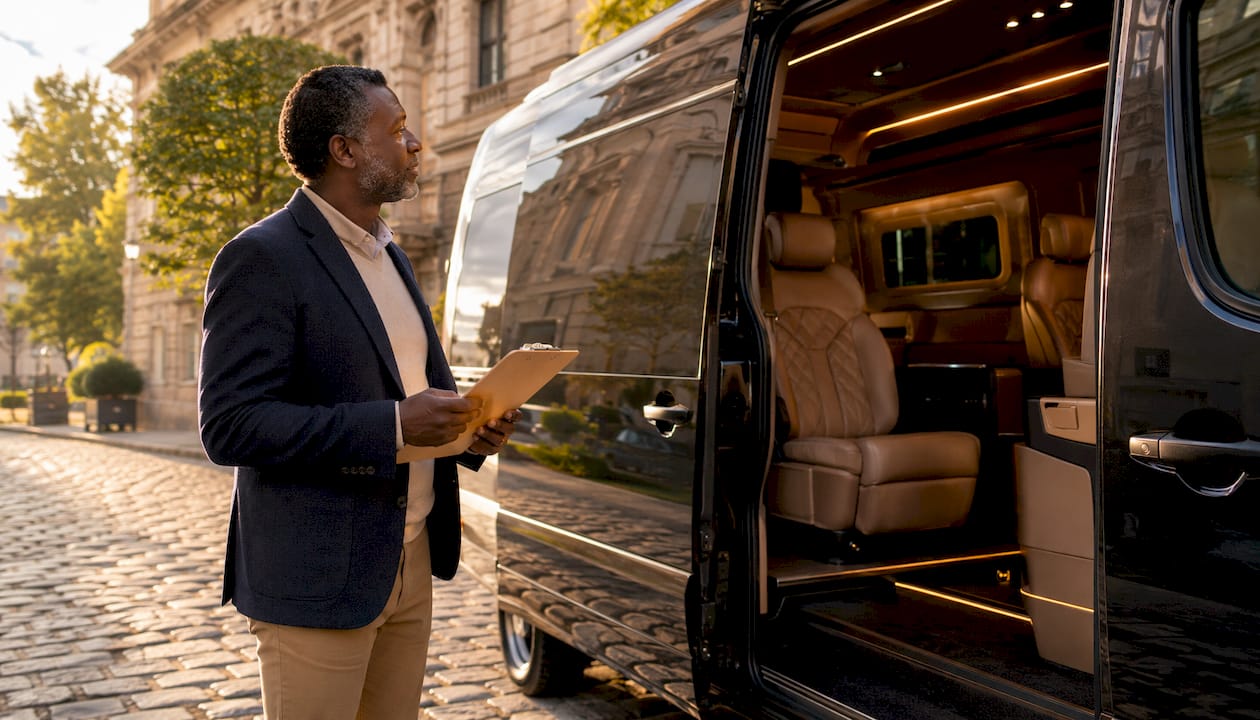
Matching vehicle class to guest profile is where luxury wrap party themes either land or fall flat. Here is how each class performs in a production context.
Stretch limousine or luxury sedan fleet (1–6 guests per vehicle): Best for VIP arrivals, red-carpet moments, and talent transport. Limited onboard entertainment space, but unmatched for photo ops and brand presence. Award-show limousine planning follows the same staging logic.
Executive Sprinter or luxury van (8–14 guests): The strongest all-around choice for small-group luxury transit. Luxury van configurations balance comfort, AV capability, and loading access in a way larger vehicles cannot match for intimate groups. Interior height typically allows standing, and power outlets support basic AV loads.
Party bus (20–40 guests): Purpose-built for onboard entertainment. Dancing space, built-in sound systems, and bar setups are standard. The tradeoff is a larger staging footprint and more complex permitting in dense urban areas.
Motorcoach (40–55 guests): Maximum capacity, restroom access, and luggage bays for production gear. AV integration requires advance coordination with the operator. Parking and turnaround radius demand early route scouting.
Multi-car caravan: A convoy of sedans or SUVs creates a visual arrival moment and works well for staged red-carpet drops. Red carpet arrival vehicle selection follows its own logic: exotic or premium cars front the caravan, production vehicles follow.
Capacity note: Mercedes Sprinter executive configurations typically seat 8–14 passengers depending on interior layout, making them a practical anchor for small-group luxury van group travel when a full party bus would feel oversized.
When should you book, and what does the day look like?
Lead times by vehicle type:
- Stretch limos and sedans: Several weeks minimum; longer lead times during peak seasons like awards season and major holidays.
- Executive Sprinters and vans: Approximately one to one and a half months; longer for multi-van fleets
- Party buses: Typically one and a half to two months; very popular dates require booking well in advance.
- Motorcoaches: About two to three months; custom AV integration may add additional lead time.
Deposits typically represent a significant portion of the total contract value, with the balance due shortly before the event. Cancellation windows of around one to two months are standard for luxury vehicles; inside that window, expect to forfeit the deposit.
Sample day-of timeline (party bus, a few dozen guests, a few-hour window):
| Time | Activity |
|---|---|
| T-90 min | Staging crew arrives; vehicle positioned, AV tested, catering loaded |
| T-30 min | Security and attendants in position; guest check-in opens |
| — | Guests board; welcome remarks, first beverage service |
| — | Departure; onboard entertainment begins |
| 1:00 | First stop (venue drop or photo location); 20-minute window |
| 1:30 | Re-board; second entertainment set |
| 2:30 | Return to origin or final venue drop |
| 2:45 | Load-out begins; production crew breakdown |
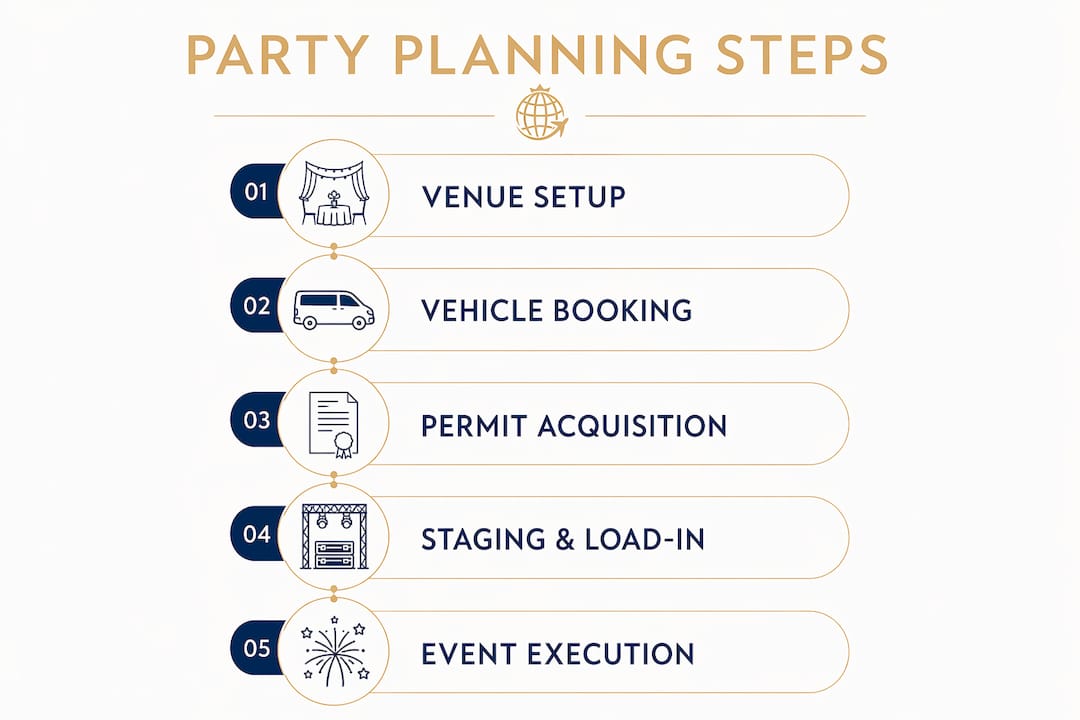
Build a contingency buffer at every stop to allow for unexpected delays. Traffic, late guests, and AV resets all eat into that window faster than expected.
What drives the budget, and how do you model it?
Primary cost drivers for luxury transit wrap parties:
- Vehicle hourly rate and minimums: Party buses typically carry 4–6 hour minimums; motorcoaches often require 8 hours.
- Chauffeur overtime: Anything beyond the contracted window bills at 1.5x the hourly rate.
- Production crew: Lead production manager, onboard AV technician, and attendants are separate line items from the vehicle operator.
- Catering and licensed bartenders: Moving-vehicle catering requires secure service ware, spill mitigation, and a licensed vendor in most states.
- Permit fees: Staging permits, temporary use permits, and traffic control vary by municipality.
- Contingency reserve: Budget a contingency percentage above your hard costs to cover live-event variables.
| Guest Count (approximate) | Vehicle Class | Estimated Hours (typical) | Key Cost Variables |
|---|---|---|---|
| Small groups under twenty | Executive Sprinter fleet | Several hours | Multi-van coordination, AV tech |
| Medium groups of a few dozen | Party bus | Several hours | Licensed bar, onboard catering, permits |
| Larger groups over fifty | Motorcoach | Multiple hours | AV integration, restroom servicing, staging |
These are planning frameworks, not quoted prices. Every market prices differently; always get itemized proposals.
What permits and insurance do you actually need?
Alcohol rules for moving vehicles vary sharply by state. Some states permit consumption of alcohol in hired passenger vehicles under specific conditions, but open-container laws in other states can expose your client to liability even inside a chartered bus. Confirm the rule in every jurisdiction your route crosses, not just your departure city.
Typical permit requirements:
- Staging/parking permits for load-in zones (often required 2–3 weeks in advance)
- Temporary use permits for private property staging areas
- Special event permits when the route affects public traffic flow
- Municipal traffic control approval for convoy or caravan formats
For insurance, require a minimum of $1,000,000 per occurrence commercial auto liability from every vehicle operator, with your client named as additional insured. Catering vendors need general liability coverage at the same floor. Request a waiver of subrogation on both policies. Dram-shop exposure is real: if a licensed bartender over-serves a guest who is later injured, liability can attach to the event organizer without proper vendor agreements in place.
How do you plan a route that actually works on event day?
Route selection for a luxury transit event is a production decision, not just a logistics one. The route determines your permit burden, your staging options, and your contingency flexibility.
Route planning checklist:
- Scout curb access at every stop: can the vehicle pull fully off traffic lanes?
- Identify emergency egress points every mile; brief your driver and production manager on each.
- Check noise ordinances for any route segment near residential zones after 10:00 PM.
- Confirm load-in clearance heights for any parking structure or covered staging area.
- Designate a municipal liaison contact (name and cell number) for live reroutes.
Municipal liaison and transit-agency coordination consistently prove their value when live closures or weather force a route change. Have two alternate routes mapped before event day, not during it.
For multi-van fleets, fleet coordination and staging require a lead vehicle with a dedicated production contact who can relay route changes to every driver simultaneously.
How do you design the onboard experience without breaking the vehicle?
AV and power planning come first. Most party buses carry 20–30 amps of usable onboard power; a motorcoach with a generator can support significantly more. Know the power budget before you spec lighting rigs, fog machines, or additional PA systems.
Catering on a moving vehicle requires secure service ware (weighted bases, lids, non-slip trays) and a food-safety plan that accounts for temperature hold times. Hot food on a 3-hour route needs chafing equipment rated for vehicle use. Cold service is simpler and lower-risk.
For décor and branding, avoid adhesives that damage vehicle interiors. Tension-mounted signage, fabric backdrops, and magnetic surfaces work. Any lighting rig must be secured so it cannot shift during turns or hard stops. Keep the driver's sightlines completely clear.
What staffing do you need, and what's your emergency plan?
Recommended roles by vehicle type:
- Sedan/limo: Chauffeur; optional onboard attendant for VIP talent.
- Executive Sprinter: Chauffeur plus one onboard attendant for groups over 10.
- Party bus (20–40 guests): Chauffeur, lead production manager, two onboard attendants, one licensed bartender, one security officer.
- Motorcoach (40–55 guests): Driver, co-driver for long routes, lead production manager, two attendants, two bartenders, two security officers.
All security personnel should carry current guard cards for the state of operation. Background checks are standard for entertainment-industry clients. Brief every staff member on the emergency plan before guests board.
Emergency plan essentials: Know the nearest hospital or urgent care to every stop on your route. Carry a vehicle-breakdown protocol in writing: who calls the backup vehicle, who communicates with guests, and who contacts the client. A group text chain with all staff and the client's point of contact is the fastest communication tool on event day.
Why does one integrated partner reduce your risk?
Splitting transport, production, and staffing across three vendors creates three contracts, three insurance stacks, and three points where a miscommunication can derail the event. A single integrated planning and production partner consolidates those handoffs into one accountable relationship.
Selection criteria for an integrated partner: demonstrated entertainment-industry transport experience, an in-house production crew (not subcontracted), COI documentation meeting your client's insurance requirements, and verifiable references from film, TV, or music clients. Ask specifically whether their production manager has worked moving-vehicle events, not just static venues.
What contract clauses protect you before you sign?
Minimum contract items to require:
- Specific vehicle IDs, year, make, model, and passenger capacity
- Hourly minimums, overtime rates, and fuel surcharge policy
- Cancellation and rescheduling policy with exact refund windows
- Payment schedule with deposit and balance due dates
- COI requirements and additional insured language
- Staging access times and load-in/load-out responsibilities
- Explicit contingency clause: who provides and pays for a replacement vehicle if the contracted unit breaks down
Liability language to request: Additional insured endorsement naming your client and your production company. Waiver of subrogation so the vendor's insurer cannot pursue your client after a claim. Indemnification clause covering vendor negligence.
Operational clauses matter too. Confirm in writing who is responsible for permit fees, whether route changes require written approval, and what constitutes a billable overtime trigger.
Sample itineraries you can adapt right now
Template 1: Short VIP loop (60–90 minutes) Vehicle: Executive Sprinter, 8–12 guests. Staging: 30 minutes pre-departure. Route: origin venue to one scenic or branded stop, return. AV: background music, no PA needed. Permit need: staging permit only.
Template 2: Multi-stop city tour (2–3 hours) Vehicle: Party bus, 25–35 guests. Staging: 60 minutes pre-departure. Route: 2–3 stops (rooftop bar, private venue, return). AV: full sound system, MC or DJ. Permit need: staging permit plus stop-specific parking clearances.
Template 3: Arrival-to-afterparty caravan Vehicle: 3–5 luxury sedans or SUVs plus one party bus. Staging: 45 minutes for caravan assembly. Route: production wrap location to red-carpet venue, then afterparty. AV: sedans carry no PA; party bus handles entertainment for the afterparty leg. Permit need: caravan coordination permit in dense cities; red-carpet staging permit.
| Vehicle Class | Suggested Guests | Minimum Hours | Typical Permit Need |
|---|---|---|---|
| Executive Sprinter | 8–14 | 3 hrs | Staging permit |
| Party bus | 20–40 | 4 hrs | Staging + stop permits |
| Motorcoach | 40–55 | 6 hrs | Staging + traffic control |
| Multi-car caravan | 10–30 (distributed) | 3 hrs | Caravan/convoy permit |
Key Takeaways
A luxury transit wrap party succeeds when one integrated partner owns vehicle selection, permits, production crew, and day-of operations from a single contract.
| Point | Details |
|---|---|
| Match vehicle to guest count | Sprinter for 8–14, party bus for 20–40, motorcoach for 40–55 guests. |
| Permits and alcohol rules vary by state | Confirm open-container laws for every jurisdiction on your route, not just the departure city. |
| Require COI from every vendor | Demand $1,000,000 per occurrence auto liability with additional insured and waiver of subrogation. |
| Build in 10–20% contingency | Live-event variables (overtime, reroutes, AV resets) consistently consume unbudgeted funds. |
| Rigaglobaltravel as integrated partner | Rigaglobaltravel handles vehicle spec, talent transport, and production coordination as a single turnkey provider for entertainment-industry wrap events. |
What planners consistently get wrong on transit wrap events
The most common failure mode is not the vehicle or the route. It is underestimating load-in time. A party bus that needs 90 minutes of AV setup, catering load, and décor installation does not become ready in 45 minutes because the schedule says so. Build the real time in, then add a buffer.
The second most common problem is ignoring local alcohol rules until the day before. Dram-shop liability and open-container laws are not abstract risks. They are the kind of oversight that ends careers and generates lawsuits. Call the municipal attorney's office or a local entertainment attorney four to six weeks out, not four to six days.
Accessible boarding is the third gap. A luxury event that cannot accommodate a guest with mobility needs is not a luxury event. Confirm lift availability, step height, and boarding time for every vehicle before you present the plan to your client.
The practical fix that works every time: put one production manager at each vehicle hub with authority to make real-time calls. Not a walkie-talkie relay to someone offsite. A person on the ground who knows the plan, knows the contingencies, and can act without a phone call.
Rigaglobaltravel handles the plan so you can run the event
When the article's checklist runs to permits, COIs, multi-vehicle staging, and onboard production specs, the last thing you want is to manage five separate vendor relationships on event day. Rigaglobaltravel is built specifically for entertainment-industry clients who need one partner to own the transport and production side of a wrap party from contract to load-out.
The fleet covers limousines, executive Sprinters, and celebrity transport across New York, Los Angeles, and Miami, with production coordination that handles vehicle specs, permits liaison, staffing, and on-site operations as a single scope of work. No handoffs between a transport broker and a separate production crew. One contract, one point of contact, one team accountable for the whole event.
If you are planning a wrap party and want a quote or availability check, contact Rigaglobaltravel directly through the celebrity and talent transport page.
Useful sources and further reading
Rigaglobaltravel resources:
- What Is a Wrap Party Shuttle for Cast and Crew? — background on wrap-party transit concepts
- How to Book Luxury Transport for a Film Set — procurement and day-of coordination for production crews
- How to Coordinate Luxury Transport for Fan Conventions — large-group movement and staffing tips
- How to Manage VIP Hospitality Transport at Sports Venues — staging and VIP handling best practices
External references:
- El Cerrito/Richmond Annex Walk & Roll — Bus Party Organization Guide — municipal liaison and transit coordination steps
- Transportation Choices Coalition — Ride Transit Month 2026 — community transit event examples and partner organization models
- National Campaign for Transit Justice — Transit Equity Day Toolkit — volunteer and community engagement frameworks for transit events
For permits: Contact your city or county's Special Events Permit Office directly. Most major U.S. cities publish permit applications online; processing times range from 10 business days to 6 weeks depending on event complexity. Always request COIs from vendors before the permit application deadline, not after.