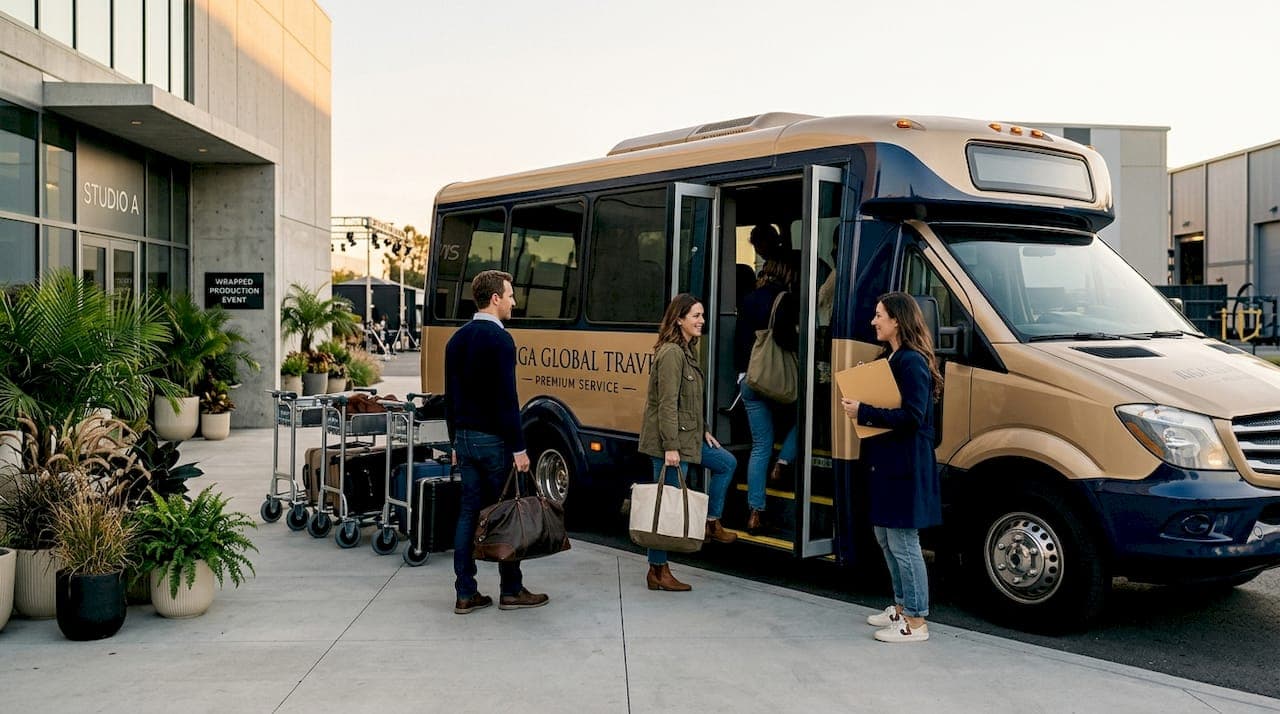
A wrap party shuttle is a dedicated vehicle service arranged to transport film, television, or theater cast and crew between production locations, hotels, and the wrap party venue as a coordinated extension of production logistics. Unlike a general party shuttle service, this is a purpose-built transportation solution tied directly to call sheets, wrap times, and the specific geography of a production. Event planners and production coordinators who treat wrap party transportation as an afterthought routinely face late arrivals, scattered crew, and the kind of chaos that undercuts an otherwise well-organized celebration. Getting this right requires understanding how these shuttles operate, what vehicles work best, and how to plan around the unpredictable nature of production wrap times.
What is a wrap party shuttle and how does it work?
A wrap party shuttle is point-to-point transport integrated directly with production schedules, connecting hotels, studios, shoot locations, and the wrap party venue in a coordinated sequence. The term "wrap party shuttle" is the common shorthand used by planners and vendors, while the broader industry category is production crew transportation or film crew shuttle service. Both terms refer to the same operational model: scheduled vehicles running defined routes timed to production activity.
The service works by mirroring the daily crew shuttle ecosystem already in place on most productions. Rather than treating the wrap party run as a one-off booking, experienced coordinators extend the daily loop structure to include post-wrap runs to the event venue. This means the same routing logic, driver briefings, and staging areas used during the shoot week carry over into wrap night, which reduces setup time and driver confusion significantly.
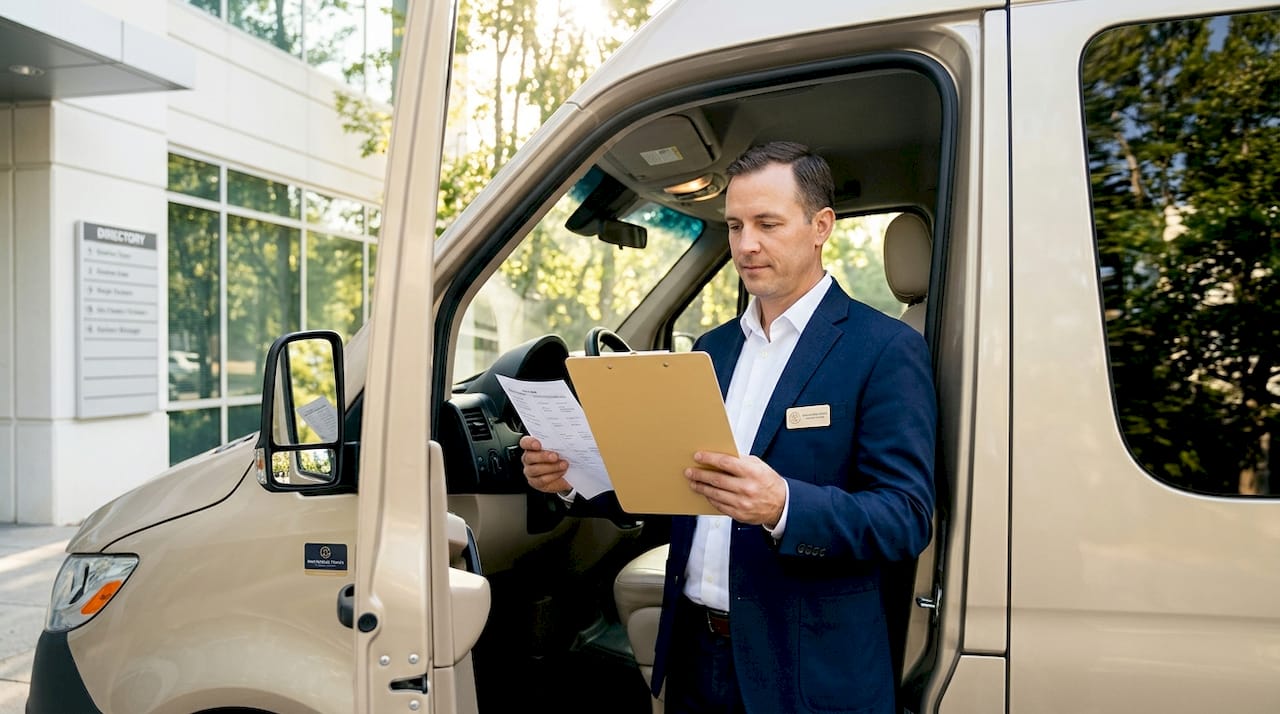
Drivers receive call sheets and location maps derived directly from the production call sheet. Standby vehicles are positioned at key pickup points to handle the staggered nature of department wrap times. A grip department may wrap two hours before the camera department, so a single fixed shuttle time serves no one well. The operational answer is continuous loops with buffer windows built in after estimated wrap times.
How does a wrap party shuttle operate within production logistics?
The operational framework of a wrap party shuttle service rests on three pillars: scheduling tied to call sheets, routing across multiple locations, and real-time driver communication.
Scheduling works by anchoring pickup windows to estimated wrap times plus a buffer, typically 30 to 45 minutes, to account for departmental clearance and gear breakdown. Production guides recommend continuous loops and standby vehicles rather than fixed single-run schedules, because wrap times on any production are rarely precise.
Routing connects at minimum three location types: the base camp or studio lot, cast and crew hotels, and the wrap party venue. On larger productions, this may expand to include satellite shoot locations, off-site parking areas, and secondary hotels. Each route leg needs a confirmed address, a designated pickup zone, and a clear driver instruction sheet.
Communication is the variable most planners underestimate. Drivers need a direct line to the transportation coordinator, not just a printed itinerary. When the director calls a last-minute pickup change or a department wraps early, that information has to reach the driver within minutes.
Key operational elements to coordinate before the event:
- Confirm all pickup and drop-off addresses with GPS coordinates, not just street names
- Assign a dedicated transportation coordinator as the single point of contact for all drivers
- Build a minimum 45-minute buffer into every scheduled pickup after estimated wrap time
- Stage standby vehicles at the studio lot and primary hotel to handle overflow
- Distribute driver packets that include the call sheet, venue contact numbers, and alternate routes
Pro Tip: Brief your drivers in person or via video call the morning of the wrap. A five-minute walkthrough of the route and the communication protocol eliminates 80% of the confusion that happens when drivers rely solely on printed instructions.
What are the benefits of wrap party shuttles vs. other options?
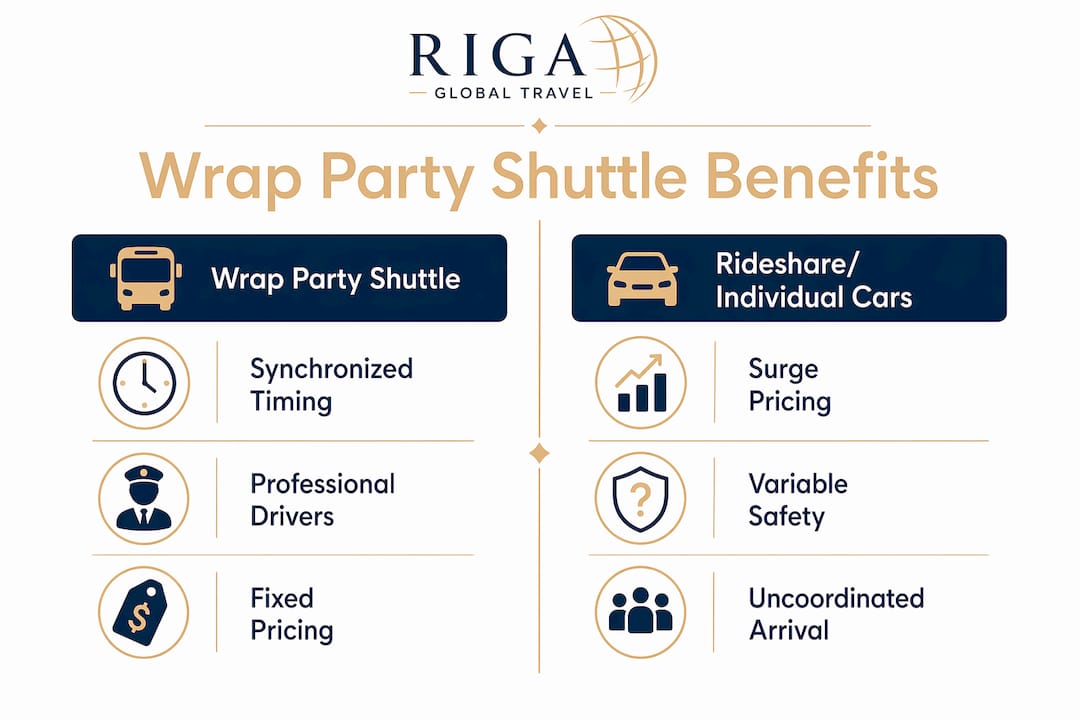
The core advantage of a wrap party shuttle over rideshare apps or individual car arrangements is group synchronization. When cast and crew arrive at a wrap party together, the event starts with energy rather than a slow trickle of arrivals over 90 minutes.
"Party buses ensure group cohesion, reduce surge pricing risks, and allow shared scheduling with professional drivers." — Group Travel in Toronto
Rideshare platforms like Uber and Lyft introduce three specific problems for production events: surge pricing during peak hours, no guarantee of vehicle availability for large groups, and zero coordination with production timing. A 60-person crew attempting to rideshare from a studio lot at 11 PM on a Friday will face all three simultaneously. A pre-booked shuttle eliminates all of them.
Safety is the second major factor. Crew safety and transport synchronization improve measurably when a professional driver handles the route rather than individual crew members driving after a celebration. This matters to production companies from both a duty-of-care and liability standpoint.
| Factor | Wrap party shuttle | Rideshare / individual cars |
|---|---|---|
| Group arrival timing | Synchronized, coordinated | Staggered, unpredictable |
| Cost for large groups | Fixed rate, scalable | Variable, surge-prone |
| Safety and accountability | Professional driver, insured | Individual responsibility |
| Communication overhead | Single coordinator contact | Per-person coordination |
| Crew experience during transit | Shared, celebratory | Isolated |
The cost argument also favors shuttles at scale. Half-day and full-day pricing for production crew shuttles in markets like New York City starts around $550 to $1,600 depending on group size and vehicle type. That fixed rate covers an entire crew, while rideshare costs for the same group can easily exceed that figure with surge pricing factored in.
What planning steps ensure a successful wrap party shuttle?
Effective planning for wrap party transportation starts earlier than most coordinators expect. Early booking during peak production seasons like spring and fall is the single most important step, because quality vendors fill up fast and last-minute bookings limit your vehicle options.
Follow this sequence to build a reliable shuttle plan:
- Confirm your crew count and locations at least three weeks out. Get a firm headcount from department heads and lock in all pickup and drop-off addresses before approaching vendors.
- Book your primary and standby vehicles simultaneously. A standby vehicle is not optional for crews over 30 people. Staggered wrap times make overflow a near-certainty.
- Build your driver packet from the production call sheet. Include pickup windows, venue address, coordinator contact, and alternate routes for traffic contingencies.
- Communicate the shuttle schedule to all departments via the call sheet. Crew members who do not know the shuttle exists will make their own arrangements, creating the exact fragmentation you are trying to avoid.
- Assign one transportation coordinator as the live point of contact on wrap night. This person handles real-time schedule changes and relays updates to all drivers immediately.
- Plan a final shuttle no earlier than 90 minutes after the last estimated wrap time. Departments always run long, and a shuttle that leaves before the camera crew wraps is a shuttle that half your crew misses.
Pro Tip: Ask your vendor about their experience with film crew shuttle logistics specifically. A vendor who regularly works productions understands call sheet timing and wrap variability in ways that a general event transport company simply does not.
When selecting a vendor, prioritize three criteria: a verifiable safety record, direct experience with entertainment industry clients, and the ability to provide adaptable real-time transportation adjustments when schedules shift. References from other production coordinators carry more weight than any marketing material.
What vehicle types and features work best for wrap party shuttles?
Vehicle selection for wrap party transportation depends on crew size, route distance, and the tone of the event. A 15-person indie film wrap has different needs than a 200-person network television production.
Vehicles range from 10 to 56 passengers and are typically equipped with Wi-Fi, climate control, entertainment systems, and secure gear storage. The standard options break down as follows:
- Sprinter vans (10 to 14 passengers): Best for smaller departments, talent runs, or secondary pickup routes. Fast, maneuverable, and easy to stage at multiple locations.
- Minibuses (20 to 30 passengers): The workhorse of mid-size productions. Balances capacity with flexibility and fits most urban pickup zones.
- Charter buses (40 to 56 passengers): Appropriate for full-crew moves on large productions. Requires confirmed staging space at both pickup and drop-off locations.
- Party buses (20 to 40 passengers): Adds an experiential element to the transit itself, with AV systems and interior lighting that extend the celebration atmosphere from the venue to the ride.
Capacity staging by mixing vehicle types is the most effective approach for productions with staggered department wrap times. A sprinter van handles early-wrapping departments while a charter bus waits for the full crew. This reduces wait times and prevents shuttle overcrowding without requiring a single massive vehicle to sit idle for two hours.
| Vehicle type | Passenger capacity | Best use case |
|---|---|---|
| Sprinter van | 10 to 14 | Talent runs, small departments |
| Minibus | 20 to 30 | Mid-size crew moves |
| Charter bus | 40 to 56 | Full-crew transport |
| Party bus | 20 to 40 | Experiential wrap night transport |
Branded bus wraps and custom graphics are available from select vendors and turn the shuttle itself into a production branding moment. For studio productions or network events, a wrapped vehicle carrying the show's title from the lot to the venue is a detail that crew members notice and remember. For guidance on matching vehicle types to crew needs, the luxury bus types guide from Rigaglobaltravel covers the decision framework in practical terms.
Key takeaways
A wrap party shuttle succeeds when it is treated as an extension of the production's daily crew transport system, not as a standalone event booking.
| Point | Details |
|---|---|
| Define the service correctly | A wrap party shuttle is point-to-point production transport tied to call sheets and wrap times, not a generic party bus booking. |
| Stage multiple vehicle types | Mix sprinter vans, minibuses, and charter buses to handle staggered department wrap times without overcrowding or long waits. |
| Book early and plan buffers | Secure vehicles at least three weeks out and build 45-minute buffers after every estimated wrap time. |
| Equip drivers with call sheets | Providing drivers with production call sheets and location maps is the single most effective way to reduce communication chaos on wrap night. |
| Choose production-experienced vendors | Vendors familiar with entertainment industry logistics handle schedule variability far better than general event transport companies. |
Why wrap party logistics deserve more respect than they get
I have seen productions spend months perfecting every detail of the wrap party itself and then treat the transportation as a 48-hour afterthought. The result is always the same: half the crew arrives late, the other half is still waiting at the studio, and the first hour of the event is spent managing logistics instead of celebrating.
The part that surprises most coordinators is how much the shuttle experience shapes the mood of the night. A crew that rides together, laughs together on the bus, and arrives as a group walks into that venue already in celebration mode. A crew that trickles in via rideshare over 90 minutes never quite finds that collective energy.
What I have found actually works is treating the wrap shuttle brief the same way you treat the call sheet for a shoot day. Specific, detailed, distributed to everyone who needs it, and updated in real time when things change. The coordinators who do this consistently have wrap nights that run smoothly. The ones who send a single group text with an address do not.
The other thing worth saying plainly: do not underestimate how much wrap times vary by department. The art department and the camera department rarely wrap within the same hour. A single fixed shuttle time is a compromise that serves no one. Build the multi-vehicle, staggered-loop approach into your plan from the start, and you will spend wrap night celebrating instead of fielding calls from stranded crew members.
— Sammy
How Rigaglobaltravel handles wrap party transportation
Rigaglobaltravel specializes in limousine and concierge transportation for the entertainment industry, which means wrap party shuttle logistics are a core part of what the team does every day.
For event planners and production coordinators managing cast and crew transport, Rigaglobaltravel offers vehicle options scaled to any production size, drivers experienced with call sheet timing and wrap variability, and coordination support that integrates directly with your event logistics. Whether you need a single sprinter van for a talent run or a multi-vehicle fleet for a full network production wrap, the team builds the plan around your schedule, not a generic template. Visit Rigaglobaltravel to request a tailored quote and get transportation planning support from a team that understands production from the inside.
FAQ
What is a wrap party shuttle?
A wrap party shuttle is a dedicated vehicle service that transports cast and crew between studios, hotels, and the wrap party venue as part of production logistics. It operates as a scheduled, coordinated service tied to call sheets and wrap times rather than an on-demand booking.
How is a wrap party shuttle different from a regular party bus?
A wrap party shuttle is integrated into the production's transportation schedule and coordinated with call sheets, while a regular party bus is a standalone event rental. The key difference is operational: wrap party shuttles use standby vehicles, continuous loops, and real-time driver communication to handle the unpredictable timing of production wrap events.
How far in advance should I book wrap party transportation?
Book at least three weeks in advance, and earlier during peak production seasons like spring and fall. Advance planning is recommended because crew size, event complexity, and vehicle availability all require lead time to coordinate properly.
What vehicles are used for wrap party shuttles?
Typical vehicles include sprinter vans for 10 to 14 passengers, minibuses for 20 to 30, and charter buses for up to 56. Party buses are also used when the transit experience itself is part of the wrap night celebration.
How do I handle staggered wrap times when planning shuttle routes?
Use capacity staging with mixed vehicle types to run smaller vehicles for early-wrapping departments while larger vehicles wait for the full crew. Build a 45-minute buffer after every estimated wrap time and assign a live transportation coordinator to relay real-time schedule changes to all drivers.