
Planning limousine service for award shows is the process of coordinating luxury ground transportation across multiple vehicles, vendors, and regulatory requirements to deliver a flawless guest arrival experience at high-profile events. The stakes are high: a single missed pickup or staging conflict on a red carpet can damage both the event's reputation and the planner's. Whether you're managing transportation for the Screen Actors Guild Awards or a regional entertainment gala, the fundamentals of vehicle selection, permit compliance, and on-site logistics apply equally. This guide covers every step, from early prerequisites through post-event evaluation, so you can execute with precision.
How to plan limousine service for award shows: prerequisites and tools
Before you contact a single limo company, you need a clear picture of your event's scale, venue constraints, and regulatory requirements. Skipping this phase is the most common reason award show transportation fails on the night.
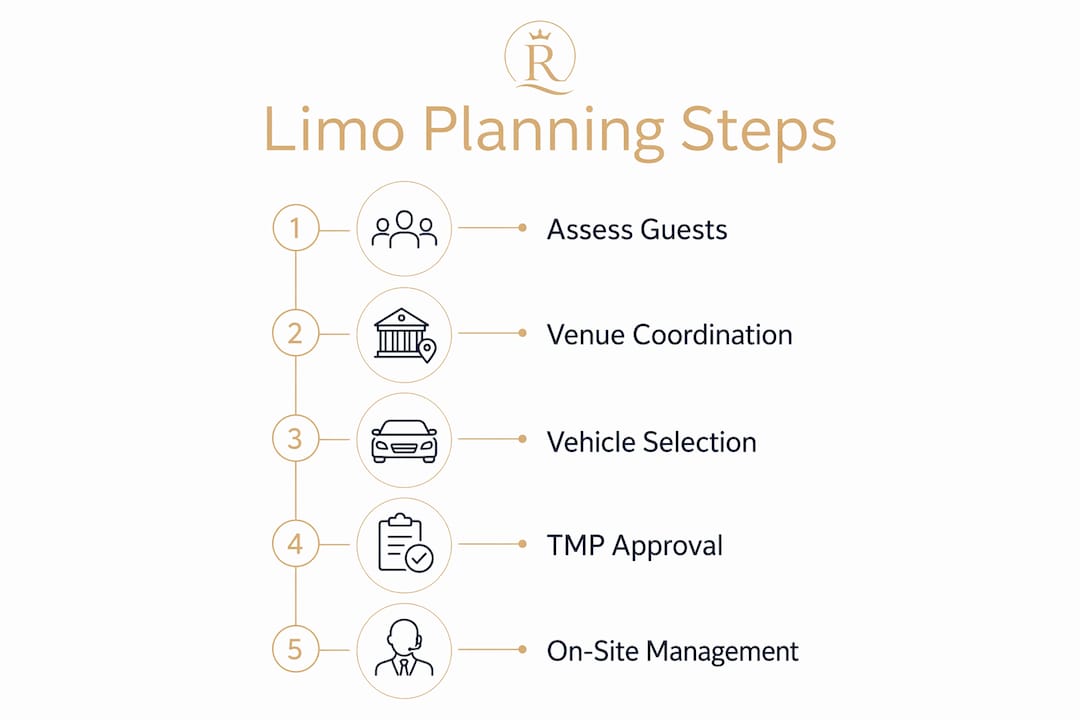
The first step is establishing your guest count and VIP tier structure. A 200-person gala with three A-list talent arrivals requires a fundamentally different transport plan than a 500-person industry dinner with no red carpet. Separate your guests into tiers: principal talent, presenting guests, and general attendees. Each tier drives a different vehicle type, pickup window, and staging priority.
Venue coordination comes next. Contact the venue's operations manager to confirm curb capacity, loading zone access, and any existing restrictions on vehicle length or idling time. Many award show venues in urban centers have strict rules about stretch limousines exceeding a certain length due to turning radius constraints.
The regulatory layer is non-negotiable. Large events impacting public roads require a Transport Management Plan (TMP) and must advertise road closures at least 7 days in advance. A TMP links local council meetings, police approvals, and transport agencies to permit road closures and manage heavy vehicle routing. This is the structural backbone of any award show limo operation. Start TMP discussions with local councils and transport agencies at least 6 weeks before your event date to align with forum meeting schedules and approval timelines.
| Prerequisite | Tool or action |
|---|---|
| Guest count and VIP tiers | Event registration data, talent rider review |
| Venue curb access | Site visit, venue operations contact |
| Transport Management Plan | Local council and transport authority submission |
| Road closure advertising | Public notice at least 7 days before event |
| Limo vendor shortlist | RFP to minimum 3 licensed operators |
| Event permits | Municipal permits office, minimum 6 weeks out |
How do you select and coordinate limo vehicles for award show guests?
Vehicle selection is where event limousine planning tips diverge sharply from generic transportation advice. The best limos for award shows are not always the largest or most expensive. They are the ones that match your guest profile, venue access, and event tone.

Luxury sedans and stretch limousines provide different capacities and luxury levels, while party buses offer capacity advantages but less formal ambiance. For red carpet arrivals, a Lincoln Town Car or Mercedes-Benz S-Class sedan signals understated prestige and fits tighter urban curb lanes. A classic stretch limousine seats 8 to 10 and photographs well for media coverage. Party buses work for group transport between after-parties but rarely suit the formality of a main award show arrival.
| Vehicle type | Capacity | Best use case | Red carpet suitability |
|---|---|---|---|
| Luxury sedan (Mercedes S-Class, Cadillac CT6) | 2 to 4 | Principal talent, solo VIPs | High |
| Standard stretch limousine | 8 to 10 | Presenter groups, sponsor guests | High |
| SUV limousine (Cadillac Escalade stretch) | 14 to 20 | Mid-tier VIP groups | Medium |
| Party bus | 20 to 40 | Staff, general attendees | Low |
Chauffeur professionalism is as important as the vehicle itself. For limo services for celebrities, require that all drivers hold current commercial licenses, carry event-specific insurance, and have prior red carpet experience. Brief every chauffeur on the event timeline, VIP names, and the exact staging sequence at least 48 hours before the event.
Coordinating pickup and drop-off schedules requires a master transport manifest. Assign each vehicle a call time, pickup address, arrival window at the venue, and a designated staging position. Build 15-minute buffers between principal talent arrivals to prevent curb congestion and give photographers clear windows for each guest.
Pro Tip: When hiring multiple vendors for a single event, negotiate a lead vendor arrangement. One company manages all vehicle dispatch and communication, reducing the coordination overhead on your team and eliminating the blame-shifting that happens when two vendors share a staging area.
What does limousine rental pricing look like for award shows?
Budgeting for premium transport for gala events requires understanding both the base rate structure and the fees that accumulate on top. Planners who focus only on the hourly rate routinely overspend by 30 to 40 percent.
A standard stretch limousine averages $95 per hour, but special-event limo rentals range from $350 to over $1,100 depending on vehicle type and duration. Most operators require a minimum booking of 3 to 5 hours for award show dates, which are classified as peak demand periods. Additional fees typically include chauffeur gratuity at 15 to 20 percent, fuel surcharges, tolls, and charges for extra amenities or extended wait times. These fees should be confirmed in writing before signing any contract.
Negotiating clear quotes upfront is the single most effective way to prevent budget overruns. Request itemized quotes that separate the base hourly rate, minimum hours, and every potential surcharge. Compare at least three vendors before committing.
Budgeting tips for award show limo rentals:
- Request all-in quotes that include gratuity, fuel, and tolls so comparisons are accurate
- Book vehicles 8 to 12 weeks in advance for major award show dates to avoid surge pricing
- Negotiate a flat rate for the full event window rather than an open hourly meter
- Confirm cancellation and change policies in writing, especially for last-minute guest list revisions
- Allocate a 15 percent contingency line in your transport budget for overtime, additional vehicles, or unexpected fees
- Separate VIP vehicle costs from general guest transport in your budget to track spend by tier
For multi-vehicle events, ask vendors about fleet discounts. Booking five or more vehicles with a single operator typically yields a 10 to 15 percent reduction on the total contract value.
How do you manage on-site limo logistics at award shows?
On-site execution is where the plan meets reality. TMP approvals can take 6 weeks or more to finalize, which means your curb staging strategy must be locked before the event date. Review your curbside limo operations plan against the approved TMP to confirm that staging positions, vehicle lengths, and arrival sequences all comply with permitted road use.
Assign a dedicated transport coordinator to the curb for the full duration of arrivals. This person's only job is managing vehicle flow: confirming each car's position, communicating with the lead chauffeur, and relaying changes to the event's security and production teams. Do not split this role with any other event function.
Communication protocols matter more than any technology. Establish a dedicated radio channel or group messaging thread that includes all chauffeurs, the transport coordinator, venue security, and the event producer. Every vehicle movement, delay, or guest change gets communicated through this single channel. Parallel communication threads create confusion and missed calls.
Contingency planning separates good transport operations from great ones. Identify two alternative staging areas within 500 meters of the venue in case the primary curb becomes blocked. Pre-position one standby vehicle near the venue for last-minute additions or breakdowns. Brief all chauffeurs on the contingency routes before arrivals begin.
Pro Tip: Use a shared live-tracking app like Google Maps location sharing or a fleet management tool to give your transport coordinator real-time visibility on every vehicle's position. This eliminates the "where is the car?" radio calls that clog your communication channel during peak arrival windows.
What are the most common limo service problems at award shows?
Even well-planned luxury transportation for events encounters problems. Knowing the failure points in advance lets you resolve them before they escalate.
- Delays and no-shows: Require all vendors to confirm vehicle and driver assignment 24 hours before the event. A vendor who cannot confirm by that deadline gets replaced.
- Last-minute guest changes: Maintain a flexible vehicle reserve of at least one sedan and one stretch unit that can be redeployed without disrupting the master manifest.
- Traffic disruptions: Your TMP should include alternative approach routes. Share these with all chauffeurs during the pre-event briefing.
- Vendor miscommunication: A single point of contact on both your team and the vendor's team eliminates the telephone-game errors that cause staging conflicts.
- Tipping disputes: Tipping limo drivers 15 to 20 percent is standard practice. For multi-hour bookings, flat rates between $100 and $150 are common. Clarify whether gratuity is included in the contract or expected separately, and communicate this to any client or talent handler who will be traveling.
After the event, conduct a structured debrief within 48 hours. Review the transport manifest against actual arrival times, document every deviation, and collect feedback from chauffeurs and the on-site coordinator. This post-event evaluation becomes the foundation for your next award show transport plan.
The quality of your post-event debrief determines the quality of your next event's transport operation. Document every deviation from the plan, not just the problems.
You can also review how limousine provisions in talent contracts affect your on-site obligations, particularly when talent riders specify vehicle type, chauffeur gender, or staging requirements that differ from your standard plan.
Key takeaways
Successful award show limousine service requires TMP compliance, tiered vehicle selection, itemized budgeting, and a dedicated on-site transport coordinator working from a single communication channel.
| Point | Details |
|---|---|
| Start permits early | Submit TMP applications at least 6 weeks before the event to meet approval timelines. |
| Match vehicle to guest tier | Use luxury sedans for principal talent and stretch units for presenter groups. |
| Budget beyond the hourly rate | Add 15 to 20 percent for gratuity, fuel surcharges, tolls, and a contingency reserve. |
| Lock curb staging before event day | Confirm staging positions against the approved TMP before the first vehicle arrives. |
| Debrief within 48 hours | Document every deviation from the transport manifest to improve future operations. |
What I've learned planning limo logistics for high-profile events
The thing most event planners underestimate is how much the TMP drives everything else. You cannot finalize your curb staging, your vehicle lengths, or your arrival sequence until the TMP is approved. I've seen planners spend weeks perfecting a transport manifest only to have the local council restrict the curb to vehicles under 25 feet, which eliminates every stretch limousine on the list. Start the permit process before you start the vehicle selection process.
The second lesson is that vendor relationships matter more than vendor pricing. A limo operator who has worked your venue before knows the loading dock supervisor, understands the security protocols, and has a relationship with the traffic management team. That institutional knowledge is worth more than a 10 percent discount from an operator who has never staged at the venue.
I also think planners over-invest in vehicle amenities and under-invest in chauffeur briefings. A guest riding in a standard sedan with a chauffeur who knows their name, their destination, and their schedule has a better experience than a guest in a fully stocked stretch with a driver who is reading the address off a phone. Brief your drivers like you brief your production team.
— Sammy
How Rigaglobaltravel supports your award show transport planning
Rigaglobaltravel specializes in luxury event transportation for the entertainment industry, from single-talent pickups to full fleet coordination across multi-day award show schedules. The team manages TMP coordination, vendor vetting, curb staging design, and real-time on-site dispatch so your transport operation runs independently of your broader event production.
For planners who need a partner with direct experience in red carpet logistics, talent rider compliance, and multi-vendor fleet management, Rigaglobaltravel offers tailored service packages built around your specific event requirements. Contact the team to discuss your next award show transport plan.
FAQ
How far in advance should you book limos for award shows?
Book limousine rentals for red carpet events 8 to 12 weeks in advance. Award show dates are peak demand periods, and operators fill their fleets early.
What is a Transport Management Plan and why does it matter?
A Transport Management Plan is a formal document submitted to local councils and transport authorities that permits road closures and manages vehicle routing. TMP approvals take 6 weeks or more, making early submission critical for award show limo staging.
How much does it cost to hire a limo for an award ceremony?
Special-event limo rentals range from $350 to over $1,100 depending on vehicle type and duration. Budget an additional 15 to 20 percent for gratuity, fuel surcharges, and tolls.
How much should you tip a limo driver at an award show?
Standard limo driver gratuity is 15 to 20 percent of the total fare. For multi-hour award show bookings, flat rates between $100 and $150 are common and should be clarified in the contract.
What vehicle works best for red carpet arrivals?
Luxury sedans like the Mercedes-Benz S-Class and Cadillac CT6 are the top choice for principal talent arrivals. They fit tight urban curb lanes, photograph cleanly, and signal prestige without the logistical complexity of a full stretch limousine.