
Luxury transport planning for sports press conferences is defined as the coordinated management of premium vehicles, security-conscious routing, and real-time scheduling to move high-profile guests without friction. The industry term for this discipline is executive event transport logistics, and it applies directly when you plan luxury transport for sports press conferences at venues ranging from NFL stadiums to FIFA World Cup sites. The core challenge is not finding a nice car. It is building a system that holds together when match times shift, security perimeters expand, and fifty journalists need to be somewhere in thirty minutes.
What are the core elements of a luxury transport plan for sports press conferences?
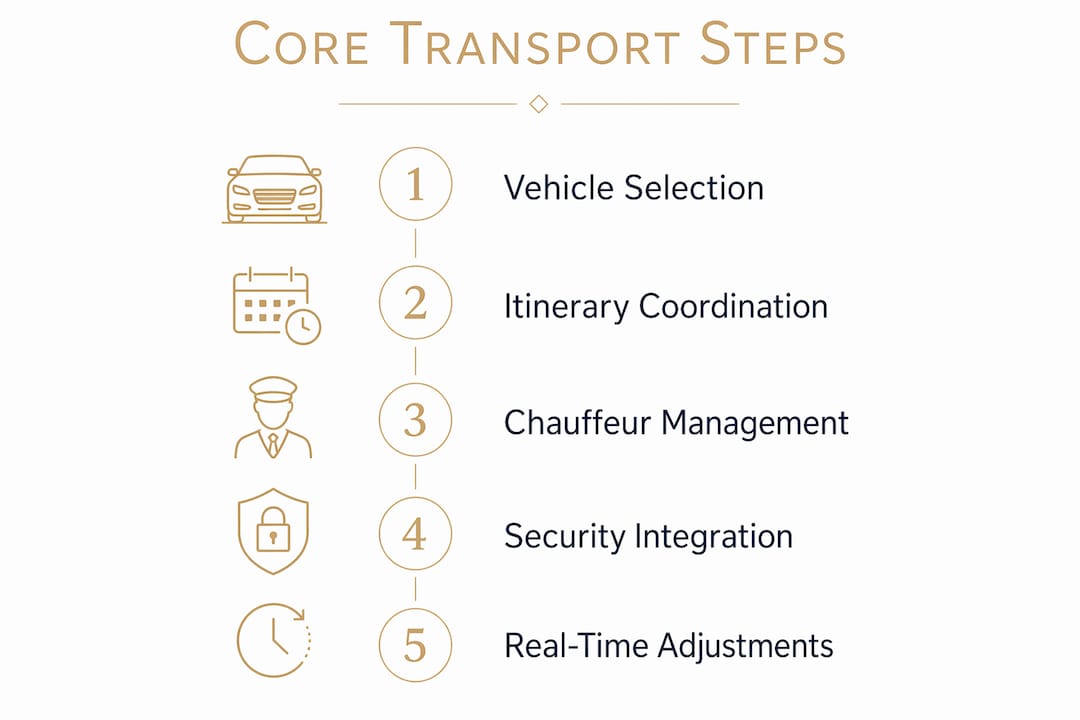
Effective conference transportation planning starts with four non-negotiable components: vehicle selection, itinerary coordination, security integration, and stakeholder communication. Miss any one of them and the entire operation becomes reactive instead of controlled.
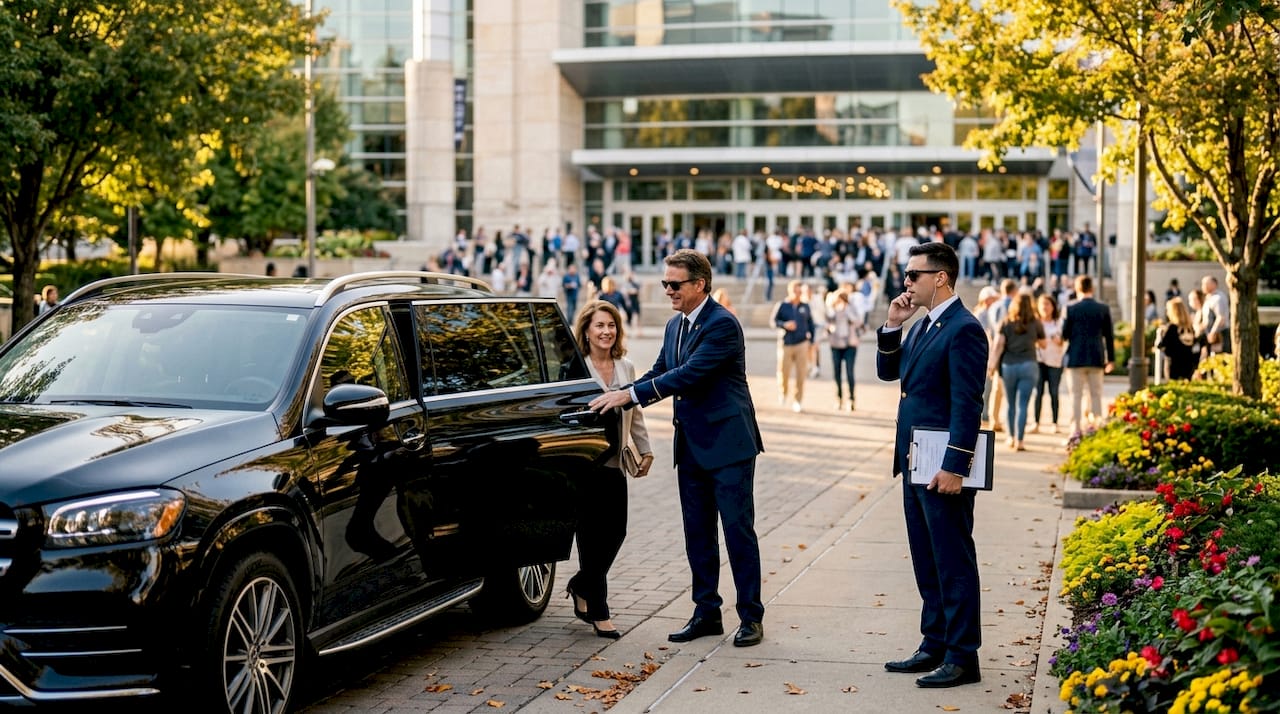
Vehicle selection goes beyond aesthetics. Press and VIP guests at events like the Super Bowl or a FIFA press day expect Mercedes-Benz Sprinter vans, Cadillac Escalades, or Lincoln Navigators with professional chauffeurs who understand media protocol. The vehicle must match the guest tier, and the fleet must be large enough to handle simultaneous pickups across multiple hotels.
Itinerary coordination means building transport scenarios rather than fixed schedules. VIP transport plans must anticipate multiple unfolding scenarios because demand spikes and last-minute changes are inherent to sports tournaments. A scenario-based approach gives your team three or four pre-approved departure windows instead of one rigid timeline.
The remaining pillars are equally critical:
- Venue security requirements, including staging areas, credentialing checkpoints, and restricted gate access, must be mapped before the first vehicle moves.
- Accreditation and hospitality teams need a direct line to the transport coordinator so guest transitions from hotel lobby to press room are continuous, not fragmented.
- A single point of contact for all bookings, billing, and schedule changes reduces the administrative errors that derail operations on event day.
- Equipment and media gear transport must run on a separate schedule from people movement to prevent bottlenecks at loading zones.
For high-end transport solutions at the press conference level, the on-site chauffeur role is as much about coordination as driving. Chauffeurs who understand venue layouts and security protocols are a logistical asset, not just a service upgrade.
How to manage logistics and timing effectively during dynamic sports event schedules
Timing is where most luxury transport plans fail. Sports events do not run on office-meeting schedules, and press conferences are often called within minutes of a final whistle or a trade announcement.
-
Build multi-departure scenario plans. Pre-approve three departure windows for every major movement: early, on-time, and delayed. Scenario-based departure planning allows real-time adjustment as match events unfold without requiring a full replanning cycle.
-
Schedule earlier than you think necessary. Stadium departures must factor security checks and restricted access zones that add significant time to what looks like a short trip on a map. A venue that is two miles away can require forty-five minutes of buffer on a match day.
-
Use live event data to trigger adjustments. Assign one team member to monitor match progress, broadcast feeds, or official event communications. When a press conference is confirmed, that person activates the pre-approved transport scenario immediately.
-
Plan internal venue routing in advance. Coordinate with venue operations to identify controlled vehicle paths, loading dock access, and internal handoff points. Improvising these routes on event day costs time and creates security conflicts.
-
Cover every leg of the journey. End-to-end coordination for press and conference transport goes beyond simple vehicle bookings. It requires aligning airport pickups, hotel staging, and venue arrivals into one continuous movement plan with security alignment at each transition.
Pro Tip: For international press traveling to multi-city events like the 2026 FIFA World Cup, build a dedicated airport-to-hotel leg with a separate chauffeur briefed on customs exit timing and baggage handling. This leg sets the tone for every subsequent movement.
Coordinating executive transport services for VIPs and media on sports match days requires the same staging and security perimeter awareness that governs the entire operation.
What operational models improve efficiency and reliability for large-scale press and VIP transport?
The difference between a transport operation that holds up under pressure and one that collapses is almost always structural. The most reliable model centralizes all guest movement under one operational schedule managed by a single coordination desk.
Centralizing all guest movement into one schedule with a single coordination desk minimizes the handoff errors that are typical in multi-venue press cycles. A media summit example demonstrates this clearly: one coordination point with unified billing and scheduling managed hundreds of bookings without the duplication errors that occur when multiple vendors operate independently.
The table below compares the two dominant operational models for large-scale sports press transport:
| Factor | Centralized single-provider model | Multi-vendor fragmented model |
|---|---|---|
| Schedule control | One desk manages all movements in real time | Each vendor manages its own schedule independently |
| Billing and admin | Unified invoicing reduces reconciliation time | Multiple invoices increase administrative load |
| Error rate at handoffs | Low, because all information lives in one system | High, because vendors lack shared situational awareness |
| Fleet scalability | Provider scales fleet across venues from one contract | Scaling requires renegotiating with each vendor separately |
| Security integration | Single provider briefs all chauffeurs on venue protocols | Security briefings must be repeated across multiple vendors |
Super Bowl LX planners began coordinating more than a year in advance, managing over 600 buses and 23,000 parking spots across multiple cities and venues. That scale is only achievable with centralized operational control. For a press conference operation, the principle is identical even if the fleet size is smaller.
Integrating with venue vehicle access permissions and local traffic regulations is non-negotiable. Permit lead times and vehicle access restrictions must be planned for match days, including neighborhood road closures and restricted gate entries that begin hours before kickoff. A transport provider unfamiliar with these restrictions will have vehicles stuck outside a perimeter with no recourse.
How do security and venue policies impact luxury transport planning for press conferences?
Security is not a constraint you work around. It is a variable you build into the plan from day one. Venues hosting high-profile sports press conferences operate under layered security protocols that directly determine where your vehicles can go and when.
- Staging pick-ups outside the strictest security perimeter with coordinated escorted transfers reduces operational risk and improves the guest experience. At Estadio BBVA, the recommended approach stages vehicles approximately 800 meters from the security perimeter, with guests walking an escorted internal route to the vehicles. This circumvents bottlenecks at credentialing checkpoints.
- VACIS procedures are mandatory for vehicles accessing stadiums during event periods. At Mercedes-Benz Stadium in Atlanta, FIFA guidance requires all vehicles to report to Vehicle and Cargo Inspection Screening before gaining access. This checkpoint adds time that must be built into every schedule.
- Parking permits and restricted neighborhood access require lead times of several hours. The KC2026 traffic plan requires permits up to four hours before match time, with road closures beginning two hours prior near stadiums.
- Separate schedules for people transport and equipment delivery prevent conflicts at loading zones and credentialing gates. Treating these as one operation is a documented source of failure at major venues.
- Work directly with the event's accreditation team to confirm which vehicle types and credential levels are authorized for each access point. This information changes between events and sometimes between days of the same event.
Pro Tip: Request the venue's vehicle access map and security briefing document at least three weeks before the event. Most venue operations teams will share this with credentialed transport providers. Use it to brief every chauffeur individually, not just the lead coordinator.
For events at large convention-style venues, corporate transport logistics at facilities like the Orlando Convention Center follow similar layered access protocols that reward early coordination with venue security staff.
Key takeaways
Effective luxury transport for sports press conferences requires centralized coordination, scenario-based scheduling, and security integration built into the plan from the start, not added as an afterthought.
| Point | Details |
|---|---|
| Scenario-based scheduling | Pre-approve multiple departure windows to handle real-time match day changes without replanning. |
| Centralized single provider | One coordination desk with unified billing reduces handoff errors across multi-venue press operations. |
| Security-first staging | Stage vehicles outside security perimeters and use escorted routes to avoid credentialing bottlenecks. |
| VACIS and permit planning | Build mandatory vehicle inspection checkpoints and permit lead times into every transport schedule. |
| Early operational start | Begin planning more than a year out for regional multi-venue events to allow fleet scaling and contingency development. |
What I've learned from planning transport at high-profile sports events
Most transport plans I've reviewed treat security as a footnote. They specify the vehicle, confirm the pickup time, and assume the rest will work itself out. It never does. The plans that hold up under pressure are the ones where the coordinator has already walked the escorted route from the staging area to the press room, knows which gate accepts which credential level, and has a backup departure window confirmed before the event starts.
The insight that changed how I think about this work came from watching a well-resourced operation fall apart at a major stadium event because two vendors were each waiting for the other to confirm a handoff. No one owned the moment. Centralizing that ownership, putting one person or one provider in charge of the full movement chain, is not a luxury. It is the only model that works at scale.
Building relationships with local authorities and venue operations teams before event week is equally underrated. The transport coordinator who has already spoken with the venue's security director gets answers in ten minutes on event day. Everyone else waits in a queue. That relationship is worth more than any vehicle upgrade.
The planning discipline required for events like the Super Bowl applies directly to a press conference operation, even if your fleet is twelve vehicles instead of six hundred buses. Start early, build scenarios, own the coordination, and brief every driver personally.
— Sammy
How Rigaglobaltravel handles luxury transport for sports press events
Rigaglobaltravel specializes in centralized luxury transport coordination for the entertainment and sports industry, with a fleet and operational model built specifically for high-profile press conferences, award ceremonies, and media events.
Every booking runs through a single coordination desk that manages scheduling, security briefings, and real-time adjustments across multiple venues. The fleet includes executive sedans, SUVs, and Sprinter vans, all operated by chauffeurs experienced in media protocol and venue access procedures. Whether you are coordinating a post-game press conference at a major stadium or managing international press arrivals for a multi-day sports summit, Rigaglobaltravel builds the transport plan around your event's security requirements and schedule variables. Contact Rigaglobaltravel to discuss your next event.
FAQ
What does luxury transport planning for sports press conferences involve?
Luxury transport planning for sports press conferences covers vehicle selection, scenario-based scheduling, security integration, and centralized coordination across airport, hotel, and venue legs. The goal is continuous, punctual movement for press and VIP guests regardless of schedule changes.
How far in advance should you start planning event transport logistics?
For regional multi-venue events, planning should begin more than a year in advance to allow fleet scaling, permit acquisition, and contingency development. For single-venue press conferences, a minimum of four to six weeks allows time to secure venue access permits and complete security briefings.
Why is a single transport provider better than multiple vendors?
A single coordination point with unified billing and scheduling eliminates the handoff errors that occur when multiple vendors operate without shared situational awareness. It also simplifies security briefings and real-time schedule adjustments.
What is VACIS and how does it affect luxury vehicle scheduling?
VACIS (Vehicle and Cargo Inspection Screening) is a mandatory security checkpoint that vehicles must clear before accessing stadiums during event periods. Build VACIS processing time into every arrival schedule to prevent delays at credentialed access gates.
How should vehicles be staged at venues with strict security perimeters?
Stage vehicles approximately 800 meters outside the strictest security perimeter and use escorted internal routes to walk guests from the secure zone to the vehicles. This approach avoids credentialing bottlenecks and keeps high-profile guests moving on schedule.