
Film festival transportation for talent, crew, and executives requires dedicated hourly chauffeured infrastructure, not standard car service. It has to plug directly into your production coordinators and handlers, run on live scheduling instead of fixed timestamps, and carry backup vehicles for when a Q&A runs long. A vendor like Riga Global Travel, staffed by chauffeurs vetted for entertainment work, cuts the risk of a missed pickup derailing your day. The operational rule that matters most: stage vehicles early, and never rely on a single vendor.
TL;DR:
- Use dedicated hourly vehicles with backup options for talent, crew, and executives to prevent schedule disruptions caused by delays or overbookings.
- Build clear contractual terms that specify minimums, overtime billing, cancellation policies, and insurance requirements to avoid last-minute chaos.
- Coordinate with venue security and establish precise staging, pickup points, and communication protocols to prevent curb confusion and vehicle misplacement.
- Implement layered vendor systems with pre-funded spares and a single point of contact to ensure redundancy and swift responses during scheduling or traffic issues.
- Confirm traffic closures and detours in advance, providing drivers with detailed routes to avoid delays caused by city reroutes or security barricades.
Table of Contents
- Who Needs This Guide, and What Falls Outside It
- Matching Vehicles to Roles: Talent, Crew, and Everyone Between
- The Contract Terms and Checklist That Prevent Festival-Day Chaos
- Staging Pickups and Working With Venue Security
- Building Redundancy Into Every Festival Transport Plan
- What Festival Transportation Should Actually Cost You
- How Road Closures and Traffic Control Affect Your Schedule
- Keeping Drivers, Organizers, and Handlers on the Same Page
- What Years of Festival Bookings Have Taught Us
- How to Book Riga Global Travel for Your Festival Week
- Where to Go Next for Checklists and Contract Language
- Sources
Who Needs This Guide, and What Falls Outside It
This guide is written for the people who actually book and manage festival ground transport: production coordinators, unit managers, talent agency travel leads, publicists running press days, and festival operations directors juggling multiple screening blocks. If your job involves reconciling a call sheet against a chauffeur schedule, this is for you.
It is not written for festivalgoers looking for the cheapest way to get from a hotel to a theater. That is a different question with a different answer involving public transit maps and rideshare apps, and it sits outside what follows here.
Getting this right means coordinating several people who rarely talk to each other directly unless someone forces the issue:
- The talent's publicist or personal assistant, who controls final say on pickup timing
- The production coordinator, who owns the master schedule and call times
- On-site security, who controls curb access and staging permissions
- The venue's own event operations team, who can override anyone above if a road closes
Missing one of these voices is how a car ends up at the wrong door at the wrong time.
Matching Vehicles to Roles: Talent, Crew, and Everyone Between
Not every seat on a festival roster needs the same car, and treating them identically either overspends or underdelivers. A useful way to think about it:
- Lead talent and executives need a sedan or executive SUV with privacy glass, a driver briefed on discretion protocols, and a vehicle held on hourly dedicated disposal so it waits, not shuttles.
- Supporting cast and secondary talent can often work on point-to-point transfers for predictable moves (hotel to a fixed screening time) but should shift to hourly disposal on press or premiere days when schedules slip.
- Crew and production staff are almost always better served by a shuttle or sprinter van on a fixed loop, since group movement is about volume and reliability, not privacy.
Hourly disposal costs more per trip than point-to-point, but it buys flexibility. A junket that's supposed to end at 4:00 PM and runs to 6:15 PM is not a problem if the car is on the clock and waiting. It is a real problem if the car left after the scheduled window and now you're calling a dispatcher hoping for a replacement.
On the privacy side, insist your contract specifies driver non-disclosure agreements, no dash-cam recording of passengers, and no third-party ride-sharing of the vehicle during your booking window. The logistics behind entertainment industry transport treat these details as baseline, not upsell, because a single privacy breach or missed pickup can cost far more than the premium for dedicated service.
Pro Tip: Book one tier above what you think you need for lead talent during premiere week. An executive SUV held on standby for four extra hours costs less than the reputational damage of a star arriving late to a red carpet.
The Contract Terms and Checklist That Prevent Festival-Day Chaos
Most transportation failures during festival week aren't mechanical. They're contractual gaps discovered at the worst possible moment. Build your checklist and your contract language before the festival, not during it.
Day-of essentials to confirm 24 to 48 hours out:
- Vehicles pre-staged at approved back-of-house points, not just "nearby"
- A single confirmed handler contact per talent, with a backup name
- Live ETA updates pushed to a shared channel, not just a driver's phone
- A written record of who has authority to reassign a car mid-day
On the contract itself, insist on these clauses before signing:
- Hourly blocks with clear minimums, so you know the floor cost before overtime starts
- Overtime billing stated in writing, typically in 15 or 30-minute increments past the booked window
- Cancellation terms that distinguish between a full-day cancellation and a same-day trim
- PO-based invoicing with net-30 or net-45 terms, since production accounting rarely pays on the spot
Insurance and driver vetting deserve their own line item. Ask for proof of commercial auto coverage limits, not just "insured," and ask how chauffeurs are screened, background checks, entertainment-specific training, discretion agreements.
One missed pickup during a festival window can cascade into a delayed press slot, a bumped screening introduction, or a rescheduled interview block, and the cost of that kind of disruption in entertainment logistics tends to run well past what the car service itself cost. That's the math that justifies paying for redundancy before you need it.
Staging Pickups and Working With Venue Security
Red-carpet choreography looks effortless from the sidewalk. Behind it is a staging plan negotiated with venue security days in advance, and skipping that negotiation is the single fastest way to get a car turned away at the curb.
- Confirm the approved drop point in writing with venue security, not just the festival's general logistics team. Screenings often restrict vehicle access to a single lane, and that lane can change between the premiere and the after-party.
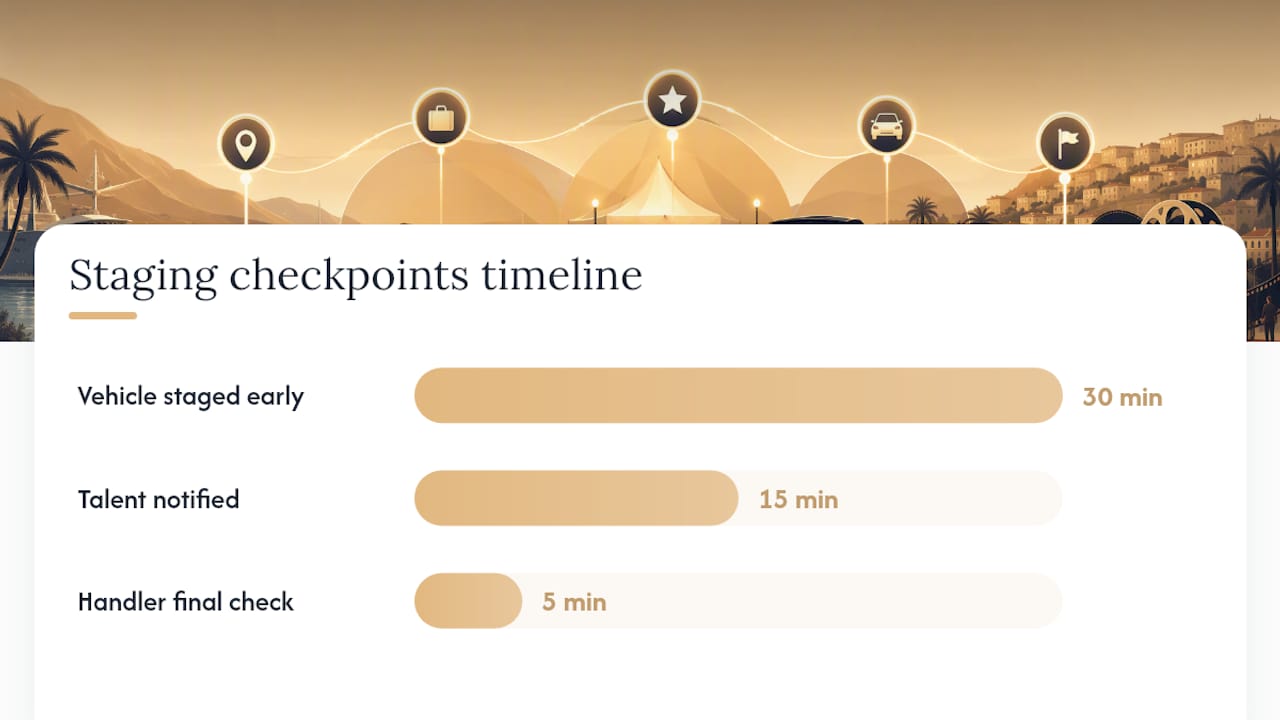
- Build a staging timeline with checkpoints, not just an arrival time. Vehicle staged 30 minutes early, talent notified 15 minutes out, handler confirms final walk 5 minutes out.
- Set the handler interface rule clearly: the chauffeur takes movement instructions only from the named handler or publicist, never from a well-meaning assistant or a security guard trying to speed things along. This single rule prevents most red-carpet confusion.
- Give chauffeurs discretion authority to hold position or circle if the curb is blocked, rather than requiring a call-in for every deviation.
Pre-staging matters more than most production teams realize. A vehicle waiting at the approved back-of-house point before talent exits avoids curb congestion entirely and keeps camera timing synchronized for the arrival shot. Waiting until the exact pickup minute to start moving the car into position is how you end up circling the block during a five-minute window.
Pro Tip: Run a test approach during load-in, a day or two before the actual event, so your chauffeur physically knows the approved lane, the security checkpoint, and the fallback route if that lane closes without notice.
Timing buffers should be conservative by default. Playbooks built for touring casts recommend padding transfer windows well beyond the theoretical drive time, especially for same-day matinee-to-evening transitions where one delay compounds into the next.
Building Redundancy Into Every Festival Transport Plan
A single-vendor plan is a single point of failure, and festival week is exactly when that failure shows up. The standard fix is a layered vendor model: one primary contracted provider for principal talent and executives, a vetted local operator on call for crew and overflow, and a standby rideshare account funded and ready for true emergencies.
Pre-funded emergency accounts matter more than most budgets account for. Having a card already loaded and authorized for a last-resort ride means nobody is fumbling for approval while talent stands on a curb.
What this looks like in practice:
- A primary vendor holding the bulk of hourly bookings for talent and execs
- A secondary local operator contracted for crew shuttles and spare capacity
- A designated Incident Lead with standing authority to reassign vehicles without escalation
- A reservation system giving planners a live manifest, not a spreadsheet updated by hand
On the technology side, live GPS tracking and automated delay alerts aren't luxury features anymore. Enterprise event mobility platforms increasingly build role-based access control into their reservation boards, so a publicist can see their talent's car status without seeing every other booking on the account. That kind of visibility is what separates a coordinated operation from a chain of phone calls.
What Festival Transportation Should Actually Cost You
Hourly blocks make sense whenever a schedule has any real chance of shifting, which during festival week is almost always. Point-to-point pricing only wins when a move is fixed and unlikely to change, like a single airport arrival with a known flight time.
Budget guidance worth following:
- Add a contingency line for spare vehicles and overtime, since layered vendor models with pre-positioned spares consistently reduce missed-transfer incidents
- Request net-30 or net-45 invoicing tied to a PO, not a card swipe at the end of the week
- Negotiate festival-week rates in advance, before the vendor's calendar fills, since demand spikes hard during the festival's opening weekend
A production transportation budgeting guide makes the case that paying 15 to 25% more upfront for guaranteed availability beats scrambling for last-minute coverage once the festival is underway.
How Road Closures and Traffic Control Affect Your Schedule
Festivals reroute cities. Downtown blocks close for red-carpet installations, press lines take over curb lanes that were open the week before, and local police departments issue their own access rules that override whatever the festival's own logistics team assumed.
Your transportation vendor needs a direct line into that traffic picture, not a general awareness of it. That means confirming which streets close and when, which credentials get a vehicle past a police checkpoint, and which detour routes chauffeurs should already know before the closure notice goes out publicly.
Build this into your planning at least a week ahead:
Coordinate with the festival's own transportation or operations desk, since they typically receive city closure schedules before the general public does. Cross-reference that against your pickup and drop points for every day of the festival, not just premiere night, since press days and industry screenings often trigger their own smaller closures. Give chauffeurs alternate routes in advance rather than expecting them to improvise around a closure they discover in real time.
The biggest scheduling risk isn't the closure itself. It's the closure nobody told the driver about until the car is already stuck at a barricade three minutes from call time. Vendors with local festival experience usually maintain their own closure notes from past years, which is worth asking about directly when you're vetting a provider. If a company can name the specific block that closes for the opening-night gala without checking a map, that's a good sign they've done this before.
Keeping Drivers, Organizers, and Handlers on the Same Page
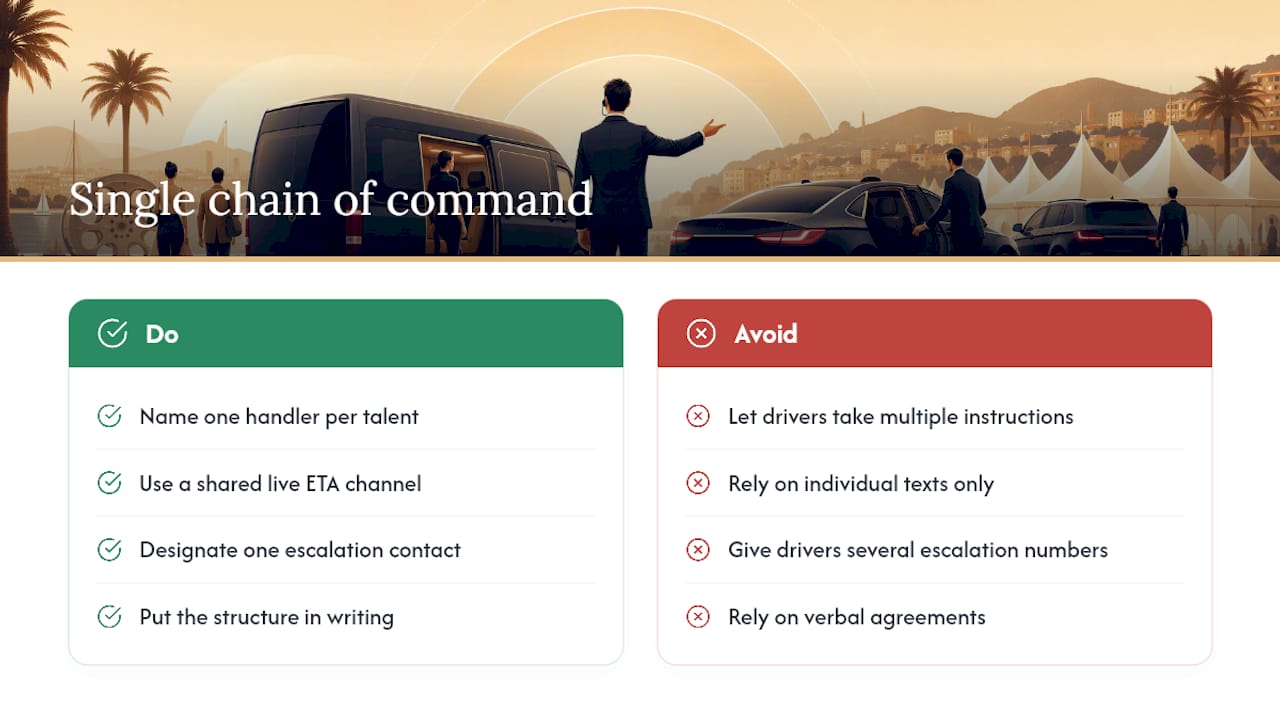
Every festival transportation failure traces back to a communication gap somewhere. The fix isn't more phone calls. It's a defined chain of command that everyone, including the chauffeur, agrees to follow before the first pickup.
The chauffeur takes instructions from one named handler per talent, full stop. Not from a security guard trying to speed the line, not from a well-meaning assistant, not from the organizer's intern. This single rule, enforced without exception, resolves most on-the-ground confusion during red-carpet moments and eliminates the awkward standoff where two people give a driver conflicting directions.
Live ETA updates should flow through a shared channel, a group thread, a dispatch board, a reservation platform's live manifest, rather than a string of individual texts that nobody else can see. When a car is running four minutes behind, the publicist, the production coordinator, and the venue's stage manager all need to know at the same moment, not in sequence.
Festival organizers should also designate a single point of contact for vendor-side escalations. If a chauffeur hits a closed street or a security hold, that driver needs one number to call, not three, to get a decision fast. Reservation platforms built around role-based access solve part of this by giving each party visibility limited to what they need, which cuts down on the noise of everyone copying everyone else on every update.
Set this structure in writing before the festival starts. Verbal agreements about who talks to whom tend to fall apart exactly when the schedule gets tight.
What Years of Festival Bookings Have Taught Us
A festival week runs on rhythm more than raw capacity. The morning press junket, the afternoon industry screening, the evening premiere. Each block has its own staging demands, and the vehicles that worked perfectly at 10:00 AM can be exactly wrong for a 7:00 PM red-carpet arrival if nobody adjusted the plan in between.
The recurring failure point is handler confusion, not mechanical breakdown. Cars sit ready. Drivers show up early. What goes wrong is two people giving a chauffeur conflicting instructions ten minutes before a scheduled move. Fixing that is less about technology and more about discipline: one handler, one line of authority, written down before the first car rolls.
Last-minute fixes almost always come down to whether a spare vehicle was already staged nearby. The operations that run smoothly are the ones that treated redundancy as a line item, not an afterthought.
— Sammy
How to Book Riga Global Travel for Your Festival Week
Most festival transportation problems come down to one thing: a vendor treating your booking like a standard airport run instead of a production with moving parts. A reliable vendor builds festival-week bookings around dedicated hourly disposal, chauffeurs briefed on handler protocols, and corporate invoicing that production accountants recognize.
When you request a quote, ask for specifics: fleet availability across your festival dates, confirmed backup vehicle capacity, and a single dispatch contact for the week rather than a rotating call center. A scalable fleet matters when your schedule shifts, and festival schedules always shift.
If your festival sits in the New York market, start with Riga Global Travel's celebrity and talent transportation page to see how VIP bookings are structured, or reach out through the New York limousine service page to request festival-week availability and corporate account terms directly.
Where to Go Next for Checklists and Contract Language
For deeper detail on chauffeur vetting and privacy protocols, read why celebrities need private chauffeurs. Production coordinators building their first festival plan should start with production set transportation basics, and crew-specific planning benefits from broadcast crew shuttle service guidance. For on-site logistics support beyond vehicles, mobile office trailer rentals cover temporary command centers during multi-day events.
Sources
- The Logistics of the Entertainment Industry
- The Master Guide to Event Transportation Management
- Airport Transfer Playbook for Touring Casts