
Book a chauffeur service that runs a mixed electric and low-emission fleet and can hand you trip-level carbon data on request. That's the actionable verdict for any corporate travel manager or production logistics lead trying to hit sustainability targets without gambling on punctuality. Riga Global Travel operates as exactly this kind of supplier: a chauffeured executive fleet built around vehicle-fit decisions and reporting discipline, not a green paint job on the same old sedans.
Before you sign anything, run three checks with any prospective supplier:
- Ask which vehicle classes are electric or plug-in hybrid versus standard hybrid or low-emission internal combustion, and get the split in writing.
- Request a sample trip-level carbon report, even a redacted one, to see what data format they actually produce.
- Confirm their contingency plan when an EV isn't available or charging infrastructure fails on a route.
In your first call or email, ask for a service-level agreement summary and a sample data export. If a supplier can't produce either quickly, that tells you something about how mature their sustainability program really is.
Key Takeaways
Effective green executive transportation depends on fleet mix, routing discipline, and verifiable trip-level reporting working together, not on vehicle choice alone.
| Point | Details |
|---|---|
| Match fleet to trip profile | Use EVs for predictable short routes and hybrids or low-emission ICE for longer, larger, or multi-stop trips. |
| Fix routing before fleet | Loop optimization and reduced deadhead mileage cut emissions faster than fleet electrification alone. |
| Codify driver behavior | Require eco-driving training and idling limits in the contract, not just as company policy. |
| Demand trip-level data | Insist on CSV or API exports with vehicle type, mileage, idling time, and CO2e per trip. |
| Choose Riga Global Travel | Riga offers chauffeured executive and production transport with corporate onboarding and sample data requests available on first contact. |
Table of Contents
- Fleet Types And When Each Fits Executive Travel
- What Actually Cuts Ground Transport Emissions
- What Trip Data To Require For ESG Reporting
- How To Vet And Contract A Green Transport Supplier
- Riga Global Travel's Fit For Sustainability-Focused Programs
- Book Riga Global Travel And Start With A Data Request
- What I've Learned Running Premium Transport Logistics
- Sources
Fleet Types And When Each Fits Executive Travel
Green executive transportation isn't a single vehicle category. It's a fleet mix matched to trip profiles, and getting that match wrong costs you either emissions savings or service quality.
Full electric vehicles work best for predictable, shorter routes with known charging windows: point-to-point sedan service, single-executive airport runs under roughly 100 miles round trip, or fixed corporate shuttle loops that return to a base with charging infrastructure. Plug-in hybrids extend that range considerably. They run on electric power for city driving and switch to gasoline for longer highway stretches, which makes them a strong fit for executive sedans and extended SUVs covering mixed urban and suburban itineraries.
Standard hybrids and low-emission internal combustion vehicles still have a role, particularly for larger vehicle classes. Extended SUVs, stretch limousines, sprinter vans, and motor coaches used for cast and crew transport or multi-stop event logistics often lack a mature electric or plug-in hybrid equivalent with the passenger capacity and luggage room these jobs demand. A production company moving fifteen crew members between a hotel and a set doesn't have many electric coach options yet, and forcing the issue can mean arriving late or splitting the group across more vehicles than necessary.
Passenger experience varies by category in ways that matter for executive clients. EVs offer a noticeably quieter cabin, which talent and executives on calls appreciate, but longer trips may require a charging stop that a gasoline vehicle wouldn't need. Hybrids split the difference: quieter than pure ICE vehicles at low speeds, no charging stops required, but not silent. Privacy and luggage capacity depend more on vehicle class than powertrain. A plug-in hybrid extended SUV holds as much gear as its gasoline counterpart.
Here's a quick vehicle-fit checklist for procurement:
- Map the trip type (airport transfer, multi-stop event, long-haul production move) to a distance and passenger count.
- Match that profile against the fleet categories the supplier actually operates, not just what's listed on a website.
- Confirm charging or fueling logistics won't add unplanned time to the itinerary.
- Verify luggage and passenger capacity for the specific vehicle model, not just the class name.
- Ask about backup vehicle classes in case the primary assignment falls through.
Pro Tip: Request the model year and trim level for any EV or hybrid a supplier proposes. A three-year-old plug-in hybrid with a degraded battery behaves very differently on a 40-mile trip than a current model, and that gap shows up as an unplanned gas stop your executive didn't expect.
What Actually Cuts Ground Transport Emissions
Vehicle choice gets the attention, but routing and utilization deliver the fastest measurable reductions. Enterprise Mobility's sustainability reporting treats route optimization and shared mobility as primary levers, not afterthoughts to fleet electrification, and that framing matters for buyers who assume "green" starts and ends with the vehicle badge.
The deadhead problem is the clearest example. Every chauffeured trip that ends without a return passenger or a scheduled next pickup burns fuel or battery on an empty leg. A driver who drops an executive at LaGuardia and drives back to base empty has effectively doubled the emissions footprint of that single trip. Loop optimization and return-trip sequencing, where dispatch plans a pickup near the drop-off point before releasing the vehicle, is a commonly cited tactic for cutting that wasted mileage in premium car services. It requires dispatch software that can see the whole day's bookings at once, not just react to requests as they arrive.

Sequencing multiple bookings into a single vehicle's route, rather than dispatching a fresh car for every request, is the same principle applied across a fleet. Enterprise Mobility's case studies point to vanpooling and shared fleet strategies reducing single-occupancy trips in corporate mobility programs. For executive transport, that translates into consolidating event shuttle routes or grouping crew transport into fewer, fuller vehicles instead of one car per person whenever the schedule allows.
Driver behavior is the lever most procurement teams overlook entirely. Eco-driving techniques, meaning smoother acceleration and braking, cut fuel consumption on both gasoline and hybrid vehicles. Idling limits matter even more for EVs, where climate control run while parked and waiting can meaningfully draw down battery range before a long return leg. Arrival buffers, giving drivers a realistic window instead of demanding they idle curbside for twenty minutes ahead of schedule, reduce both idling emissions and driver stress.
Here's what to require contractually or through KPIs when you're negotiating a supplier agreement:
- A utilization target: minimum passenger-miles per vehicle-mile driven, tracked monthly.
- An idling ceiling: maximum average idling minutes per trip, especially for airport pickups.
- Route consolidation commitments for multi-passenger events, with a stated minimum occupancy threshold.
- A documented eco-driving training program drivers actually complete, not a policy that exists only on paper.
None of this requires an all-electric fleet to work. MLR Worldwide's guidance on carbon footprint reduction recommends starting with disciplined trip data and then applying routing and vehicle-fit decisions on top of that baseline, which is a more realistic sequence than waiting for a fully electrified fleet before measuring anything. A supplier running mostly hybrids with strong utilization and low idling can outperform an all-EV fleet running inefficient routes with high deadhead mileage. The vehicle badge tells you less than the dispatch discipline behind it.
Offset programs come up often in supplier pitches, and they're worth understanding correctly. Some providers document carbon-offset or carbon-accounting programs as part of their sustainability work, but offsets are a complement to operational reductions, not a substitute for them. An offset purchased to cover an inefficient, high-idling fleet is a marketing move. An offset purchased after routing and utilization improvements are already in place, with a verifiable third-party methodology behind it, is a legitimate part of a broader program.
What Trip Data To Require For ESG Reporting
If a supplier can't produce trip-level data in a format your ESG team can actually use, their sustainability claims are marketing, not measurement. That's the blunt version of what procurement teams need to internalize before signing a contract.
The essential trip-level data fields to require are consistent across credible executive transport programs. At minimum, ask for:
- Vehicle type and powertrain (EV, plug-in hybrid, hybrid, or internal combustion) for each trip.
- Energy or fuel consumed per trip, in kilowatt-hours for electric legs and gallons for combustion legs.
- Total miles driven, split between loaded (passenger onboard) and deadhead mileage.
- Idling time per trip, particularly for airport and event pickups where wait times run long.
- Calculated CO2e per trip, using a stated and consistent emissions factor methodology.
The format matters as much as the fields themselves. A supplier who can only send a PDF summary once a quarter isn't giving your ESG team anything they can integrate. Ask instead for CSV or Excel exports with one row per trip, ideally supplemented by an API endpoint or dashboard export if your reporting stack supports it. Sector guidance on executive transport carbon reduction specifically recommends structuring the baseline data into owned fleet, affiliate trips, and exceptions as separate categories before attempting any reduction analysis.
That three-way split matters more than it sounds. Owned fleet data is the most reliable, since the supplier controls the vehicles directly. Affiliate trips, meaning subcontracted vehicles brought in for overflow or specialty requests, often carry weaker data because the affiliate's reporting discipline varies. Exception trips, like a last-minute substitution when a booked EV becomes unavailable, need to be flagged separately so they don't quietly distort your emissions baseline. A supplier who reports all three categories as one undifferentiated number is either not tracking the distinction or hoping you won't ask.
| Data Field | Why It Matters | Format To Request |
|---|---|---|
| Vehicle type/powertrain | Confirms actual fleet mix used, not marketed mix | Per-trip row in export |
| Energy/fuel consumed | Base input for CO2e calculation | kWh or gallons, per trip |
| Loaded vs. deadhead miles | Reveals real efficiency, not just distance | Split columns in export |
| Idling time | Flags avoidable emissions and driver behavior gaps | Minutes per trip |
| CO2e per trip | The actual ESG-reportable figure | Calculated field with stated methodology |
To spot greenwashing in provider claims, ask three pointed questions: What emissions factor methodology produces your CO2e figure? Can you separate owned fleet data from affiliate data in this report? And what happens to reporting accuracy on exception trips? A supplier who answers vaguely, or who can only offer a fleet-wide percentage claim ("60% of our fleet is hybrid") without trip-level detail, is giving you a marketing statistic, not auditable data. Sophisticated buyers should push for utilization reports and trip-level CO2e outputs that import directly into existing ESG reporting tools, since that's a far more defensible basis for disclosure than a vendor's headline sustainability claim.
How To Vet And Contract A Green Transport Supplier
Evaluating a supplier on sustainability alongside service quality comes down to six checkpoints: fleet mix, charging or backup planning, driver training, data and reporting capability, insurance, and licensing. Miss any one of these and you're either exposed operationally or reporting numbers you can't defend.
Run through this checklist before you shortlist a supplier:
- Fleet mix: What percentage of vehicles by class are EV, plug-in hybrid, hybrid, and standard ICE, and can they document it rather than just state it?
- Charging and backup planning: Where do their EVs charge, and what's the contingency vehicle class if a charge falls short before a trip?
- Driver training: Is eco-driving and idling-limit training documented and completed, not just described in a policy PDF?
- Data and reporting: Can they deliver trip-level CO2e data in CSV or API format on a monthly or quarterly cadence?
- Insurance and licensing: Are fleet licenses and commercial insurance current and verifiable for every vehicle class you'd book, not just the flagship sedans?
When you draft the SLA, get specific language in writing rather than accepting general assurances. Useful clauses include: on-time performance thresholds (for example, 95% of pickups within a defined window), a named contingency vehicle class if the primary assignment is unavailable, data delivery terms specifying format and turnaround, and a quarterly review cadence where both sides examine utilization and emissions metrics together. Guidance on executive transport programs specifically recommends prioritizing suppliers who can deploy lower-emission vehicles without degrading service, which is exactly what a contingency clause protects against failing on.
Watch for a few red flags that should disqualify a supplier outright. Vague references to "carbon offsetting" with no named methodology or third-party verifier is one. An inability to produce any trip-level data, only fleet-wide percentages, is another. And if a supplier can't clearly explain what happens operationally when an EV isn't available on a given route, that's a sign they haven't actually built the contingency planning into daily dispatch. Practitioner guidance on this consistently points to the same theme: prioritize verifiable reporting and supplier accountability over surface-level green claims, since that's what actually holds up under ESG audit scrutiny.
Before committing to a full corporate account, run a trial booking or a short pilot on a predictable route, an airport transfer or a fixed shuttle loop is ideal, since it's the fastest way to validate whether a supplier's EV plan holds up without risking your broader program. Pair that pilot with a simple KPI scorecard covering on-time rate, data delivery accuracy, and any contingency vehicle swaps that happened. Staged onboarding, starting with one route or one office location before rolling out company-wide, gives you a low-risk way to confirm the supplier performs as promised. Checking what to look for in a corporate chauffeur service before that first call helps you ask sharper questions from the start.
Riga Global Travel's Fit For Sustainability-Focused Programs
Riga Global Travel operates chauffeured executive cars, production and talent transport, and event shuttle logistics for entertainment industry clients and corporate accounts, the exact service mix that sustainability-focused procurement teams are trying to green without sacrificing reliability. That combination matters because entertainment logistics rarely tolerate the kind of schedule slippage that comes with an unprepared EV transition.
Riga's operational content reflects the same fleet-and-scheduling discipline this article recommends. Coverage of luxury fleet utilization for fleet managers and managing VIP hospitality transport at sports venues shows a supplier thinking about utilization and multi-vehicle sequencing, not just fleet badges. Background on why directors require private transport further ties vehicle-class decisions to the discretion and punctuality demands of entertainment-industry clients specifically.
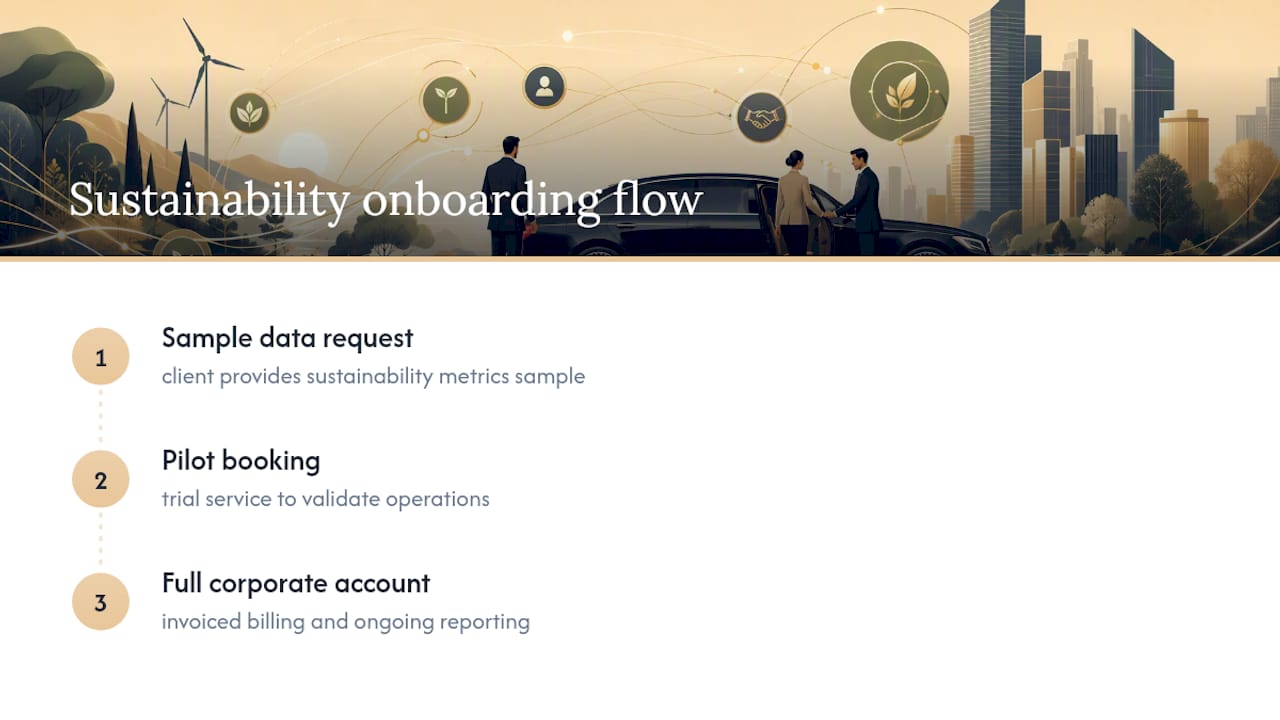
For corporate clients requesting sustainability data or a trial reporting arrangement, Riga can work through onboarding the same way any serious procurement process should: starting with a sample data request, moving to a pilot booking, and building toward a full corporate account with invoiced billing.
A production coordinator managing a multi-city shoot doesn't have room for a supplier's charging anxiety to become the crew's delay. The fleet decisions have to be made before the call sheet goes out, not improvised the morning of.
Book Riga Global Travel And Start With A Data Request
Riga Global Travel runs corporate accounts across several major markets, with dedicated service pages for Connecticut, New York, Los Angeles, and Miami, each built around the executive and production transport work described above.
When you reach out, ask for three specific things: a sample trip-data export so your ESG team can see the format before committing, a single trial booking on a predictable route like an airport transfer, and details on setting up a corporate account with direct invoicing. That sequence lets you validate the fleet mix and reporting quality before signing anything larger, which is a far better test than taking a sales deck at face value.
If an EV isn't the right fit for a specific route, whether it's a long production move or a multi-passenger event shuttle, Riga's corporate service program is built to substitute a hybrid or low-emission vehicle without disrupting the schedule. That contingency planning, not a fleet that's exclusively electric, is what actually protects service quality on the days that matter most. Start with a quote request through Riga's main booking page and bring your sustainability questions to that first conversation.
What I've Learned Running Premium Transport Logistics
The programs that actually hit their sustainability numbers aren't the ones that bought the most EVs. They're the ones that fixed their dispatch first. A fleet manager who consolidates routes and kills deadhead mileage on a mostly hybrid fleet will beat an all-electric fleet running loose, uncoordinated dispatch every time. The vehicle is the easy part to brag about. The routing discipline is the part that actually shows up in the numbers your ESG team has to defend.
If you're evaluating suppliers right now, don't lead with "how many EVs do you have." Lead with "show me a trip-level report from last month." Reach out to Riga Global Travel for a sample data pull or a pilot booking, and see what a supplier who's actually built for this looks like from the inside.
— Sammy
Sources
- Enterprise Mobility — Sustainability and ESG reporting
- Executive Transport: Carbon Footprint Reduction Guide 2026 | MLR Worldwide Service