
Yes, a version of tarmac meet-and-assist is possible at most major airports, but it almost never means a stranger's car driving up to the aircraft door. Real tarmac access is authorized by the airport operator and, in many cases, air traffic control, not sold as a standard add-on. Book your meet-and-assist service early, then confirm directly with the provider whether airside access is realistic for your specific airport and flight.
TL;DR:
- Only authorized airport or air traffic control personnel can provide genuine airside tarmac access, which is rarely sold as a standard service and requires prior approval.
- Tarmac transfers are limited to specific situations such as VIP arrivals or private jets, and most commercial airports restrict vehicle access during peak hours due to congestion and security.
- Booking a reliable meet-and-assist involves detailed planning, including confirming exact meeting points, flight details, and securing airport authorization in advance; last-minute changes often cause delays.
- Providers should clearly identify airport contacts, offer contingency plans for gate changes, and ensure drivers are trained and qualify for airside operations to avoid service failures.
- Costs vary widely based on the level of airside access and airport authorization, with genuine airside transfers commanding the highest rates, and booking well in advance reduces fees and improves reliability.
Table of Contents
- What a Tarmac Meet-and-Assist Service Actually Includes
- How Tarmac Escorts and Airside Access Actually Work
- Booking Checklist: What Your Provider and the Airport Need
- When a Tarmac Transfer Is Realistic, and What to Do Instead
- How to Evaluate a Meet-and-Assist Provider
- Pricing Structure and Typical Cost Ranges
- From Booking to Curbside: The Passenger Timeline
- Cancellation Policies and Additional Fees
- The Riga Global Travel View on Reliable Handoffs
- Book a Confirmed Airport Handoff With Riga Global Travel
- Sources
- FAQ
What a Tarmac Meet-and-Assist Service Actually Includes
"Tarmac meet-and-assist" gets used loosely in marketing, but the real service breaks down into distinct segments depending on where the escort starts and ends. Understanding these categories matters more than the label a company puts on its website.
The four common configurations are:
- Gate-to-gate: an escort meets you at one gate and walks you to a connecting gate, useful for tight international-to-domestic transfers.
- Gate-to-curb: staff meet you as you exit the aircraft area and guide you through immigration, customs, and baggage claim to a waiting vehicle.
- Curb-to-gate: the reverse, for departures, starting at drop-off and ending at the gate or jet bridge.
- Gate-to-vehicle: the closest thing to a literal tarmac transfer, where authorized ground staff meet a passenger at the aircraft and escort them directly to a vehicle staged in an approved area.
Most quality providers bundle in flight monitoring, so your escort adjusts to delays without you having to call anyone. Baggage handling, priority immigration and TSA lane coordination, and lounge access setup round out a standard package, according to DFW International Airport's meet-and-greet program, which publishes one of the more transparent breakdowns of what airport-level meet-and-greet actually covers.
Premium add-ons vary by provider and airport, but often include private-suite lounge access, negotiated curbside pickup closer to the terminal doors, and pet handling for travelers moving animals through connections. None of these guarantee tarmac access. They just tighten the experience around the parts of the airport that are actually open to arrangement.
How Tarmac Escorts and Airside Access Actually Work
Airports divide their operational areas into two zones that matter enormously for anyone promising a "tarmac transfer." The movement area covers taxiways, runways, and anywhere aircraft actively move under air traffic control direction. The non-movement area, sometimes called the apron or ramp, covers gate parking positions and staging zones where ground crews work but ATC doesn't actively direct traffic.
That distinction determines who can legally put a vehicle near your aircraft. A vehicle entering the movement area needs a trained, radio-equipped driver and direct ATC clearance. Entering the non-movement apron still requires airport authorization, but the rules are somewhat less rigid.
The FAA's Advisory Circular 150/5210-20 on Ground Vehicle Operations sets the federal baseline: drivers operating in these zones need documented training, working radios, and, for movement-area work, active coordination with air traffic control. The circular specifically calls out non-routine and special operations, including VIP arrivals, as situations where airports should have written procedures rather than improvising on the day.
Practically speaking, a vehicle cannot enter airside without either airport operator authorization or an approved escort arrangement, as Platinum Aviation's explainer on DFW tarmac access lays out clearly. That single fact is why any provider promising a blanket "tarmac car ride" at every airport should raise your guard. Access gets approved airport by airport, sometimes flight by flight, and a reliable operator verifies it rather than assumes it.
Booking Checklist: What Your Provider and the Airport Need
A meet-and-assist reservation lives or dies on the details you provide upfront. Airports and providers both need specific data before they can even evaluate whether tarmac-adjacent service is feasible for your itinerary.
- Passenger information: full legal name matching your photo ID, flight number, date, arrival or departure time, and whether the flight is international or domestic.
- Terminal and gate: the known gate if available, since terminal assignment affects which escort routes and staging areas apply.
- Operational specifics: number of bags, any mobility assistance needs, and whether an onward driver or vehicle needs a live contact number.
- Contact chain: a local phone number for you and a named contact on the provider's side with authority to change the plan if gates shift.
- Lead time: most airport-level meet-and-greet programs recommend booking at least 24 to 48 hours ahead, though tarmac-adjacent or VIP handling often needs longer.
Pro Tip: Never book with "meet at the aircraft" as your only instruction. Specify the exact meeting point, like "Gate A14 jet bridge, door 2" or "Terminal B arrivals hall near the information desk." Vague instructions are the single most common cause of missed pickups.
Last-minute schedule changes happen constantly with commercial and private aviation. A provider worth using has a named escalation contact who can reroute your escort the moment a gate change hits the board, not someone who finds out when you call in a panic from the jet bridge.
When a Tarmac Transfer Is Realistic, and What to Do Instead
Genuine tarmac vehicle transfers tend to cluster around a narrow set of circumstances. Private jet operations at FBOs (fixed-base operators) routinely bring vehicles right up to the aircraft, since that's standard practice at general aviation facilities. Airport-approved VIP operations, official government movements, and ceremonial arrivals sometimes get similar treatment at commercial terminals, but only with advance coordination and sign-off from the airport operator.
Several factors work against a tarmac transfer even when a provider wants to arrange one:
- ATC and gate congestion: busy hub airports rarely have spare capacity to accommodate non-routine vehicle movement during peak banks.
- Security posture: heightened security periods can suspend non-essential airside access entirely.
- Visibility and time of day: low-visibility operations and nighttime restrictions often limit vehicle movement near active aircraft.
- Insurance and liability limits: many airports cap how many non-employee vehicles they'll authorize on the ramp at once.
When the tarmac itself isn't available, the practical alternatives deliver nearly the same outcome. Secured curbside handoff with a controlled escort walking you from the gate to a waiting vehicle covers most executive and talent needs. Private-jet apron transfers remain genuinely available for that category of travel. Expedited lounge-to-vehicle routing, where an escort moves you through a private lounge and out a side exit to a pre-staged car, often beats a literal tarmac pickup for speed and privacy anyway.
How to Evaluate a Meet-and-Assist Provider
Vague promises are the biggest red flag in this industry, and "tarmac transfer" is the phrase most often stretched past what an airport will actually permit. A reliable provider can back up the claim with specifics, not just enthusiasm.
Ask these questions before you book:
- Can you name the airport operations contact or department that authorized this arrangement?
- Do you provide a written contingency plan if my gate changes?
- Are your drivers movement-area qualified, with current radio and ATC communication training?
- What happens if the airport denies airside access on the day of my flight?
Pro Tip: If a sales rep can't name a specific airport contact or describe what happens when a gate changes at the last minute, that's your answer. A provider that has actually done tarmac-adjacent work talks about airport approvals and MOUs (memorandums of understanding) without prompting.
The clearest red flags: generic "tarmac transfer" language with no airport-specific detail, no mention of movement-area training standards, and refusal to put a contingency plan in writing. Providers following FAA ground vehicle operations guidance train drivers on vehicle lighting, airport diagrams, service road use, and yielding to aircraft. That level of operational discipline is what separates a real airside operation from a marketing line.
Pricing Structure and Typical Cost Ranges
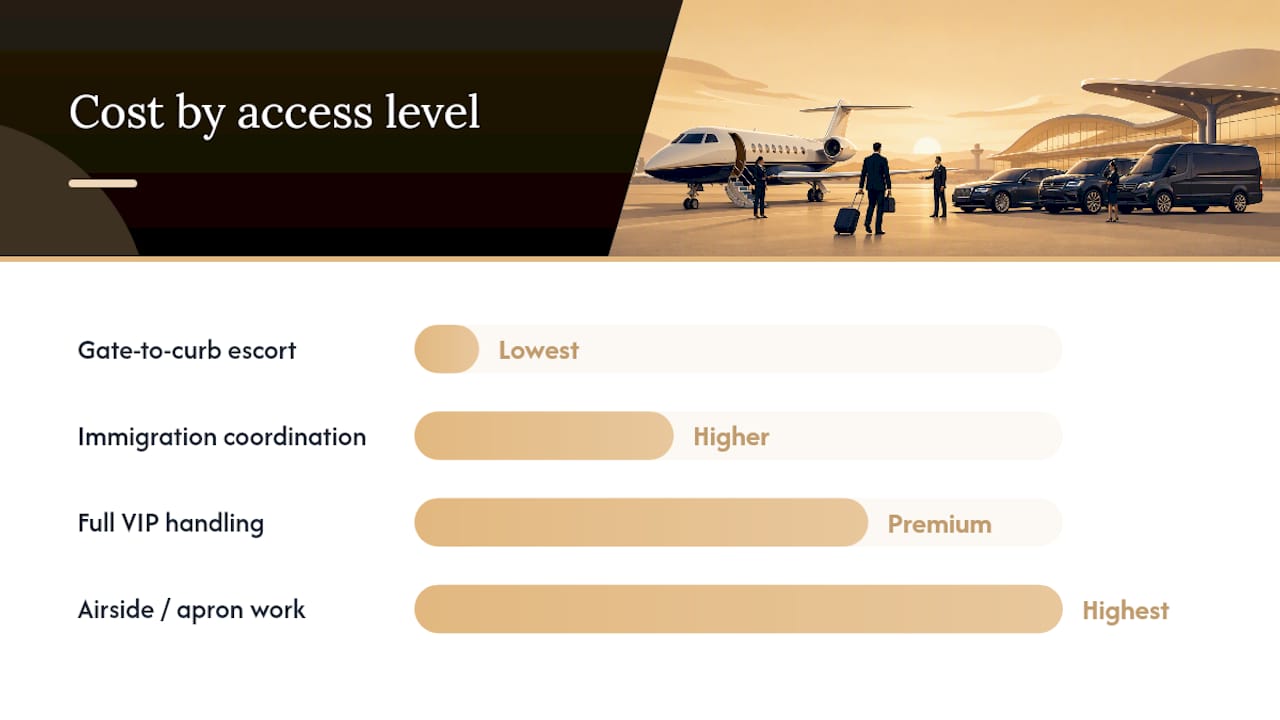
Meet-and-assist pricing scales with how far into controlled airport territory the service reaches, not with the marketing label attached to it. A basic gate-to-curb escort for a domestic arrival sits at the lower end of most fee structures, since it involves standard terminal access and no special airport authorization.
Add international immigration coordination, and the price climbs because staff need to navigate customs and border protection processes alongside you. Full VIP handling, including lounge coordination, porter service, and a chauffeur staged curbside, pushes into premium territory. Genuine airside or apron-adjacent work, when an airport actually approves it, commands the highest rates in the category because it requires trained personnel, insurance coverage, and airport-specific authorization that most bookings never touch.
Expect quotes to vary significantly by airport, time of day, and how far in advance you book. A same-day request during a peak travel period costs more than a scheduled booking made a week out, largely because providers need to secure staff and, where relevant, airport clearances on short notice. Group size, baggage volume, and whether you need multilingual staff or specialized mobility assistance all factor into the final number as well.
Many providers do not publish flat rates for meet-and-assist add-ons because the service depends on the airport, the flight, and the level of access requested. It is best to get a quote tied to your specific itinerary rather than rely on advertised flat fees that may not reflect airport-by-airport variations.
From Booking to Curbside: The Passenger Timeline
A meet-and-assist reservation moves through a predictable sequence, and knowing each step helps you spot where things typically go wrong.
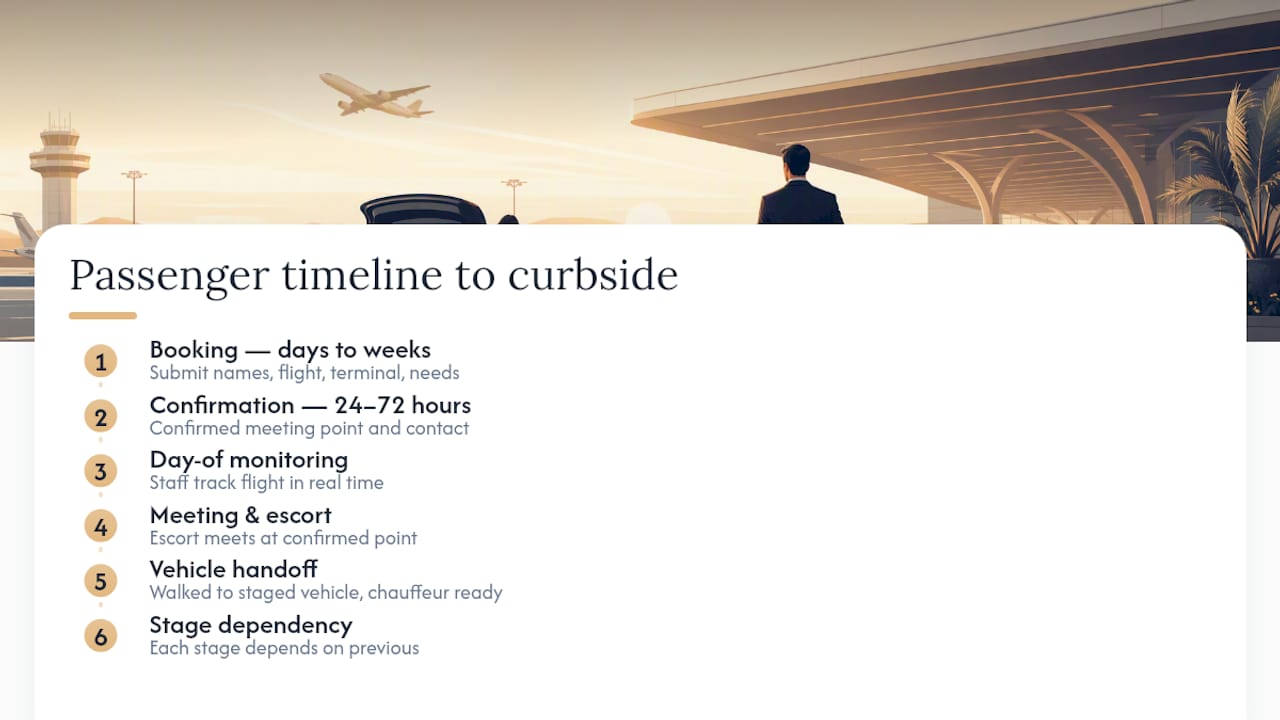
Booking (days to weeks ahead): You submit passenger names, flight details, terminal, and any mobility or baggage needs. The provider confirms availability and, if tarmac-adjacent service is requested, begins checking with the airport operator on feasibility.
Confirmation (24 to 72 hours out): You receive a confirmed meeting point, not just "we'll find you." This is when a competent provider locks in the exact door, hall, or gate location, plus a contact number for your escort.
Day-of monitoring: Staff track your flight in real time. Delays, gate changes, and early arrivals all get absorbed here without you needing to call anyone, provided the provider actually monitors flight data rather than relying on the printed schedule.
Meeting and escort: Your escort meets you at the confirmed point, handles immigration or TSA coordination as needed, and manages baggage.
Vehicle handoff: You're walked to a waiting vehicle, ideally with the chauffeur already staged and aware of your arrival status.
Each stage depends on the one before it. A provider that skips written confirmation of the meeting point is setting up the entire timeline to fail at the handoff, which is the step most travelers actually care about.
Cancellation Policies and Additional Fees
Cancellation terms vary by provider, but most meet-and-assist services follow a tiered structure tied to how much lead time you give them. Canceling more than 24 to 48 hours before your flight typically incurs no charge or a minimal administrative fee, since the provider hasn't yet committed staff or airport coordination resources.
Same-day cancellations or no-shows usually carry a higher fee, often close to the full service cost, because staff have already been scheduled and, for airside-adjacent bookings, airport paperwork may already be filed. Flight delays are typically handled without penalty as long as the provider had accurate flight-tracking information going in, but a full itinerary change, like switching airports or travel dates, often counts as a new booking rather than a modification.
Additional fees tend to show up around three areas: extended waiting time beyond what the quote covered, extra passengers or baggage beyond the original count, and last-minute upgrades like adding immigration escort or lounge access after the reservation is already confirmed. Always ask for the cancellation and change policy in writing before you pay a deposit, and confirm whether "confirmed" pricing includes contingencies like a two-hour ground delay or a terminal change.
The Riga Global Travel View on Reliable Handoffs
Some providers plan controlled handoffs for talent and executives around key practices such as continuous flight monitoring, a single named meeting point, chauffeur accountability from that point forward, and a written contingency plan before the flight lands. That combination, not literal tarmac access, is what actually protects a high-priority traveler's schedule. Expect any provider worth hiring to spell out airport coordination and escalation contacts before you ask.
— Sammy
Book a Confirmed Airport Handoff With Riga Global Travel
Some providers offer alternatives to guessing whether a "tarmac transfer" promise will hold up on the day of your flight, building handoffs around chauffeurs staged in advance, confirmed meeting points, and direct access to management rather than an app, supported by extensive experience working with production companies and studios in logistics.
For executives, talent, and production teams, that means airport transfer service built around real-time flight monitoring and a chauffeur who waits, rather than circles. If your booking involves a high-visibility client or public figure, the celebrity transportation service adds privacy protocols and NDA-based references on top of the same controlled handoff. Ask directly whether airside or apron-adjacent elements are realistic for your airport when you book, and give Riga Global Travel the same lead time you'd give any airport-level meet-and-greet program, generally 24 to 48 hours minimum for standard requests and longer for anything involving special coordination.
Reach out to confirm your terminal, flight details, and meeting point now, and get a chauffeur staged and ready before your wheels touch down.
Sources
- AC 150/5210-20, Ground Vehicle Operations on Airports (FAA)
- Meet and Greet Services | DFW International Airport
Always ask your provider to confirm airport-operator permission directly whenever a tarmac promise is part of the pitch.
FAQ
Can You Assist an Elderly Person to Their Gate at the Airport?
Yes. Gate-to-curb and curb-to-gate escort services are specifically designed for travelers who need mobility assistance, including elderly passengers who want help navigating security, immigration, and long terminal walks. Most airport-level meet-and-greet programs list mobility support as a standard reservation field.
Who Qualifies for Special Assistance at Airports?
Any traveler can request meet-and-assist service, but it's especially common among elderly passengers, unaccompanied minors, travelers with disabilities, and high-priority passengers like executives or talent who need a controlled, private handoff. Qualification usually just means booking ahead and specifying your needs at reservation.
Is Airport Meet-and-Assist Legit?
Yes, when the provider can name specific airport contacts and describe how they handle gate changes or delays. Legitimate operators follow FAA ground vehicle operations standards for any airside work and confirm authorization with the airport operator rather than assuming access.
Can You Get Someone to Help You Through the Airport?
Yes, through a booked meet-and-assist service that provides an escort from your gate, through immigration or security, and to baggage claim or your vehicle. Services like Riga Global Travel's airport transfer program pair that escort with a waiting chauffeur so the handoff stays continuous from plane to car.
How Much Does a Tarmac Meet-and-Assist Service Cost?
Pricing depends on the airport, the level of access requested, and how far in advance you book, since genuine airside work costs more than standard terminal escort. This service pricing varies depending on specifics; current pricing is typically available by requesting a quote directly from the provider.