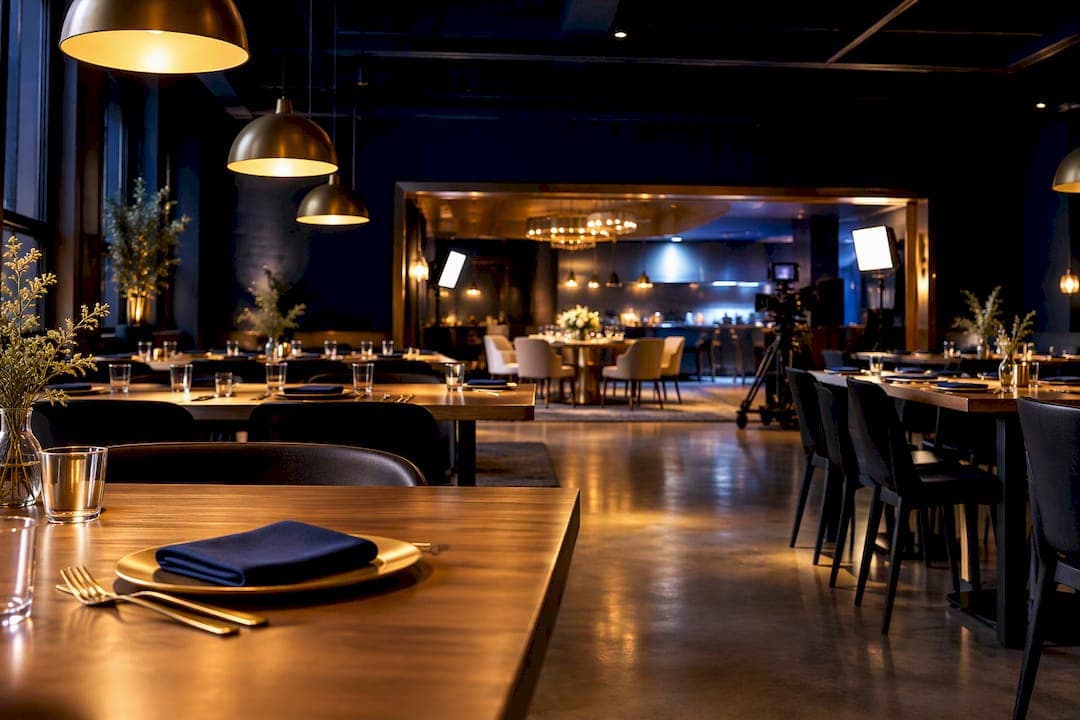
A dining buyout for a production means renting the entire restaurant, including staff and kitchen, for exclusive use during prep, shoot, and strike windows. Expect a food-and-beverage minimum or flat fee, plus explicit clauses on insurance and meal service. Before you sign anything, check the venue's pricing formula, confirm it carries adequate production insurance, and map your shoot schedule against union meal-penalty windows. Ask for a sample banquet event order (BEO) and a term sheet first.
TL;DR:
- Production buyouts are typically priced based on displacement revenue multiplied by about 1.35 times, plus a premium for exclusivity, with the higher of this or F&B minimums setting the floor.
- Contracts should specify separate hourly rates for prep, shoot, and strike, and require production to carry adequate insurance, named as additional insured.
- Meeting union meal rules requires careful timing, with penalties escalating if breaks are delayed beyond six hours, so using walking meals and strict scheduling mitigates payroll costs.
- Confirm delivery of the certificate of insurance before signing and ask about experience with previous buyouts to avoid red flags like vague agreements or lack of insurance documentation.
- Key operational details such as parking, power capacity, kitchen access, and staging should be reviewed on-site during walkthrough to prevent delays and ensure smooth production days.
Table of Contents
- What Is a Dining Buyout for Productions, and When Do You Need One?
- How Buyout Pricing and Food-and-Beverage Minimums Actually Work
- Contracts, Insurance, and the Location Agreement Checklist
- Union Meal Rules and Meal Penalties: What Triggers a Payroll Hit
- Prep, Power, and Parking: Operational Logistics for Production Buyouts
- Choosing the Right Venue: Questions to Ask and Red Flags to Avoid
- Moving Crew and Talent Around a Dining Buyout Without Blowing the Schedule
- How Riga Global Travel Supports Dining Buyouts on Production Days
- Where to Verify These Rules Yourself
- Sources
- FAQ
What Is a Dining Buyout for Productions, and When Do You Need One?
A full buyout locks the entire restaurant for your production alone. No walk-in customers, no shared dining room, no competing kitchen orders. That's different from private dining, where you get a separate room but the rest of the restaurant stays open, and from a standard catered venue booking, where you're renting space but bringing your own food service.
Productions choose full buyouts when they need total control: closed sets with talent, dialogue-heavy scenes that can't tolerate ambient restaurant noise, or corporate events where confidentiality matters. Private dining works fine for smaller crews grabbing a wrap dinner without camera equipment in the room.
Buyouts tend to make sense above 25 to 30 guests, or whenever the shoot requires filming inside the dining room itself. Below that, a semi-private space usually costs less and creates less friction with the venue's regular business.
Most venues offering production buyouts will provide:
- Dedicated staff for the full booked window, not just for service hours
- Kitchen access negotiated separately from dining room access
- A basic floor plan and existing furniture layout (moving fixtures is a separate conversation)
- Limited house AV, though productions typically bring their own lighting and sound
What they won't automatically include: extended prep time before service, storage for production gear, or parking. Those get negotiated, not assumed.
How Buyout Pricing and Food-and-Beverage Minimums Actually Work
Most restaurants don't have a set "production rate" sitting in a binder. They calculate it, and understanding the formula lets you sanity-check any quote you receive.
The starting point is displacement math: what would this space earn during your requested time slot on a normal night? A restaurant doing $8,000 in an average Tuesday dinner service has a rough displacement number to build from. From there, operator pricing guidance recommends a buyout multiplier around 1.35 times that baseline, plus an access premium for the exclusivity itself. That premium accounts for lost walk-in revenue, staff scheduling disruption, and the simple fact that exclusivity has its own market value.
Here's the basic calculation sequence:
- Estimate average revenue for that day part and day of week.
- Apply the buyout multiplier (commonly 1.25 to 1.50 times baseline).
- Add an access or scarcity premium, especially for peak nights or short-notice bookings.
- Compare the result against a straight food-and-beverage minimum, then use whichever number is higher as your floor.
Buyout floor example: A restaurant with $8,000 average dinner revenue, a 1.35x multiplier, and a 15% access premium lands near $12,400 as the buyout floor before extras.
Flat fees work better for shorter, predictable bookings. F&B minimums suit longer or open-ended shoot days where the venue wants upside if your crew eats and drinks well beyond the floor.
Extras that catch planners off guard: service charges (often 20 to 22% on top), gratuity separate from the service charge, AV rental if you need house equipment, staff overtime past the contracted window, and corkage if you bring outside beverages. Deposits typically run 25% for smaller bookings and up to 50% for larger buyouts and wedding-scale events, often nonrefundable past a set cancellation date.

Contracts, Insurance, and the Location Agreement Checklist
A dining buyout contract is really two documents stitched together: a standard venue rental agreement and a location agreement borrowed from film production practice. Both matter, and most disputes trace back to one being sloppy.
Start with the location agreement language. These documents commonly grant producers usage and licensing rights that go far beyond the shoot day itself, including perpetual, worldwide rights to footage shot on premises. Restaurant owners should insist on narrowing that grant to the specific project and a defined time window, not blanket rights to reuse footage in unrelated marketing later.
Before signing, confirm the contract clearly defines:
- Prep, shoot, and strike windows as separate time blocks with separate hourly rates
- Permitted uses of the footage, tied to the named project only
- Indemnity scope, spelling out who's liable for what
- Holdover fees if the crew runs past the contracted strike time
- Security deposit amount and exactly what damage triggers a deduction
On insurance, restaurants should verify the production carries general liability, property damage, and workers' compensation coverage, and should be named as additional insured on the production's policy, not the other way around.
Pro Tip: Ask for the certificate of insurance before the walkthrough, not the week of the shoot. A production that stalls on providing it is telling you something about how the rest of the booking will go.
Union Meal Rules and Meal Penalties: What Triggers a Payroll Hit
Meal penalties are the line item that blows up otherwise well-planned production budgets, and they're entirely avoidable with the right timing.
SAG-AFTRA rules require the first meal break within six hours of call time, with escalating half-hour penalties per performer for every half hour that break is delayed. Miss it by an hour and a half on a large cast, and that's real money leaving the budget for something that a better-timed dinner reservation would have avoided entirely.
Producers manage this exposure with a few standard tools:
- Walking meals, where cast and crew eat while working rather than stopping production entirely
- Non-deductible breaks (NDBs), short pauses that don't count against the six-hour clock
- Grace periods, brief extensions negotiated in advance rather than absorbed as penalties
Producer guidance on meal-penalty avoidance stresses aligning timecards and production reports carefully. If your paperwork says the meal happened at 1:15 p.m. but the call sheet says otherwise, that mismatch becomes a payroll dispute later.
Venues handling this well set up separate crew meal zones apart from any on-camera dining area, offer both plated and boxed options depending on whether the meal is a sit-down break or a walking meal, and timestamp service so your production report has documentation that matches reality.

Prep, Power, and Parking: Operational Logistics for Production Buyouts
The contract gets the headlines, but the walkthrough is where buyouts actually succeed or fail. Lock these details in person, not over email.
- Confirm prep, shoot, and strike windows separately. A venue quoting "6 hours" needs to specify whether that includes the two hours your crew needs to load in lighting and set dressing beforehand.
- Walk the loading zone and parking with the venue manager. Vendor trucks, crew vehicles, and talent cars all need somewhere to go that doesn't block the restaurant's neighbors or violate local permits.
- Ask about power capacity before you bring generators. Older buildings sometimes can't handle production lighting rigs without tripping breakers, and you need to know that days ahead, not during setup.
- Clarify kitchen access rules. Some venues let production caterers use house kitchen space; others require a completely separate prep area for crew meals.
- Confirm cleaning and leftover-food handling. Who's responsible for trash removal and food disposal after strike matters more than it sounds once you're negotiating a damage deposit dispute.
A vendor operating guide for parking and staging during production buyouts is worth reviewing before your walkthrough, since congestion problems at the loading dock tend to cascade into late meal service and overtime.
Choosing the Right Venue: Questions to Ask and Red Flags to Avoid
Vetting a venue for a production buyout comes down to a short list of pointed questions, asked before you get emotionally attached to the space.
Ask directly: Can they provide proof of insurance before the deposit is due? Have they hosted a production buyout before, and can they name one (references matter here)? What's their deposit and cancellation policy in writing? How do they typically handle separate crew meal service versus talent dining?
A venue that hedges on insurance, has no BEO template to show you, or can't describe how they've staffed a similar booking before is telling you they're improvising. Those are the three biggest red flags: no insurance documentation, no prior buyout experience, and vague or verbal-only pricing.
On negotiation, ask for a tiered proposal rather than a single number. A base package covering the room, staff, and standard menu, plus a premium tier adding extended hours or expanded kitchen access, gives you leverage to trim rather than accept an all-or-nothing quote. Push for a payment cadence that ties the final balance to wrap, not to the booking date.
Moving Crew and Talent Around a Dining Buyout Without Blowing the Schedule
Timed shuttles and detailed manifests keep cast and crew arriving in waves instead of all at once, which cuts down on the site congestion that turns a tight meal window into a late one. Coordinated arrival times matter as much as the venue's parking and staging plan itself. Want a coordination call to map your shoot day against transport timing? Reach out before you lock the venue.
— Sammy
How Riga Global Travel Supports Dining Buyouts on Production Days
Getting cast, crew, and vendors to a buyout on schedule is half the battle of avoiding meal penalties in the first place. Riga Global Travel provides ground transportation services for productions in the U.S. entertainment industry, serving major studios and offering direct contact with ownership rather than through an app.

For a dining buyout, that means talent transfers timed to your call sheet, wrap shuttles that clear the venue fast during strike, crew buses that solve the parking problem before it starts, and day-rate chauffeurs for executives sitting in on tastings or vendor walkthroughs. Coordinated arrivals mean fewer people standing around waiting for a table, which means less risk of triggering a six-hour meal penalty clock. Riga Global Travel also handles the broader concierge side: hotel, ticketing, and security arrangements that come up around a production shoot.
Check availability for your shoot dates and get a quote through Riga Global Travel's services page before you finalize your buyout timeline.
Where to Verify These Rules Yourself
Primary sources beat secondhand summaries when a contract or payroll dispute is on the line.
- SAG-AFTRA's meal-period rules for the official escalating penalty structure
- Wrapbook's producer guide to meal penalties for timecard and documentation practices
- Sway's restaurant buyout pricing breakdown for the displacement and multiplier math
- Riga Global Travel's guide to production set transportation for integrating transport with your buyout schedule
- Wild Foodz's business travel meal planning guide for broader vendor coordination workflows
Sources
- Key provisions in film location agreements
- Meal periods — SAG‑AFTRA
- Producer's guide: Meal penalties — Wrapbook
- Sway — Restaurant buyout pricing
- Should your restaurant appear on television? — Primerus
FAQ
What Is the 30/30/30 Rule for Restaurants?
There's no single, widely recognized "30/30/30 rule" tied to production dining buyouts specifically. Definitions of that phrase vary by context and market, so ask any venue quoting it to explain exactly what they mean before assuming it matches industry-standard buyout pricing.
What Does a Buyout Mean for a Restaurant?
A buyout means the restaurant closes to regular customers and reserves the entire space, staff, and kitchen exclusively for one group or production. It's priced using displacement revenue math plus a buyout multiplier, rather than a standard per-cover menu price.
How Much Does a Production Dining Buyout Typically Cost?
Cost depends heavily on the venue's average revenue for that time slot, the day of week, and the length of your prep, shoot, and strike windows. Expect a floor calculated from displacement revenue and a multiplier near 1.35x, plus service fees, gratuity, and any AV or overtime charges layered on top.
How Far in Advance Should I Book a Dining Buyout for a Shoot?
Popular venues in production-heavy markets often need four to eight weeks of lead time, especially for weekend bookings or larger cast counts. Ask about deposit deadlines early, since many venues require a nonrefundable deposit of 25 to 50% to hold the date.
Can Riga Global Travel Help Coordinate Transportation Around a Dining Buyout?
Yes. Riga Global Travel arranges talent transfers, crew buses, and wrap shuttles timed to a production's meal service schedule, which helps avoid the late arrivals that trigger union meal penalties. Current service details and quotes are available on Riga Global Travel's site.