
Budget crew transportation using a simple rule: vehicle type × hours or days × shoot days, plus a contingency line on top. The three levers that move that number most are right-sizing your vehicles to actual headcount, union and Los Angeles Studio Zone rules that change payroll and per diem math, and overtime or surcharges that quietly inflate a clean-looking quote. Wrapbook tracks these drivers closely, and firms in the industry build production quotes around exactly this framework.
TL;DR:
- Vehicle mismatch is the primary cost driver, with over- or under-sized vehicles causing significant budget inefficiencies.
- Union rules, location boundaries, and surcharges must be carefully included in the budget to avoid costly revisions or compliance issues.
- Using automated expense tracking and real-time dispatch software can prevent overpayments and improve schedule adherence.
- Incorporating contingency funds of around 10% for overtime and 5-10% for rebookings helps manage unexpected route changes and last-minute adjustments.
- Building a detailed, itemized vendor contract upfront ensures transparency on costs like tolls, surcharges, and overtimes, reducing financial surprises.
Table of Contents
- Crew Transportation Budget Breakdown: The Line Items You Must Include
- What Really Drives Crew Transport Costs (and What's Normal to Pay)
- Seven Practical Ways to Reduce Crew Transportation Costs
- Vendor Contracting Checklist: What to Require in Writing
- A Sample Crew Transportation Budget Template You Can Fill In Today
- Regulatory Compliance Costs Beyond Union and Studio Zone Rules
- Environmental and Sustainability Line Items in Transportation Budgeting
- Technology for Tracking Crew Transportation Expenses
- Author Perspective: Lessons From Riga Global Travel
- How Riga Global Travel Helps You Control Production Transportation Costs
- Sources
- FAQ
Crew Transportation Budget Breakdown: The Line Items You Must Include
A transportation budget that gets approved without revisions has the same bones every time, regardless of production size. Skip a line item here and it shows up later as a change order nobody planned for.
Here's the core structure production accountants expect to see:
- Talent sedans and SUVs — calculated as vehicles × hours per day × hourly rate × shoot days. A single talent car running 10 hours a day for a 15-day shoot at $75/hour runs a different total than one booked flat-rate per transfer.
- Crew shuttles or vans — usually priced as a day rate per vehicle rather than hourly once you cross into multi-stop runs with more than six people.
- Airport transfers — flat-rate per trip × number of transfers, not hourly. Mixing this into your hourly vehicle math is a common budgeting error.
- Driver lodging and per diems — required whenever a shoot pulls drivers outside their normal service radius overnight.
- Tolls, congestion surcharges, and parking — a named line, not an assumption baked into the base rate.
- Per diems for crew — separate from driver per diems, and often set by union agreements rather than production discretion.
- Fuel surcharges — increasingly common on long-haul or rural location moves.
- Equipment freight transport — grip trucks, camera vehicles, and production trailers, priced separately from personnel transport.
- Dispatch and administrative fees — the coordination layer vendors charge for manifest management and 24/7 availability.
The Studio Zone matters here specifically because it changes which of these lines even apply. Shooting inside the 30-mile Los Angeles Studio Zone typically means standard rates. Cross that boundary and union travel-time pay, meal penalties, and per diem obligations activate, according to Wrapbook's crew travel guide. A location scout 40 miles outside the Zone can add payroll costs that have nothing to do with the vehicle rental itself. For a deeper walkthrough of how these lines interact on a real production, see a detailed breakdown of transportation budget pitfalls.
What Really Drives Crew Transport Costs (and What's Normal to Pay)
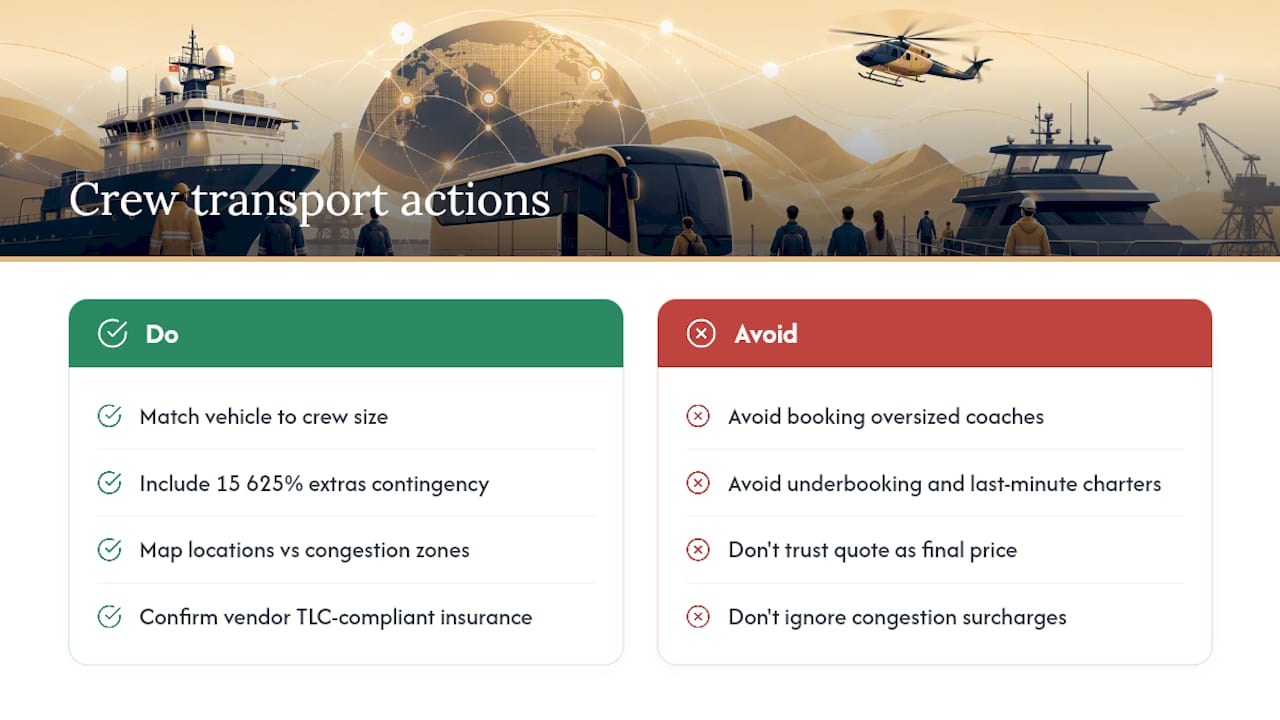
Vehicle mismatch is the single biggest cost driver in crew transportation, ahead of fuel prices, driver wages, or even distance. Book a 30-passenger coach for a 14-person crew and you're paying for empty seats every single day of the shoot. Book too small, and you're chartering a second vehicle mid-production at a rush rate, which almost always costs more than getting it right the first time.
Vendor quotes on the same route can vary by 40% or more depending on vehicle class, minimum hour requirements, and how surcharges get bundled into the base number. Here's what typical daily and hourly rates look like across common production vehicle classes.
Those base numbers rarely reflect what actually lands on the invoice. Extras like overtime, tolls, and gratuity commonly add another 15% to 25% on top of quoted rates, according to charter bus industry pricing analysis. Build that percentage into your estimate before you present a number to a line producer, not after the invoice arrives.
Congestion surcharges add another variable that catches out-of-market productions off guard. New York's Congestion Relief Zone imposes per-trip charges inside its boundary that compound fast when you're running a dozen daily movements through Manhattan. Map your shoot locations against that zone before finalizing vehicle counts, and confirm every vendor carries insurance minimums that meet TLC requirements if you're operating in New York City specifically.
Seven Practical Ways to Reduce Crew Transportation Costs
Cutting transportation spend doesn't mean cutting corners on safety or reliability. It means being deliberate about where the money actually goes.
- Limit travel to essential personnel. Every additional passenger seat is a marginal cost. Hire local crew where the labor market supports it instead of flying and driving people in from out of market.
- Consolidate pickup points. Staggering arrivals by department and running fewer, fuller vehicles beats sending five half-empty sedans to five different addresses.
- Block-book and negotiate flat multi-day rates. Vendors price single-day bookings higher than committed weekly or run-of-show contracts because they're absorbing more scheduling risk on a one-off.
- Choose charter shuttles over rideshare once you cross roughly eight to ten riders. Below that threshold, rideshare can work fine. Above it, a chartered minibus usually beats the combined cost of coordinated rideshare trips, and it eliminates surge pricing risk entirely.
- Check state and local production tax incentive programs. Some incentive structures include transportation and logistics spend as a qualified expense category.
- Automate expense tracking and timecard reconciliation. Manual travel-day tracking hides overpayments that automated systems catch immediately.
- Build in contingency before you need it. A 10% wrap-time contingency on the transport subtotal and a 5–10% rebooking float against air and hotel spend absorb the overtime runs and last-minute route changes that hit almost every production at some point.
Pro Tip: Run the rideshare-versus-charter math before you commit to either, not after week one. The breakeven point moves depending on trip frequency, not just headcount.
Vendor Contracting Checklist: What to Require in Writing
A verbal quote is not a budget. Before signing with any ground transportation vendor, require the following in the contract itself:
- An itemized all-in rate that explicitly lists what's included: tolls, fuel, wait time, and driver meals. A rate that looks 10% cheaper but excludes tolls isn't actually cheaper.
- Defined overtime triggers and driver duty-hour policies, including what happens when a shoot runs long and a driver hits a federally mandated rest requirement.
- 24/7 dispatch access with clear cancellation and modification terms that allow same-day schedule changes without punitive fees.
- A certificate of insurance with stated minimums, plus confirmation of ADA-accessible vehicle availability if your production requires it.
- An escalation protocol naming who to call when something breaks at 5 a.m., and a defined cadence for manifest updates as call sheets shift.
| Checklist item | Why it matters |
|---|---|
| All-in itemized rate | Prevents surprise line items on the final invoice |
| Overtime and duty-hour terms | Avoids driver swaps mid-shoot at rush pricing |
| Same-day cancellation flexibility | Protects against weather and schedule shifts |
| Insurance certificate with minimums | Confirms regulatory compliance before day one |
| Manifest update cadence | Keeps dispatch aligned with the actual call sheet |
A Sample Crew Transportation Budget Template You Can Fill In Today
Here's a worked example for a 15-day mid-size shoot with a 25-person crew, split across two sedans for talent and one minibus for crew shuttle.
- Talent sedans: 2 vehicles × 10 hours/day × $85/hour × 15 days = $25,500
- Crew minibus: 1 vehicle × $700/day × 15 days = $10,500
- Airport transfers: 8 transfers × $150 flat = $1,200
- Tolls and congestion surcharges: estimated $600
- Subtotal: $37,800
Once your movement matrix spans multiple boroughs, states, or more than roughly 40 daily transfers, it's usually time to escalate to a travel management company or a full-service provider rather than managing dispatch in-house.
Regulatory Compliance Costs Beyond Union and Studio Zone Rules
Union agreements and the Studio Zone get most of the attention, but they're not the only regulatory layer that touches your transportation line. Commercial driver's license requirements, state-specific vehicle inspection mandates, and local livery licensing all affect which vendors you can legally hire in a given market.
New York City requires TLC-licensed vehicles and drivers for most for-hire ground transport, and TLC insurance minimums are non-negotiable procurement checkpoints, not suggestions. A vendor who can't produce current documentation isn't a budget line, it's a liability risk that could shut down a shoot day entirely.
Cross-state moves introduce another layer: interstate charter operations fall under federal motor carrier safety rules, which affect driver duty-hour limits and, indirectly, how many drivers you need on a multi-day road move. A production running a coach from New York into Connecticut needs to confirm the vendor's interstate authority, not just their local city permit.
None of this typically adds a massive line item to the budget on its own. What it does is eliminate the cheapest quotes you'll receive, because unlicensed or improperly insured operators often underbid legitimate vendors by a wide margin. Building a compliance verification step into vendor selection, before comparing rates, keeps your budget from looking artificially low based on a bid you can't legally accept.
Environmental and Sustainability Line Items in Transportation Budgeting
Sustainability considerations are showing up more often in production transportation budgets, partly from studio-level environmental commitments and partly from client-side sustainability requirements on commercial and branded content work.
Fuel-efficient or hybrid vehicle fleets sometimes carry a modest rate premium over standard sedans and vans, but that premium can be offset by lower per-mile fuel costs on longer location moves. If a production is running significant daily mileage between hotel and set, the fuel-efficiency math starts to matter more than it does on a single-location soundstage shoot.
Carbon offset programs are another line some productions now include explicitly, particularly on projects tied to a studio's environmental reporting requirements. This isn't universal across the industry yet, and it's not a cost every production needs to carry. But if your production is working under a sustainability mandate from a network or studio partner, budget for it as its own line rather than trying to absorb it into general transportation costs.
Route consolidation, which already saves money through fewer vehicles and fuller loads, also happens to be the most direct sustainability lever available to a transportation coordinator. Fewer half-empty vans on the road is both a budget win and an emissions reduction, which makes it one of the rare line items where the financial and environmental incentives point the same direction.
Technology for Tracking Crew Transportation Expenses
Manual expense tracking is where transportation budgets quietly bleed money, usually through travel days that get misclassified on timecards or invoices that don't get reconciled against the original quote until weeks after the fact.
Digital payroll platforms that integrate travel-day visibility directly into timecard systems catch these discrepancies in near real time rather than at wrap, when it's too late to correct course. Wrapbook's guidance on crew travel points to automation as a direct lever for avoiding travel-day overpayments, since manual tracking makes it easy for a travel day to get logged as a work day or vice versa.
Beyond payroll, dispatch software that gives a production's travel coordinator live access to the call sheet means rebooking happens before a driver shows up to an empty location, not after. That real-time manifest access is what separates a reactive transportation operation from one that catches problems early. A centralized movement matrix that syncs with the actual shooting schedule, rather than a static spreadsheet built at prep, is the difference between a coordinator who's ahead of the day and one who's constantly playing catch-up.
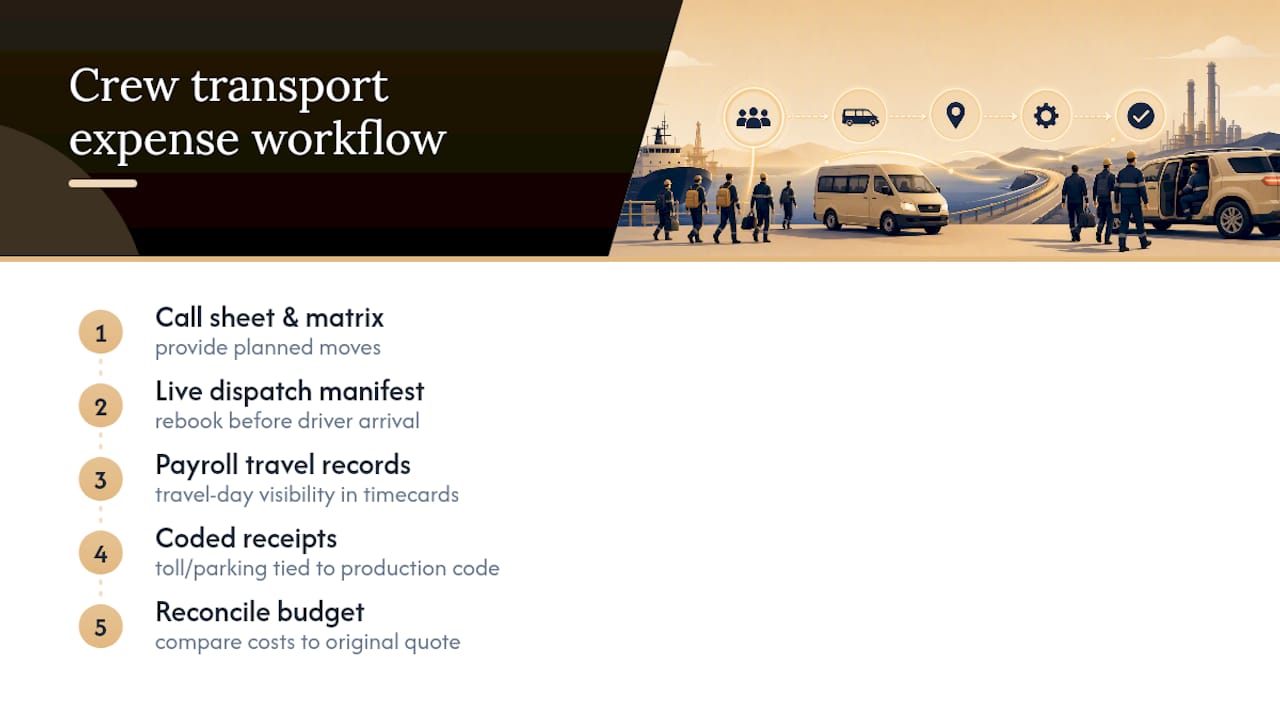
Expense-tracking apps that let department heads submit toll and parking receipts against a specific production code also cut down on the end-of-show reconciliation nightmare that eats a coordinator's time during wrap week, when everyone's already moved on to the next job.
Author Perspective: Lessons From Riga Global Travel
The mistakes that blow up a crew transportation budget are rarely dramatic. They're an oversized coach nobody downsized after the crew list shrank, a surcharge line nobody added until the invoice arrived, and a rebooking made in a panic at double the rate it would have cost a day earlier. A centralized manifest with daily budget tracking catches all three before they compound, because someone sees the mismatch while there's still time to fix it cheaply.
How Riga Global Travel Helps You Control Production Transportation Costs
Chasing down separate quotes for talent sedans, crew shuttles, and airport transfers eats hours you don't have during prep. Riga Global Travel builds production manifests and all-in quotes upfront, with tolls, wait time, and surcharges itemized before you ever sign, and 24/7 dispatch that handles same-day schedule changes without a scramble.

That single-vendor structure means one manifest, one point of contact, and one invoice instead of reconciling five separate vendor bills at wrap. If your next production is running through Los Angeles, request a production transportation quote through Riga Global Travel's Los Angeles limousine service and get an itemized rate before you finalize your budget spreadsheet.
Sources
- 8 Ways to Save on Crew Travel Costs | Wrapbook
- Charter Bus for Film Crew NYC: 5 Honest Facts for 2026
- MTA Congestion Relief Zone information
FAQ
How much should I budget per crew member for transportation?
There's no fixed per-head number since it depends on vehicle type and distance, but calculating by vehicle (sedans, shuttles, coaches) rather than by individual headcount gives a far more accurate estimate.
What triggers union travel pay on a production?
Shooting outside the Los Angeles Studio Zone commonly activates union travel-time pay and per diem obligations that don't apply to in-zone shoots, according to Wrapbook.
When does a charter shuttle beat rideshare for cost?
Charter shuttles typically become more cost-effective than coordinated rideshare once a group reaches roughly 8 to 10 riders, based on charter bus cost comparisons.
Does Riga Global Travel provide all-in production quotes?
Yes, Riga Global Travel builds itemized all-in quotes covering tolls, wait time, and surcharges alongside production manifests and 24/7 dispatch support.