
A limo dispatcher in entertainment is the professional responsible for coordinating chauffeurs, managing vehicle logistics, and delivering flawless transportation experiences for high-profile clients and live events. This role sits at the center of every successful celebrity pickup, award show transfer, and multi-vehicle film production run. If you work in entertainment and rely on ground transportation, the dispatcher is the person who makes or breaks your schedule. Understanding this role helps you communicate better with your transportation provider and set realistic expectations from the start.
What is a limo dispatcher in entertainment?
A limo dispatcher is defined as the centralized operational hub coordinating clients, chauffeurs, and departments like VIP hospitality across every active booking. The title "limo dispatcher" is the common industry shorthand. The recognized professional term is chauffeur dispatch coordinator or ground transportation dispatcher, and both labels describe the same function: real-time management of luxury vehicle logistics on behalf of clients.
In the entertainment sector, this role carries more weight than in standard corporate transport. A dispatcher working for a company like Rigaglobaltravel handles talent pickups, press junket transfers, red carpet arrivals, and after-show runs, often simultaneously. The stakes are high because a missed pickup or a late arrival is not just an inconvenience. It can delay a production, miss a broadcast window, or create a public relations problem.
The dispatcher manages 50+ inquiries per shift, covering everything from confirming reservation details to rerouting a driver around a sudden road closure. That volume requires sharp focus and the ability to triage competing priorities without losing composure.
What are the primary responsibilities of a limo dispatcher?
The limo dispatcher job description in entertainment covers a wider range of duties than most people expect. The role is not limited to answering phones and assigning cars. It involves active, real-time management of multiple moving parts across the full lifecycle of every booking.
Core responsibilities include:
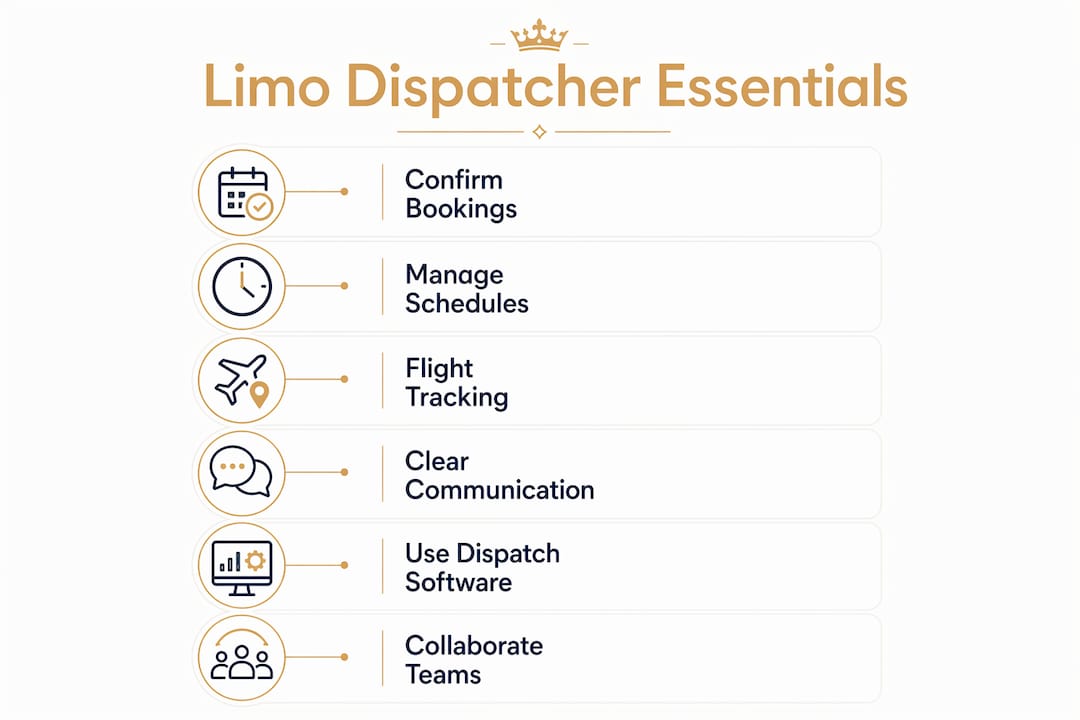
- Reservation management: Confirming bookings, verifying client details, and assigning the correct vehicle class and chauffeur for each job
- Chauffeur coordination: Briefing drivers on pickup locations, client preferences, dress code, and any special instructions from event teams or talent management
- Flight and traffic monitoring: Tracking inbound flights in real time and adjusting pickup times based on delays, early arrivals, or gate changes
- Client communication: Sending confirmations, sharing driver details, and providing live ETAs to clients or their representatives
- Problem resolution: Handling last-minute vehicle breakdowns, driver no-shows, or sudden schedule changes without disrupting the client experience
A typical dispatcher shift includes confirming reservations, managing return trips, answering guest questions, and adjusting schedules based on flight and traffic updates. That description sounds straightforward until you picture doing all of it at once during a major awards night with 30 vehicles in motion.
Pro Tip: Always confirm the dispatcher has direct access to flight tracking tools like FlightAware or OAG before booking entertainment transport. A dispatcher working blind on flight data is a liability, not an asset.

Clear, written communication is also part of the job. Detailed pricing and written quotes prevent misunderstandings between clients and the service provider. The dispatcher often owns this process, making sure every client receives an itemized confirmation before the vehicle rolls. You can read more about how these agreements work in the context of talent transportation contracts.
How technology shapes modern limo dispatching
The shift from manual dispatching to digital platforms is the single biggest change in the limo service management space over the past decade. Traditional dispatching relied on phone calls, paper logs, and radio contact with drivers. A missed call or a miscommunication could derail an entire event schedule.
Modern dispatch software platforms replace that fragile system with centralized dashboards offering automated pricing, scheduling, and live journey updates. The dispatcher sees every vehicle on a map, monitors driver status in real time, and can push schedule changes to a chauffeur's device in seconds.
| Feature | Traditional dispatching | Modern dispatch software |
|---|---|---|
| Booking confirmation | Manual phone call | Automated notification to client and driver |
| Driver tracking | Radio check-in | Live GPS dashboard |
| Schedule changes | Phone relay chain | Instant push update to driver app |
| Client communication | Dispatcher calls client | Automated ETA sharing |
| Pricing transparency | Verbal quote | Automated itemized confirmation |
The practical benefit for entertainment clients is reduced anxiety. When a talent manager knows exactly where their artist's car is and receives an automatic ETA update, they stop calling the dispatcher every five minutes. That frees the dispatcher to focus on the next problem before it becomes a crisis.
Real-time control panels monitoring flights, traffic, and driver locations allow proactive intervention before clients notice a problem. That is the defining advantage of modern dispatch technology over legacy phone-based systems.
Pro Tip: When evaluating a luxury transport provider, ask whether their dispatch platform supports white-label client portals. White-label dispatch software signals a professional operation built for high-volume, high-expectation clients.
The broader future of luxury transportation points toward even deeper integration between dispatch platforms, AI-assisted routing, and client-facing mobile apps. Dispatchers who understand these tools will hold a significant advantage as the industry evolves.
What skills and experience are required to become a limo dispatcher?
Understanding how to become a limo dispatcher in entertainment starts with recognizing that the role demands a specific combination of people skills, technical ability, and composure under pressure. The technical side can be taught. The composure cannot.
Premium dispatch roles prioritize candidates with at least 12 months of prior experience in hospitality, call center operations, or transportation dispatching. That baseline matters because the job requires handling difficult conversations calmly, managing competing demands simultaneously, and making fast decisions with incomplete information.
Key skills and qualifications include:
- Local geographic knowledge: A dispatcher who does not know the difference between the Staples Center loading dock and the main entrance is a problem waiting to happen. Venue-specific knowledge is non-negotiable in entertainment markets like Los Angeles, New York, and Las Vegas.
- Communication clarity: Dispatchers relay instructions to chauffeurs and reassurances to clients at the same time. Ambiguous communication creates errors. Direct, concise language prevents them.
- Technical proficiency: Familiarity with dispatch software platforms, flight tracking tools, and GPS systems is now a baseline expectation, not a bonus skill.
- Multitasking under pressure: The most complex dispatching moments occur during dynamic schedule adjustments, such as unexpected guest requests or event timing changes, requiring expert multitasking and swift decision-making.
- Discretion: Entertainment clients expect confidentiality. A dispatcher who discusses client movements or talent schedules outside the team is a liability.
Limo dispatcher training typically combines software onboarding with scenario-based practice. The best training programs simulate high-pressure event nights, forcing new dispatchers to manage multiple simultaneous crises before they face them live.
How does a limo dispatcher support entertainment events and VIP clients?
Entertainment event transportation is categorically different from corporate airport runs. The scale, the stakes, and the unpredictability all operate at a higher level. A dispatcher supporting a film premiere or a major music tour is managing a logistics operation, not just booking cars.
Here is how a dispatcher handles a complex entertainment event from start to finish:
- Pre-event planning: The dispatcher reviews the full event schedule, maps all pickup and drop-off locations, assigns vehicles and chauffeurs, and confirms every detail in writing with the event coordinator or talent manager.
- Day-of briefing: Each chauffeur receives a detailed brief covering client identity, preferred communication style, dress code, route, and any special instructions from security or production teams.
- Live monitoring: The dispatcher watches flight arrivals, monitors traffic on key routes, and tracks every vehicle on the dispatch dashboard throughout the event window.
- Real-time adjustment: When a flight lands 40 minutes late or a venue changes the talent entrance at the last minute, the dispatcher reroutes drivers, updates clients, and absorbs the disruption without passing the chaos to the passenger.
- Post-event coordination: Return trips, after-party transfers, and hotel drop-offs are confirmed and executed with the same precision as the initial pickups.
Dispatchers function as event stabilizers who must stay calm managing shifting schedules caused by weather, flight delays, or venue changes. Hiring in this space prioritizes calm problem-solving over technical knowledge alone, because a technically skilled dispatcher who panics under pressure is less useful than a composed one who knows how to improvise.
Collaboration is also central to the role. Dispatchers work alongside event planners, hospitality teams, and security coordinators to align transportation with the broader event timeline. For high-profile red carpet events, that coordination extends to planning black car logistics weeks in advance.
Key takeaways
A limo dispatcher in entertainment is the operational backbone of luxury transportation logistics, and their effectiveness directly determines whether high-profile clients arrive on time, safely, and without incident.
| Point | Details |
|---|---|
| Central coordination role | Dispatchers manage all communication between clients, chauffeurs, and event teams in real time. |
| Technology is non-negotiable | Modern dispatch software replaces manual systems with live tracking, automated confirmations, and instant schedule updates. |
| Experience requirements | Premium roles require at least 12 months in hospitality, call center, or dispatching, plus local geographic knowledge. |
| Event stabilizer function | Dispatchers absorb schedule disruptions from flight delays and venue changes before clients feel the impact. |
| Discretion and professionalism | Entertainment clients demand confidentiality and composure, making soft skills as critical as technical ability. |
What I have learned from watching dispatchers work under pressure
Most people in entertainment think of the dispatcher as a background function. Book the car, confirm the time, done. That view misses the reality entirely.
The dispatchers I have seen perform at the highest level share one trait: they treat every booking as if it will go sideways, because eventually it will. They have already mapped the alternate route before the driver needs it. They have already called the client's assistant before the assistant calls them. Proactive dispatcher actions like contacting drivers or guests before problems arise are what separate a good shift from a disaster.
The technology shift has changed the job description, but it has not changed the core requirement. Software gives a dispatcher better tools. It does not give them better judgment. The dispatchers who thrive are the ones who use real-time dashboards to stay three steps ahead, not just to react faster.
If you are considering this career path, my honest advice is to spend time in a hospitality or event coordination role first. The client management instincts you build there transfer directly to dispatching. And if you are on the entertainment side evaluating a transport provider, ask to speak with the dispatcher directly. How they answer your questions tells you everything about how they will perform on event night.
— Sammy
How Rigaglobaltravel handles entertainment transportation logistics
Rigaglobaltravel specializes in limousine and concierge services built specifically for the entertainment industry. The dispatch team at Rigaglobaltravel manages multi-vehicle event runs, VIP airport transfers, and red carpet arrivals with the same operational discipline described throughout this article. Every booking is backed by real-time fleet monitoring, written confirmations, and direct dispatcher access for clients and their representatives.
If you are coordinating transportation for a production, a talent roster, or a high-profile event, explore Rigaglobaltravel's services to see how professional dispatch coordination translates into flawless on-the-ground execution. The team is available to build a custom transportation plan around your event timeline and client requirements.
FAQ
What does a limo dispatcher do in entertainment?
A limo dispatcher coordinates chauffeurs, manages reservations, monitors flight arrivals, and handles real-time schedule changes to deliver reliable transportation for entertainment clients and events. The role covers all communication between passengers, drivers, and event teams.
What qualifications do you need to become a limo dispatcher?
Most premium dispatch roles require at least 12 months of experience in hospitality, call center operations, or transportation, combined with local geographic knowledge and proficiency with dispatch software platforms.
How is entertainment dispatching different from standard limo dispatching?
Entertainment dispatching involves higher client profiles, larger vehicle fleets, tighter schedules, and greater demand for discretion. Dispatchers must coordinate with talent managers, security teams, and event planners simultaneously, often managing dozens of active bookings during a single event window.
What technology do limo dispatchers use?
Modern dispatchers use centralized dispatch software platforms with live GPS dashboards, automated client notifications, flight tracking integrations, and real-time driver communication tools. These platforms replace manual phone-based systems and significantly reduce the risk of service failures.
Why does dispatcher quality matter for entertainment clients?
A skilled dispatcher prevents service failures before clients notice them by monitoring flights, traffic, and driver locations proactively. In entertainment, where a delayed pickup can affect a broadcast or a public appearance, dispatcher quality directly affects event outcomes.