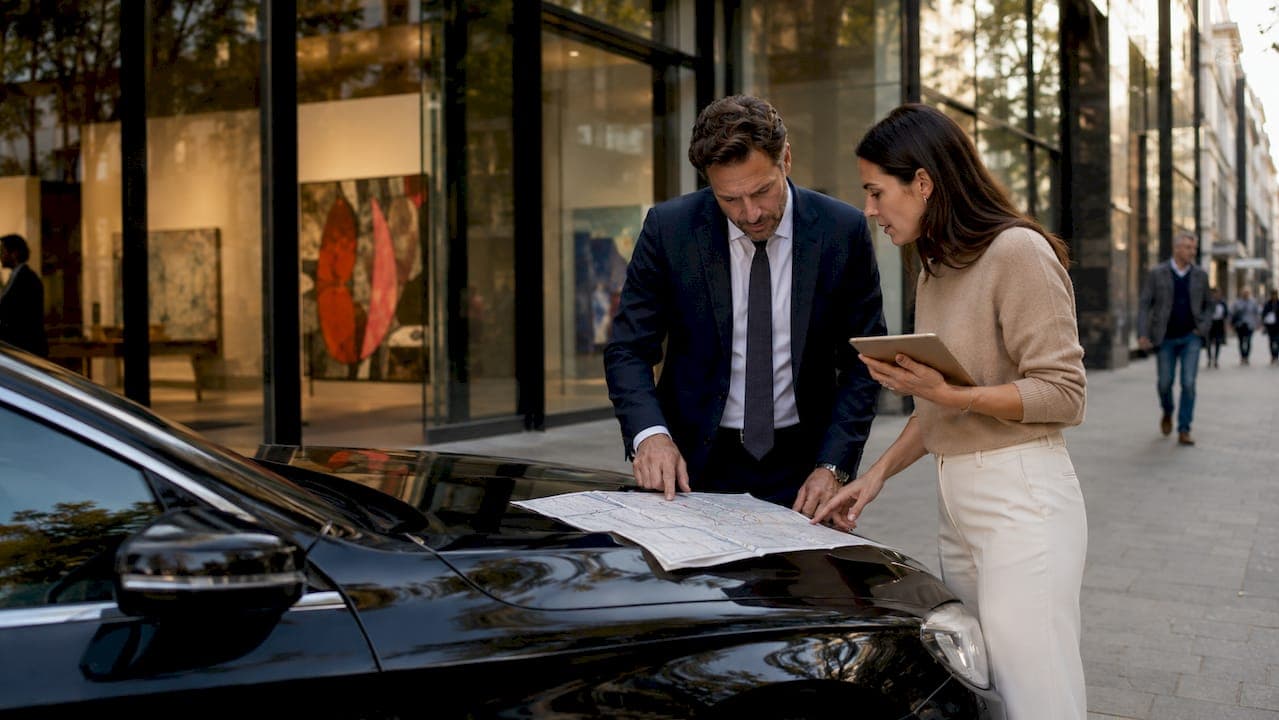
A media tour car service is a specialized chauffeured transportation solution built around the demanding logistics of media tours, where spokespeople move between multiple interview locations on tight, unforgiving schedules. Unlike standard car services, this category of media transportation service is designed from the ground up to protect interview windows, preserve spokesperson privacy, and coordinate multi-stop routes without a single missed beat. PR teams managing promotional campaigns rely on these services because a delayed arrival at a broadcast studio is not a minor inconvenience. It is a canceled segment, a missed journalist, and a damaged brand moment. Rigaglobaltravel serves entertainment industry clients who understand this reality firsthand.
What is a media tour car service and how does it work?
A media tour car service is defined as a professional chauffeured transport solution configured specifically for the scheduling, privacy, and multi-stop coordination demands of media tours. The industry term used by transportation and PR professionals is "chauffeured media transportation," though "media tour car service" captures the function accurately for planners searching for this type of support.
Media tours are tightly scheduled series of interviews or meetings with journalists and broadcasters, compressed into a short period and conducted in person, virtually, or in hybrid formats. That compression is the core challenge. A spokesperson may complete six to ten interviews in a single day, each at a different location or studio, with transition windows as short as fifteen minutes between segments.
The car service exists to protect those windows. Professional drivers map routes in advance, account for traffic patterns, and build buffer time into each leg of the schedule. Named providers like Village Coach operate luxury tour buses with experienced professional drivers who understand media event contexts and treat discretion as a core job requirement, not an afterthought.
How media tour logistics create unique transportation demands
The operational complexity of a media tour is unlike a corporate airport transfer or a red carpet pickup. Consider a national product launch where a brand spokesperson completes back-to-back interviews with morning television producers, afternoon radio hosts, and evening digital media outlets across a single city. Each stop has a different address, a different contact, and a different arrival protocol.
Satellite Media Tours add another layer. Spokespeople complete multiple back-to-back interviews from one studio location, but getting to and from that studio on time, with privacy intact, still requires coordinated car service logistics. Virtual and hybrid tour formats reduce physical travel but do not eliminate it. Broadcast studios, production facilities, and event sites still require secure, on-time transportation even when portions of the tour run remotely.
Here is what distinguishes a media event car service from general transportation:
- Pre-tour route planning that accounts for every stop, load-in time, and studio access requirement
- Real-time schedule monitoring so drivers adjust routes when interviews run long or short
- Privacy protocols that prevent unauthorized access to the vehicle and protect spokesperson conversations
- Coordination with PR team contacts at each stop so arrivals are expected and smooth
- Contingency planning for last-minute venue changes, which happen on nearly every major tour
Pro Tip: Brief your car service provider with the full itinerary at least 48 hours before the tour begins. Drivers who have studied the route in advance handle schedule changes far more effectively than those receiving updates in real time.
Vehicle options: comparing media tour car service types
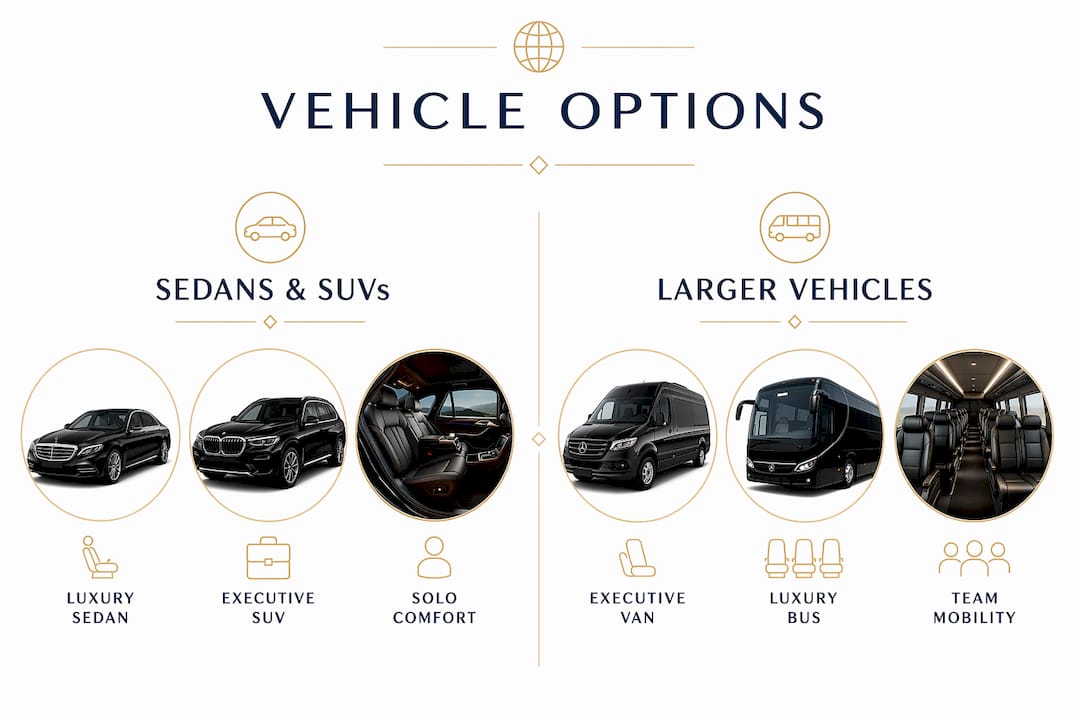
Choosing the right vehicle is as strategic as choosing the right driver. The vehicle type affects team comfort, spokesperson preparation time, and the overall professionalism of the tour's execution.
| Vehicle Type | Best For | Key Features | Ideal Tour Scale |
|---|---|---|---|
| Luxury sedan | Solo spokesperson, single-city tour | Privacy, speed, discreet arrival | Small, 1-3 stops |
| Executive SUV | Spokesperson plus PR manager or stylist | Extra space, privacy partition option | Medium, 3-6 stops |
| Executive van | Small media team, equipment transport | Cargo space, seating for 6-8 | Regional, multi-stop |
| Luxury tour bus | Full media crew, multi-city or national tour | Wi-Fi, workstations, storage, amenities | Large-scale, national |
Luxury tour buses come equipped with Wi-Fi, workstations, performance amenities, and ample storage for promotional materials. That matters because a spokesperson traveling between cities needs to review talking points, take calls, and rest before the next segment. A standard van does not provide that environment.
Key factors to evaluate when selecting a vehicle:
- Team size: A solo spokesperson does not need a tour bus. A cast of four plus a PR director and publicist does.
- Route complexity: Multi-city tours with overnight legs require vehicles built for extended travel.
- Equipment needs: Product samples, display materials, and media kits require cargo capacity.
- Brand image: The vehicle arriving at a studio reflects on the client. A luxury sedan signals professionalism; an unmarked minivan does not.
Pro Tip: For national tours, consider a luxury bus as a mobile base of operations. Teams that work, rest, and prepare in one consistent environment perform better across a five-day, multi-city schedule than those switching between hotels and rental cars.
Benefits of media tour car services for PR event success
The business case for a dedicated car service for press events is straightforward: a single missed interview on a national media tour can cost more in lost coverage than the entire transportation budget. Selecting the right media tour car service reduces stress, improves schedule adherence, and enhances overall media tour professionalism and brand image.
The benefits extend well beyond punctuality:
- Spokesperson focus: When a driver handles all logistics, the spokesperson uses transit time to prepare, not to navigate or manage ride apps.
- Privacy and security: Professional drivers respect confidentiality. Pre-tour briefings, product details, and media strategy discussed in the vehicle stay in the vehicle.
- Scalability: The same provider can handle a single-city launch and a 12-city national tour, adjusting vehicle types and driver teams as the scope grows.
- Reduced PR team burden: A coordinated media tour logistics partner removes transportation management from the PR team's plate entirely.
- Brand consistency: Every arrival is clean, on time, and professional, which reinforces the campaign's credibility with media contacts.
"Transportation providers protect the media tour window through precise logistics and discretion. The interview schedule is the product. The car service is what keeps it intact."
For regional and national tours, cost efficiency is also real. Delays caused by mismanaged transportation compound across a full tour schedule. One missed segment triggers rescheduling costs, publicist overtime, and potential loss of a media placement that took weeks to secure. A professional studio executive car service approach, applied to media tours, eliminates that risk category entirely.
How to plan and coordinate a media tour car service
Effective planning separates tours that run smoothly from those that spend two days recovering from a first-day logistics failure. Follow this sequence when integrating a car service into your media tour plan:
- Select a provider with media tour experience. General car services handle airport transfers. Media tour providers understand broadcast studio protocols, talent management, and the cost of a late arrival. Ask specifically about their experience with press events and promotional campaigns.
- Share the full itinerary in advance. Include every stop, contact name, load-in time, and address. Drivers who have studied the route perform better under pressure.
- Establish a single point of contact. One PR team member communicates directly with the driver or dispatch. Multiple people sending conflicting updates create confusion at the worst possible moments.
- Build buffer time into every leg. Schedule arrivals fifteen minutes before each interview window. Media schedules slip. Buffer time absorbs that slip without cascading into the next segment.
- Plan for virtual and hybrid adjustments. Virtual media tours still require transportation to broadcast studios or event sites. Confirm which segments require physical presence and plan vehicle logistics accordingly.
Pro Tip: Treat your driver as a member of the media tour team, not a vendor. Drivers who receive a full briefing, understand the tour's stakes, and know the spokesperson's schedule become proactive partners rather than reactive service providers. That distinction shows up in performance.
Route planning technology has improved significantly. Providers using real-time traffic data and GPS-integrated dispatch can reroute mid-tour without disrupting the spokesperson's preparation time. When evaluating providers, ask whether their drivers use dynamic routing tools or rely on static pre-planned routes. For complex multi-city tours, the difference is measurable. You can also review how to plan black car service for high-profile events to understand the planning framework that applies equally well to media tours.
Key takeaways
A media tour car service is the operational infrastructure that keeps a spokesperson's interview schedule intact, and choosing the wrong provider is one of the most preventable failures in PR event planning.
| Point | Details |
|---|---|
| Core definition | A media tour car service is chauffeured transport built for multi-stop, time-sensitive interview schedules. |
| Vehicle selection matters | Match vehicle type to team size, route complexity, and tour scale for best results. |
| Driver role is strategic | Professional drivers protect privacy, manage timing, and function as active tour team members. |
| Plan 48 hours ahead | Share the full itinerary with your provider at least two days before the tour begins. |
| Virtual tours still need cars | Hybrid and virtual formats still require secure, on-time transport to studios and broadcast sites. |
What I've learned watching PR teams get transportation wrong
I have watched PR teams spend months securing a national media tour, locking in morning show segments, podcast studios, and trade press interviews, only to lose two segments on day one because their car service treated the job like an airport pickup. The driver did not know the studio load-in protocol. The vehicle was not large enough for the spokesperson, the publicist, and the product samples. The buffer time was not built in. By 11 a.m., the tour was already running forty minutes behind.
The mistake is not choosing the wrong vehicle. The mistake is treating transportation as a commodity purchase rather than a strategic one. A media tour car service is not interchangeable with a ride-share or a general black car booking. The provider needs to understand what is at stake when a spokesperson misses a segment. That understanding changes how they plan, how they communicate, and how they perform under pressure.
My honest advice: vet your provider the same way you vet a media relations firm. Ask for references from past media tours. Ask how they handle last-minute itinerary changes. Ask whether their drivers have worked with entertainment or PR clients before. The answers will tell you immediately whether you are talking to a logistics partner or a car service that happens to have nice vehicles.
The teams that get this right treat the car service as an extension of the PR operation. The teams that get it wrong find out on day one of the tour, when there is no time to fix it.
— Sammy
How Rigaglobaltravel supports your next media tour
Rigaglobaltravel specializes in chauffeured transportation for the entertainment industry, with direct experience supporting media tours, press events, and promotional campaigns where timing and discretion are non-negotiable. Every vehicle in the fleet is matched to the specific demands of the tour, whether that means a luxury sedan for a solo spokesperson or an executive van for a full PR team with equipment. Drivers are briefed on media tour protocols, understand studio access requirements, and treat confidentiality as a professional standard. For PR teams planning their next campaign, explore premium media tour transport through Rigaglobaltravel and build your logistics on a foundation that does not leave coverage on the table.
FAQ
What is a media tour car service?
A media tour car service is a chauffeured transportation solution designed for the multi-stop, time-sensitive logistics of media tours. It provides professional drivers, route planning, and privacy protocols to keep spokespeople on schedule across multiple interview locations.
How is a media event car service different from a regular car service?
A media event car service is configured for broadcast studio protocols, tight interview windows, and spokesperson privacy, while a standard car service handles general point-to-point transfers. The key difference is operational preparation and driver expertise in media tour contexts.
What vehicle types work best for media tour logistics?
Luxury sedans and executive SUVs work best for solo spokespeople on single-city tours, while executive vans and luxury tour buses suit larger teams on regional or national multi-stop schedules.
Do virtual media tours still require a car service?
Yes. Virtual and hybrid media tours still require transportation to broadcast studios, production facilities, and event sites. Secure, on-time car service remains a logistical requirement even when portions of the tour run remotely.
How do I book a media car service for a press event?
Select a provider with documented media tour experience, share the full itinerary at least 48 hours in advance, and establish a single PR team contact for all driver communications. Confirm that the provider uses real-time routing tools and has experience with studio access protocols.