
A chauffeur is defined as a professional driver of luxury vehicles whose role extends well beyond basic transportation into managed, service-oriented travel. The role of personal driver vs chauffeur is a distinction that matters far more than most people realize when booking transportation. Both get you from point A to point B, but the service scope, vehicle standards, and professional expectations are fundamentally different. Whether you are arranging airport pickups for a film executive, booking event transport, or simply evaluating your daily travel options, understanding these differences saves you from costly mismatches between what you expect and what you actually receive.
What are the duties of a personal driver?
A personal driver's core responsibility is safe transportation combined with practical trip logistics and basic vehicle maintenance. The role is defined by reliability and consistency rather than elevated service. Personal drivers typically work for companies transporting employees, or for private individuals who need regular, dependable transport without the full-service package a chauffeur delivers.
Personal driver duties generally include:
- Safe, on-time transportation from one location to another, following traffic laws and adjusting routes for delays
- Route and timing management, including monitoring traffic conditions and planning departure times to meet schedules
- Basic vehicle upkeep, such as keeping the car clean, checking tire pressure, and flagging mechanical issues for service
- Scheduling coordination, particularly for company drivers who manage multiple passengers or recurring routes
- Compliance with licensing requirements, including holding a valid driver's license and, in many jurisdictions, a commercial or for-hire vehicle license
The employment context matters here. A company driver working for a corporation operates under different expectations than a private household driver. In some countries, the legal classification changes entirely. In the Philippines, for example, household drivers fall under domestic worker laws rather than standard employment regulations, which affects their contracts, benefits, and legal protections.
Pro Tip: When hiring a personal driver, always confirm whether the role is classified as household employment or standard employment in your jurisdiction. The classification determines tax obligations, benefits, and termination rights for both parties.
How do chauffeur responsibilities extend beyond basic driving?
A chauffeur's job begins long before the passenger steps into the vehicle. The full scope of chauffeur duties includes pre-trip route assessment, alternate routing, flight tracking, passenger assistance, and maintaining a vehicle to luxury standards. This is not a list of nice extras. These are baseline expectations for any professional operating at the chauffeur level.
Here is what a professional chauffeur handles on a typical day:
- Pre-trip route planning: Reviewing primary and alternate routes, checking weather conditions, and identifying potential delays before departure
- Flight tracking: Monitoring real-time flight data to adjust pickup times for airport transfers, a capability that basic drivers rarely provide
- Passenger assistance: Opening doors, handling luggage, assisting passengers in and out of the vehicle safely
- Professional presentation: Wearing formal attire, maintaining calm and discreet communication, and never discussing passenger business with third parties
- Vehicle preparation: Polishing the exterior, cleaning the interior, checking fluid levels, and confirming the vehicle meets luxury presentation standards before every trip
- Record keeping: Logging trip times, mileage, and expenses, which supports billing accuracy and compliance with for-hire vehicle regulations
Chauffeur services are also sold as dedicated, schedule-managed solutions with drivers on standby for evolving itineraries rather than simple point-to-point drop-offs. This "as-directed" model means a chauffeur stays with the client through a full day of meetings, events, or travel changes without requiring a new booking for each leg.
Pro Tip: Ask any chauffeur service whether flight tracking is included in airport pickups. Services that monitor arrivals in real time and adjust without extra charges are operating at a genuinely professional level. Those that do not are closer to a glorified taxi service.
For entertainment industry clients, the studio executive car service model illustrates exactly how chauffeur responsibilities scale up. Drivers in that context manage talent schedules, set call times, and coordinate with production assistants, all while maintaining the discretion that high-profile clients require.
What is the real difference in service experience?
The deciding factor between a personal driver and a chauffeur is whether the provider includes service extras beyond driving. Titles alone tell you very little. A company marketing a "personal driver" service might deliver chauffeur-level quality, while a business using the word "chauffeur" might offer nothing more than a clean car and a polite greeting.
| Category | Personal driver | Chauffeur |
|---|---|---|
| Vehicle type | Personal car, company sedan | Luxury sedan, SUV, limousine |
| Service model | Defined trips, point-to-point | Dedicated, schedule-managed, as-directed |
| Passenger assistance | Typically none | Door opening, luggage handling, boarding support |
| Attire and presentation | Casual to business casual | Formal, uniform standard |
| Flight and schedule tracking | Rarely included | Standard practice |
| Discretion and confidentiality | Variable | Professional expectation |
| Record keeping | Basic or none | Trip logs, expense tracking |
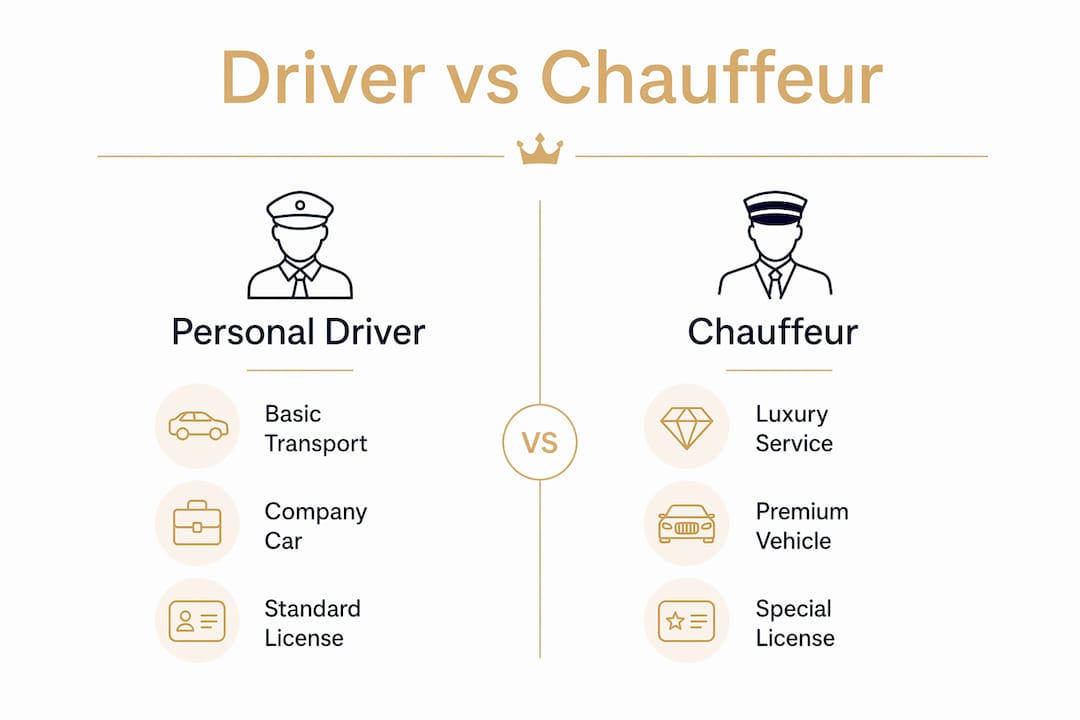
The practical implication is significant. A personal driver gets you to your destination. A chauffeur delivers a managed travel experience where the passenger's time, comfort, and privacy are actively protected throughout the journey. For executives, talent, or anyone conducting business during transit, that difference translates directly into productivity and peace of mind.
Safe and polite driving is the baseline for all professional drivers. Chauffeurs build on that baseline with preparation, discretion, and personalized attention that turns a car ride into a controlled, professional environment. For clients in the entertainment industry, where schedules shift hourly and confidentiality is non-negotiable, that elevation is not optional. It is the minimum acceptable standard.
How do legal and licensing requirements differ?
Regulatory compliance sets the legal floor for both roles, but it does not define service quality. For-hire vehicle drivers must hold correct licenses, maintain trip logs, and behave courteously as minimum standards. Meeting those requirements makes a driver legal. It does not make them a chauffeur.
Key licensing and legal distinctions include:
- Standard driver's license: Required for all personal drivers; sufficient for household or private employment in most U.S. states
- Chauffeur's license or commercial license: Required in many jurisdictions for for-hire vehicle operators, including limousine and luxury car services
- Trip logging: Mandatory for licensed for-hire drivers in regulated markets like Westchester County, New York; less commonly enforced for private household drivers
- Employment classification: Household drivers may fall under domestic worker protections, while business drivers operate under standard employment law. This distinction, documented in frameworks like the Philippines kasambahay law, affects benefits, termination rights, and contract terms
- Vehicle licensing: Commercial vehicles used for hire require separate registration and insurance beyond personal vehicle coverage
| Legal factor | Personal driver | Chauffeur |
|---|---|---|
| License type | Standard driver's license | Chauffeur's or commercial license (jurisdiction-dependent) |
| Employment classification | Household or company employee | For-hire, business, or contracted professional |
| Trip log requirement | Rarely required | Often mandated by local transport authority |
| Insurance | Personal or employer policy | Commercial for-hire vehicle insurance |
Regulatory compliance ensures a legal baseline, but true service quality is determined by extras such as timing management and passenger care. Clients hiring for luxury or executive transport should verify both the legal credentials and the service scope before signing any agreement.
When should you choose a personal driver versus a chauffeur?
Choosing between these two options comes down to how much logistics and service responsibility you want to delegate. If your needs are straightforward, a personal driver is cost-effective and practical. If your travel involves complex schedules, high-profile appearances, or clients who expect a polished experience, a chauffeur is the correct choice.
Choose a personal driver when:
- Your transportation needs are routine and predictable, such as daily commutes or school runs
- Budget is a primary consideration and service extras are not required
- You are comfortable managing your own schedule and logistics
- The vehicle type does not affect your professional image or client perception
Choose a chauffeur when:
- You are traveling to or from airports with variable flight times that require real-time tracking
- Your itinerary changes frequently and you need a driver on standby throughout the day
- You are transporting clients, talent, or executives where presentation and discretion matter
- The event or occasion demands a luxury vehicle and formal service, such as award shows, premieres, or championship events
- You want luggage handling, door service, and a driver who anticipates your needs rather than simply responding to them
For entertainment industry professionals, the on-site sports chauffeur model offers a useful reference point. Those services combine dedicated vehicle standby, schedule management, and client discretion in a single package, which is exactly what a true chauffeur service delivers.
Pro Tip: When evaluating any transportation provider, ask three specific questions: Do you track flights in real time? Is the driver on standby or dispatched per trip? What is the dress code and communication protocol? The answers reveal the actual service level regardless of what title the provider uses.
Key takeaways
The core difference between a personal driver and a chauffeur is service scope: personal drivers handle transportation, while chauffeurs manage the entire travel experience including logistics, presentation, and passenger care.
| Point | Details |
|---|---|
| Service scope defines the role | Chauffeurs manage logistics, etiquette, and vehicle standards beyond basic point-to-point driving. |
| Titles are unreliable indicators | Ask about specific services like flight tracking and luggage handling rather than relying on job titles. |
| Legal classification matters | Household drivers and for-hire chauffeurs operate under different licensing and employment frameworks. |
| Chauffeur services offer standby availability | Dedicated, as-directed service with schedule management is a chauffeur standard, not a personal driver feature. |
| Match the service to the occasion | Routine transport suits a personal driver; executive, event, or airport travel warrants a chauffeur. |
What I have learned from watching clients get this wrong
I have seen clients in the entertainment industry book a "chauffeur" and receive what was essentially a rideshare with a nicer car. I have also seen the reverse: a personal driver who operated with the full professionalism of a seasoned chauffeur because the client took the time to define expectations clearly. The title is almost irrelevant. The service scope is everything.
The most common mistake is assuming that paying more automatically buys a higher service level. It does not. I have watched production coordinators spend three times the going rate on a service that called itself luxury but had no flight tracking, no formal attire standard, and a driver who texted during wait times. The price was chauffeur-level. The service was not.
What actually separates a great transportation experience from a frustrating one is specificity on both sides. Clients who define their expectations in writing, including vehicle standards, communication protocols, and schedule flexibility, consistently get better results. Providers who can answer specific operational questions without hesitation are the ones worth trusting.
In 2026, the gap between personal driver and chauffeur services has widened because technology has raised the baseline. Flight tracking apps, real-time traffic data, and digital trip logging are now standard tools. Any provider not using them is operating below the current professional threshold. When you are evaluating options for corporate or entertainment travel, that technology integration is one of the clearest signals of genuine professionalism.
My honest advice: stop asking what someone calls themselves and start asking what they actually do. The answers will tell you everything.
— Sammy
How Rigaglobaltravel serves clients who need more than a driver
Rigaglobaltravel specializes in limousine and concierge transportation for the entertainment industry, where the difference between a personal driver and a true chauffeur is felt on every call sheet. Every Rigaglobaltravel driver operates to full chauffeur standards: formal attire, real-time flight tracking, dedicated standby availability, and the discretion that talent, executives, and production teams require. Whether you need a single airport transfer or a full production week of managed travel solutions, Rigaglobaltravel builds the service around your schedule, not the other way around. Explore what a properly staffed, professionally managed transportation service looks like for your next project.
FAQ
What is the main difference between a driver and a chauffeur?
A personal driver provides point-to-point transportation with basic vehicle upkeep, while a chauffeur delivers a managed travel experience including route planning, passenger assistance, formal presentation, and schedule management. The service scope beyond driving is the defining distinction.
Is a chauffeur license required to work as a chauffeur?
In many U.S. jurisdictions, for-hire vehicle operators must hold a chauffeur's license or commercial driver's license in addition to a standard license. Requirements vary by state and county, so verifying local regulations before hiring or working as a chauffeur is necessary.
How does a chauffeur service differ from Uber or rideshare?
Rideshare platforms like Uber provide on-demand point-to-point trips with no guaranteed vehicle standard, attire requirement, or schedule management. A chauffeur service offers dedicated availability, luxury vehicles, formal service protocols, and flight tracking for airport pickups that rideshare cannot match.
What should I ask before hiring a chauffeur service?
Ask whether the driver tracks flights in real time, whether they are on standby or dispatched per trip, what the vehicle and attire standards are, and whether trip logs and expense records are provided. These questions reveal actual service quality regardless of how the provider markets itself.
Can a personal driver provide the same service as a chauffeur?
A personal driver can match chauffeur-level professionalism if the client defines expectations clearly and the driver is trained accordingly. However, standard personal driver duties do not include the logistics management, formal etiquette, or luxury vehicle standards that define chauffeur service by default.