
Sports production equipment moves by three primary methods: ground (mobile broadcast units and heavy-haul trailers), air (flypacks on FAA-certified palletized racks), and sea (RoRo, containerization, and breakbulk). The decision rule is simple: choose ground for domestic speed and control, air when you need rapid international deployment, and sea when scale or weight makes flying impractical.
Pick your method by this rule:
- Ground: Domestic events, regional circuits, or venues reachable within a day's drive
- Air: International events with short lead times or venues with restricted road access
- Sea: Large international moves where freight cost matters more than transit speed
Table of Contents
- What are the main ground transport options for sports productions?
- How do air flypacks work for fast international deployments?
- What sea shipping methods work best for large international moves?
- What does your venue truck compound actually need?
- How do you choose between ground, air, and sea?
- What packing and staffing practices protect high-value gear?
- What do cost and lead time look like by transport type?
- What risk, permit, and insurance items must you confirm?
- Rigaglobaltravel handles the people side of your production move
- Key Takeaways
- The part of production logistics most executives get wrong
- Useful sources and further reading
What are the main ground transport options for sports productions?
Ground is the workhorse of domestic sports production logistics. The core vehicle is the mobile broadcast unit (M/U), which ranges from a standard van-sized truck up to a 53-foot expando trailer. Expando trailers extend laterally on-site to create a full control room, with interior rack space, bench positions, and belly bays for secured flight cases. NEP's TS2B, for example, can operate as a straight unit when space is tight or expand to gain a full bench wall for robotic cameras, EVS servers, and communications gear.
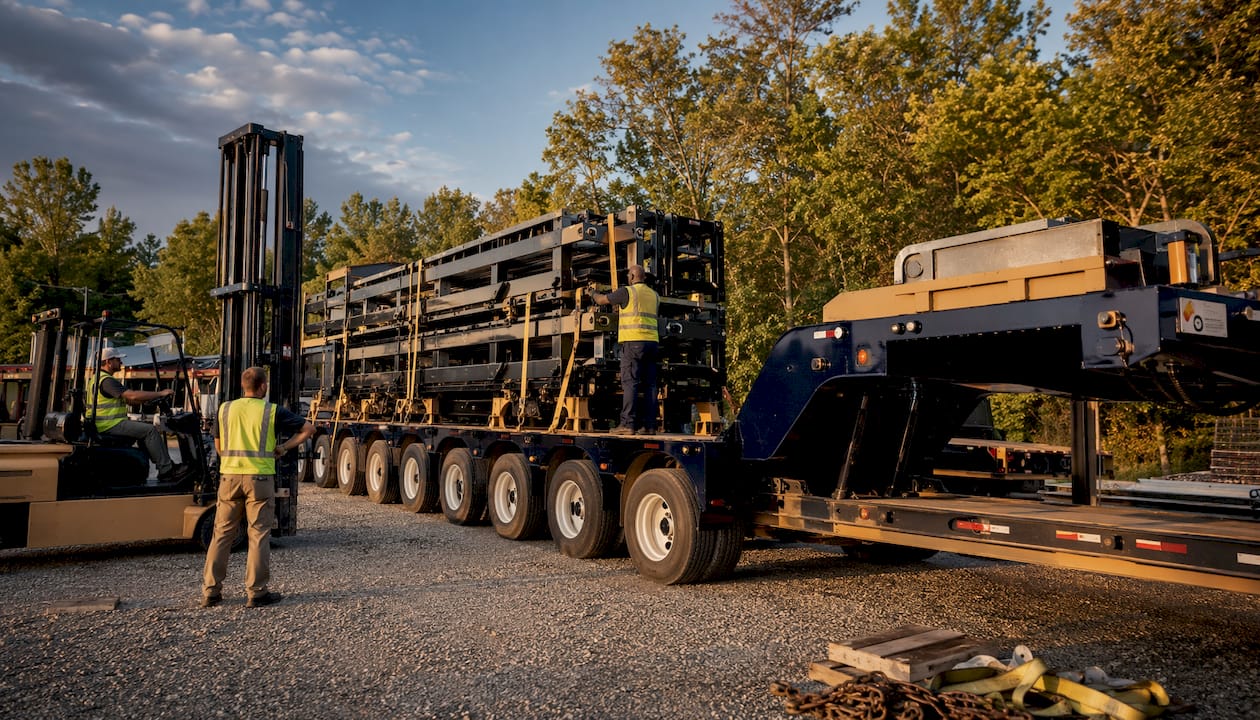
For oversized rack systems that cannot fit inside a standard trailer, heavy-haul options take over. RGN trailers (Removable Gooseneck) are the preferred choice when equipment needs to drive or roll directly onto the deck, eliminating the need for cranes at pickup and delivery. Step-deck trailers handle taller loads that would exceed legal height limits on a standard flatbed. Multi-axle RGN configurations can carry extreme weights, with some setups rated well above 100,000 lbs.
Pro Tip: Confirm the venue's turning radius and dock access before booking a 53-foot unit. A truck that cannot maneuver into the compound costs you hours on load-in day.
| Trailer Type | Best For | Drive-On Capable | Key Consideration |
|---|---|---|---|
| Expando M/U (53 ft) | Full production control room | No | Requires level pad, shore power |
| Step-deck | Taller rack systems within height limits | No | Crane or forklift needed at both ends |
| RGN | Self-propelled or wheeled gear | Yes | Higher per-mile rate; saves crane cost |
| Standard flatbed | Smaller equipment within legal dimensions | No | Widest carrier availability |
Modern IP-based mobile units combine modular workstation "sandboxes" and distributed production routing, meaning a single truck can now handle production capacity that once required two or three vehicles. That changes compound planning: fewer trucks, tighter footprint, but higher per-unit value and more complex power needs.
How do air flypacks work for fast international deployments?
When a production needs to be operational overseas within days, FAA-certified palletized racks are the answer. A flypack is a modular rack system engineered to fold flat, fit on the lower deck of a widebody aircraft, and come online within hours of arrival when pre-cabled and rehearsed. The racks use MPO fiber assemblies pre-terminated at the factory, so on-site setup is largely a matter of unfolding, connecting, and powering up rather than re-cabling from scratch.
When air makes sense:
- International events with fewer than 10 days of lead time
- Venues with no viable road access for large trucks
- Productions that need to scale up or down per event without committing to a full M/U
Flypack packing checklist:
- Confirm aircraft type and lower-deck pallet dimensions before finalizing rack height
- Pre-terminate all MPO/fiber connections and label every bundle at both ends
- Weigh and balance each pallet; distribute heavy items low and toward the center
- Document every component on a manifest tied to the pallet number
- Rehearse the unpack sequence with the crew before departure
Pro Tip: Pre-test the entire flypack as a live system before it leaves the facility. A fault found in the warehouse takes 20 minutes to fix; the same fault found on-site, 6,000 miles away, can cost a broadcast.
Tactical flypacks are increasingly replacing full-sized M/U logistics where speed or venue access is the limiting factor. The trade-off is payload: aircraft cargo holds impose strict weight and volume limits, so productions must choose carefully which gear flies and which ships by sea or ground.
What sea shipping methods work best for large international moves?
For heavy or oversized production gear crossing an ocean, three methods cover nearly every scenario.
RoRo (Roll-on/Roll-off) is the gold standard for wheeled equipment. Gear drives directly onto the vessel via a stern ramp, eliminating crane lifts and the handling damage that comes with them. Even non-running equipment can travel RoRo using MAFI trailers towed by port tractors. If the gear has wheels and fits within standard RoRo height limits (typically 5–6 meters depending on vessel class), this is almost always the right call.
Containerization suits dismantlable or mid-sized equipment. Standard 40-foot High Cube containers offer the lowest freight rates per cubic meter, and container ships call at virtually every commercial port in the world. For out-of-gauge items, flat racks (a container floor with sturdy ends but no walls or roof) handle cargo that is too wide or tall for a standard box. The cost of mechanical labor to dismantle and repack is often offset by the lower freight rate.
Breakbulk handles what nothing else can: static, oversized loads that exceed RoRo ramp dimensions and flat rack capacity. Cargo is lifted directly from the dock using cranes, which requires detailed lifting plans, port services, and specialized carriers. Charges are calculated on freight tons (the greater of weight or volume), with surcharges for heavy lifts typically over 20–30 metric tons.
Statistic: Breakbulk is generally the most expensive sea shipping option; port handling charges for breakbulk run significantly higher than for RoRo or containerized cargo.
The labor vs. transit-speed trade-off is the central decision: containerization cuts freight cost but demands more manual packing at both ends, while project cargo and breakbulk charge premiums for handling and special lifts. Earlier planning almost always favors containers.
What does your venue truck compound actually need?
The truck compound is the single most critical infrastructure item on any production site. Its location, power supply, and fiber access determine how fast the production can go live.
Site confirmation checklist:
- Unobstructed compound area of approximately 80 feet by 30 feet per M/U
- Compound positioned within 100–150 feet of the facility cross-connect
- Dedicated Cam-Lok or Camlock shore power circuits; satellite and transmission vehicles may require 200-amp service
- Clear southern sky view for satellite uplink vehicles
- Fiber/SMPTE cable paths routed to avoid crossing pedestrian or vehicle traffic
- Generator trailer siting with adequate exhaust clearance and fuel access
- Sheltered or shaded area if the event runs in high heat
Pro Tip: Ask the venue for a fiber demarcation map and transformer capacity spec before the site visit. Discovering a power shortfall on load-in day means renting a generator at event-week rates.
Statistic: Proximity to the cross-connect within 100–150 feet is a standard planning benchmark; longer cable runs add complexity, cost, and signal-management risk.
How do you choose between ground, air, and sea?
| Method | Best For | Capacity | Transit Speed | Labor Required | Cost Profile | Special Handling | Venue Access |
|---|---|---|---|---|---|---|---|
| Ground M/U | Domestic events, full control room | Up to 53 ft expando | Same day to 3 days | Low (drive-in) | Moderate; mileage + driver | Shore power, level pad | Requires compound space |
| Heavy-haul trailer | Oversized racks, large systems | 40,000–150,000+ lbs | 1–5 days domestic | Moderate (crane or drive-on) | Moderate–high; permits add cost | RGN, step-deck, forklifts | Permit routes required |
| Air flypack | Fast international, limited access | Lower-deck pallet limits | 1–3 days door-to-door | High (pack/unpack crew) | High; airfreight rates | FAA-certified racks | No compound needed |
| Sea RoRo | Wheeled gear, international | Vessel deck capacity | 2–6 weeks | Low (drive-on) | Moderate | MAFI trailers if non-running | Major RoRo ports only |
| Sea container | Dismantlable gear, remote ports | 40 ft HC standard | 2–5 weeks | High (dismantle/repack) | Low–moderate | Flat racks for out-of-gauge | Universal port coverage |
| Sea breakbulk | Oversized, static, irregular | Unlimited | Variable | Very high (crane plans) | High; freight tons + surcharges | Heavy-lift cranes, crating | Route-specific ports |
Lead-time planning template:
- Overnight domestic ground: 12–24 hours
- Regional ground (cross-country): 3–7 days
- Air international: 1–3 days transit plus 1–2 days customs clearance
- Sea RoRo or container: 2–6 weeks port-to-port plus inland drayage
- Sea breakbulk: 4–10 weeks including port services and crane scheduling
What packing and staffing practices protect high-value gear?
Modularization is the single biggest lever on load/unload time. A well-designed flypack or flight-case system lets a small crew unpack and go live in hours; a poorly organized truck build can consume a full day of labor before a single cable is connected. White-glove packing practices start with labeling every case, rack, and cable bundle at both ends with a manifest number tied to a digital inventory.
Staffing by transport method:
- Ground M/U: driver, one or two A/V techs for connection; forklift operator if belly bays are loaded
- Air flypack: dedicated pack/unpack crew of 4–6; at least one fiber/MPO specialist
- Sea container or flat rack: rigger, mechanical team for dismantle/reassembly, forklift or crane operator at both ports
Pro Tip: Use color-coded case labels by system (audio, video, comms) and number them in unpack sequence, not alphabetically. The crew that arrives at 2 AM after a transatlantic flight will thank you.
On-site, dock plates and portable ramps eliminate the gap between truck bed and loading dock. For crane lifts, confirm lift points and weight distribution with the rigger before the truck arrives, not after.
What do cost and lead time look like by transport type?
Cost drivers vary sharply by mode. Ground transport costs scale with mileage, driver hours, fuel, and permit fees for oversized loads. Air freight charges on dimensional weight, so dense, compact flypacks cost less per pound than bulky, low-density cases. Sea freight for containers is priced per TEU (twenty-foot equivalent unit), while breakbulk charges on freight tons with heavy-lift surcharges.
| Transport Type | Typical Lead Time | Cost Profile | Primary Cost Drivers |
|---|---|---|---|
| Domestic ground M/U | 1–3 days | Moderate | Mileage, driver, fuel, permits |
| Heavy-haul trailer | 2–7 days | Moderate–high | Permit fees, escort vehicles, crane |
| Air flypack | 1–3 days transit | High | Airfreight rate, dimensional weight, customs |
| Sea RoRo | 2–6 weeks | Moderate | Port fees, vessel schedule, drayage |
| Sea container | 2–5 weeks | Low–moderate | TEU rate, dismantle labor, drayage |
| Sea breakbulk | 4–10 weeks | High | Freight tons, heavy-lift surcharges, port handling |
Premium air or expedited project cargo is worth the cost when a delayed shipment means a missed broadcast window. When the schedule allows, booking sea containerization 8–12 weeks out typically cuts total freight cost more than any other single decision.
What risk, permit, and insurance items must you confirm?
Oversized road moves in the United States require state DOT permits, and many states mandate pilot cars (escort vehicles) for loads exceeding specific width or height thresholds. Route surveys are standard practice for loads that approach bridge clearance or weight limits. Skipping a route survey to save time is the most common cause of a load being turned back at a bridge or tunnel.
Risk and compliance checklist:
- Obtain state DOT oversize/overweight permits for every state the load transits
- Confirm pilot car requirements with the carrier before departure
- Carry all-risk cargo insurance covering replacement value, not depreciated value, for high-value production gear
- For international moves, prepare a full customs documentation package (commercial invoice, packing list, carnet if applicable) at least two weeks before sailing
- Stage critical spare components in a second, faster shipment or on an airline-compliant flypack to cover shortfalls
Pro Tip: Insure at replacement value, not book value. A five-year-old broadcast router may carry $0 on the books but cost $80,000 to replace on short notice.
Statistic: Breakbulk port handling charges run significantly higher than RoRo or container handling, making insurance and contingency planning proportionally more important for those shipments.
Customs holds at ports or airline cargo facilities are among the most common causes of timeline slippage on international moves. A missing or incorrect carnet can freeze a shipment for days. Assign one person on the logistics team to own documentation end-to-end.
Rigaglobaltravel handles the people side of your production move
Equipment logistics get the gear to the venue. Getting your talent, executives, and crew there on time, without friction, is a separate discipline — and the one most productions underestimate until game day.

Rigaglobaltravel provides celebrity and talent transportation and concierge ground services built specifically for sports and entertainment productions. Services include VIP transfers timed to truck compound access windows, multi-stop crew shuttles coordinated with load-in schedules, equipment rider coordination, and on-the-ground troubleshooting when plans change. Pairing Rigaglobaltravel's personnel logistics with your equipment transport plan means one fewer coordination gap between the production office and the venue floor. For New York-area productions, luxury chauffeur service is available for executives, talent, and press. Contact Rigaglobaltravel to confirm availability for your next event date.
Key Takeaways
Ground, air, and sea each serve a distinct production scenario; matching the method to the event's timeline and scale is the decision that controls both cost and risk.
| Point | Details |
|---|---|
| Match method to timeline | Ground for domestic speed, air for fast international deployment, sea when cost outweighs transit time. |
| Compound siting is non-negotiable | Plan for an 80-by-30-foot unobstructed area per M/U, within 150 feet of the facility cross-connect. |
| Modularize before you ship | Pre-cabled flypacks and labeled flight cases cut on-site setup from days to hours. |
| Insure at replacement value | High-value broadcast gear must be covered at current replacement cost, not depreciated book value. |
| Rigaglobaltravel covers personnel | VIP transfers, crew shuttles, and rider coordination pair with equipment logistics to reduce game-day gaps. |
The part of production logistics most executives get wrong
The conventional wisdom treats equipment transport and people transport as two separate workstreams managed by two separate teams. On paper, that makes sense. In practice, it creates the single most predictable failure mode in live sports production: the truck compound is ready, the gear is on-site, and the director of photography is stuck in traffic because nobody coordinated the crew call with the vehicle pool.
The equipment logistics community has spent decades refining flypack design, compound siting rules, and RoRo procedures. Those systems are genuinely good. What they do not solve is the human choreography: who arrives when, which entrance they use, how VIP talent movement intersects with load-in traffic, and what happens when a flight lands two hours late on event morning.
Productions that treat ground transportation for people as an afterthought tend to discover its importance at the worst possible moment. The smarter approach is to build the personnel transport schedule alongside the equipment transport plan, using the same compound access windows and the same timeline logic. A crew shuttle that arrives during peak load-in creates a bottleneck. A VIP transfer that shares the service entrance with a 53-foot expando trailer creates a safety issue. These are not edge cases.
The practical fix is simple: assign one point of contact to own both the equipment compound schedule and the personnel transport schedule, and require them to reconcile the two before the first truck rolls. Reserve arrival and departure windows for VIP vehicles the same way you reserve power circuits: early, in writing, and with a backup plan.
Useful sources and further reading
- Sports Video Group — venue and mobile unit infrastructure guidance
- Sports Video Group white paper: M/U truck compound infrastructure
- Diversified case study: Fox Sports Jewel Event Broadcast System
- Container News: RoRo, container, and breakbulk shipping overview
- Jack Cooper: Heavy equipment transport guide
- ESPN and Game Creek Video flagship mobile unit coverage
- Rigaglobaltravel: VIP production crew transport options
- Rigaglobaltravel: Multi-city production tour transport guide
- Rigaglobaltravel: Production set transportation for film pros