
A security sweep for vehicles is a pre-ride physical inspection combined with route and advance checks, distinct from routine mechanical service. Production companies, talent managers, and corporate travel managers should require one before any pickup involving a public figure, a high-visibility set, or an executive with a predictable schedule. A proper sweep covers the exterior walk-around, an interior check, a luggage and compartment check, and a route advance, all before the passenger ever gets near the door.
TL;DR:
- Vehicle security sweeps should include detailed exterior and interior checks, document verification, and route advance, especially for high-profile or high-risk transports.
- Conduct a full sweep before the first pickup of the day and perform shorter spot checks whenever the vehicle is unattended or a driver change occurs.
- Always request and review documentation such as insurance certificates, driver credentials, and inspection SOPs before booking any chauffeur service.
- Route planning should incorporate multiple paths, avoid predictability, and include tight staging at airports and crowded venues to reduce exposure.
- For production or VIP transport, incorporate driver vetting, NDAs, and documented inspection procedures into the booking process as standard protocol.
Table of Contents
- What Is a Vehicle Security Inspection Checklist?
- How Do You Perform a Pre-Ride Vehicle Security Sweep Step by Step?
- How Do You Plan Secure Routes and Advance Work?
- What Should You Verify With a Provider Before Booking?
- When Production and Executive Schedules Actually Need a Full Sweep
- How Riga Global Travel Handles Security Sweeps for Every Booking
- Sources
- FAQ
What Is a Vehicle Security Inspection Checklist?
Most delays and gaps in a vehicle security sweep come from skipping steps, not from a lack of training. A written checklist forces consistency, whether the chauffeur is a veteran or new to a specific account.
The exterior walk-around comes first. A trained driver or security lead checks all doors and windows for forced-entry marks, inspects tires and wheel wells, and opens luggage bays and undercarriage compartments to confirm nothing has been added or removed since the last inspection. Visible tampering, like pried panels or disturbed dust patterns around access points, is the tell most people miss because they're looking for something dramatic instead of something subtle.
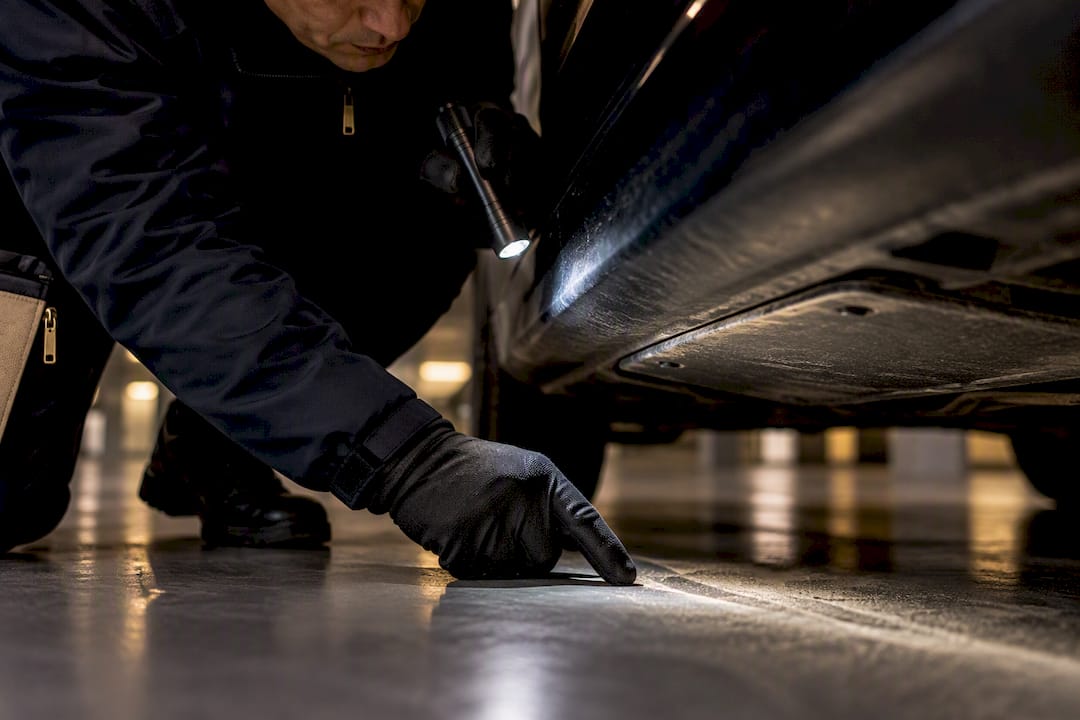
Interior checks come next: under seats, inside trunks, beneath floor mats, and around HVAC vents where small items can be tucked out of sight. Anyone conducting this check should visually confirm wiring near dashboards and door panels looks factory original, with no loose splices or added components.
Documentation checks matter as much as the physical sweep. Verify the driver's ID matches the manifest, confirm the license class is appropriate for the vehicle, and request a current insurance certificate before the trip starts, not after.
- Doors, windows, tires, and luggage bays show no signs of forced entry or tampering
- Under-seat, trunk, and HVAC vent areas are visually clear
- Driver ID, license class, and insurance certificate match the manifest
- Dispatch contact, live GPS tracking, and panic button function are confirmed working
- Sweep is repeated after any unattended period and at every driver change
Communications verification rounds out the checklist. Confirm the vehicle has a working dispatch contact, that live GPS tracking is active, and that a panic button or equivalent alert function works before departure.
Pro Tip: Run the full sweep before the first pickup of the day, then a shorter spot check (five to ten minutes) any time the vehicle sits unattended or a new driver takes over mid-shift. Treat every gap in custody as a reset.
How Do You Perform a Pre-Ride Vehicle Security Sweep Step by Step?
A repeatable sequence matters more than speed. Guidance drawn from the motorcoach security best practices used across the passenger transport industry treats pre-trip inspection as separate from mechanical service, and that separation is the backbone of a defensible SOP.
- Stage the vehicle. Position it in a controlled area away from foot traffic where possible. Keep keys with one designated person, never left in the ignition or handed off casually.
- Sweep the exterior. Use a mirror on an extension pole and a flashlight to check the undercarriage, wheel wells, and bumper cavities. A creeper helps for low-clearance vehicles where a visual check from standing height misses the underside entirely.
- Open every compartment. Trunk, luggage bays, spare tire well, and any external storage get opened and visually cleared before anything is loaded.
- Sweep the interior in order. Check seat backs and cushions, floor mats, glove compartments, center console, and HVAC intakes. Move front to back so nothing gets skipped under time pressure.
- Verify the driver and paperwork. Confirm registration, insurance, and, for rented or subcontracted vehicles, the rental agreement matches who's actually behind the wheel.
- Escalate if anything looks wrong. Isolate the vehicle, keep people at a safe distance, notify operations immediately, and contact local emergency services if there's any indicator of a genuine threat.
A vehicle inspection guide built around explosive-detection best practices describes specific "hot spots" inspectors should never skip, along with the correct posture: engine off, parking brake set, high-visibility clothing on. That same guidance is explicit that if a suspicious item turns up, the response is isolation and notification, not investigation by untrained staff.
A brief, documented spot sweep can run five to twelve minutes and still catch tampering or an obvious concealment. Reserve the longer, full sweep for situations where a specific risk indicator exists, like an unattended vehicle in a public lot or a report of unusual activity near the staging area.
How Do You Plan Secure Routes and Advance Work?
A sweep only protects the vehicle at a single point in time. Route planning protects the entire trip.
Primary and alternate routes matter because a single fixed path creates a pattern, and patterns are exactly what someone surveilling a production or an executive would look for. Advance route work reduces predictability, and for repeated transfers, like a talent shuttle running the same hotel-to-set route every morning, varying timing and path is worth more than any single physical check.
- Require at least one alternate route for any repeated or high-visibility transfer
- Choose low-exposure pickup and drop-off points, and position an agent at transitions when possible
- Confirm live dispatch monitoring, a defined reactionary gap, and a documented contingency plan before departure
- Treat airports, event load-ins, and crowded public spaces as their own category requiring tighter staging
Airports, event load-ins, and crowded public venues each carry different exposure levels, so a one-size routing plan doesn't hold up. Ask any provider directly about routing policy, real-time monitoring assurances, and what a documented contingency plan actually looks like on paper. A good route planning framework for VIP transportation treats these as separate line items, not an afterthought bundled into the base fare.
What Should You Verify With a Provider Before Booking?
The sweep is only as good as the paperwork behind it. Before signing anything, request the documents that make these promises enforceable rather than aspirational.
- Commercial passenger registration, liability insurance limits, and a current certificate of insurance
- Driver background checks, driving record abstracts, and training certificates on file
- A written NDA covering staff, along with a stated data-retention and GPS-tracking policy
- A documented pre-trip and post-trip inspection SOP, separate from routine maintenance records
- Vehicle age and maintenance policy in writing, not verbal assurance
A buyer's checklist for secure executive chauffeur service recommends exactly this combination: credentials, insurance, NDAs, and inspection records, all requested before the first booking rather than after an incident. The APTA recommended practice for nonrevenue vehicle security inspections gives a useful reference point for scaling inspection scope to fleet size, which is worth citing directly in a statement of work.
Pro Tip: Paste a short clause directly into your SOW: "Provider shall conduct a documented pre-trip security inspection prior to each passenger pickup and maintain inspection records separate from mechanical service logs, available on request." That single sentence turns a verbal promise into something you can actually enforce.
When Production and Executive Schedules Actually Need a Full Sweep
Not every pickup needs the full procedure. A daily airport run for a known executive with a vetted, recurring driver usually calls for a fast spot check. A red carpet arrival with multiple talent transitions, unfamiliar staging, and press proximity calls for the full sweep and a documented advance, every time.
Production load-ins are their own category. Multiple vehicles, multiple handoffs between drivers, and long unattended periods between calls all raise exposure. A talent transportation protocol built for production managers treats every driver change and every gap in custody as a reason to re-sweep, not a formality to skip because the schedule is tight.
The judgment call is where experience matters most: knowing which pickups are routine and which ones deserve the full procedure is what separates a checklist that gets followed from one that gets ignored under time pressure.
— Sammy
How Riga Global Travel Handles Security Sweeps for Every Booking
Pre-ride sweeps, route advance, and driver vetting can be built into chauffeured services for production, talent, and corporate accounts, not just offered as optional add-ons.
Chauffeurs may be screened before assignment, and NDAs can be available on request for production or executive accounts. That's a different model from an app-dispatched ride where you get whoever's closest and hope the vetting happened somewhere upstream. Documentation of the sweep procedure can sometimes be requested for a purchase order or production insurance file and may be included in booking confirmation.
Requesting a sweep clause is simple: mention it when you set up your corporate account, or add it directly to your booking through Airport Transfers, Limousine Service, and Corporate Service. For high-profile talent moves, the celebrity transportation team handles NDA requests and sweep documentation as a standard part of the intake conversation. Run one trial booking with the clause written into your SOW and see the inspection record for yourself before committing to a full production schedule.
Sources
Three documents give any provider conversation real teeth. The motorcoach security best practices guidance lays out the pre-trip inspection standard. The APTA recommended practice frames inspection scope for nonrevenue vehicles. A commercial vehicle cleaning checklist offers a practical companion for compartment-by-compartment thoroughness.
- Motorcoach Security – Best Practices (TSA-related guidance)
- Vehicle inspection guide (Office for Bombing Prevention / TSWG)
- Secure Executive Chauffeur Service: What to Verify Before Booking | Experience Life PMA
FAQ
What Is Included in a Vehicle Security Sweep?
A vehicle security sweep includes an exterior walk-around, an interior check of seats, floor mats, and vents, a luggage and compartment inspection, driver and document verification, and a route advance for the trip ahead. It excludes electronic bug detection, which is a separate specialty entirely.
How Long Does a Pre-Ride Security Sweep Take?
A full sweep typically takes longer than a spot check, while a documented spot sweep runs five to twelve minutes and still catches obvious tampering or concealment. Reserve the longer procedure for higher-risk pickups like red carpet arrivals or unattended vehicles in public lots.
Does Riga Global Travel Perform Security Sweeps Before Pickups?
Riga Global Travel builds pre-ride vehicle checks, driver vetting, and route planning into its chauffeured service for production and corporate clients, with NDAs available on request through its corporate service and celebrity transportation teams. Current pricing and service details are listed on the Riga Global Travel site.
What Documents Should You Request From a Chauffeur Provider?
Request commercial passenger registration, a current certificate of insurance, driver background check records, and a written pre-trip inspection SOP, all recommended in buyer checklists for secure executive transport. A written NDA covering staff should also be part of the standard packet.
What Happens if a Sweep Finds Something Suspicious?
Isolate the vehicle immediately, keep everyone at a safe distance, and notify operations before attempting any further inspection. If there's genuine reason to suspect a threat, contact local emergency services rather than having untrained staff investigate further.