
Luxury fleet utilization is defined as the ratio of time luxury vehicles actively serve paying clients to their total available hours, making it the primary efficiency metric in entertainment industry fleet management. Understanding what luxury fleet utilization means separates fleet managers who control costs from those who simply track trips. The industry standard targets a utilization rate of 70%–85% to balance operational demand against asset availability. For entertainment professionals managing limousines, executive vans, and chauffeur fleets, this metric carries extra weight because vehicle downtime, idle comfort runs, and client wait times all erode margins without appearing in basic trip logs.
What does luxury fleet utilization mean in practice?
Fleet utilization, in the formal sense used by fleet operations professionals, measures how much of a vehicle's available capacity is being put to productive use. In luxury fleets, "productive use" means time spent actively transporting a paying client, not time spent idling in a hotel driveway or circling a film studio lot. That distinction matters enormously.
Utilization is an efficiency metric, not a direct profitability indicator. A vehicle logging 10 hours of engine time may have carried a client for only 3 of those hours. The remaining 7 hours represent fuel burn, wear, and driver cost with no corresponding revenue. In the entertainment industry, where productions run on tight call sheets and talent schedules shift without warning, that gap between total vehicle hours and revenue-generating hours is where margins disappear.
The standard formula is straightforward: divide productive hours by total available hours, then multiply by 100 to get a percentage. A fleet running at 60% utilization has meaningful room to grow. A fleet running at 90% is likely overextended and risking service failures. Rigaglobaltravel applies this framework across its entertainment fleet to keep vehicles working efficiently without compromising the quality clients expect.

How is luxury fleet utilization measured and calculated?
Four measurement methods apply to luxury fleets, and each captures a different dimension of performance.
Time-based utilization divides active client transport hours by total available hours. This is the most relevant method for luxury fleets because idling and waiting times are constant features of entertainment transport. A chauffeur waiting outside a recording session is not generating revenue, but the vehicle is consuming fuel and accumulating engine hours.
Distance-based utilization measures miles driven against a benchmark. It works well for delivery fleets but misses the point in luxury transport, where a short airport run at peak demand is worth far more than a long empty repositioning drive.
Engine-hour utilization tracks total engine run time. For specialty vehicles like executive vans used on production sets, this metric captures wear more accurately than distance alone.
Vehicle-count utilization compares active vehicles to total fleet size on any given day. This method gives fleet managers a quick read on whether the fleet is right-sized for current demand.
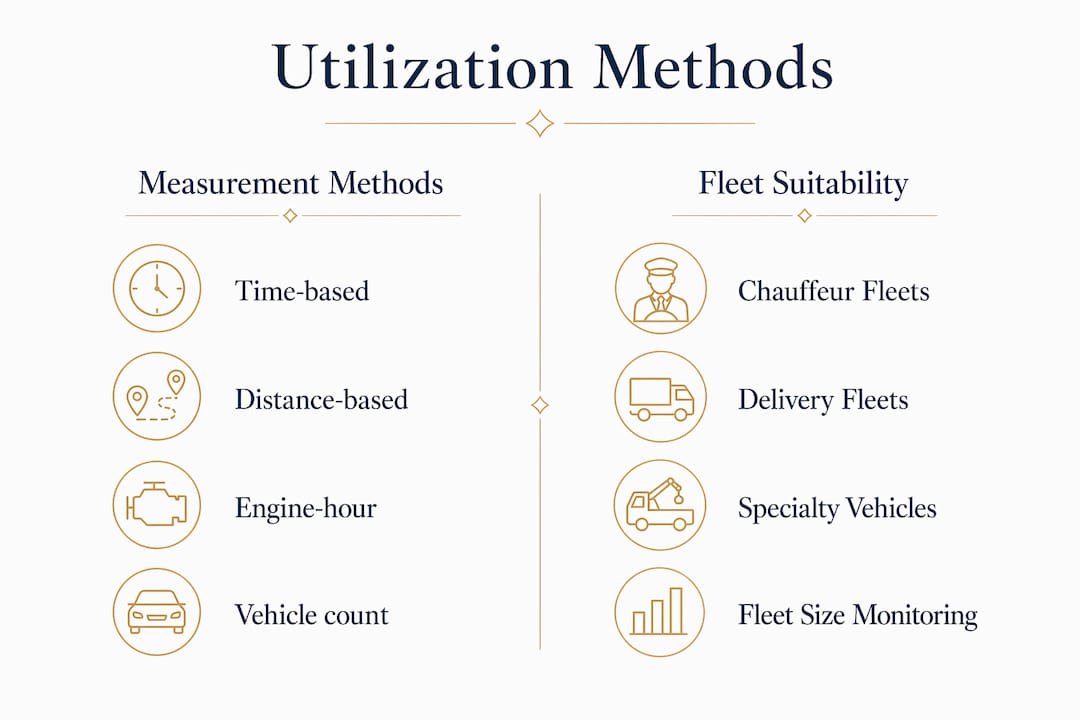
| Method | Best for | Limitation in luxury fleets |
|---|---|---|
| Time-based | Chauffeur and limousine fleets | Requires clean data on client-on-board time |
| Distance-based | High-mileage route fleets | Ignores idle revenue loss |
| Engine-hour | Specialty and production vehicles | Does not reflect client experience quality |
| Vehicle-count | Fleet sizing decisions | Too broad for daily operational decisions |
Telematics platforms capture ignition status, GPS location, distance, and engine hours simultaneously, giving fleet managers a multi-dimensional picture that no single metric provides alone.
Pro Tip: Pair telematics data with your client booking system. When a vehicle's ignition-on time consistently exceeds booked client time by more than 30%, you have a measurable idle problem worth addressing immediately.
What unique challenges affect luxury fleet utilization in entertainment?
High raw utilization numbers can be deeply misleading in luxury fleet management. A vehicle logging 12 hours of engine time on a film production day may have spent 4 of those hours idling to maintain cabin temperature for a talent client. That idling is operationally necessary but financially corrosive.
High utilization can mask inefficiencies like engine idling and empty routing, both of which drain margins in luxury fleets. Entertainment industry fleet managers face a specific version of this problem because the service standard requires vehicles to be climate-ready, spotlessly presented, and immediately available. That readiness costs money whether or not a client is on board.
Common sources of hidden operational loss in entertainment luxury fleets include:
- Empty miles: Repositioning vehicles between locations without a client on board
- Idle comfort runs: Running climate control and electronics to maintain cabin readiness
- Client wait time: Vehicles staged at venues, studios, or airports ahead of unpredictable talent schedules
- Driver shift gaps: Time between one driver's shift end and the next driver's pickup of the same vehicle
- Unplanned route changes: Last-minute itinerary shifts that create inefficient routing
Privacy and exclusivity requirements compound these challenges. Celebrity and talent transport often demands dedicated vehicles that cannot be shared or redeployed mid-day, which structurally limits utilization rates regardless of scheduling quality. Fleet managers must account for this when setting realistic utilization targets.
Overutilization above 85% increases maintenance needs and risks degrading the exclusive client experience that defines luxury transport. Pushing a fleet too hard to hit efficiency numbers is a direct threat to the service quality that clients pay a premium for.
How can entertainment fleet managers optimize luxury fleet utilization?
Optimization in luxury fleet management is not about squeezing every available hour out of each vehicle. It is about deploying the right vehicle at the right time with the minimum waste between bookings.
- Audit current utilization by vehicle. Pull time-based and engine-hour data for each asset individually. Fleet-wide aggregate metrics hide underperforming vehicles that drag down overall efficiency.
- Map empty miles and idle patterns. Identify which routes and locations generate the most non-revenue engine time. Production studio runs and airport staging are common culprits.
- Right-size the fleet to actual demand. Accurate utilization data enables decisions on whether to reduce owned vehicles, redeploy assets to higher-demand markets, or shift from ownership to on-demand sourcing for peak periods.
- Coordinate driver shift handovers. Gaps between drivers are a silent utilization killer. Scheduling overlapping handovers at high-demand locations cuts idle time between bookings.
- Integrate booking data with dispatch. Real-time visibility into confirmed bookings lets dispatchers reposition vehicles proactively rather than reactively.
- Apply lifecycle management standards. Formal inspection records and value-based maintenance decisions preserve vehicle condition and extend the productive life of each asset.
The role of luxury vans in productions illustrates why step-by-step optimization matters. A production van sitting unused between morning and evening call times represents a fixable utilization gap, not an unavoidable cost.
Pro Tip: Segment your fleet by vehicle type before analyzing utilization. A limousine and an executive van serve different booking patterns. Mixing them into a single utilization figure produces a number that is accurate for neither.
Reducing idle engine hours and empty routing delivers fuel savings and margin improvements that compound across a full production season. Small reductions in daily idle time add up to meaningful cost recovery over a 12-month period.
What are the benefits of maintaining an optimal utilization rate?
A utilization rate in the 70%–85% range delivers financial and operational benefits that rates outside this band cannot match. Below 70%, fixed costs per booking rise because vehicles sit unused. Above 85%, maintenance frequency increases and service reliability drops.
| Utilization rate | Financial impact | Service impact |
|---|---|---|
| Below 60% | High fixed cost per booking | Vehicles available but underused |
| 60%–70% | Moderate inefficiency | Adequate availability, room to grow |
| 70%–85% | Optimal cost-per-booking ratio | Strong availability and service quality |
| Above 85% | Rising maintenance costs | Risk of booking conflicts and service failures |
The financial case for hitting the 70%–85% band is direct. Fuel costs drop when idle time falls. Maintenance intervals extend when vehicles are not overworked. Vehicle resale value holds when lifecycle management is applied consistently. Each of these factors compounds over a multi-year fleet ownership cycle.
The service case is equally clear. Clients in the entertainment industry pay for guaranteed availability and consistent quality. A fleet running at optimal utilization has the capacity to absorb schedule changes, last-minute additions, and extended wait requirements without pulling vehicles from other bookings. That reliability is the product, not just the vehicle.
Key Takeaways
Luxury fleet utilization is the single most important efficiency metric for entertainment fleet managers, and keeping it in the 70%–85% range is the clearest path to controlling costs while protecting service quality.
| Point | Details |
|---|---|
| Core definition | Utilization measures productive client hours against total available vehicle hours. |
| Target rate | The 70%–85% range balances cost efficiency with service availability and vehicle longevity. |
| Hidden costs | Idle comfort runs, empty miles, and shift gaps inflate engine hours without generating revenue. |
| Measurement method | Time-based utilization is the most accurate metric for luxury chauffeur and limousine fleets. |
| Optimization priority | Integrating booking data with dispatch and auditing per-vehicle data drives the fastest gains. |
The number that matters most is not the one most managers track
Fleet managers in entertainment almost always track trip counts. Trip counts feel concrete. They show activity. They give dispatchers something to report. The problem is that trip counts tell you nothing about how much of each trip was revenue-generating versus operationally necessary but unprofitable.
I have seen fleets with impressive trip volumes running at margins that made no sense until someone pulled the idle-time data. The vehicles were busy. The drivers were busy. But a significant share of engine hours were going to climate runs, staging waits, and empty repositioning. None of that showed up in the trip count.
The shift that changes everything is moving from counting trips to measuring Passenger-on-Board time as a share of total engine time. That single change in how you read your telematics data reframes every operational decision. Suddenly, a vehicle that looks productive by trip count looks like a cost center when you see its actual client-on-board percentage.
The other misconception I encounter regularly is that higher utilization is always better. It is not. Pushing a luxury fleet above 85% to hit an efficiency target is a false economy. You gain a better-looking metric and lose the buffer that lets you handle a last-minute talent request or a schedule overrun without a service failure. In entertainment, that buffer is not a luxury. It is the product.
— Sammy
Rigaglobaltravel's approach to luxury fleet management
Rigaglobaltravel serves entertainment industry professionals who need more than a vehicle. They need a fleet operation built around the unpredictable demands of productions, talent schedules, and high-profile events.
Rigaglobaltravel applies data-informed dispatch and lifecycle management to keep its luxury fleet operating in the 70%–85% utilization band without sacrificing the availability and quality that entertainment clients require. Whether you need limousine service in Los Angeles for studio runs or luxury transport in New York for talent and executive travel, Rigaglobaltravel's fleet is sized and managed to deliver consistent service without the operational gaps that underutilized or overextended fleets create. Explore Rigaglobaltravel's celebrity transportation services to see how utilization management translates directly into reliable, premium client experiences.
FAQ
What does luxury fleet utilization mean?
Luxury fleet utilization measures the proportion of time luxury vehicles actively transport paying clients relative to their total available hours. It is the primary efficiency metric for fleet managers in the entertainment industry.
What is a good utilization rate for a luxury fleet?
A rate between 70% and 85% is the recognized target range. Rates below 70% indicate underused assets, while rates above 85% risk service failures and accelerated vehicle wear.
Why is time-based utilization the best metric for luxury fleets?
Time-based utilization captures idle time and wait time that distance-based metrics miss. In luxury transport, vehicles frequently run engines without carrying clients, making raw distance data an unreliable efficiency measure.
How does idle time affect luxury fleet profitability?
Idle engine time burns fuel and accumulates wear without generating revenue. In entertainment fleets, comfort runs and staging waits are common idle sources that inflate costs and reduce net margin per booking.
How can fleet managers reduce empty miles in luxury fleets?
Integrating real-time booking data with dispatch systems allows proactive vehicle repositioning. Coordinating driver handovers at high-demand locations and auditing route patterns by vehicle type are the most direct methods for cutting empty miles.