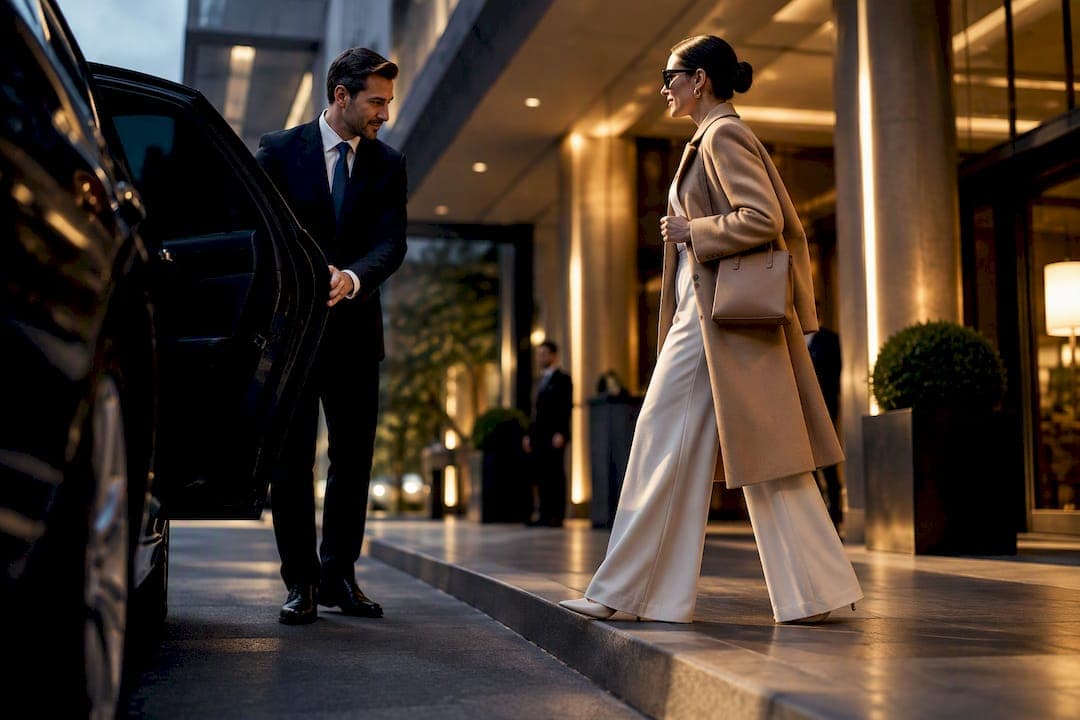
Specialized press junket transportation delivers discreet, unbranded vehicles and schedule-driven movement that keeps talent on time and protected from the moment they leave the hotel to the moment they leave the last interview room. It runs on a manifest, not a guess, and it treats the ride as part of the press day, not an afterthought. Riga Global Travel's manifest-first talent transport protocol is one example of how that discipline gets written down and executed.
TL;DR:
- A press junket transport relies on a detailed, schedule-aligned manifest to prevent delays that can eliminate multiple interview slots or impact schedule integrity.
- Vehicles must be chosen based on purpose, such as SUVs or vans for efficiency and maneuverability, rather than appearance alone, with short, manageable trips prioritized over luxury options like limousines.
- Confidentiality protocols demand unbranded vehicles, driver discretion, and signed NDAs to protect talent privacy amid increased visibility during press days.
- Early booking, clear change authority, and detailed contingency plans are essential to avoid common logistical mistakes and maintain schedule flexibility.
- A qualified provider should have comprehensive liability coverage, a transparent pricing structure, and a documented process rooted in a well-constructed manifest for smooth execution.
Table of Contents
- What a press junket transport provider actually delivers
- How transport decisions change the outcome of a press day
- Practical vehicle-selection rules for junket days
- The manifest, staging, and contingency checklist
- When to book and how pricing typically works
- Protocols and a short example from junket coordination
- Discreet vehicles and privacy protocols on junket days
- Special accommodations for talent and media personnel
- Insurance and liability considerations for junket transport
- Mistakes to avoid and quick wins
- How Riga Global Travel supports press junket days
- Sources
- FAQ
What a press junket transport provider actually delivers
A press junket is not a taxi service with a nicer car. It is a coordination function that happens to include driving. A real specialist assigns a day-of coordinator who tracks the run of show, dedicated chauffeurs who stay with one assignment for the full day, and vehicles with no visible branding, matching what specialist transport providers treat as a baseline expectation for entertainment clients.
The provider should also own the physical logistics around the vehicle itself:
- Staging and parking coordination so a car is never circling a block when talent walks out.
- Equipment handling for wardrobe racks, garment bags, and quick-change needs between interview blocks.
- Built-in buffer time for wardrobe or touch-up stops that the printed schedule does not show.
- A live communication channel, usually SMS or a group dispatch feed, so a five-minute slip gets flagged before it becomes a fifteen-minute problem.
Ask any prospective provider to describe their dispatch process before you ask about the fleet. The car matters less than who is watching the clock.
How transport decisions change the outcome of a press day
Junkets exist to compress interviews into one tightly scheduled day, since a press junket is built to generate weeks of coverage from a single day of talent availability. That compression means a transport delay does not just cost minutes, it costs interview slots that will not be rescheduled.
Junket interview blocks often run just 4 to 6 minutes per outlet, according to reporting on how studio press days are structured, which means a fifteen-minute transport delay can eliminate two or three scheduled conversations outright.
There is a quieter cost too. Talent who arrive rattled from a bad drive give flatter answers on camera. A calm, predictable ride functions as a reset between a chaotic morning and a room full of cameras, particularly on days with tight downtown routing or a studio gate that only allows one vehicle through at a time.
Practical vehicle-selection rules for junket days
Vehicle choice should follow the job, not the budget line that looks most impressive. A stretch limousine photographs well but is often the wrong call: it is slow through studio gates, hard to park near a loading dock, and overkill for a single executive doing back-to-back interviews.
- Executive SUV: best for one or two principals moving between a hotel and a single venue with wardrobe in tow.
- Executive Sprinter van: right for a talent plus glam team plus a publicist, especially when there is gear to carry.
- Shuttle loop with multiple vehicles: needed when several talent members rotate through the same venue on staggered call times.
- Sedan: fine for a single publicist or an early-morning crew scout, rarely right for talent on camera days.
Studio gates, narrow backlot driveways, and LAX curb restrictions all favor a shorter, more maneuverable vehicle over a longer one, even when the longer one looks better in photos.
Pro Tip: Pack a small kit in every vehicle, hangers, a phone charger, still water, and a way to kill outside noise, so a wardrobe fix or a quick call never has to wait for the next stop.
The manifest, staging, and contingency checklist
Everything on a junket day traces back to one document: the manifest. A weak manifest is the single most common cause of a transport day going sideways, and a good transport partner will not run a car without one.
- List every passenger by role, not just by name, so a driver knows who is talent, who is glam, and who is the point of contact.
- Lock call times and pickup windows against the actual run of show, not the schedule that was true three revisions ago.
- Name who has change authority, usually one publicist or one production coordinator, so a driver never takes a last-minute instruction from someone unauthorized.
- Specify exit instructions for each stop: which door, which floor, whether security needs advance notice.
- Confirm who secures curb and staging access. Transport providers move vehicles; they do not create permit authority, a distinction production-focused transport guidance makes explicit. That responsibility sits with production.
- Set contingency triggers in advance, so everyone agrees ahead of time what happens if traffic runs long, a stop gets added, or a security incident forces a reroute.
A one-page manifest built from this list travels well between agencies, studios, and transport vendors, and it turns a chaotic morning into a series of known steps. For teams moving larger crews alongside talent, a look at options for VIP production crew transport covers how to scale this same logic up.
When to book and how pricing typically works
Book earlier than feels necessary. Complex multi-city junkets or anything involving more than two vehicles deserves two weeks of lead time. A single-city, single-vehicle day can often be arranged inside 72 hours, and same-day bookings should be treated as an exception, not a plan.
Pricing in this category generally takes one of three shapes:
- Hourly with a minimum, common for single vehicles on shorter days.
- Day rate, common when a vehicle and driver are committed to one assignment for the full schedule.
- Corporate retainer with direct billing, common for agencies or studios running junkets on a recurring basis.
Watch for surcharges before they show up on an invoice: waiting time beyond the booked window, overtime past the scheduled return, and parking or staging fees at venues that charge for vehicle holds. A written quote should spell out exactly how waiting, overtime, and parking are calculated, and it should name who has authority to approve a change once the day is underway.
Protocols and a short example from junket coordination
A manifest built for a press junket needs one more layer than a standard car booking: it has to map to the actual run of show, not just a pickup address. Riga Global Travel's talent transit and media support guidance describes a manifest-first approach that ties each vehicle assignment to a specific interview block, so a driver knows not just where to go but why the timing matters.
Consider a multi-talent junket with four principals rotating through a hotel ballroom on staggered thirty-minute blocks. A shuttle loop with two vehicles, each running a fixed circuit between a green room and the ballroom, kept every rotation on schedule despite one talent arriving fifteen minutes late from an earlier commitment.
The vehicle assignment should follow the interview block, not the other way around.
That is the operational instinct worth remembering when a schedule looks tight on paper.
Discreet vehicles and privacy protocols on junket days
Talent moving through a junket day are visible in ways they are not on a normal production day. There are more people in the building, more phones, and more reasons for a passerby to notice which car just pulled up. Unbranded vehicles are the baseline defense against that exposure, and they are treated as a core feature by specialist entertainment transport operators rather than a premium add-on.
Privacy protocols usually cover a few concrete practices: chauffeurs briefed on which entrances and routes avoid public sightlines, drivers who do not discuss passengers or itineraries with anyone outside the authorized contact list, and vehicles staged away from public parking where a lens has a clear line of sight. None of this requires anything exotic. It just requires a provider who treats confidentiality as a working procedure rather than a marketing line.
The strongest version of this system includes signed confidentiality agreements between the transport company and its chauffeurs, so a driver's obligation to discretion is contractual, not just implied. Ask a prospective provider whether their drivers operate under any confidentiality commitment and whether that commitment is documented. If the answer is vague, treat that as useful information about how the rest of the day is likely to run.
Special accommodations for talent and media personnel
High-profile talent and visiting media personnel each need something slightly different from a transport plan, and a good provider adjusts for both without being asked twice. For talent, that usually means a driver who has worked entertainment assignments before and understands why a five-minute early arrival can be worse than a five-minute late one, since it can leave a vehicle idling in a visible spot.
For visiting media personnel, particularly international press flying in for a single junket day, accommodations often center on airport coordination: a chauffeur meeting them at arrivals, handling luggage without being asked, and getting them to a hotel with enough buffer to recover before a full day of interviews. Travel management specialists working in media and entertainment note that this kind of round-the-clock support and flexible handling of baggage and scheduling is a standard expectation in this segment, not a special request.

A publicist coordinating both groups on the same day should give the transport provider a clear read on who needs which kind of attention: talent needs low visibility and precise timing, visiting press often needs airport familiarity and a bit more schedule cushion. Naming that difference in the manifest, rather than assuming a driver will infer it, is the simplest way to avoid a mismatch.

Insurance and liability considerations for junket transport
A press junket puts a provider's vehicles and drivers in close proximity to talent, executives, and members of the press, often across multiple stops in a single day. That raises the stakes on the paperwork side more than a routine airport run does. Before booking, a PR team should confirm that the provider carries commercial auto liability coverage appropriate to chauffeured passenger transport, not a personal auto policy stretched to cover business use.
It is also worth confirming who bears responsibility if a schedule change requested by production creates a routing risk, such as a last-minute stop added without enough lead time to plan the route safely. That responsibility should be addressed in the written agreement before the day starts, not negotiated after an incident.
Confidentiality agreements matter here too, not just for privacy but for liability: a provider whose drivers sign NDAs and follow documented protocols is demonstrating the kind of operational discipline that also tends to correlate with careful driving and incident reporting. None of this is exotic contract language, but it is worth reading before signing rather than assuming it is standard.
Mistakes to avoid and quick wins
Three mistakes show up again and again on junket days. Booking transportation too late, so the only available vehicles are the wrong size. Choosing a vehicle class based on how it looks rather than how it fits through a studio gate. And leaving change authority unclear, so three people are texting a driver three different instructions at once.
Three fixes solve most of it. Build one standard manifest template and reuse it for every junket. Drive or map the actual route the day before, not the week before. And name exactly one day-of contact who can authorize changes.
Use the coordination checklist above as the starting document, not a reference to consult after something goes wrong.
— Sammy
How Riga Global Travel supports press junket days
A specialist transport provider generally offers chauffeured vehicles, day-of coordination, and manifest-first planning built around the schedule pressure a press junket creates. That means a dedicated coordinator tracking the run of show, drivers assigned to one job for the day instead of juggling multiple pickups, and a manifest built before the first car ever leaves the lot.
When requesting a quote, ask for vehicle class recommendations based on your actual passenger count and equipment, a written breakdown of waiting time and overtime terms, and confirmation of who holds change authority once the day begins. Riga Global Travel's celebrity transportation page is the place to start that conversation for talent-specific bookings.
Sources
- Press junket — Wikipedia
- What Is a Press Junket? Meaning, Schedule, and How Studio Press Days Work — L.A. Castle Studios
FAQ
How much does a press junket cost?
Press junket costs vary widely by scale, venue, and number of media outlets involved, and no single published figure covers all formats. Transportation is typically quoted separately as an hourly rate with a minimum, a day rate, or a corporate retainer, with the final number depending on vehicle count and day length.
What does press junket mean?
A press junket is a concentrated promotional event where talent gives back-to-back interviews to many media outlets over one or a few days, according to its standard definition. It replaces weeks of scattered individual interviews with a single scheduled event.
Can you give me an example of a press junket?
A typical example involves a film's cast rotating through a hotel ballroom or studio space, giving short interview blocks, often 4 to 6 minutes per outlet, to dozens of media outlets across a single day. Green rooms, staging areas, and a tightly timed transport schedule keep the rotation moving.
What are the benefits of attending a press junket?
For studios, a junket generates a large volume of coverage from a single day of talent time rather than weeks of separate interviews. For media outlets, it offers guaranteed access to talent on a fixed schedule, which is harder to secure through individual interview requests.