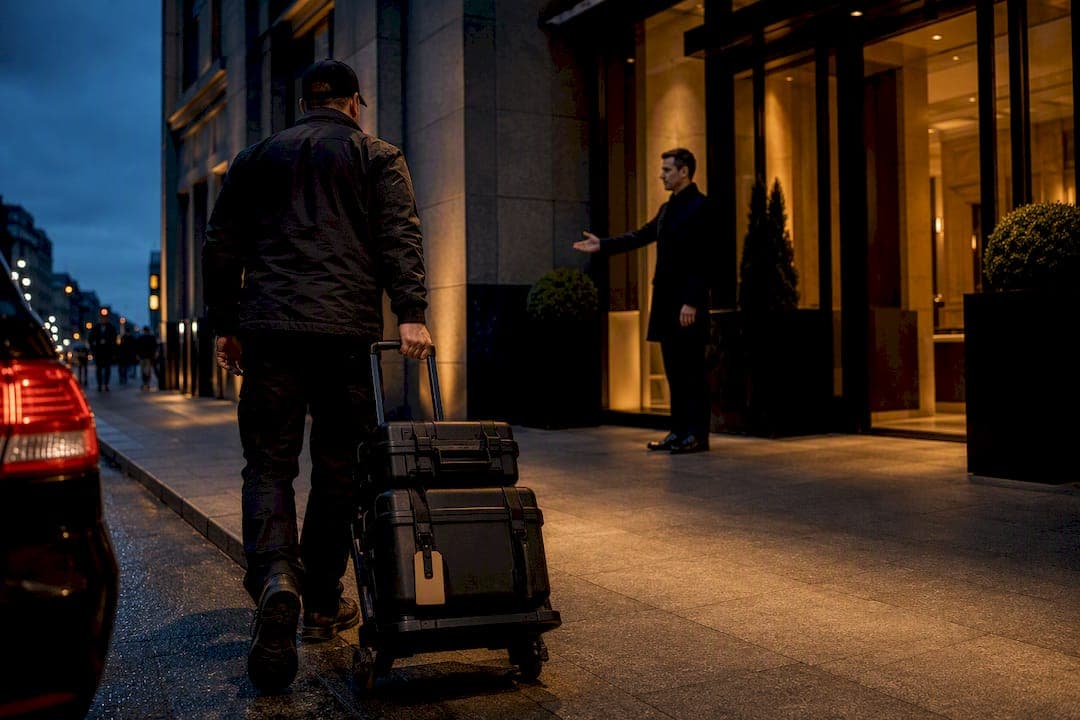
Press junket logistics means coordinating talent, media, venue technology, and transport so a single day of interviews produces broadcast-ready content for dozens of outlets without a single missed slot. The operational goal is simple to state and hard to hit: keep every interview block running on time while giving journalists what they need to file immediately. That means nailing four things at once: the schedule, the venue and its technical staging, talent transit, and on-site media support.
TL;DR:
- Ensuring strict scheduling and buffer times for talent and media transit prevents delays and keeps the day's flow on track.
- Venue selection should prioritize dedicated power supply, flexible staging capabilities, private dressing rooms, and guaranteed load-in windows to avoid technical issues.
- Reliable communication protocols, with a designated schedule authority and operational channels, are essential to manage unforeseen delays or technical failures.
- Providing high-bandwidth Wi-Fi, wired upload stations, and designated media transfer areas accelerates coverage and avoids bottlenecks during the event.
- Coordinating transportation with production-aware chauffeurs and planning for parking and shuttle logistics prevent schedule disruptions and privacy breaches.
Table of Contents
- What Does a Typical Press Junket Day Schedule Look Like?
- How Do You Choose the Right Venue and Lock Down Staging?
- How Much Buffer Time Do You Need for Talent Transit?
- What Do Journalists Need to File Their Stories On Site?
- Who Owns What: Staffing, Security, and Credentialing
- What Drives the Budget, and When Should You Lock Vendors?
- Checklist and Templates You Can Copy Into a Run Sheet
- Contingency Planning and Risk Management for Press Junkets
- Coordination With Public Relations and Marketing Teams
- Communication Protocols During the Event
- Post-Event Wrap-Up and Material Distribution
- Transportation Logistics for Media Attendees
- What Practical Transport Lessons Actually Hold Up
- Let Riga Global Travel Handle Your Junket-Day Transport
- Sources
- FAQ
What Does a Typical Press Junket Day Schedule Look Like?
A junket compresses what would normally take weeks of scattered interviews into one tightly scheduled day, sometimes two or three for a major release. On-camera TV interview blocks usually run 4 to 6 minutes each, while roundtables and print or digital sessions stretch longer since multiple reporters share the same slot.
A workable one-day flow generally looks like this:
- Talent and crew arrival, hair and makeup, wardrobe check (60 to 90 minutes before the first interview)
- Technical and sound check with the first outlet already staged and ready
- Interview blocks in 15 to 20 minute rotations, grouped by format (TV first, then digital video, then print/roundtables)
- Two short breaks built in, one mid-morning and one after lunch, for talent reset and equipment checks
- Load-out and equipment strike once the final outlet wraps, following best practices for event rubbish removal in Melbourne to keep the venue clean and green
Stagger talent and outlet lineups so no two crews compete for the same hallway or backdrop at once. A five-minute overlap sounds trivial until you have three networks waiting on one narrow corridor.
How Do You Choose the Right Venue and Lock Down Staging?
Hotel suites and ballrooms remain the default for smaller junkets because they come with built-in catering, parking, and guest rooms for talent. But purpose-built production stages in markets like Los Angeles and Albuquerque now offer integrated green rooms, teleprompter pipelines, and parking for 20 or more vehicles, which changes the math for bigger releases. Real-time backdrop switching in particular lets a production generate outlet-specific-looking footage without physical set resets, which accelerates rotation dramatically compared to rebuilding a set between segments.
Before signing anything, confirm the venue can deliver:
- Dedicated power distribution separate from house lighting circuits
- A lighting grid rated for continuous multi-camera use, not just ambient event lighting
- Teleprompter support and backdrop-switching capability if you're running more than six outlets
- Private dressing rooms adjacent to the interview space, not down a separate hallway
- Loading dock or ground-level access for equipment trucks
Get guaranteed load-in windows, backup power commitments, and after-hours crew access written into the venue contract, with a penalty clause if the space isn't ready at the agreed time.
Pro Tip: Walk the venue at the same time of day you'll actually be shooting. A ballroom that looks perfect at 10 a.m. can flood with harsh afternoon light by 2 p.m. if the windows face west.

How Much Buffer Time Do You Need for Talent Transit?
Talent movement on a junket day should run like a security operation, not a shuttle service. Buffer time and clearly marked transition zones between arrival, hair and makeup, and the first interview are what actually prevent a 9 a.m. call time from sliding into a 9:40 a.m. scramble.
Build in these transition rules:
- Schedule at least 15 minutes between vehicle arrival and the makeup chair, and another 10 minutes between makeup and the first camera
- Route talent through a separate entrance from press and crew whenever the venue layout allows it
- Create a labeled transition zone between the green room and interview room where talent finishes hair and makeup touch-ups and gets last-second messaging notes
- Confirm your ground-transport vendor understands production call times, not just pickup addresses
That last point matters more than most planners budget for. A production-aware chauffeur who times door-to-door movement to the minute keeps talent out of public sightlines and out of the lobby where a fan or a stray camera can turn a two-minute walk into a fifteen-minute problem.
What Do Journalists Need to File Their Stories On Site?
Treat visiting media as production clients, not guests, and coverage speed improves noticeably. That means labeled, surge-protected outlets near every workstation and wired connections for crews who don't trust venue Wi-Fi with a broadcast feed.
Beyond power, journalists need:
- High-bandwidth Wi-Fi on a segmented SSID reserved for media, separate from talent and crew traffic
- A wired upload bay for outlets filing large video files
- Designated flash-card and file-transfer stations so camera crews can hand off footage without hunting for an open laptop
- A quiet prep room for podcast recording or camera checks away from the main interview traffic
Skipping any of these doesn't just annoy reporters. It slows down the coverage you invited them there to produce, and a junket where half the outlets are still uploading footage at midnight defeats the entire point of concentrating the day.
Who Owns What: Staffing, Security, and Credentialing
A junket needs a clear owner for every function, or the small failures pile up fast. At minimum, staff a lead publicist, a stage manager running the interview clock, a technical lead for AV, a transport coordinator tracking every vehicle in motion, and a security lead controlling access points.
Credentialing should happen before anyone reaches the interview floor:
- Check-in desk verifying outlet, crew size, and equipment against a pre-approved list
- Wristbands or lanyards color-coded by access level (press, crew, talent, staff)
- A separate secure checkpoint for talent and VIP guests, away from general media check-in
Catering timing needs the same discipline. Feed talent privately, on a schedule that never overlaps with their interview blocks, and stagger media catering so the buffet line doesn't become the new bottleneck between rotations.
What Drives the Budget, and When Should You Lock Vendors?
Junket budgets scale with talent profile, venue complexity, and production scope, and costs for high-profile releases have been reported to range from tens of thousands to well over a hundred thousand dollars depending on those factors. Security, ground transport, and dedicated production crew are recurring line items that push a junket budget noticeably above a comparably sized general event, according to event planning guidance from Cvent.
Cost priorities typically rank in this order:
- Venue rental and technical staging (highest single line item for multi-outlet days)
- Talent transport and security
- Production crew (camera, lighting, teleprompter operators)
- Catering and media amenities
- Contingency and insurance reserves
Checklist and Templates You Can Copy Into a Run Sheet
Three documents cover most of what a day-of team needs.
- Day-of checklist: tech checks complete, credentials issued, transport windows confirmed, media handoff points staffed, emergency contacts posted at check-in
- Interview-block sheet: slot time, outlet name, format (TV/print/digital), interviewer name, and expected file-delivery method for that outlet
- Talent one-pager: arrival time, transition-zone location, privacy notes for handlers, and emergency contact numbers
Pro Tip: Print the interview-block sheet in landscape and post one copy at the stage manager's station and one at the check-in desk. Digital versions get missed when someone's phone dies at 10 a.m.
Contingency Planning and Risk Management for Press Junkets
The schedule you build on paper will break somewhere during the day. A flight delays talent by 40 minutes, a network's satellite truck arrives without the right cable, or a fire alarm test the venue forgot to mention clears the floor for ten minutes. None of that has to derail the day if you've planned for it.
Build a contingency plan around three failure points: talent delay, technical failure, and venue disruption. For talent delay, keep a flex block of 20 to 30 minutes somewhere in the middle of the schedule that can absorb a late start without pushing every outlet back. For technical failure, have a backup camera, a spare wireless mic pack, and a second internet connection (a cellular hotspot works) that doesn't depend on the venue's main network. For venue disruption, know your secondary space before you need it, even if it's just a quiet hallway that can hold two roundtables in a pinch.
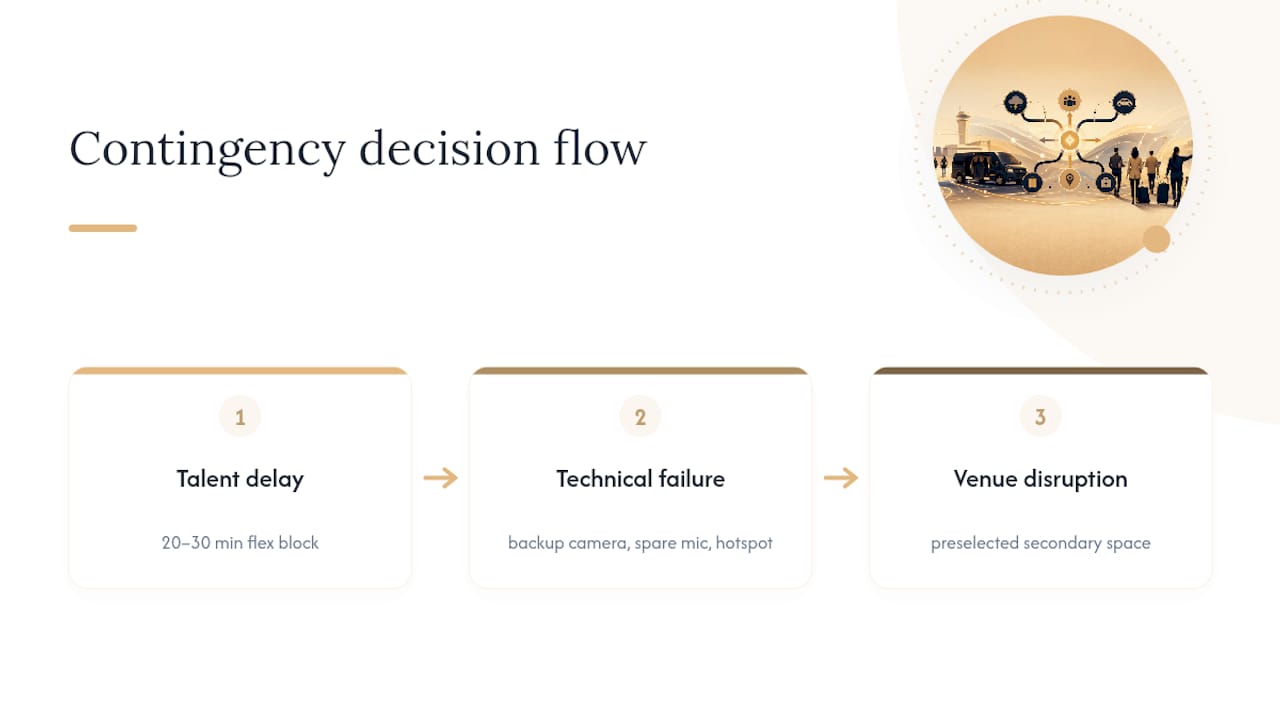
Insurance matters here too. Event liability coverage and, for larger junkets, talent travel insurance are standard contingency line items that PR event budgeting guidance recommends building in from the start rather than adding after a problem hits. Write a simple decision tree into your run sheet: who calls an audible if talent runs 30 minutes late, who has authority to cut a roundtable short, and who communicates schedule changes to waiting media. Without that clarity, a ten-minute delay turns into a fifty-minute argument about whose call it is to fix it.
Coordination With Public Relations and Marketing Teams
Logistics and messaging have to move in lockstep, or the day looks smooth on the run sheet and falls apart in the room. The PR team owns message development, media training, and outlet prioritization; the logistics team owns the physical machinery that makes those messages deliverable on schedule. Neither function works well without constant contact with the other.
Start joint planning at least four weeks out, not the week of. PR needs to know the technical constraints (how many outlets the venue and crew can realistically rotate per hour) before finalizing an outlet list, and logistics needs the final talking points and key visual moments before locking the backdrop and lighting plan. A coordinated outreach and prep process that pairs message development with day-of scheduling is what separates a junket that generates consistent coverage from one that generates scattered, off-message clips.
Marketing usually wants specific visual assets out of the day, on top of interview coverage: b-roll, social clips, a step-and-repeat photo moment. Build those into the interview-block sheet as their own line items with assigned time slots, not as something the crew squeezes in between outlets. Assign one person, usually the stage manager or a marketing liaison, to own the handoff between PR's message priorities and the logistics team's physical schedule. When that liaison role doesn't exist, marketing tends to discover mid-day that the photo moment they wanted got dropped because nobody blocked time for it.
Communication Protocols During the Event
A junket day generates constant small decisions, and without a communication protocol, those decisions get made by whoever happens to be standing closest. Set one before doors open.
Use a single primary channel, typically a group text thread or a walkie-talkie network, staffed by the stage manager, transport coordinator, and lead publicist at minimum. Keep it to operational updates only: talent status, delays, technical issues, schedule changes. Route message and content questions to a separate PR channel so the operations thread doesn't get buried under unrelated chatter.
Assign a single person as the schedule authority for the day. Every other team member, including talent handlers and outlet escorts, reports timing issues up to that person rather than making independent calls about whether to hold or advance a rotation. This matters most when things go sideways: if a network's satellite feed drops during their slot, someone needs clear authority to decide whether to pause the rotation or move to the next outlet and slot the affected network back in later.
Give transport a direct line to the schedule authority separate from the general operations channel. A driver stuck in traffic ten minutes out needs to reach someone who can adjust the schedule immediately, not wait for a lull in a busy group thread. Post check-in and end-of-day status updates at fixed intervals (every 30 minutes is standard) so leadership isn't pinging the floor team for updates they should already have.
Post-Event Wrap-Up and Material Distribution
The junket isn't finished when the last outlet leaves. Material distribution and follow-up determine whether the day converts into actual coverage or sits unused on a hard drive.
Collect and organize footage, photos, and b-roll before the crew strikes the set, not after. Assign one person to confirm every outlet received what they needed, whether that's a raw camera file, a photo gallery, or a transcript, before they leave the building. A structured post-junket follow-up process that includes prompt asset delivery and thank-you outreach tends to produce stronger long-term outlet relationships than treating the day as a one-off transaction.
Within 24 to 48 hours, send a wrap-up package to any outlets that couldn't attend in person: a press release, select quotes, high-resolution photos, and any b-roll cleared for distribution. Log which outlets published coverage and which didn't, since that data shapes who gets priority access at the next event. Debrief the internal team within a week while details are fresh: what venue issue slowed the schedule, which transport gap needs fixing, whether the technical staging held up under real conditions. That debrief is what makes the next junket run tighter than this one.
Transportation Logistics for Media Attendees
Talent transit gets most of the planning attention, but media transportation logistics deserve their own line item, especially for junkets held outside a major media hub or at a venue without easy public transit access.
Provide clear arrival instructions with a specific drop-off point separate from the talent entrance, and staff that drop-off with someone who can direct crews quickly to check-in rather than leaving them to wander a lobby with camera gear. For junkets pulling media from multiple cities, arrange shuttle service from a designated hotel or airport pickup point on a fixed schedule rather than leaving outlets to arrange their own transport and arrive at inconsistent times.
Parking is a bigger issue than most planners expect, particularly for TV crews traveling with satellite trucks or heavy camera equipment. Confirm the venue can accommodate truck-sized vehicles before outlets show up expecting standard parking. If the venue lacks adequate on-site parking, arrange an off-site lot with a shuttle rather than discovering the problem when a satellite truck can't find a spot ten minutes before their slot. Build a few minutes of flex time into the arrival schedule for media specifically, since traffic and parking delays hit press crews just as often as they hit talent, and a media rotation that starts late has the same ripple effect on the day as a late talent arrival.
What Practical Transport Lessons Actually Hold Up
Buffer time isn't a nice-to-have on paper. It's the difference between a talent transfer that clears a lobby unnoticed and one that ends up on a fan's phone. Production-aware chauffeurs who know call times, not just addresses, prevent more schedule failures than any run sheet revision. Transport and venue staging have to plan together, or privacy gaps show up exactly where cameras are already rolling.
— Sammy
Let Riga Global Travel Handle Your Junket-Day Transport
This transportation service specializes in managing transit challenges common to press junket days: keeping talent on schedule, out of public view, and moving between hotel, green room, and interview floor efficiently.
Our services cover celebrity and talent transportation, secure hotel-to-venue transfers, event-day drivers briefed on production call times, and discreet vehicles suited to press days where privacy is part of the job. A typical engagement starts with a quote covering your junket dates, day-rate options for multi-vehicle needs, and a short operations consult so our team understands your run sheet before the first pickup. Productions staging in Southern California can start with our Los Angeles limousine service, and Northeast teams can check our New York limousine service for junket-day availability. Reach out to request a quote and lock your transport dates before your venue and crew calendar fills up.
Sources
- What Is a Press Junket? Meaning, Schedule, and How Studio Press Days Work | L.A. & ABQ Castle Studios
- Press event planning primer | Cvent (PR event considerations)
- Press Junkets 101: What are They and Why Do They Matter for Your Brand? | Publicity for Good
FAQ
How Much Does a Press Junket Cost?
Costs vary widely by talent profile and production scope, with high-profile junkets reported to run from tens of thousands to well over a hundred thousand dollars once venue, security, and transport are factored in.
What Does Press Junket Mean?
A press junket is a concentrated media event where talent gives back-to-back interviews to dozens of outlets, usually compressed into one to three days instead of weeks of scattered press.
What Is a Junket Interview?
A junket interview is a short, scheduled media slot, typically 4 to 6 minutes for TV, where talent answers questions from one outlet before rotating to the next.
How Long Is a Movie Press Tour?
A press tour built around a junket usually concentrates into one to three intensive days at a single location, though a full publicity campaign around a release can extend across multiple cities over several weeks.
What Ground Transport Details Should Be in a Junket Contract?
Specify pickup and drop off windows tied to call times, vehicle type, and driver familiarity with production schedules. Riga Global Travel builds these details into its talent transportation agreements before the junket date.