The fastest way to protect crew safety and keep a night shoot on schedule is to book dedicated production transport on a standby or day-rate basis with a dispatcher who provides real-time updates. That single decision solves most of the problems that wreck a night shoot: fatigue, missed pickups, and gear left unguarded in a parking lot at 3 AM. Operators built for entertainment logistics often run on exactly this model, and production transport expert Sammy treats it as the baseline, not an upgrade.
TL;DR:
- Weather and schedule shifts are common during night shoots, so booking a dedicated vehicle on a standby or day-rate basis ensures reliability regardless of overruns.
- Contracts must specify flexible pickup windows, gear allowances, on-site waiting terms, and backup vehicle clauses to avoid disputes over delays or failures.
- Vehicle selection depends on crew size and equipment volume, with features like climate control, lockable storage, and proper load space critical for gear safety.
- Managing fatigue involves scheduling rest periods in advance, rotating drivers on long routes, and carrying emergency kits to mitigate remote-location risks.
- Effective planning includes daylight route scouting, setting clear dispatch protocols, and proximity of lodging to limit commute times and maintain crew alertness overnight.
Table of Contents
- What Is the Best Booking Model for Night Shoot Transportation?
- Which Vehicles Actually Work for Nighttime Shoots?
- How Do You Manage Fatigue and Remote-Location Risk?
- How Should You Plan Routes and Call Times for Night Shoots?
- How Do You Run Transportation Smoothly on Set?
- What Does a Well-Run Night Shoot Actually Look Like?
- Where Conventional Night-Shoot Planning Falls Short
- Get a Night Shoot Transport Quote That Covers the Details
- Tools and Pages to Check Before a Night Shoot
- Sources
- FAQ
What Is the Best Booking Model for Night Shoot Transportation?
Night shoots run long, and schedules shift without warning. That reality should drive the booking model you choose, not the other way around.
Point-to-point booking works fine for a single predictable pickup, like a producer's airport run. It falls apart on a night shoot where wrap time depends on weather, a stubborn scene, or a location permit with a hard curfew. A dedicated crew shuttle solves the group-movement problem but usually runs a fixed loop, which limits flexibility if call times split. Standby or day-rate transport is built for exactly this uncertainty: the vehicle and driver are yours for the block, whether the day runs 8 hours or 14.
Full-day chauffeur hire tends to be more cost-effective than stacking individual bookings once a shoot runs multiple stops or is prone to overruns, according to logistics guidance from Milky Way Forecast built around unpredictable nighttime scheduling. The same math applies to a film set.
Before you sign anything, get these items written into the contract:
- Pickup windows with a grace period for delays, not a single fixed time
- A gear allowance that specifies case count and total weight, not just "production equipment"
- A written driver brief covering the location, call sheet contact, and expected wrap window
- On-site waiting terms so idle time doesn't get billed as a separate line item
- A backup vehicle clause naming a specific replacement time if the primary vehicle fails
Pro Tip: Negotiate overtime rules before the shoot, not during it. Set a per-hour rate for anything past the estimated wrap time so a 2 AM schedule slip doesn't turn into a billing argument the next morning.
Which Vehicles Actually Work for Nighttime Shoots?
Vehicle choice comes down to headcount and gear volume, not preference. A five-person crew with two camera bodies and a light kit fits comfortably in an SUV. Add a grip truck's worth of cases, and you need a Sprinter van with real cargo separation. Anything above 12 crew members points toward a minibus, and full cast-and-crew moves on a larger production call for a coach.
Fitout matters as much as size. Look for:
- In-vehicle charging for phones, monitors, and small battery packs
- Climate control that can run for hours without draining the vehicle's main battery
- Lockable storage separate from passenger seating, with soft lash points to secure cases
- Enough floor clearance for cases to sit flat, not stacked and shifting on turns
Run a basic vehicle prep check before every night call: full fuel, tire pressure and tread, a working spare, headlights and taillights confirmed, and a battery that's been load-tested if the vehicle sits idle between calls. The same discipline that goes into camera and power checklists for remote night shoots applies directly to the vehicle carrying that gear.
Rideshare apps are not a substitute here. They offer no guaranteed reliability during off-peak overnight hours, no dispatch coordination, and no cargo space built for production equipment.
Pro Tip: Ask any vendor whether their vehicles carry a properly rated jack, a spare tire, and basic tools. Nighttime breakdowns on rural routes rarely get fast roadside help.
How Do You Manage Fatigue and Remote-Location Risk?
Fatigue is the single biggest safety risk on a night shoot, and it's largely preventable with a schedule built in advance rather than fixed on the fly.
- Shift sleep schedules two days out. Crews who adjust bedtimes ahead of an overnight call reduce circadian shock and stay sharper behind the wheel, a practice Milky Way Forecast recommends for anyone working extended night hours.
- Rotate drivers on long routes. Any single-driver leg past two or three hours should trigger a rotation or a standby driver, especially on rural roads with poor lighting.
- Pack an emergency kit. First aid supplies, a satellite communicator or personal locator beacon for dead zones, flashlights, and warm layers belong in every vehicle, not just the lead car.
- Assess the site before the crew arrives. Wildlife activity, unpaved road quality, and lighting gaps should get flagged during daylight scouting, alongside any permit or access restrictions tied to the location.
Pro Tip: Set a mandatory rest window (six to eight hours minimum) between wrap and the next call time, and put it in writing. Verbal agreements get ignored when a production is behind schedule.
How Should You Plan Routes and Call Times for Night Shoots?
Hotel-to-set proximity is one of the most overlooked levers in night-shoot planning. A 45-minute commute at 2 AM isn't the same as a 45-minute commute at rush hour, but crews still burn hours getting to and from set that could go toward sleep. Set an acceptable commute threshold for the production, generally under 30 minutes for overnight calls, and pick lodging around it rather than the other way around.
Scout every route in daylight before the shoot. Tools that show night-by-night timing and route conditions help crews sequence stops and avoid wasted driving, a discipline that maps directly onto multi-location production days.
Dispatch protocols need to be defined before call time, not improvised during it:
- One dispatcher reports directly to the production manager or transportation coordinator
- Primary and secondary comms channels are named in advance (radio plus a group text as backup)
- GPS tracking is enabled on all vehicles so location changes get caught immediately
- Pickup windows, wrap procedures, and a contingency return route are documented on the call sheet
A dedicated dispatcher who reports straight to the production manager shortens response time significantly when a location moves at night, cutting into lost shooting time rather than transport confusion.
How Do You Run Transportation Smoothly on Set?
On-set execution is where good planning either holds up or falls apart. Vehicles should be staged close enough to talent and key crew holding areas that a scene change doesn't cost 15 minutes of walking and waiting.
- Assign standby roles before the shoot starts. One driver stays with the vehicle at all times; nobody wanders off for coffee during a live take.
- Require sign-off on gear loading. Expensive or fragile equipment gets a name attached to it when it goes into the vehicle and again when it comes out.
- Use a simple communication chain. A text to dispatch, confirmed by an on-site runner, beats a radio call that gets lost in set noise.
- Set clear wrap rules. Once picture wraps, departure should happen within a fixed window, not whenever the last person finishes packing up, to protect everyone's rest window for the next call.
What Does a Well-Run Night Shoot Actually Look Like?
Sammy's working checklist for night crews starts with hotel proximity: keep lodging within a short, direct drive from set, and confirm the route in daylight before the first call sheet goes out. Feed crews before departure, not after wrap, and build in the rest window before the next call, not after it.
A professional dispatcher and chauffeur team experienced in entertainment client logistics treats a late wrap as a routine variable rather than a crisis. When a scene runs two hours over, the dispatcher already has a revised pickup time, a backup driver on standby, and a route ready that avoids a closed road. On a small night shoot with three locations and a midnight wrap, that kind of coordination is the difference between everyone home by 3 AM and a crew stranded arguing about whose job it was to call the vendor.
Where Conventional Night-Shoot Planning Falls Short
Most production transportation advice focuses on the vehicle: get a bigger van, get a nicer SUV, book earlier. That's not wrong, but it misses where night shoots actually go sideways, which is almost always in the gaps between bookings, not the bookings themselves. A crew shuttle that's flawless on paper still fails if nobody defined who calls the driver when a scene runs long.
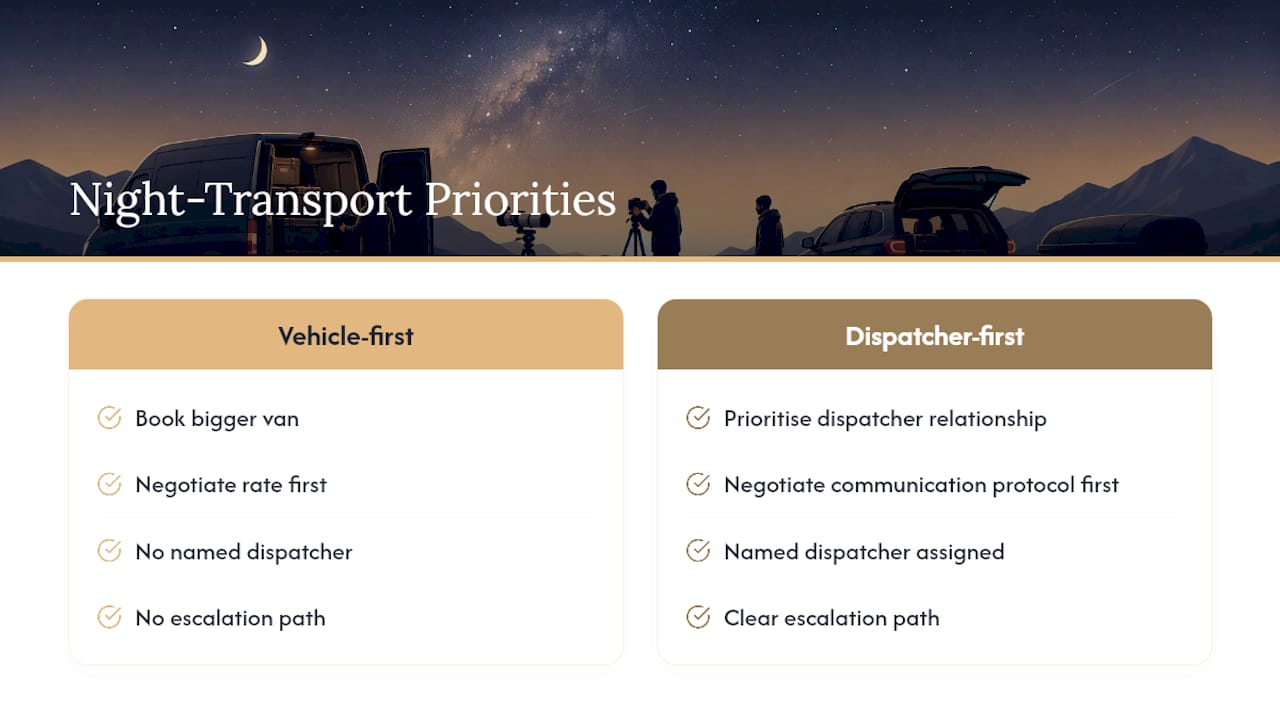
The overlooked piece is dispatch, not the vehicle. A day-rate contract without a named dispatcher and a clear escalation path is just a nicer version of a rideshare, unreliable exactly when reliability matters most. Productions that get night transport right treat the dispatcher relationship the same way they treat their line producer relationship: someone who's reachable, briefed, and empowered to make a call without waiting for a chain of approvals at 1 AM.
If there's one thing to prioritize first, it's this: negotiate the communication protocol before you negotiate the rate. A slightly more expensive vendor with a responsive dispatcher will save a production more money in lost shooting time than a cheaper one that goes quiet after the driver drops off the first pickup.
— Sammy
Get a Night Shoot Transport Quote That Covers the Details
Riga Global Travel is built for the exact scenario this guide covers: unpredictable wrap times, gear that needs secure handling, and crews who need a dispatcher who actually answers at 2 AM. Unlike a rideshare app or a generic car service, every booking comes with a named contact and a vehicle matched to your crew and equipment, not whatever happens to be nearby.

When you request a quote, specify standby hours (not just a pickup time), gear dimensions and case count, a direct dispatch contact, and a backup vehicle clause. That's what turns a booking into a plan. Productions running in Los Angeles, New York, or Miami can check availability directly through Riga Global Travel's Los Angeles limousine service or New York limousine service pages, or submit a general request through the main booking page to get a quote built around your call sheet.
Tools and Pages to Check Before a Night Shoot
A few resources are worth bookmarking before your next overnight call:
- Trip-planning tools for night-by-night timing and route sequencing
- Riga Global Travel's guide on hotel-to-set transfers and production set transportation
- Local road closure notices, park access rules, and emergency service locations near your shoot site
Sources
- Milky Way Forecast — Milky Way photography planning
- MilkyWayPlanner — Multi-night trip planning
- Adorama — First night photography hunt guide
FAQ
What Is Standby Transportation for Night Shoots?
Standby transportation means the vehicle and driver are booked for a full block of time rather than a single fixed trip, so schedule changes and overruns don't require a new booking.
How Much Buffer Time Should I Add for Night-Shoot Pickups?
Build at least a 15 to 30 minute grace window into every pickup time, since night shoots routinely run past their planned wrap.
What Vehicle Fits a Small Night-Shoot Crew?
An SUV works for up to about five crew members with modest gear; a Sprinter van suits larger crews or heavier equipment loads that need separate cargo space.
Why Shouldn't I Use Rideshare for a Night Shoot?
Rideshare apps offer no guaranteed availability during off-peak overnight hours and no cargo space or dispatch coordination built for production gear and crew movement.
Who Should Handle Dispatch on a Night Shoot?
A single dispatcher who reports directly to the production manager or transportation coordinator, reachable through a primary and backup comms channel, cuts response time when locations or call times shift.